

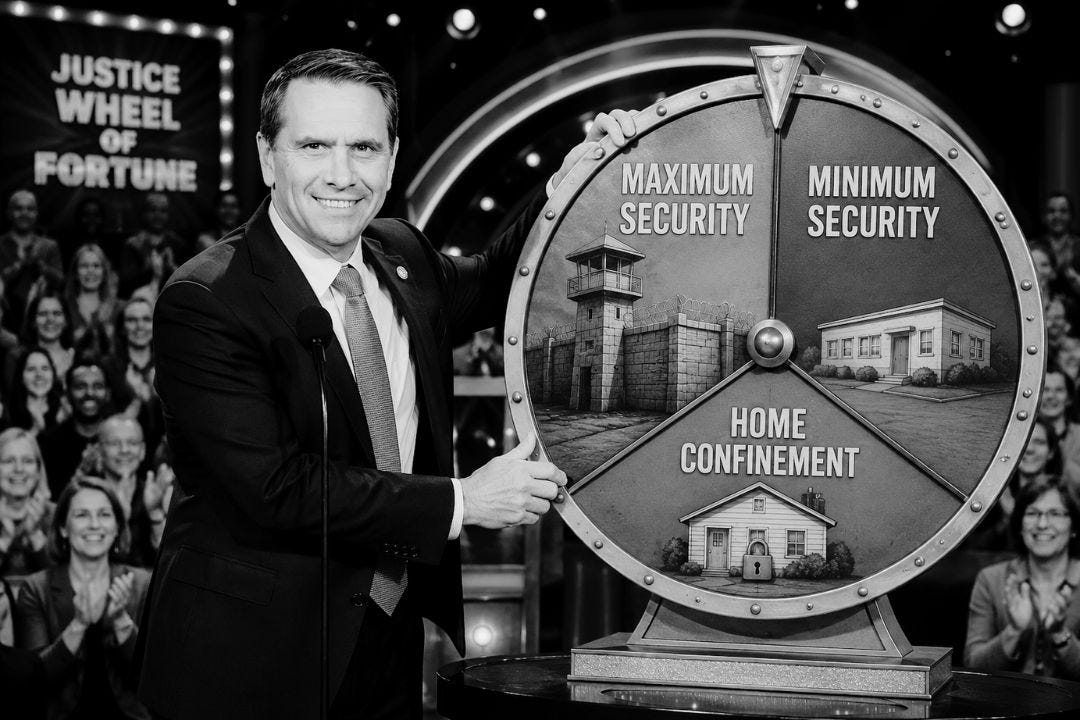
In early May, with no press release and no fanfare, the Justice Department quietly rewrote one of the most consequential rules in the federal prison system. The change fits on a single page. Almost no one noticed. And it hands the Attorney General something no Attorney General has openly claimed before: the power to personally decide where any federal prisoner in America serves their sentence.1
If you are convicted of a federal crime, the question of where you do your time is not a small one. It is the difference between a minimum-security camp and a maximum-security penitentiary. It is the difference between a prison an hour from your kids and one two time zones away. Under the rule that just changed, that decision can now be made by one political appointee, and right now, that appointee is Todd Blanche.
What actually changed
On May 6, 2026, Bureau of Prisons Director William K. Marshall III signed Change Notice 3 to Program Statement 5100.08, the manual that governs how federal inmates are classified and assigned to facilities. The notice rewrites the “Purpose and Scope” section to declare that, under the principle that all Justice Department functions are vested in the Attorney General, “in certain circumstances, the Attorney General may exercise authority to designate or redesignate the place of a prisoner’s imprisonment, consistent with the requirements of 18 U.S.C. § 3621(b).” When the Attorney General invokes that authority, the Bureau is reduced to a supporting role: it “may provide relevant information in order to facilitate the determination.”
Before I go any further, one piece of credit that has to come first: I owe this whole post to attorney Liz Oyer. She’s the one who caught it. She walks through the highlights in her video below, and she’s exactly the kind of person who notices the things buried on page one where they’re meant to go unread. Follow her here on Substack. Do it now, before you read another word of mine.
To understand why that matters, you have to understand how prison placement has worked for decades.
Until now, the decision about where a person serves their sentence was made by career officials at the Designation and Sentence Computation Center, using an objective scoring system built around one priority: public safety. The system weighs the nature of the offense, the length of the sentence, criminal history, and a set of “public safety factors” revolving around issues relating to violence, sex offenses, gang ties, escape risk and more. People are sorted into security levels based on what those factors say, not on who they are or what they believe. Because prison is supposed to be about punishment and rehabilitation, by law, the Bureau also tries to place people within 500 driving miles of home so families can visit. The personal preference of the Attorney General had nothing to do with any of it. That was the entire point.
Change Notice 3 inserts the Attorney General into that process. It gestures at a limit — the new authority is to be used “consistent with the requirements of 18 U.S.C. § 3621(b)” — but that tether is largely cosmetic. Section 3621(b) is simply the list of factors the Bureau already weighs; the notice adds no procedure for how the Attorney General is to apply them, no published criteria for when the power may be invoked, and no stated limit on which prisoners it reaches. The policy supplies no criteria of its own, no appeal, and no internal review. The Attorney General need only notify the Bureau of his intention “as soon as practicable.” He is not required to explain himself.
Why this is dangerous
A discretionary power with no rules attached is an invitation, and it cuts both ways.
Nothing in this policy prevents it from being used to punish. A person prosecuted for protesting an ICE raid, or for vandalizing federal property at a demonstration, is not a violent offender and would never score into a high-security facility under the normal system. But the normal system is no longer the only one that matters. Under this rule, there is nothing on paper stopping the Attorney General from sending that person to serve their time among people convicted of murder and sexual assault, not because of who they are, but because of what they protested. When the power to place exists without published limits, the line between a placement decision and a punishment decision disappears.
And nothing in the way this power is structured prevents it from being used to reward. The same discretion that can send a disfavored person to a penitentiary can send a favored one to a camp, a halfway house, or home confinement with a puppy. The policy does carry a line promising that placement decisions are made “without favoritism given to an inmate’s social or economic status,” but read it closely, because that promise governs the Bureau’s classification process, the very process this rule now lets the Attorney General step around. No equivalent safeguard attaches to the Attorney General’s own exercise of the power. The anti-favoritism principle is reserved for the machinery the rule was written to bypass.
We do not have to imagine what preferential treatment looks like in this Justice Department, because we have already watched it operate in the clemency process. Reporting over the past year has described a pardon system increasingly steered by paid advocates and personal connections to the president. One account even called it a “selling of indulgences.” There is no reason to assume prison placement will be insulated from the same dynamic. A discretionary placement power with no safeguard attached is exactly the kind of lever the wealthy and the well-connected know how to pull.
That is the real problem. This is not about whether Todd Blanche will abuse the power. It is that the rule was rewritten to make abuse possible, quietly, and to strip the individualized process of the checks that used to stand in the way.
The Maxwell tell
There is a reason to think this rule was written backward, to justify something that already happened.
In August of last year, Ghislaine Maxwell, serving 20 years for conspiring to sexually abuse minors, was moved from a low-security prison in Florida to a minimum-security camp in Texas. The transfer came shortly after she met with Blanche, then the Deputy Attorney General, who said he wanted to hear what she knew about Jeffrey Epstein. As a convicted sex offender, Maxwell carried a public safety factor that, under the Bureau’s own rules, requires placement in at least a low-security institution, a level above a camp. Moving her to a minimum-security camp would have required the Bureau to set that factor aside, an extraordinary step for someone with her conviction. Her placement appeared to break the Bureau’s own rules.
At the time the transfer happened, the policy that would have authorized it did not exist. It exists now. As Rep. Deborah Ross, who has demanded answers from the Bureau, put it, the clear implication is that the Department violated its own rules to move Maxwell, and is now rewriting those rules to cover its tracks. A policy that can place Maxwell in a camp today could move her again tomorrow, to a halfway house or to home detention, with no one empowered to say no.
What can be done
This rule was not debated. It was not announced. It was signed and posted, hiding in plain sight, in the hope that no one would read it closely.
But the timing creates an opportunity. Todd Blanche is currently the acting Attorney General, and the Senate Judiciary Committee is scheduled to take up his nomination to hold the job permanently on July 15. The committee has every reason, and every right, to demand that he explain this policy before it votes: why the change was made, who asked for it, how many times the authority has already been used, and what limits, if any, he believes constrain it. And while we’re talking about Blanche, did you see the formal complaint filed by 101 former judges with the New York State Bar?2
Wrapping things up please know this.
Elected officials answer to constituents who call. If you find this as alarming as I do, contact your senators, especially any who sit on the Judiciary Committee, and ask them to put these questions to Blanche on the record before they confirm him. And share this, because the entire strategy behind a change like this depends on people not noticing.
Mitch Jackson, Esq.
Join Uncensored Objection
You’re here because something isn’t adding up. On politics, privacy, and your Constitutional rights, you want the actual legal, factual truth — not cable news, not talking points.
I’m Mitch Jackson, a trial lawyer for 40 years. Law. Facts. No spin.
Free subscribers get my 10-page starter guide from Privacy in America. Paid members get the full 251-page PDF version of my book. Upgrade today and your access links arrive instantly.
See the full Change Notice

One hundred and one former judges joined the Democracy Defenders Fund and Lawyers Defending American Democracy in filing a complaint with the New York State Bar Attorney Grievance Commission, asking for an investigation into acting Attorney General Todd Blanche for violating the New York Rules of Professional Conduct on three grounds: his role in settling Trump v. I.R.S., which the complaint calls incompatible with his ethical duties; his alleged use of Justice Department authority to pursue the personal and political enemies of his former client, now the president, through frivolous and harassing cases; and his personal handling of the Department’s flawed release of Epstein and Maxwell documents, including a questionable interview of Ghislaine Maxwell. The complaint contends he served the interests of one man over the interests of the nation, and the open question becomes whether the New York Bar will investigate and act quickly against a sitting official who has not yet been confirmed, a question made more urgent because the Trump Justice Department has dismantled its own internal accountability and floated a rule letting the attorney general freeze state disciplinary proceedings, leaving state bars as the last body able to hold these lawyers to account even as Blanche stays tangled in a separate scandal over his refusal to assure the court that the government has dropped a plan giving Trump access to 1.776 billion dollars in taxpayer money for January 6 defendants.
This man must NOT be confirmed. The DOJ is out of control and TB will do whatever it takes to abuse any authority he is given. There is no ambiguity.
It just gets worse and worse every day. The USA is rapidly falling into a full on dictatorship.
You say or do anything that offends Trump - you’re arrested. You pay off the right person or kiss the right ass - you’re pardoned.
Unreal.