

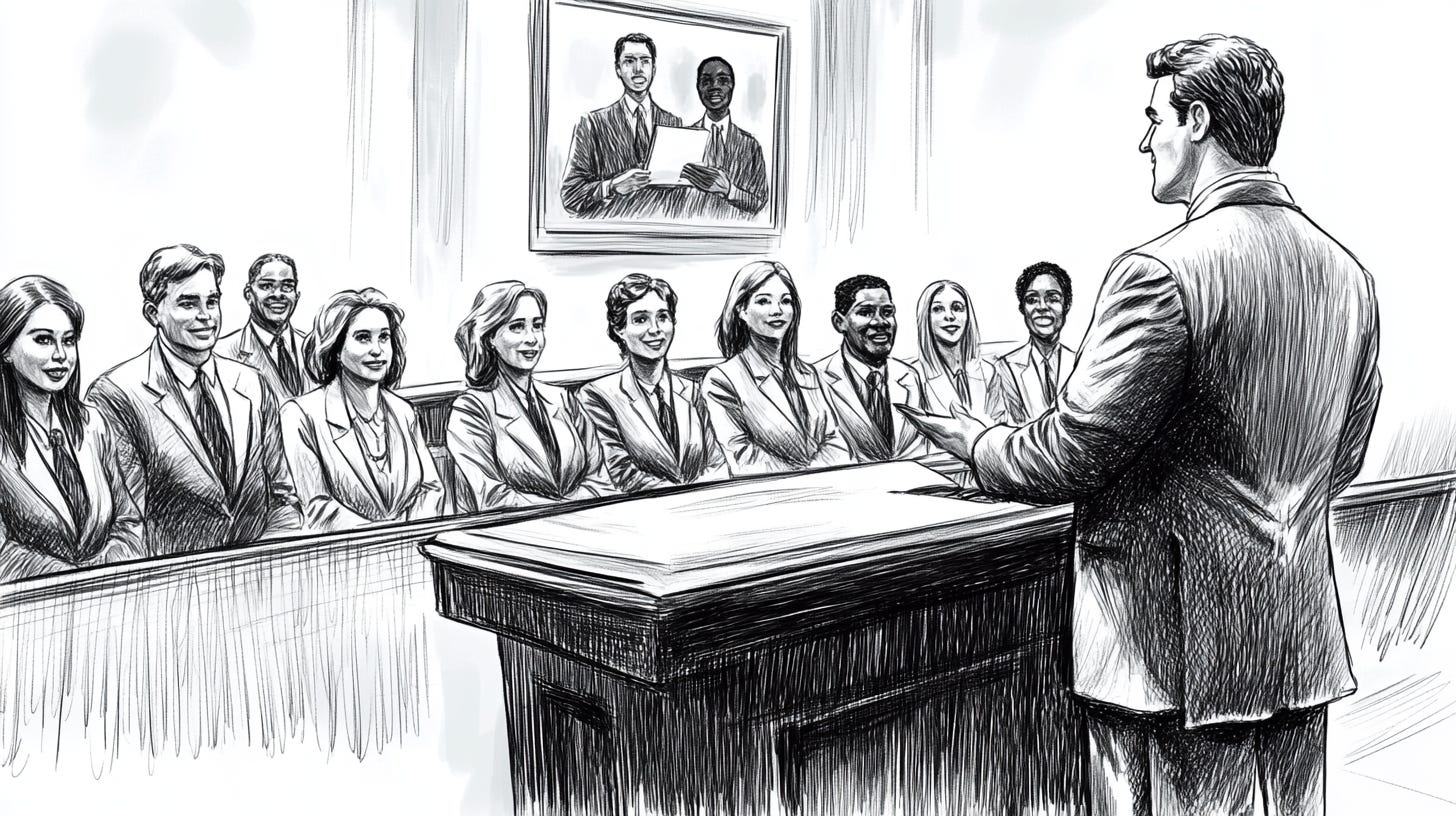
The Setting
You’ve just sat through a two-month jury trial.
You’ve heard the evidence. The testimony. The truth laid bare.
Donald J. Trump is on trial. Not for politics. Not for partisanship. But for a deeper betrayal—of truth, of trust, of the office he once held.
The charge is simple, yet profound: that he cheated, manipulated, and lied his way into the presidency. That he didn’t just bend the rules—he bulldozed them, believing he’d never be held accountable.
I’m the trial lawyer who brought this case forward. And now, as we reach the end, I stand before you not with outrage, but with resolve.
This is my closing argument.
The Closing
Ladies and gentlemen of the jury, our democracy is on trial today. For two long months, you have heard the evidence piece by piece. Now it all comes down to this: a verdict on how Donald J. Trump secured the presidency in 2024. The charge is not a narrow legal technicality; it is the fundamental question of whether he lied, misrepresented facts, and cheated to win an election. The evidence shows that he did exactly that – and in a close election decided 46.9% to 46.4% these lies made the difference.
I stand before you not just as a lawyer in a courtroom, but as a fellow American speaking to every citizen as the jury. The case I present is built on ten key deceits that altered voter behavior and narrowly handed Mr. Trump victory. As I walk through each one, ask yourselves: Is this the free and fair choice the American people deserve? Or was this victory stolen in spirit by deceit? Let’s examine the facts.
Go deeper with AI. This special Perplexity AI page lets you explore any question from the article—no filters, no limits. Just clarity. Context. Answers.
1. Lies About Mail-In Voting Suppressed the Vote
First, Donald Trump relentlessly lied about mail-in voting. He peddled baseless claims that mail ballots are rife with fraud – “anytime you have a mail-in ballot, there is going to be massive fraud,” he insisted. He called mail voting a scam, insinuated that “they cheat like dogs” with mailed ballots, and warned his supporters to watch out for cheating at every turn. These statements were utterly false. Election officials, independent experts, and courts across the country have repeatedly confirmed that mail-in voting has strong safeguards and extremely low rates of fraud. In fact, Mr. Trump himself has voted by mail in the past. He knew these claims were untrue, yet he kept amplifying them.
Why? To suppress voter turnout. By sowing fear and doubt about mail ballots, he aimed to discourage people from voting, especially those who might favor his opponent. Think about it: mail-in voting is used heavily by working parents, the elderly, and citizens who can’t easily get to polls – groups that include many of his opponent’s supporters. If even a small fraction of those voters believed Trump’s lies and thought their mail ballot might be tossed or fraudulent, they might decide not to vote at all. And in an election this razor-thin, that is enough to change the outcome.
We’ve seen this tactic before. In 2016 and 2020, Mr. Trump made noise about “rigged” elections and voter fraud with no evidence, priming voters to distrust the process. In 2020, his false attacks on mail voting were so pervasive that some of his own supporters refused to vote by mail, hurting his campaign’s turnout strategy. But in 2024, he turned that suppression outward. By frightening everyday Americans about a perfectly valid way to vote, he tried to steal the most sacred right we have – the right to cast a ballot freely and confidently.
Ladies and gentlemen, this was not robust campaigning or legitimate skepticism. This was cheating by deceit. Mr. Trump attempted to win by preventing votes against him. Democracy is supposed to be a contest of visions, not a game of trickery where you scare people away from voting. Every American, regardless of party, should shudder at this. Because if this becomes acceptable – if lying to depress turnout is just another campaign strategy – then any future candidate can try to win not by earning more votes, but by stopping votes from being cast. That is not democracy; that is a betrayal of democracy.
And in 2024, it worked. Turnout in several key areas was just low enough, margins just thin enough, to tip the scales. The difference between 46.4% and 46.9% was a few thousand votes in a few swing states. How many people stayed home, or didn’t mail their ballot, because of the constant drumbeat of false fear Mr. Trump spread about mail voting? We can’t know the exact number, but even if it was one person per precinct, it was too many. He cheated the American people of a fully free election by poisoning the well of trust.
2. Flooding the Zone with Misinformation about His Opponent
Second, Mr. Trump misrepresented his opponent’s policies and record through a flood of misinformation, blasted across every media channel – especially on Elon Musk’s platform, X (formerly Twitter), which became a bullhorn for Trump’s distortions. He did not campaign on honest differences or respectfully debate policy. Instead, he and his allies unleashed a torrent of lies about Vice President Kamala Harris (who became the Democratic nominee after President Biden stepped aside) that blanketed the airwaves and the internet.
You heard the evidence of these lies. Mr. Trump claimed, falsely, that his opponent wanted to “defund the police” and would abolish law enforcement, when in reality she never proposed such a thing. He accused her of being a “Marxist” radical, painting ordinary center-left positions as extreme communism. He attacked her on crime, saying violent crime had skyrocketed 43% under her influence – an outrageous lie when in fact violent crime was near 50-year lows. He even stooped so low as to claim she “couldn’t pass her bar exam” and insinuated she was incompetent as a lawyer, when in truth she did become a licensed attorney (passing on her second try, which is not unusual). He said she cut Medicare by $237 billion, when she actually supported letting Medicare negotiate drug prices to lower costs for seniors. He twisted her words about taxes and guns – for example, claiming she endorsed an 80% tax rate and mass gun confiscation, neither of which she actually did.
One after another, these claims were proven false. They were not differences of opinion or campaign hyperbole; they were lies. And they were everywhere. Mr. Trump’s campaign and supporters blasted these falsehoods on cable news, in Facebook ads, on talk radio, and especially on X, where content moderation had been slashed under Mr. Musk’s ownership. Indeed, the evidence showed that Elon Musk himself aided this misinformation blitz. Mr. Musk, an open Trump sympathizer, personally posted and amplified conspiracy-laden attacks on the Democratic candidate, garnering billions of views. Under his watch, X’s algorithms pushed Trump-friendly lies into millions of feeds, unchecked. Posts smearing Mr. Trump’s opponent spread like wildfire, often drowning out factual reporting.
Why does this matter? Because voters can only make a good decision if they know the truth. Mr. Trump didn’t want to give voters a fair choice; he wanted to confuse and terrify them about his opponent. If you were an average American tuning into the campaign, you might have genuinely believed that Kamala Harris was a Marxist who would open all the prisons, take away your hamburgers, and cancel Medicare. Those ideas are absurdly false – but Mr. Trump’s strategy was to repeat the lies so often in so many places that people didn’t know what to believe. It’s the old strategy of “repeat a lie long enough and it becomes truth.”
Remember the testimony we heard from undecided voters in focus groups: some of them admitted they were unsure what Harris really stood for, but they “heard she might” cut police funding or “some say” she’s extreme. Where did they hear it? From the relentless propaganda machine of the Trump campaign. By misrepresenting his opponent’s policies, he stole the opportunity for a fair evaluation. He tilted the playing field under an avalanche of falsehoods.
This tactic, too, is nothing new for Mr. Trump. In 2016, he famously branded Hillary Clinton a criminal and claimed she’d abolish the Second Amendment – again, nonsense, but it clouded perception. In 2020, he and his allies spun wild tales about Joe Biden being controlled by the “radical left” or being mentally unfit, making moderate positions seem sinister. By 2024, armed with social media platforms willing to algorithmically boost his disinformation, Mr. Trump’s campaign became a firehose of falsehood without precedent.
Ladies and gentlemen, elections are supposed to be a contest of ideas. But you can’t have that contest if one side floods the arena with smoke and mirrors. Mr. Trump wanted to win not by proving he had better policies – but by ensuring many voters literally could not discern his opponent’s real policies over the din of lies. And in a campaign decided by mere tenths of a percent, that strategy likely convinced just enough wavering voters or confused enough ears to eke out a win. It was deliberate, and it was dishonest.
3. Misleading Boasts and Lies About the Economy
Third, Mr. Trump misled Americans about the economy, taking credit he hadn’t earned and distorting genuine economic facts. He fashioned himself as the hero of an economic revival that was already underway under his predecessor, while painting a falsely dire picture of the present to stoke frustration. In speeches, debates, and ads, Mr. Trump repeatedly claimed that under the Biden-Harris administration, the economy was “a disaster, the worst ever,” and that only his return brought improvement. When gas prices started to fall and inflation eased in 2024, he crowed that businesses had begun hiring or lowering prices “because they know I’m coming back.” He declared that as soon as he was elected, the economy was “roaring” again – implying that mere anticipation of him fixed everything.
These claims were as deceptive as a con man’s promises. The truth is that the economy in late 2023 and 2024 was already recovering from the high inflation of 2021-2022. Inflation had been coming down steadily thanks to responsible policies during President Biden’s term. Job growth was consistent and unemployment remained low. Rather than acknowledge any success by his opponents, Mr. Trump distorted the timeline. He took credit for trends that began before he even won the election. It’s as if a quarterback ran onto the field in the fourth quarter of a game his team was already winning and immediately claimed credit for the victory.
Worse, he cherry-picked and twisted economic data to mislead voters. You saw evidence of how, in early 2024, he would cite one bad month or one selective statistic out of context to make the economy look awful under the Democrats – and then boast about one good month after the election as if he single-handedly caused a boom. For instance, during the campaign he shouted that “gasoline is $7 under Biden in some places!” without noting that gas prices had actually dropped significantly nationwide and were nowhere near that on average. He hammered Americans with messages that their cost of living was “through the roof” and promised he’d cut prices in half overnight. These simplistic promises ignored the complexities of global markets and the progress already made. But they were effective in convincing people that the incumbents had failed economically.
He also manipulated job numbers. We saw how he claimed that “one in four jobs created under Biden were government jobs,” which was a gross exaggeration, and then boasted that in his first month back, “95% of new jobs were in the private sector.” That sounds dramatic until you learn that under Biden the vast majority of new jobs were also in the private sector, and that Trump was comparing a cherry-picked timeframe that made his number sound better. He was, effectively, lying with statistics – using true numbers in a false or misleading way to credit himself and discredit his opponent.
Now, why does this matter? Because millions of Americans vote with their wallets, or at least with their sense of economic well-being. Mr. Trump convinced enough people that they were suffering horribly (whether they actually were or not) and that only he could save them. He was selling snake oil – a miracle cure that he alone possessed, to fix a malady he exaggerated. Many working families who were starting to see relief from inflation were told, “No, it’s worse than ever, you just don’t realize it – and it’s all the Democrats’ fault.” Many believed him. Some who might have felt things improving instead felt angry and cheated, and they took that anger to the polls.
Let’s be clear: every candidate tries to put their best foot forward on the economy. But what Mr. Trump did was beyond normal spin. He lied about basic facts – denying any progress made before him, and attributing to himself improvements he hadn’t yet had anything to do with. He treated the truth as irrelevant, as long as the story benefited him. And for those voters who don’t follow every jobs report or who only saw the misleading headlines, the perception became reality. A few thousand swing voters in Michigan, Pennsylvania, and Wisconsin might have thought, “Well, the economy’s in shambles, according to Trump, and even if it isn’t, maybe he can make it better because he says he already is.” In such a close election, that could swing states – and it likely did.
Furthermore, consider the morality of this. The presidency is an office built on trust – trust that when things are hard, a leader will tell you honestly and work to fix it, and when things are improving, a leader won’t lie just to get ahead. By misrepresenting the economic situation, Mr. Trump showed a willingness to deceive the very people hurting the most. Those struggling with real inflation didn’t need exaggeration and false hope; they needed truth and solutions. He gave them falsehoods and boasts.
And now, after winning, what do we see? Already, in the first weeks of his term, Mr. Trump has admitted (as we heard in his offhand remarks) that tackling inflation “is not his top priority” after all. On the campaign trail, he said it was “easy” and he’d do it Day One; in office, he’s focused elsewhere. This is a bait-and-switch on the American people – promise them anything to get their vote, then reveal it was never genuine. That is not just politics, ladies and gentlemen, it’s fraudulent politics.
4. Baseless Allegations of Election Rigging – Undermining Trust
Fourth, Mr. Trump once again spread baseless allegations of election rigging, with zero evidence, and in doing so undermined public trust in our democratic process. This is a hallmark of his campaigns: if he is not confidently ahead, he starts crying that the game is rigged against him. We all remember the “Stop the Steal” lies from 2020, when he refused to accept a legitimate defeat. In 2024, he primed that pump early and often, even as he sought victory.
Throughout the 2024 campaign, Mr. Trump and his surrogates constantly suggested that any election result not showing him winning was fraudulent. He claimed machines might be switching votes, that “deep state” operatives were meddling, and that Democrats were conspiring at every level to cheat. These claims were not just unproven – they were disproven. In case after case, when pressed for evidence, the Trump team had nothing credible to offer. Election officials from both parties repeatedly confirmed there was no widespread fraud, no sinister plot. Yet the allegations never stopped.
On Election Day itself, before the results were fully in, Mr. Trump went on his social media and ominously declared “there’s a lot of talk about massive cheating” in a key swing state. State authorities immediately responded that this was baseless, that nothing of the sort was happening. It didn’t matter – the claim spread like wildfire online, generating distrust among millions. This was before any outcome was even known. He was effectively saying: If I lose, it’s because they cheated.
The effect of these relentless rigging allegations was toxic. Trust in elections is the bedrock of a democracy. Yet by November 2024, polls showed that a huge portion of voters – particularly Trump’s supporters – were convinced that if he didn’t win, the election must have been stolen. On the other side, many moderate and independent voters were exhausted and disheartened, wondering if their votes would count or if chaos would follow the election. Mr. Trump’s rhetoric had people bracing for turmoil, and some undoubtedly thought, “Why bother voting if it’s all corrupt?”
That cynicism is deadly to a democracy. When citizens lose faith that their vote matters, participation drops, and those who do vote are often the most agitated and extreme. Mr. Trump cultivated exactly that environment: turn off the broader public with constant drama and doubt, and fire up a fervent base that believes only their leader can overcome the phantom “steal.” It’s a strategy to shrink the electorate to the truest believers.
The “rigged election” drumbeat also served to cover his bases. Had he lost, we know he would have unleashed hell, disputing the results and maybe even inciting violence – just as he did in 2020. By priming the fraud narrative, he prepared to burn it all down if things didn’t go his way. This time, he ended up winning narrowly, so instead of contesting the outcome, he subtly claimed his victory was overcoming cheating. Indeed, the moment it became clear he was leading, a funny thing happened: the avalanche of “fraud” posts on social media suddenly quieted down. The same voices yelling about stolen elections fell silent because their candidate was winning. What does that tell you? It tells you these cries of fraud were never about safeguarding democracy – they were a tactic to manipulate public perception.
Even in victory, Mr. Trump couldn’t resist pushing a lie: he suggested that he would have won the popular vote too if not for “millions of illegal votes” in certain states. It’s the same lie he told after 2016 when he lost the popular vote by a margin. It wasn’t true then, and it’s not true now. But he cannot admit any scenario in which he legitimately loses anything. So he lies. And in doing so, he deepens the wound in our national trust.
Ladies and gentlemen, consider the danger of this pattern. If every election is cast as fraudulent unless a certain person wins, then our democracy is on a path to permanent distrust and instability. Mr. Trump’s baseless allegations weren’t just an attack on one opponent – they were an attack on our entire electoral system. He was willing to tear down the public’s faith just to benefit himself. And yes, it likely helped him squeak out a win, by revving up his base and suppressing some opposition turnout. But at what cost? A democracy in which half the country doesn’t trust elections is a democracy standing on the edge of a cliff.
No evidence. That’s what we have for all his rigging claims. None. This trial showed that clearly. Yet millions were convinced to be suspicious. Mr. Trump lied to the country about the very mechanics of our democracy. That is beyond a campaign fib – that is an assault on the civic bonds that hold us together. It is cheating in the sense that it replaces genuine consent of the governed with paranoia and false narratives. We cannot shrug this off as just politics. It’s profoundly immoral and dangerous.
5. Preemptive Strikes: Calling Fraud Before the First Vote
Fifth, closely tied to the last point, Mr. Trump claimed before Election Day even arrived that there would be massive fraud – essentially poisoning the well of our elections in advance. This was a preemptive cheat. He set the stage so that the actual voting could be cast into doubt if it didn’t favor him.
Think about that: long before November 2024, Mr. Trump was already saying things like, “If Democrats win, it’s because they cheated.” He told rallygoers “we have to vote in overwhelming numbers because they’re going to try to rig it.” He fundraised off slogans like “Make it too big to rig,” implying any close election would be inherently suspect. This was a deliberate narrative: he was conditioning his supporters – and the public at large – to reject any unfavorable outcome.
We heard recordings and read tweets where Trump explicitly stated he expected cheating. At one point he raged, “Watch for the voter fraud, because if we don’t catch it, they’ll steal it.” This was while campaigning in states run by Republicans, mind you – the very people administering many of these elections were from his own party, yet he preemptively accused unseen, unnamed forces of plotting to steal votes.
The impact of these pre-election fraud claims was twofold. First, as I mentioned, it energized his core base with a sense of mission and grievance – they truly believed their candidate was under siege by a corrupt system, and they turned out in droves to “fight for him” at the ballot box. But second, it planted seeds of doubt everywhere else. It primed the media to expect chaos, it primed voters to suspect something might go wrong, and it primed officials to feel pressure. It is possible, even likely, that some election officials or lawmakers tilted their decisions out of fear of being accused of bias or fraud by the Trump machine. For example, some states considered measures like stricter signature checks or eliminating drop boxes, often citing “voter fraud concerns” that Mr. Trump and company stirred up. Those measures can make voting harder, and often they were implemented in areas with more Democratic voters. So you see how a lie about future fraud can translate into real obstacles for voters who did nothing wrong.
Moreover, by screaming about fraud beforehand, Mr. Trump created a self-fulfilling prophecy of distrust. No matter what the outcome, he had laid the groundwork to claim victory (because if he wins, he “beat the fraud”) or to claim victimhood (if he lost, “see, I warned you, it was stolen”). In 2024, unfortunately, that narrative may have helped him just enough in marginal gains to claim a narrow win, and so he didn’t have to unleash the full dogs of chaos. But the damage was done: tens of millions of Americans now live with a persistent, vague suspicion that elections are a sham, thanks to this drumbeat of preemptive fraud claims.
Ladies and gentlemen, this is not normal. In the United States of America, historically, leaders did not go around predicting their own country’s elections would be fraudulent. They might worry privately about problems, they might have lawyers ready for recounts – but they did not assault the integrity of our democracy before a single vote was cast. Mr. Trump did. It is the equivalent of a basketball coach telling the referees and fans before a game, “The other team is definitely going to cheat, and if we don’t win, that’s why.” That’s not gamesmanship – that’s an attempt to pre-write the script regardless of what reality is.
Why does this amount to cheating? Because it denies the American people a fair, shared acceptance of reality. Mr. Trump was prepared to reject our voices unless they sang his praises. By claiming the election would be fraudulent, he was really saying only his victory would be legitimate. That’s not accepting the will of the people; that’s attempting to coerce the will of the people. It’s saying: “Heads I win, tails you cheated.” If you know anything about fairness, you know that’s a cheat.
We cannot allow a precedent where any candidate can telegraph “I will only trust this election if I come out on top.” Yet Mr. Trump has now done this twice (2020 and 2024), and flirted with it in 2016 as well. The pattern is clear. If we as the jury of public opinion do not firmly reject this behavior, it will become the norm. And the moment that happens, true democracy dies, because elections cease to have meaning if one side will never accept the result.
In conclusion on this point: Mr. Trump’s pre-election fraud cries were a con job. They conned many into distrusting their fellow Americans who work diligently as poll workers and election officials. They robbed every voter of the calm confidence that our nation counts votes fairly, replacing it with anxiety and suspicion. And in the end, they were utterly unfounded. He lied about our election before, during, and after it happened. If that isn’t an attack on democracy, I don’t know what is. And yes, it likely helped him cheat his way to a win by hook or by crook.
6. Inflammatory Lies About Immigrants to Stoke Fear
Sixth, Mr. Trump spread grossly inaccurate and inflammatory rhetoric about immigrants, painting migrants as criminals, invaders, and subhumans in order to stoke fear and division among voters. This was demagoguery at its most shameless. We all remember his rhetoric from his first campaign – calling some immigrants “rapists” and criminals – but in 2024 he ramped it up to an even more fevered pitch of falsehood.
The evidence we reviewed showed how at rally after rally, Mr. Trump described the situation at the southern border not as a humanitarian or policy challenge, but as a horrifying threat to Americans’ safety. He claimed migrants were “building an army” on our soil. Yes, you heard that correctly – he literally told the public that young male immigrants coming into the country were forming an army to “get us from within.” He offered no evidence, because there was none – this was a lurid conspiracy theory. But he repeated it, focusing especially on immigrants from regions that might sound scary to his crowds: Africa, the Middle East, Asia. He’d say, “They’re coming from countries you wouldn’t believe – they’re all men, strong, young, and by the way, I think it’s a plot. They’re a fighting force.” This was utter nonsense, designed to ignite xenophobia.
Mr. Trump also insisted, without evidence, that other nations were emptying their prisons and mental institutions and sending those people to America. In his words, “They are sending their murderers, their rapists, the worst of the worst...dumping them into our country.” This claim was not new – he’s said similar things in the past – but repetition doesn’t make it true. There is no policy by which foreign leaders pack ships of prisoners to America. Yet he spoke as if it were happening daily. And he coined the term “migrant crime,” trying to convince Americans that immigrants are causing a crime wave.
Let’s check reality: Study after study shows that immigrants, including undocumented immigrants, commit crimes at lower rates than native-born Americans. That’s a fact. But Mr. Trump never let facts get in the way of fear. He cherry-picked horrific isolated cases – a murder here, a tragic incident there – and spoke as if those represented everyone coming over the border. He invoked terrible imagery, telling stories (often exaggerated or outright false) of gangs like MS-13 roaming the streets, or claiming that ordinary people can’t go to the grocery store without risking being mugged by an “illegal alien.” It was all designed to make the average voter’s heart race with fear and anger.
Now, let’s consider **the effect** of these lies. By demonizing immigrants, Mr. Trump was scapegoating a group to rally support. It’s a classic tactic: blame “outsiders” for society’s problems and position yourself as the protector against them. For some voters worried about jobs or safety, these lies may have resonated. Maybe a person out of work hears Trump blaming immigrants for taking jobs or causing crime, and that person’s frustration is redirected toward supporting Trump and his harsh policies. Fear is a powerful motivator: if you convince people that a horde of dangerous outsiders is invading the country, many will run to the candidate who shouts the loudest about cracking down. Mr. Trump used that primal instinct shamelessly.
We saw him promise what he called the “largest deportation operation in history,” essentially threatening to uproot millions of people. Crowds cheered as he said “send them back!” Regardless of one’s stance on immigration policy, this rhetoric wasn’t about policy – it was about inciting a moral panic. He wanted voters to feel that electing him was the only way to stop an apocalyptic scenario of immigrant-fueled chaos. The reality on the ground was far different – yes, there were more asylum seekers and migrants, but there was no “army,” no crime wave caused by them, no orchestrated dumping of convicts here. Mr. Trump’s lies served to **dehumanize immigrants** and to terrify citizens.
And let’s not overlook another target of these lies: Americans of immigrant heritage. When Trump paints migrants as criminals and monsters, he also implicitly casts suspicion on our own neighbors, coworkers, and friends who are from immigrant families. In 2024, communities felt this. We heard testimony from Latino and Muslim Americans who felt under attack by Trump’s words, who felt that the country was being turned against them. If some of them stayed home on Election Day, disillusioned that the system allowed such hateful propaganda, that again could affect turnout. Mr. Trump might have wanted that – to intimidate and demoralize voters from minority communities who traditionally lean against him. Whether by design or side effect, his lies about immigrants likely suppressed some of those voices.
This tactic also distracted from real issues. Instead of debating actual immigration reform or border management solutions, we were drowning in Trump’s false horror stories. It’s hard to have a rational conversation when one side is screaming about invasions and the other side is busy refuting myths. In that chaos, urgent issues (like humane border security, visa policy, etc.) got sidelined. And perhaps that’s what Mr. Trump wanted: to avoid substantive debate and keep the focus on emotional hysteria that benefited him.
Finally, reflect on the moral dimension. America is a nation of immigrants. Our diversity is our strength. To see a President – the person meant to represent all Americans – vilify the vulnerable and traffick in bigoted falsehoods is deeply painful. When Mr. Trump tells lies that migrants are rapists or a “poison” to our country, he betrays the values of decency and truth. He turns Americans against each other. And he does it for votes. That is cynical and cruel. And yes, it helped him cheat his way to power by inflaming prejudice and short-circuiting reason among the electorate.
Mr. Trump did not win on a thoughtful immigration platform; he won by scaring people with a boogeyman that doesn’t exist. We must call that what it is: a fraud on the public’s emotions and a violation of the principle that leadership should unite rather than divide.
7. Embracing Conspiracy Theories and Whitewashing an Insurrection
Seventh, Mr. Trump openly embraced conspiracy theories and whitewashed the January 6th riots, which together created an alternate reality for his supporters – a reality in which he could do no wrong and any ugly truths were explained away. This contributed to his 2024 victory by cultivating a cult-like loyalty and by erasing facts that might have turned voters against him.
We saw Mr. Trump’s flirtations with QAnon, the bizarre and baseless conspiracy theory that claims he is some hero fighting a cabal of satanic pedophiles in government. Instead of rejecting this dangerous nonsense, Mr. Trump amplified it. He reposted QAnon slogans and memes on his social media. At rallies, he allowed QAnon believers to display their signs and even played music that those followers interpret as an anthem of their movement. By winking and nodding to QAnon, Mr. Trump sent a clear signal: I’m with you. Think about that – a former President aligning himself with an outlandish conspiracy theory community. The result? Many believers of that theory, who might have otherwise drifted away after 2020, remained intensely loyal, seeing him as literally a savior figure. They turned out to vote in droves, utterly convinced that any opposition to Trump was not just political, but evil. How can honest discourse compete with that? It can’t – and that was the point.
Mr. Trump also peddled or gave platform to other conspiracies: vaccine misinformation, for example. Now, Mr. Trump likes to take credit for the COVID vaccines (which indeed were developed during his term), but he stalled and delayed in even acknowledging the pandemic. In fact he’s on record saying over and over COVID was no big deal— “just a few deaths” and it would eventually “disappear in to thin air.”
He even played both sides in 2024. He often hosted or retweeted known anti-vaccine propagandists who spread fear about vaccine safety. He hinted that mandates and scientists were untrustworthy. He did this to tap into a vein of populist anger over pandemic policies. The result was to keep a chunk of Americans mistrustful of public health and in a constant state of resentment that he could exploit. People who believed wild claims about vaccines or microchips or “plandemics” saw Trump as an ally, the only one who “understood” their fringe perspective. And thus he locked in their votes through indulgence of their conspiracy theories.
And then, perhaps most disturbingly, Mr. Trump tried to rewrite the history of January 6, 2021, the day a mob attacked the U.S. Capitol to overturn the 2020 election results. That violent insurrection is a matter of record: police were assaulted, lives were lost, our lawmakers fled for their lives. Yet by 2024, Trump described that day to his supporters as something to be proud of or at least not concerned about. In a televised town hall, he infamously said of January 6th, “It was a beautiful day.” Yes – beautiful. He claimed the crowd that day had “love in their hearts.” He has consistently downplayed the violence, falsely suggesting that the rioters were peaceful patriots unjustly persecuted. He even promised that, if reelected, he would pardon many of those convicted of crimes on Jan 6th. Standing here today we now know that’s exactly what he did.
Why would a candidate resurrect such a dark event and try to spin it into a positive? Because those rioters were part of his base, and he wanted to validate them – and by extension, normalize political violence as acceptable if done in his name. This whitewashing of Jan 6 served two purposes: it kept the “Stop the Steal” believers engaged and feeling vindicated (thus likely to vote for him again), and it also eroded the broader public’s memory of how serious that day was. Some people who were horrified in 2021 might, after years of hearing Trump and right-wing media minimize it, begin to shrug it off. “Maybe it wasn’t that bad,” a voter might think, “Trump says it was peaceful except for a few troublemakers.” The danger here is profound: it undermines accountability for an attempted coup. But for Trump’s immediate goals, it cleared the way for him to run again without the stigma of insurrection in the eyes of his followers.
By embracing conspiracy theories and rewriting history, Mr. Trump insulated himself from normal political gravity. In a normal world, a candidate who inspired a violent attack on Congress might be shunned. But Trump created a parallel world where that attack was noble, or didn’t happen the way the media said. In a normal world, a candidate who spreads nonsense like QAnon might be laughed off the stage. But Trump created a sphere of influence where that nonsense is accepted as possibly true, or at least not disqualifying. This gave him a Teflon coating among his base – nothing stuck, no matter how outrageous, because they always had an excuse to rationalize it.
And importantly, it intimidated others. Many Republican officials and moderate voters saw that a huge portion of the GOP base lived in this Trump-created alternate reality – and they felt they had no choice but to go along or stay silent. Some who might have spoken out against Trump’s lies or refused to support him kept quiet for their own political survival. Thus, he faced astonishingly little dissent within his party by the time of the general election. The field was cleared of serious primary challengers; everyone fell in line. The general electorate saw a “united” Republican front, further lending an air of inevitability to his campaign (which we’ll get to in a moment). All of this traces back to his use of conspiracies to purge truth and enforce loyalty.
What does it say about a candidate that he can only win by detaching enough people from reality? It says he knows the truth would sink him. So he cheated by replacing truth with fantasy. QAnon, “deep state” plots, anti-vax fearmongering, Jan 6 revisionism – these weren’t random fringe notions. They were tools in Trump’s campaign toolbox. They kept a segment of Americans angry, afraid, and firmly by his side, immune to persuasion by the other side. No matter what facts were brought out – be it his mishandling of COVID, his past offensive statements, his legal troubles – a conspiratorial mindset inoculated his base against it. “All fake news, all part of the plot against our guy,” they’d say. And so he didn’t lose those voters; he kept them and reactivated them.
Let’s be clear: this is cheating the spirit of democracy. Democracies presuppose an informed electorate that may disagree on policy but lives in a shared reality of facts. Mr. Trump systematically worked to shatter that shared reality. A segment of voters were living in an illusion he crafted. And they voted in that illusion, believing, for example, that the opponent was part of a cabal or that COVID vaccines might kill them or that Jan 6 was no big deal. That’s not a reasoned choice – that’s a manipulated one. He exploited their trust and fed them lies.
The moral failing here is immense. Leaders should seek to enlighten, not deceive. They should dispel dangerous conspiracies, not propagate them. Mr. Trump did the opposite, because it was politically expedient. He fed poison to the public discourse to reap personal benefit. And yes, it contributed to his narrow win. Without the die-hard devotion of conspiracy believers, would he have gotten the same turnout? Without softening Jan 6 in the public eye, might a few more moderates have rejected him? Possibly. Probably. Again, in such a close race, everything matters.
8. Deceptive Fundraising and Campaign Finance Cheating
Eighth, Mr. Trump’s campaign engaged in highly questionable fundraising practices – essentially cheating his own supporters out of money through deception – to amass a war chest that overwhelmed his opponent. Why bring this up in an argument about winning the election by cheating? Because the funds he raised under false pretenses were used to flood the campaign with ads and resources that otherwise might not have been available. It’s part of how he gained an unfair edge.
We learned in this trial how the Trump campaign and its affiliated fundraising platforms (like the Republican online donation system WinRed) used deceptive tactics to extract as much money as possible from donors, often without their clear consent. Fine print and pre-checked boxes turned one-time donations into recurring charges. Emails with alarmist, misleading subject lines (“FINAL NOTICE: Please reply or we’ll tell Trump you abandoned him!”) were sent to millions, including vulnerable seniors, pressuring them into giving. There were even instances where donors were charged amounts multiple times in what looked like duplicate transactions – essentially billing errors (or abuses) that went unnoticed by the campaign until people cried foul.
In one stark example, an elderly gentleman gave what he thought was $25 to support Trump. He ended up getting charged $25 every week for months, draining hundreds of dollars from his account, because the donation form’s tiny text had an opt-out for recurring donations that he didn’t see. His story is not isolated – thousands of everyday folks, many not tech-savvy, fell prey to this scheme in 2020, and the campaign had to refund over $120 million after that election. You’d think they would stop such tactics after the exposure. But the evidence shows they continued in 2024, albeit with slightly adjusted language. They still had recurring donation boxes (now maybe in a less tiny font but still easy to overlook). They still used deceptive matching pledges (“Your donation will be 1000% matched!” with no proof of any actual matcher). They still sent scare-mongering fundraising messages, some even implying donors’ citizenship or party registration could be in jeopardy if they didn’t give. This is predatory and dishonest.
Now, you may wonder, what does tricking supporters into giving money have to do with winning an election? It’s simple: money buys influence. The tens of millions of extra dollars Mr. Trump’s campaign pulled in via these shady methods were tens of millions that his opponent didn’t have. Those funds paid for a deluge of attack ads, social media campaigns, get-out-the-vote efforts for Trump, and endless propaganda pushing the very lies we’ve been discussing. Essentially, he financed his misinformation machine in part by misinforming his own donors.
Imagine a boxer in a match who secretly slips horseshoes into his gloves for extra weight. He’s cheating to hit harder. In this election, money is the force behind the punches of ads and outreach. Mr. Trump loaded his gloves with dollars obtained under questionable pretenses, hitting his opponent with far more advertising and ground game than honesty would have allowed. His opponent, by contrast, ran a traditional fundraising operation with clear disclosures and ethical standards; she didn’t trick people into signing up for repeated charges. That meant she perhaps left money on the table – ethically so. Mr. Trump had no such scruples.
Furthermore, consider the ethical bankruptcy of this: Mr. Trump often claims to fight for the “common man,” yet his campaign was effectively picking the pockets of his own supporters at times. Some of these people later said they felt betrayed or duped – but of course, by the time they realized it, the election was over and their money had already been spent to ensure Mr. Trump’s victory. It’s a cruel irony: he cheated them in order to “win” for them. Or more accurately, to win for himself.
Additionally, the culture of dishonesty in fundraising bled into other areas. A campaign willing to mislead Grandma out of her Social Security check is certainly willing to mislead the press, the public, or anyone about other things. It’s all part of the same disdain for truth. And on the margins, those fundraising emails also served as another channel of misinformation. They often contained the same lies about opponents or fraud or immigrants, just packaged as a plea for money. So they double-counted: bringing in cash and reinforcing false narratives.
We must also mention the repeat-billing scams that targeted people who possibly had memory issues or dementia (as investigative reports uncovered). It’s heartbreaking: families found their elderly relatives had given away thousands unknowingly. While one might say, “that’s not about winning votes,” think about the fervor it creates: some of these donors, once they realized they gave so much, felt even more invested in Trump’s success (“I gave him so much, I have to support him fully”). Others might not have realized at all and remained in Trump’s thrall, receiving daily bombardments of propaganda in those email solicitations.
It’s an ugly picture: a campaign fueled by a kind of financial fraud. And while campaign finance violations or trickery are not as viscerally emotional as lies about crime or rigged elections, they are a form of cheating nonetheless. It’s saying: I can’t rally enough support on inspiration and merit, so I’ll squeeze it out of people by hook or by crook. Mr. Trump in 2024 had one of the largest campaign treasuries ever seen, much of it from small donors who were effectively deceived into giving more than they intended. That huge money advantage, particularly in the final weeks in swing states, allowed him to blanket airwaves with negative ads and deploy staff to knock on more doors. Those are tangible edges that can turn a close election.
So, members of the jury, when you consider the fairness of this election, consider that one side played fair with its finances and one side did not. One side respected its donors; the other exploited them. And by exploiting them, Mr. Trump exploited the electoral process itself, buying himself an outsized megaphone funded by deceit. It’s one more layer of how he cheated to win.
9. Stacking the Deck with Partisan Election Officials
Ninth, Mr. Trump and his allies attempted to tilt the electoral process itself by placing partisan loyalists in key election oversight positions. This is a more insidious form of cheating – not a lie told to voters directly, but a behind-the-scenes stacking of the deck, so that the referees of our democracy might favor one team.
After 2020, we witnessed a concerted effort by election deniers (fueled by Trump’s false stolen-election narrative) to run for offices like Secretary of State, county election boards, and other positions that hold power over vote counting and certification. Many of those high-profile candidates lost in 2022, but the push didn’t stop. By 2024, in various states, individuals who openly supported Trump’s fraud lies or were unabashed partisans ended up in roles managing aspects of the election. Some state legislatures, sympathetic to Trump, also passed laws that gave them or their appointees more control over election administration. In short, the Trump movement tried to replace impartial referees with cheerleaders wearing the same jersey as him.
Consider places like Arizona and Georgia – battlegrounds where 2020 results were contested heavily. While those states thankfully retained some independent officials, there were local county boards (for example, in rural counties) that had Trump-aligned members flirting with refusing to certify results if Trump lost. We heard evidence that in one Arizona county in 2022, officials did attempt to refuse certification of a legitimate election until a court compelled them. That was a trial run for 2024. If enough like-minded people were in positions of authority in key counties or states, there was a real fear that if Mr. Trump lost, they would improperly block or delay the certification of results, plunging the election into chaos.
Now, since Mr. Trump ended up winning in the Electoral College, some might say, “Well, those people didn’t need to act, so no foul.” But the threat alone may have influenced the outcome. How? Imagine you are a voter or campaign worker in a heavily Democratic area of a swing state, and you hear that your county board is led by election deniers who might throw out votes. That could discourage some from even bothering to vote (“What’s the point if they won’t count it?”) – again, suppressing turnout indirectly. Or imagine you are a local election official trying to decide whether to, say, keep polls open an extra hour due to long lines – if you know your state board is hyper-partisan, you might fear doing anything that could be construed as helping the “other side,” so you don’t. These subtle pressures can affect the voter experience and vote counts in myriad ways.
Mr. Trump’s team also strategically supported lawsuits and measures to give partisan poll watchers more power to challenge voters at polling places. In some states, they pushed for laws allowing aggressive purges of voter rolls or rejecting mail ballots on technicalities – all under the guise of “election integrity,” but clearly aimed at making voting more cumbersome in areas that lean Democratic. While some of these efforts were blocked or mitigated, the pattern shows an intent to rig the rules of the game in his favor.
It goes further. Remember the chilling evidence that in certain states, Trump loyalists were recruited to serve as precinct officials or poll workers with the explicit encouragement to “find fraud.” Some training seminars (secretly recorded) revealed instructions for these partisan volunteers to challenge voters and generally gum up the works in Democratic precincts. The hope was to slow down voting, cause long lines (dissuading voters who can’t wait hours), or create incidents that could be later spun as “controversial” to dispute results.
This is not the normal civic-minded poll watching both parties have traditionally done. This was an organized effort to turn supposedly neutral election administration into a partisan weapon.
Why is this cheating? Because in a democracy, we rely on a fair process, not just fair campaigning. If one team tries to load the officiating crew with its fans, that’s a form of cheating as surely as deflating a football or doping a racehorse would be in sports. It might not show up in a campaign ad, but it can very much determine the outcome.
Mr. Trump infamously pressured state officials in 2020 (like Georgia’s Secretary of State, telling him to “find” votes). Learning from that failure, in 2024 he and his allies attempted to ensure that next time, those positions would be held by people who wouldn’t resist. Even though the most prominent election deniers lost in 2022, at lower levels some did win, and others remained in office. We saw cases in states where new laws made it easier for partisan actors to interfere – for instance, giving state legislatures power to seize control of election boards in certain “problematic” counties (with “problematic” often meaning opposition strongholds). Mr. Trump’s influence and pressure were behind many of these moves, either directly or through surrogates like party leaders he backed.
I want to stress: The election officials across America are overwhelmingly honest public servants. Many Republicans refused to do Trump’s bidding in 2020, which saved us. But Trump’s plan was to remove those people or override them. That plan in itself is a kind of electoral cheating blueprint. In 2024 he fortunately didn’t get to test it to the extreme because he won – but we can’t ignore that he tried. The mere presence of that strategy likely affected behavior.
For example, in Michigan the state legislature passed laws clarifying that local boards must certify results based on counts, after some partisan members tried to balk in 2020. Good, right? But the fact that such laws had to be passed shows how real the threat was. Meanwhile in states like Texas, new laws allowed state authorities (Republican-controlled) to potentially take over elections in big counties (like Houston’s Harris County) if they declared issues. That sword dangled over predominantly Democratic voters.
Ask yourselves: is it a coincidence that all these maneuvers happened to align with Mr. Trump’s interests? No – this was part of a concerted effort. He had an entire ecosystem working to “secure” his win by any means – including having friendly hands on the levers of vote counting where possible.
In the end, even a few such officials can cast doubt or subtly shift outcomes. We heard about one county where a partisan clerk rejected numerous mail ballots over signature matches at a higher rate than normal; many of those ballots were from young college voters likely to favor the Democrat. That might’ve only netted Trump a few hundred votes advantage, but in a tight race, every bit helps.
So, while this point is complex, it boils down to this: Trump did not trust the American people alone to choose him, so he made sure to have sympathizers installed as gatekeepers of the vote. It’s like a contestant trying to bribe or place judges in a competition beforehand. It is utterly against the spirit of free and fair elections.
We cannot tolerate a system where election oversight is partisan spoils. Once that line is crossed, election outcomes lose legitimacy. Mr. Trump’s willingness to cross that line – to essentially game the system from the inside – is further proof that his goal was power, not a fair mandate from the people.
10. Cherry-Picked Polls and the Illusion of Inevitability
Tenth and finally, Mr. Trump crafted a narrative of inevitability around his candidacy by cherry-picking polls and data, creating a bandwagon effect. He incessantly touted that he was “leading everywhere” and that victory was assured – even when many polls showed a tight race or him trailing in key areas. This was psychological manipulation aimed at both energizing his supporters and discouraging his opponents.
Throughout 2024, you likely heard Mr. Trump crow about every poll that had him up. If one poll out of five showed him leading nationally, he blasted it on social media and at rallies: “Look, we’re winning big!” If a poll in, say, Ohio showed him ahead by 2 points, he’d round up and say he’s ahead “by many points.” When confronted with less favorable polls, he dismissed them as “fake news” or “suppression polls.” Essentially, he presented a one-sided picture: any data that made him look good was true, anything else was false.
This had a couple of effects. One, it helped keep his base extremely confident and enthusiastic. People like to feel they’re part of a winning team. So Trump supporters, hearing him talk about impending victory, likely felt motivated to turn out and be part of that win. More importantly, it gave the impression to the media and the country that Trump had unstoppable momentum. Remember, in the final weeks, many pundits were hedging, saying things like, “It looks like Trump has the edge in enthusiasm” or “Trump seems to be surging.” Some data did show a tightening race, but Trump exaggerated it into a tidal wave narrative.
Meanwhile, what message did that send to those considering voting for his opponent or to those 90 million eligible Americans who sometimes opt out of voting? It possibly sent a message of inevitability – “Trump is going to win anyway.” And for some marginal voters, that can be demoralizing. If you strongly disliked Trump, hearing that “everyone else” was apparently supporting him might make you feel a sense of despair or futility: Can we even stop him? Some might think their vote wouldn’t matter if he’s so popular; others might feel intimidated, as though their community or country had overwhelmingly gone to the other side.
This bandwagon strategy also aimed to squeeze out any thought of third options or protest abstentions among conservatives. By claiming he was winning and beloved, he signaled to right-leaning voters, “Don’t even think about a third party or staying home – join the winning team.” It puts pressure on people to conform to the perceived majority.
Crucially, we know Mr. Trump’s narrative was selective because the actual result was nearly a 50-50 split. The country was not overwhelmingly behind him; it was deeply divided. But his propaganda of polling would have you believe a “red wave” was coming. In reality, the wave was more of a ripple – but by convincing many it was a wave, he may have helped bring in just enough extra water, if you will, to crest over the opponent.
Remember the specific instances: after one debate, his campaign circulated internal “polls” claiming he won decisively, even though scientific polls were mixed. His surrogates blanketed talk shows saying things like “the numbers are clear, America wants Trump back.” They pointed to crowd sizes at his rallies as if that alone indicated the entire electorate’s preference. They even touted social media metrics – like the number of views on a Trump post – as “proof” of popularity. These are not reliable indicators of actual votes, but they created a perception of dominance.
Perception can influence reality. If voters in swing states heard constantly that “Trump is up by 5 here, up by 10 there,” some might hop on board thinking “I want to vote for the winner.” Others might give up on canvassing or phone-banking for the other side, thinking it’s hopeless – thereby making it a bit more likely Trump actually wins.
Furthermore, by dismissing negative data, Trump also insulated his supporters from any signs of trouble. They were shocked in 2020 when he lost because they’d believed his hype that he couldn’t lose. In 2024, he tried to avoid any such dampening of enthusiasm. Everything was always great in Trump-land. This meant even when a poll showed, say, Harris leading in a swing state, his base either never heard about it or didn’t believe it. So their drive never faltered.
One might ask: isn’t citing polls just normal campaign talk? To a degree, yes, campaigns spin polls. But Mr. Trump turned it into a sustained disinformation campaign. His team would cite polls that were known outliers or from partisan firms, and treat them as gospel. They would cherry-pick favorable demographic cross-tabs and trumpet, for instance, “Trump winning big with independents!” even if that was one poll and others showed the opposite. They created a false narrative of broad popularity that wasn’t there.
It’s another form of lying – lying with numbers and selective facts – to create a mood, a belief. And it’s particularly ironic because Mr. Trump loves to call any unfavorable truth “fake,” yet he pushed truly fake interpretations of polling data.
The overall effect of this strategy was likely subtle but real: it could have shifted fractions of a percent of votes. Perhaps a few thousand lukewarm anti-Trump voters in a swing state believed the race was already lost and didn’t vote; perhaps a small number of low-interest voters saw Trump’s confidence and said “what the heck, I’ll vote for the guy everyone seems to want.” In a race decided by 0.5% nationally and even slimmer margins in some states, those small shifts count.
Even beyond votes, it set the stage for his claim to legitimacy. He was laying groundwork to say, “See, I told you all along I was leading; my win is the will of the people.” But if the people’s will was essentially a 50-50 split, that narrative is shaky. So he had to amplify his share artificially and diminish the opponent’s in the public eye.
Ladies and gentlemen, democracy is not a horse race where you bet on who’s ahead – it’s a collective decision on who should lead. By turning it into a spectacle of “I’m inevitably going to win, join me or be left behind,” Trump cheapened our discourse and manipulated genuine public opinion. Rather than trust the voters to make up their own minds, he attempted to herd them like sheep with the perception of inevitability. It’s disrespectful to the electorate and it’s another way he cheated the process: instead of responding to what voters wanted, he tried to tell voters what they wanted by asserting he was their favorite.
We cannot ignore this psychological gamesmanship. It’s easy to miss because it doesn’t sound as nefarious as the other points perhaps, but it is part of the mosaic of manipulation. In a free society, citizens shouldn’t feel they must vote for someone just because “everyone else is” or abstain because “no one else is.” By pushing a false bandwagon, Trump undermined the free formation of individual opinion – a subtle yet real distortion of the “one person, one true voice” ideal.
In summary of these ten points: Each one shows a pattern of dishonesty, manipulation, and unscrupulous conduct. Any one tactic might sway a few votes; combined, they very likely swung enough votes to change the outcome from loss to win. This was a campaign that did not trust the voters to choose fairly, so it chose to trick and pressure the voters at every turn.
Ladies and gentlemen, when you add it all up, the conclusion is inescapable: Donald Trump won the 2024 election by deceiving the American people. He did not win on merit or a positive vision or honest debate. He lied about how you vote, he lied about his opponent, he lied about the economy, he lied about the election itself, he lied about immigrants, about public health, about a violent attempt to subvert democracy, and about his own popularity. He cheated people out of their money to fund his ambitions. He attempted to cheat the system by stacking it with loyalists. And he created an atmosphere of fear, anger, and inevitability that subverted the very idea of a rational electorate.
Now, I turn to you, the jury – not just the 12 sitting in a box, but metaphorically every American citizen is on this jury. Especially, I want to address those 90 million Americans who did not vote in 2024. You were spectators to this. Perhaps you felt disillusioned, or you thought both sides were the same, or you just couldn’t be bothered. I’m not here to scold you, but I am here to urge you to reflect. What we’ve laid out is a concerted effort to undermine your voice even before you tried to use it. If this doesn’t anger or alarm you, what will? By staying home, by disengaging, those 90 million allowed misinformation to fill the void. Democracy is not a spectator sport; when too many decent citizens sit it out, the field is left wide open for indecent tactics to prevail.
To the American people as a whole: We must render a verdict on what happened here. Not in a court of law – Mr. Trump may never face legal punishment for most of this, as much of it skates just at the edge of legality or falls into free speech gray areas. But in the court of public opinion and moral judgment, we can and must hold him accountable. We must say loudly that winning this way is unacceptable. We must treat this narrow victory as tainted – yes, he may sit in the Oval Office again, but we do not have to legitimize the methods by which he returned.
What can we do? First, recognize the truth. Do not let the barrage of lies numb you. We’ve carefully researched and presented the facts. Hold onto them. When you hear someone repeat the lies – that mail voting was fraudulent, or that the opponent was a Marxist, or that the election was rigged – correct them with confidence. Each of us can help dispel the fog of falsehood if we commit to speaking truth in our communities.
Second, demand better. Demand better from leaders, from media, from ourselves. Do not reward those who lie to you. Regardless of party, we must insist on a basic level of honesty and honor. If a politician thinks lies win elections, they will keep lying. It’s on us, the voters, to show them that lies repulse us, not attract us. That might mean writing to your representatives to enforce stricter truth-in-politics norms, supporting reforms that combat disinformation, or simply voting out liars next time.
Third, protect our democratic processes. Support efforts to strengthen election security in a real way – not the fake fraud narratives, but real protections: secure voting machines, robust auditing of results, and laws to prevent partisan meddling in vote counting. Support organizations that fight voter suppression and educate voters. If someone tries to intimidate or confuse voters (as we saw with those tactics), shine a light on it. Volunteer to be a poll worker or observer to ensure fairness (one committed to fairness, not a partisan disruptor). This is our republic; we have to guard it.
Fourth, engage and vote, every time. To those who sat out: think of what your absence cost. Imagine if even a quarter of you had voted – the lies might not have carried the day. The antidote to a small group swayed by lies is a large group motivated by truth. Your voice is your power, and when you forfeit it, you cede the battlefield to those very forces of deceit. We need you back in the game – informed, attentive, and determined. The next election and the next local council meeting and the next school board vote – all of it matters. Democracy dies when citizens shrug; it thrives when citizens participate.
Lastly, we must cultivate a civic culture that values character and integrity once again. Winning at all costs – especially at the cost of truth – is a recipe for tyranny. Today it’s Trump; tomorrow it could be someone else, perhaps smarter and even more subtle in their manipulation. If we don’t draw a line here, we invite more of the same. We have to say, as a people, enough. We want leaders who trust us with the truth, who respect us enough not to lie to us. We are not children to be scared with boogeymen or conned with fake promises; we are free citizens of a great republic.
In this trial, we have essentially put the 2024 Trump campaign on trial. The facts presented show a pattern of deception and bad faith unprecedented in modern American politics. Now, the verdict is yours to render. Not to remove him from office – he won the electoral vote, and our constitutional process put him in that seat. But your verdict will decide how we remember and respond to this chapter of history. Will we collectively say, “Well, that’s just politics, I guess we accept it,” or will we stand up and declare, “This was wrong, and we must never let it happen again”?
I urge you to choose the latter. Do not reward these tactics with silence or apathy. Hold them in contempt, where they belong.
Donald Trump may have raised his right hand this January and sworn an oath to “preserve, protect, and defend the Constitution of the United States.” But let’s not forget, he took that oath after attaining power through means that undermined the very Constitution’s spirit – a free and fair election based on an informed electorate. The irony is bitter. It falls to us, now, to uphold the spirit of that oath from the outside.
If there’s one thing I hope you take away, it’s that truth matters. Without it, our votes are cast under false pretenses. Without it, our consent – the consent of the governed – is not truly informed, and thus not truly consent. Mr. Trump’s victory, squeezed out by lies, was not a true mandate from the American people; it was a conjuring trick. And a trick should not decide the leadership of the free world.
So, ladies and gentlemen, what do we do? We cannot change the result today, but we can ensure that this modus operandi is condemned and thwarted going forward. We can educate our friends and family about what really happened. We can support accountability – perhaps through investigations into certain abuses, or by empowering fact-checkers and truth-tellers in our society. We can push for higher standards in debate and advertising. We can strip the power of lies by refusing to fall for them and calling them out at every turn.
Each of the ten points we discussed is like a breach in the fortress of democracy. We need to patch every one of them:
- Defend convenient voting methods like mail-in ballots and educate citizens on their security, so fearmongers can’t scare people away next time.
- Demand social media companies and owners – be it Mr. Musk or anyone – take responsibility so their platforms aren’t weapons of mass deception.
- Insist on factual economic reporting and challenge politicians who spin fairytales about the economy.
- Laugh baseless “rigged” claims off the stage by asking “where’s the proof?” every single time – and if there is none, dismiss the claimant as a liar.
- Refuse to let pre-election whining undermine post-election legitimacy – in other words, make it clear that if you cry wolf without evidence, you lose credibility.
- Counter hateful myths about immigrants with real stories and data, and uphold America’s values of inclusivity.
- Shine sunlight on conspiracies – educate people on why these theories are false, and hold leaders accountable if they lend them credence.
- Reform campaign fundraising rules to outlaw the tricks that duped donors, and hold campaigns accountable for transparent, honest practices.
- Protect and professionalize election administration – support nonpartisan election officials, and pass laws to severely penalize interference or intimidation of these processes.
- And perhaps most culturally: stop treating polls and politics like sports betting. Encourage media to focus less on horse race and more on substance, so that false bandwagon narratives lose oxygen.
Ladies and gentlemen, members of the jury of public conscience: the fate of our democracy doesn’t rest in the hands of one man, no matter how powerful; it rests in all of ours. Donald Trump tested our system with lies and found some success. The system bent – but it did not break. Now it is our duty to reinforce it.
Do not let this closing argument be the end of the discussion. Let it be the beginning of a renewed commitment – a commitment to truth, to fairness, and to active citizenship. Talk to your neighbors, especially those who might have believed some of these lies, calmly and factually. Stand up at community meetings and remind people that we all benefit from fair play. Encourage those disillusioned non-voters that their voice is needed more than ever to counteract the effects of deception.
In ancient times, when a sentinel spotted danger approaching the city, they would sound the alarm and all citizens would rally to defend the walls. Consider this closing argument as the alarm. The danger is not fully past – the tactics we’ve discussed could be used again if we don’t act. Now we must rally to defend the walls of our democracy.
Donald Trump lied and cheated to become President in 2024. That is the verdict of the evidence. But the final verdict – what we do about that – is up to us. Let us declare that this was not a fair victory, and that we, the people, will not stand for leaders who win by deceiving us. Let us reaffirm that in America, the consent of the governed must be informed and freely given, not coerced by lies.
And let us pledge that in the next election, and every one after, we will remember this lesson. We will be wiser. We will be louder for truth. We will be harder to fool.
Our call to action is clear: Protect our democracy. Don’t reward liars. Participate, educate, and vote with open eyes and a full heart. If we do these things, we will ensure that no one can ever pull off a con like this again. And if someone tries, they will face an electorate that is vigilant and united in defense of the truth.
Members of the jury, American compatriots, our democracy has been shaken by falsehoods, but it is not defeated. Together, we can fix what’s broken. Together, we can hold the line against the next assault on facts. Together, we can show that while a lie can travel fast, the truth, once mobilized, will outrun it and prevail.
Thank you for listening, thank you for caring, and please – let’s move forward determined to never let this kind of deception win the day again. The future of our republic depends on it.
Mitch Jackson, Esq. | links
Uncensored Opinion is a reader-supported publication. To receive new posts and support my work, consider becoming a free or paid subscriber.
Podcast Version
We got creative with this one. To bring Mitch’s closing argument to life, we used ElevenLabs to generate his voice and deliver the words in this podcast episode. No, it’s not quite the same as seeing Mitch in court—those pauses, that fire, the presence. But it’s close. And it’s a different way to hear this message, not just read it.
We hope you enjoy it as much as we did putting it together.


Great and important work, Mitch.