

Introduction
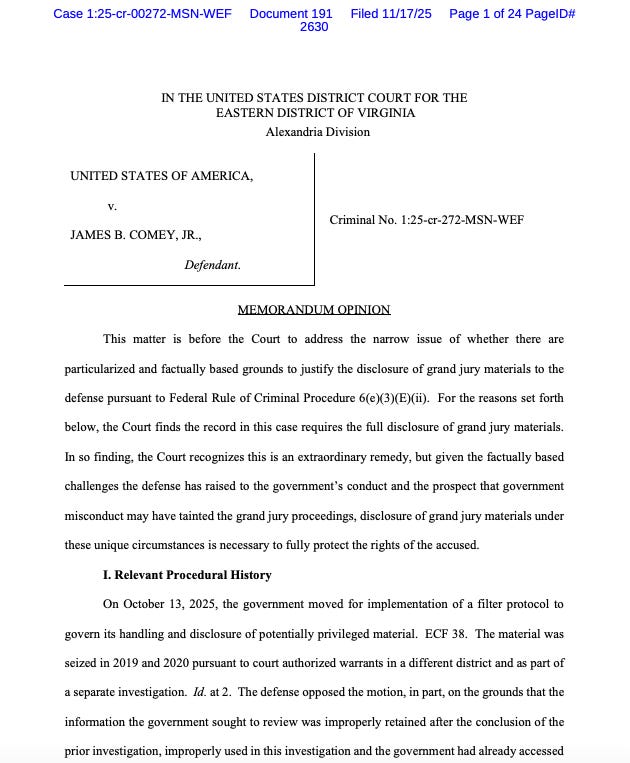
The judge just released the memo. I am sitting with it in front of me as I write this. The memo is a warning flare launched straight into America’s sky, and you can see the glow from every corner of our democracy.
I want you to understand what it means when a federal magistrate judge concludes there is a reasonable basis to suspect misconduct inside a criminal case against a former FBI Director. I want you to see what it means when grand jury notes are released to the defense because the judge sees no other way to protect the rights of the accused. I want you to see what it says about a Department of Justice placed under the command of a president who treats it as an extension of his own will.
Setting the Stage
The Comey case was always framed by the administration as a mission to punish a man who refused to bend. The charges were built around claims that he misled Congress. The public was told this was a neutral process guided by facts. I have the benefit of years inside courtrooms, depositions, and high conflict investigations.
When I read Judge Fitzpatrick’s memo, I see a pattern I have seen before in abuse of power cases. I see the fingerprints of pressure from above. I see prosecutors out of their depth placed into roles they never should have held. I see investigators handling privileged material without the basic safeguards every first year law student learns to follow. I see a timeline shaped by politics instead of law. And I see a defendant forced to fight for the simple right to know what was said behind the closed door of a grand jury.
What the Judge Found
Judge Fitzpatrick is not a partisan figure. He is a federal magistrate judge who understands the gravity of ordering grand jury materials released. He stated plainly that this is an extraordinary remedy. A judge only takes that step when the record demands it.
The memo details failures that should concern any citizen who cares about the integrity of our justice system. I read 24 pages of findings that outline investigative shortcuts, irregular searches, exposure to privileged communications, and testimony from a single agent who had already been contaminated by privileged material before he walked into the grand jury room. I read about a prosecutor who misstated basic constitutional rights and told the grand jurors they could trust the government because better evidence would show up at trial. I read about two inconsistent indictments presented in court on the same evening. You can read Judge Fitzpatrick’s memo too. Here’s the link.
Let me pause to repeat that. Two indictments. One grand jury vote. Two different documents. The judge called the situation uncharted legal territory. When a federal judge uses a phrase like that, you look up from the page and ask yourself what kind of country we are becoming.
The Pattern
The judge’s memo breaks down each concern the defense raised. I read a long list of failures that any prosecutor with even moderate experience would have avoided. The warrants used years ago to collect material from Daniel Richman were based on unrelated charges. Those warrants were executed in ways that appear to have pulled in material far beyond the proper scope. That material included conversations with Comey after Richman became his lawyer. Those conversations were privileged. Privileged material requires the highest level of protection. Instead it was treated like general evidence stored on a disc, accessed again years later by agents racing against a statute of limitations deadline.
Those agents did not seek a new warrant. They did not pause to involve a filter team. They did not halt the investigation once they realized they might be reviewing attorney client messages. They did not secure judicial guidance until after the indictment was already issued. And then they asked the court to approve a filter protocol after the damage was done.
The Judge’s Own Words
Judge Fitzpatrick wrote that the actions taken by the government raised genuine issues of misconduct. He said that the issues were linked directly to the grand jury proceedings and deserved full exploration by the defense. He described the government’s approach as cavalier. That word matters. In legal writing it is the equivalent of a siren.
The judge also referenced the prosecutor’s misstatements. One involved a wrong explanation of Comey’s Fifth Amendment rights. Another involved an assurance to the grand jury that they did not need to limit themselves to the evidence in front of them. The prosecutor told them the government had more waiting for them at trial. If you have served on a jury or watched a trial, you know how alarming that is. Grand jurors are instructed to rely only on what is placed in front of them. The judge pointed to this statement as a serious concern.
The Indictment Confusion
The strangest part of the record relates to the indictment itself. The first version presented three charges. The grand jury rejected one. That should have ended the matter. Instead a second indictment appeared with only two charges. That document was signed and returned in open court.
The problem is the timeline. There does not appear to be enough time between the grand jury vote and the return of the new indictment for the prosecutor to have drafted it, signed it, presented it, instructed the grand jury, and allowed them to vote. The judge noted that the transcript and recording do not reflect any such process. If no second presentation occurred, then the indictment used to launch this prosecution was not the same charging document the grand jury deliberated upon. That raises a structural constitutional concern.
The Larger Consequences
This is where the conversation shifts. I want you to see how this case fits into a larger pattern inside the Trump administration during his second term. We are not talking about routine procedural mistakes. We are talking about a presidency that has stretched every institutional boundary it touches. We are talking about a president who has used the Department of Justice as a weapon against perceived enemies. We are talking about a political environment shaped by intimidation, retaliation, and fear.
The Comey case sits inside that environment. The judge’s memo reflects the consequences of putting political loyalty above competence. It reflects the consequences of choosing prosecutors who lack the grounding needed for the highest stakes work in the justice system. It reflects the consequences of allowing political demands to shape investigative decisions. And it reflects the risks every one of us faces when a president chooses targets instead of pursuing justice.
Why This Matters to You
You deserve a justice system that functions with integrity. You deserve prosecutors who follow the Constitution. You deserve judges who do not have to rescue cases from misconduct. And you deserve a country where no president can attack those who refuse to bend to his will.
If they can do this to James Comey, a former FBI Director with resources, lawyers, visibility, and experience, try to picture what happens to someone without those protections. This is why I am worried. This is why I want you to pay attention. You are living in a country led by a president who has shown no interest in restraint. You are watching a justice system strained by political pressure. You are watching public servants punished for refusing to follow orders that violate their oaths. And you are living in a moment when silence is a luxury none of us can afford.
Where We Go From Here
The judge has set a hearing for early December. The defense will argue for dismissal. The judge will decide whether the misconduct described in this memo is severe enough to strike the indictment. The legal question is important, and the outcome matters.
The broader question is yours. You decide whether this kind of conduct is acceptable. You decide whether this is the America you want your children and grandchildren to inherit. You decide whether this erosion of our institutions continues.
Conclusion
I want you to carry this with you. When our institutions begin to crack, they do not collapse all at once. They weaken piece by piece. They weaken every time a prosecutor misstates a constitutional right. They weaken every time an investigator reviews privileged material without safeguards. They weaken every time a president uses his office to settle personal scores. They weaken when we stop paying attention.
You are the guardrail. You are the voice that stops this slide. Share this message. Talk about it. Stand up for the justice system you deserve. If you stay engaged, you protect more than a single case. You protect the country we all depend on.
Mitch Jackson, Esq.
This situation is devastating. If it concludes with a guilty verdict, without rule of law, it could happen consistently with anyone, I'm thinking. Are there any guardrails within the American Bar Association to protect processes, rules, and laws so that action can be taken against mischievous behavior?
RUMP's Grotesque-Shambolic hijacking of our Nation's Pre-Eminent Department of Justice CANNOT STAND. The 'People' MUST have a way, from WITHIN the Judiciary Branch, of COUNTERING AGUS' corruption by IMPEACHING and CONVICTING the AGUS for Egregious TRANSGRESSIONS against the Constitution.
Q - Is there a path for The 'People' to CONVENE such a Court (Tribunal?) to take action on behalf of The 'People'? and...
Could a resulting conviction (and order to remove) of the AGUS be enforced by the U.S. Marshalls under the Court's orders?