

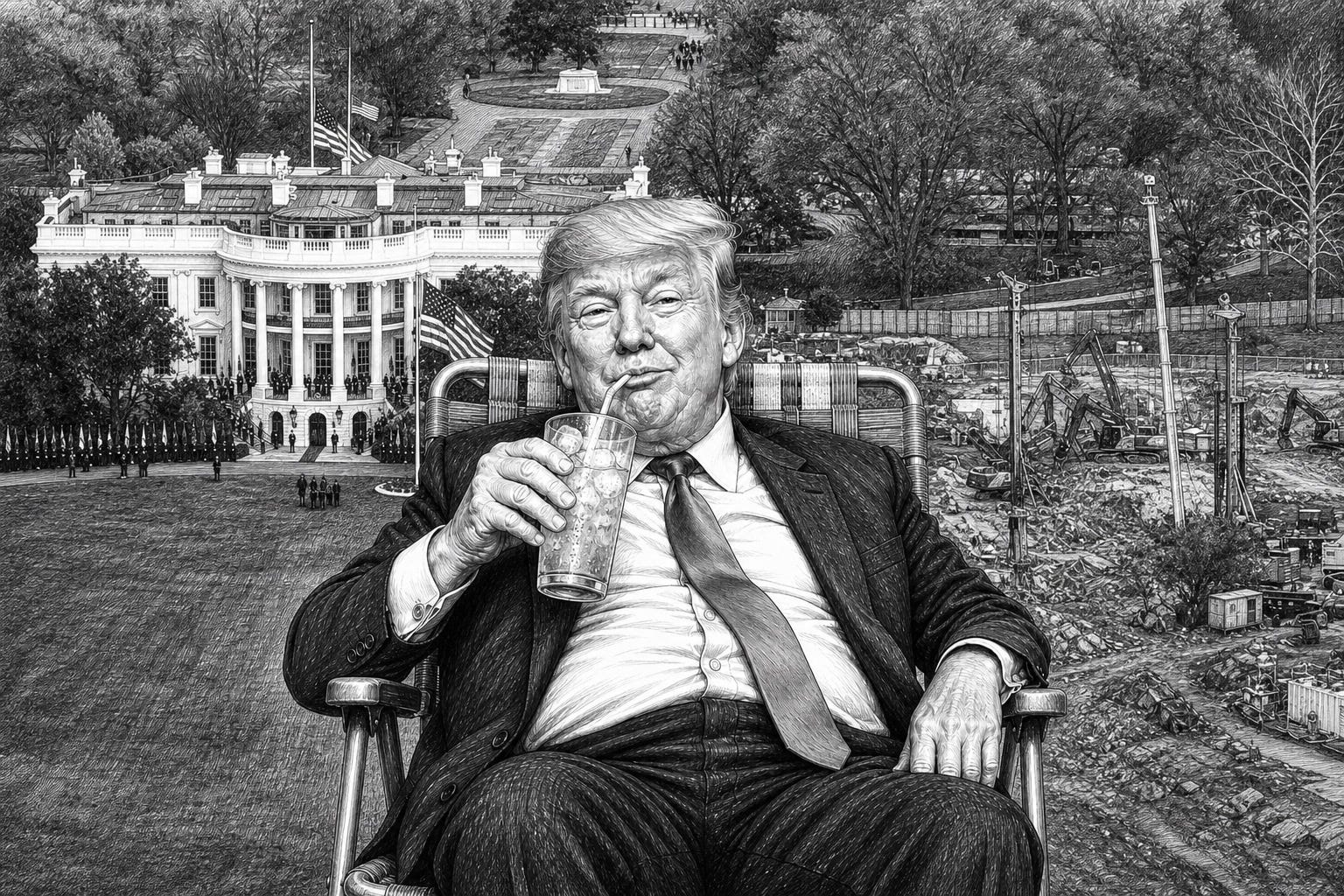
What took more than one hundred years to build and perfect was torn down in less than 72 hours. The East Wing of the White House no longer exists.
He even promised the project wouldn’t touch the East Wing.
Let’s assume that the Supreme Court does not rescue the ballroom project. Let’s also assume that Congress does not approve it because Republicans doesn’t have the votes and as a result, it also does not authorize the spending. Nobody comes along and cleans up the legal problem by giving Trump permission after the fact.
Can the government make him pay to restore what was destroyed? Can he be held responsible for federal money that was improperly spent? Could he face civil damages, restitution, disgorgement, or criminal liability? And does presidential immunity still protect him if the courts have already determined that he had no authority to do any of it?
The lawyer in me won’t let this go. Trump created this mess. He didn’t have to. And I wanted to know if he’s actually on the hook for any of it.
So my team and I dug in. Here’s what we found.
The Short Version (but keep reading because much can change with a new Congress after the midterms)
Under the hypothetical, and I don’t like the answer, Donald Trump would more than likely not be personally responsible for the cost of the demolition or restoration.
The strongest barrier is presidential immunity. But the answer is more nuanced than simply “Trump is immune.”
A final Supreme Court ruling saying that Congress possesses exclusive authority over this federal property could potentially make the official-versus-unofficial classification unusually important. If the Court merely says Trump misread his statutory authority, Nixon v. Fitzgerald (see below) gives him a formidable defense to personal civil damages. At the same time, if the Court goes further and holds that destruction of the East Wing was manifestly or palpably outside any legitimate presidential function, the case for personal liability becomes materially stronger.
There is presently no Supreme Court precedent answering that exact question and so I thought it’d be a good idea to dive in and take a look at all the issues.
What the D.C. Circuit Actually Said
The August 7 majority didn’t just disagree with Trump’s reading of a messy housekeeping statute. They went bigger.
They said the Property Clause gives Congress complete control over the White House and the land around it. The President has no constitutional authority over that federal property. None.
They said 40 U.S.C. §8106 is not optional. If you want to put up a building on federal public grounds in D.C., you need express authority from Congress. And they said §105(d) probably does not give the President his own green light to build a $400 million ballroom with privately donated money.
That’s the court telling him this is not his house to gut. Section 8106 itself is unusually direct:
“A building or structure shall not be erected” on covered federal grounds in D.C. “without express authority of Congress.” U.S. Code
The D.C. Circuit didn’t leave much room to hide. They said §105(d) does one thing. It lets Congress appropriate money for care, repair, alteration, and improvement. That’s it.
And the only current §105(d) appropriation the court could find was about $2.475 million. For maintenance. For safety. For health issues. For preventative upkeep. Not a $400 million ballroom. [read here]
Could the United States Sue Trump and Make Him Rebuild The East Wing?
As a property-law question? Possibly. As a presidential-immunity question? That’s a lot less clear. This would make a hell of a bar exam question. Sorry, law students. I couldn’t help myself.
Here’s my quick take. The United States can sue to protect its own property. That is not a theory. That is settled. The Supreme Court has recognized federal trespass suits since Cotton v. United States. And DOJ still brings cases right now seeking injunctions, restoration, and damages when someone injures federal property without authority.
If this were an ordinary federal official, or a private contractor who knowingly bulldozed a federal building without permission, the government could come after them for trespass, waste, or other injury to federal property. They could ask a court to make them put it back. They could ask for money.
Here’s the problem. Donald Trump was President when it happened.
Nixon v. Fitzgerald is the central civil-liability problem
In Nixon v. Fitzgerald, the Supreme Court drew a hard line. A former President is absolutely immune from civil damages for anything that falls inside the “outer perimeter” of his official responsibilities. That protection does not vanish just because someone alleges the act broke federal law.
The Court said it again in Trump v. United States. When a court is separating official from unofficial conduct, it cannot call an act unofficial just because it allegedly violates a generally applicable law. Immunity reaches the outer perimeter of the job, as long as the conduct is not “manifestly or palpably beyond” presidential authority. And that is the fight. Everything else is noise until you win that one.
Trump’s Argument
Management, alteration, security, and day-to-day decisions about the Executive Residence have historically run through the President and the Executive Branch. Congress itself appropriates money for the care, repair, alteration, and improvement of that house.
So Trump would say this (actually he’d be told to say this because he’d never come up with it on his own):
“Even if I exceeded the authority Congress gave me, I did it while performing a presidential function involving the Executive Residence. Fitzgerald therefore bars personal damages.”
That argument is not a bluff. It’s substantial.
The Government’s Possible Response
Keep this in mind. The current Congress and this administration are never going to sue Trump over this. But after the midterms, if Democrats take back a majority in Congress, that can change and here’s what could happen.
The government’s answer could be unusually powerful. I don’t see this DOJ doing this in a million years, especially with Todd Blanche in change, but just imagine:
“The Supreme Court has already held that Congress alone possessed authority to authorize destruction and replacement of this federal structure, that the President possessed no independent constitutional property power, and that no statute authorized what he did. This was not merely an erroneous exercise of presidential power; it was conduct outside the power of the office.”
If the Supreme Court’s ballroom opinion expressly used language such as “manifestly or palpably beyond” presidential authority, that could be decisive. Do I think it will? No, I don’t. But it’s worth pointing out just in case SCOTUS surprises us.
So in summary, the civil-immunity question would depend heavily upon how the Supreme Court describes the scope, not merely the illegality, of Trump’s conduct.
A suit by the United States Itself Presents an Additional Unresolved Question
There’s another wrinkle. Fitzgerald came out of a private damages suit. The Court’s reasoning keeps coming back to the danger of private people suing Presidents. But the holding itself is broader. It talks about immunity from “damages liability predicated on his official acts.”
I found no Supreme Court decision that answers this question head-on:
Can the United States itself sue a former President to recover for physical injury he caused to United States property while performing, or claiming to perform, an official presidential function?
The United States has the power to sue to protect its own property. That part is not in doubt. What nobody has settled is whether Fitzgerald’s immunity kills that kind of sovereign recovery case.
That distinction matters. A lawsuit by the United States to recover its own property loss is not the same thing as a private plaintiff chasing damages over a presidential policy call.
I would call this a plausible untested path. It’s not established liability so please don’t let anyone tell you it’s more than that.
18 U.S.C. §1361: Destruction or Depredation of Government Property
Section 1361 is the most obvious criminal statute. It says you cannot willfully injure or commit depredation against property of the United States. If the damage exceeds $1,000, you are looking at up to ten years in prison plus a fine under Title 18.
Physically demolishing the federally owned East Wing easily raises the actus reus question. The act is not the hard part. Willfulness is.
DOJ says §1361 is a specific-intent crime. You have to mean it. And you have to know the conduct violates the law. Unless, of course, you’re an Olympic athlete sticking your hand in the water at the Lincoln reflection pool, but that’s a prior post from another time. So with that requirement, and as Jeanine Pirro found out, that makes a prosecution for these kinds of crimes much harder than it looks.
A future Supreme Court decision saying Trump’s legal theory was wrong would prove he lacked authority. It would not prove that, months earlier, he personally knew that legal theory was wrong. The government would need evidence of his state of mind at the time. Warnings from government lawyers. Notices from Congress. Agency objections. Memoranda. Communications. Something that shows he knew he did not have lawful authority and did it anyway.
Then comes the separate constitutional fight. Under Trump v. United States, a former President gets absolute criminal immunity for core exclusive constitutional acts, at least presumptive immunity for other official acts, and no presidential immunity for unofficial conduct.
The D.C. Circuit says control of White House property belongs to Congress, not to some core exclusive Article II power. So absolute core-power immunity looks like a steep climb. But Trump could still claim presumptive immunity if the demolition is treated as an official act. And then the government has the burden of overcoming that standard.
So a §1361 case is two wars, not one. Mens rea. And presidential immunity. You have to win both.
Conduct after a Definitive Supreme Court Ruling Would Be Legally Different
This is where Trump’s risk could materially increase. Suppose the Supreme Court says:
You have no authority to continue this project without Congress.
Now let’s say that Congress continues to refuse to approve the construction and funding. Despite all of this, the executive branch nevertheless orders additional above-ground destruction or construction.
What happens?
Well, my take is that a later §1361 prosecution involving new damage would have a much stronger mens rea case because a defendant would have actual notice of the governing legal rule. It would still be necessary to determine whose acts caused the damage and whether presidential immunity applies. But the defense: “I reasonably believed I possessed legal authority” becomes substantially weaker after the Supreme Court itself has made it clear the law says otherwise.
Criminal Restitution Could Create Personal Financial Exposure
If Trump were validly prosecuted and convicted under a qualifying Title 18 property offense, the Mandatory Victims Restitution Act could require him to pay restitution to the United States. Federal law specifically contemplates the United States as a restitution victim.
For destroyed property, though, §3663A looks at the greater of the property’s value on the date it was destroyed or its value at sentencing, subject to statutory adjustments. That is where the fight gets interesting. After all, how much was the East Wing worth?
Ordinary real-estate market value is almost useless here. The White House is never going on the market. Historic significance. Architectural uniqueness. Replacement evidence. Restoration costs. Those are the numbers that could actually matter.
But I will not tell you this: “Trump could automatically be ordered to reimburse the United States for every dollar it takes to rebuild the East Wing.” My reading of the restitution statute does not say that, so don’t let anyone tell you it does.
Civil Restoration Damages Could Potentially be Broader if a Viable Civil Cause Survives Immunity
Separate from criminal restitution, the United States already sues for this kind of damage. In federal-property trespass cases, DOJ regularly seeks actual damages and restoration, including the cost of putting damaged public land and cultural resources back to the condition they were in before the injury.
If the United States beat presidential immunity and proved a real civil property claim, the relief could include reasonable restoration costs, tearing out or remediating unauthorized construction, damage to government fixtures or other property, and other losses actually caused by the conduct.
But there is no ballroom-specific federal statute that says: “An unauthorized President owes reconstruction costs.” Why would there be, right?
The cause of action, the immunity question and the right measure of damages would all have to be fought in court. None of it is automatic.
Appropriations Violations Create Another Track—But Not an Automatic Personal Debt
Congress’s power of the purse opens a second set of problems. The Purpose Statute is simple. Appropriations can be used only for the things Congress authorized.
The Antideficiency Act is simpler. Covered officers and employees cannot spend more than Congress gave them, and they cannot obligate money before an appropriation exists unless a statute says they can. A knowing and willful violation of this Act can be a crime. And GAO has already said those constraints apply to White House spending under §105(d).
None of that means this: “Trump ordered an unlawful project, therefore Trump personally owes Treasury $351.6 million.” That conclusion does not follow. Don’t let anyone sell it to you like it does.
Investigators would need the actual obligation and payment records. They would need to know who obligated each dollar. They would need the statutory source of each appropriation. They would need to know whether the security work was actually inside the appropriation’s permitted purposes. And for a criminal case, they would still need evidence that it was knowing and willful.
Certifying Officials are Where Direct Fiscal Repayment Liability Becomes Particularly Concrete
Section 3528 is the closest the law comes to a personal bill. It’s a statute that states that a certifying official who signs off on a government voucher is responsible for the legality of that payment. If the payment is illegal, improper, or prohibited, that official can be required to put the money back.
Think about what that actually means. The government does not just hand out cash because a President wants a project. Someone has to certify the voucher. Someone has to look at the payment and say, yes, this is lawful. That signature is not ceremonial. It is the moment the law attaches personal responsibility to a real human being.
If federal money was unlawfully disbursed on this project, that is the door investigators walk through. Not a speech. Not a ribbon-cutting. The voucher. The certification. The person who said this payment was legal.
But keep this in mind. The person on the hook is ordinarily the certifying official who signed the payment. Not automatically the President who demanded the project. Wanting it, announcing it, even ordering it is not the same thing as occupying the statutory role that §3528 cares about.
That distinction is the whole game. A lot of people are going to want a cleaner story. Trump tore it down, so Trump writes the check. I get why that feels right. The statute does not work that way.
Right now, there is not enough evidence to say Trump personally directed and authorized that certifying role for these expenditures. I’m guessing he probably did but proving this in court is entirely another thing. We do not have the payment records in front of us. We do not have the names on the vouchers. We do not have the paper that shows who said each dollar was legal.
Until we do, anyone telling you he is automatically personally liable under §3528 is selling you a conclusion the file does not support.
Private Donations Do Not Solve the Authority Problem
Mainstream news keeps skipping past this part, and it shouldn’t because this part of the story is important.
The D.C. Circuit recognizes that the National Park Service has statutory gift authority. Fine. They can take a donation. What the court rejected is the idea that donated money can be used as a workaround for Congress’s control over the project.
The majority’s logic is simple. Money is not authority. The government cannot do with privately collected money what the agency or the President has no legal authority to do in the first place. And that make sense, right? At the same time, §8106 separately requires express congressional authority to put up a building on the covered federal grounds.
So even if this thing were 100% privately financed (which it’s not), that would not fix the structural separation-of-powers problem. Not under the majority’s reasoning. You can raise every dollar on earth. You still need Congress.
Personal Enrichment Would Dramatically Change the Case
If the evidence ever showed Trump personally took kickbacks, secret contractor profits, undisclosed financial interests, or other benefits from the ballroom deals, we would be in a different body of law.
In United States v. Carter, the Supreme Court said a public official cannot secretly profit from transactions entrusted to him. The United States can force an accounting and make him disgorge the illicit profits, even without proving a matching dollar-for-dollar loss.
In theory, that could support disgorgement, tracing, and constructive-trust-type relief. Depending on the facts and on presidential immunity. Separate federal corruption statutes could come into play too, if the evidence is there.
But hear this line and do not blur it. Donating to the ballroom does not establish a bribe. Getting a government contract does not, by itself, establish a quid pro quo.
Without evidence connecting the two, alleging personal corruption is premature. But I will go on record saying if it turns out Trump, his family members or their companies were enriched by any of this, I wouldn’t be surprised.
The National Trust Cannot Recover the Value of the East Wing for Itself
The National Trust case is not a money case. That is the first thing to understand.
It is principally an APA and ultra-vires case. They are asking a court to declare what the law is and to stop the conduct. The APA itself waives sovereign immunity for actions seeking “relief other than money damages.” And the National Trust does not own the White House.
So even if the Trust wins on the merits, it does not walk out of court with a personal judgment against Trump for hundreds of millions of dollars in government property loss. That is not what this lawsuit is. That is not who this plaintiff is.
If anyone wants to recover the government’s own loss, that case ordinarily has to be brought by the United States itself, on a theory that actually fits. The Trust winning is not that lawsuit. Don’t confuse the two.
The Present Injunction is Not Personally Directed at Trump
This part has to be especially clear. The current injunction does not reach President Trump personally. It says so. It binds the agencies, the entities, the officers, and the agents carrying out the project. Not him.
Those officials are the ones immediately exposed if the injunction becomes operative and they violate it. They are the ones a court can actually enforce against.
Section 401 gives federal courts the power to punish disobedience of lawful orders. That part is real. But saying today that “Trump could be jailed for contempt if he keeps building” is legally irresponsible. The existing injunction deliberately leaves him out.
A future order that expressly names the Trump would be a different case. And a constitutionally extraordinary one. We are not there.
What Happens With All of This While Trump Remains President?
Under normal circumstances, and there’s nothing normal about this presidency, administration and Department of Justice, the DOJ has a longstanding Office of Legal Counsel position: indicting or criminally prosecuting a sitting President would unconstitutionally interfere with the Executive Branch.
That is an executive-branch legal position. It is not a Supreme Court holding. The Court has never itself said a sitting President categorically cannot be prosecuted. So even if prosecutors believed a §1361 case or an appropriations crime was there, a federal prosecution during Trump’s presidency would run into DOJ’s own OLC rule. And with Todd Blanche is control, I wouldn’t be surprised if Todd wants to compensate Trump aka his “I love you” guy, with money from the Trump/Blanche anti-weaponization fund, for the stress Donald’s probably going through over all of us.
All joking aside, once Trump leaves office, that particular obstacle disappears. The Trump v. United States immunity does not. I’m sorry to report that a former President can still invoke official-act immunity for what he did while he was President. Leaving the building does not leave that behind.
The practical Sequence Under My Hypothetical
If the Supreme Court ultimately says Trump lacked authority, and Congress refuses to approve this, the immediate legal consequence is almost certainly this: the unauthorized above-ground work stops.
Not a $400 million personal judgment against Trump. Don’t skip to that ending. The law doesn’t.
Then Congress decides what happens to the hole in the ground. Whether anything is eventually authorized. Whether the site is restored. Whether public money gets appropriated for restoration or for lawful security work.
Next comes the accounting. Investigators, GAO, and Congress can go through every federal dollar. The source and legal terms of the private donations. The contracts. The officials who obligated the money and the officials who certified it. The communications that show what the decision-makers knew about their legal authority.
Only after that record exists can anyone intelligently assess Trump’s genuine personal exposure. And the most important evidence will not be: “The Supreme Court said he was wrong.” It will be the answers to these questions.
What did Trump know? When did he know it? What exactly did he personally order? What money did he personally authorize or certify? Did he keep going after definitive notice that it was unlawful? Did he personally take any financial benefit?
Those questions decide whether this stays an unlawful exercise of government power, or becomes personal civil, criminal, or restitution liability. Until you can answer them, you do not have a case against the man. You have a case against the project. Those are not the same thing.
Final wrap up
If the Supreme Court ultimately holds that Donald Trump had no authority to demolish the East Wing and build the ballroom, and Congress refuses to ratify or fund the project, that judgment would establish one thing. The project lacked lawful authority. It would not, by itself, put a personal financial judgment on Trump.
His most important shield against ordinary civil damages is Nixon v. Fitzgerald. Whether that shield holds depends on whether this conduct stays inside the outer perimeter of presidential responsibility, even though Congress has exclusive authority over the property. The Supreme Court’s exact language could decide that fight.
A federal-property prosecution under §1361 is legally conceivable. It is also harder than it looks. Prosecutors would have to prove willfulness, meaning knowledge of unlawfulness. And they would have to beat Trump v. United States immunity.
A successful criminal case could open the door to restitution. But restitution is governed by statutory property-value rules. It does not automatically equal whatever it later costs the government to rebuild. Appropriations violations could expose the officials who actually obligated, certified, or disbursed illegal payments. Federal fiscal law does not automatically turn an unauthorized presidential construction decision into Trump’s personal debt to the Treasury.
And I am taking personal contempt off the front of the list. The existing injunction expressly does not bind President Trump himself.
So the strongest path to truly substantial personal liability requires something more than the Supreme Court saying the project was unauthorized. It requires evidence that puts the conduct outside protected presidential functions. It requires proof of knowing criminality after the authority was unmistakably shut down or possibly even a personal tie to unlawful fiscal acts. Find personal enrichment and it’s game on. By the way, this Congress and DOJ would never lift a finger. But maybe the future will bring different decisions.
When all is said and done, an unlawful presidency-level decision is not the same thing as a personally collectible judgment against the President who made it.
I know most of us wish it was. That is not the law.
If this analysis helped you, tell me. If there is another story you want taken apart the same way, tell me that too. If I am not in court or in a mediation, and time allows, we will do it.
Mitch Jackson, Esq.
Headlines told you Trump tore down the East Wing to build his ballroom. This post told you who can actually be made to pay for it, and your paid subscription to Uncensored Objection is what keeps this level of legal analysis landing in your inbox.
I'm not a lawyer, not even an American, but I love your posts.
Donald Trump has had a really negative impact on so much of the world these last few years. So many of us wake up each day wondering wtf he has stuffed up while we have slept. It is something which has become a toxin in the air for so many people I know and for it, this world has been steadily getting more and more angry. But you... you don't dip your toes into the drama. You don't seem to chase the media crowd for the exposure, yet you dig, every week, into the cesspit of politics and it's place in the law and it is SO much nicer to read about facts and references and previous cases that support the different angles of how it could go down. And that perspective to me has become more valuable than any social media post or newspaper cover. Thank YOU.
So, in the end, it appears that this unlawful act which he clearly had no authority to make will go unpunished. Investigated? Undoubtedly. Prosecuted? Probably not.
My only question as a non legal individual, well educated, tax paying, law abiding citizen, and proud American is this:
Was this act of blatant, wanton destruction on the White House reasonable? If it was reasonable then why not seek Congress’s approval? To me that goes to his state of mind. He knew it was illegal and chose to circumvent the proper authority because he knew it would have been declined even by his patsy Congress. You want state of mind? There it is. He doesn’t even hide that fact.