

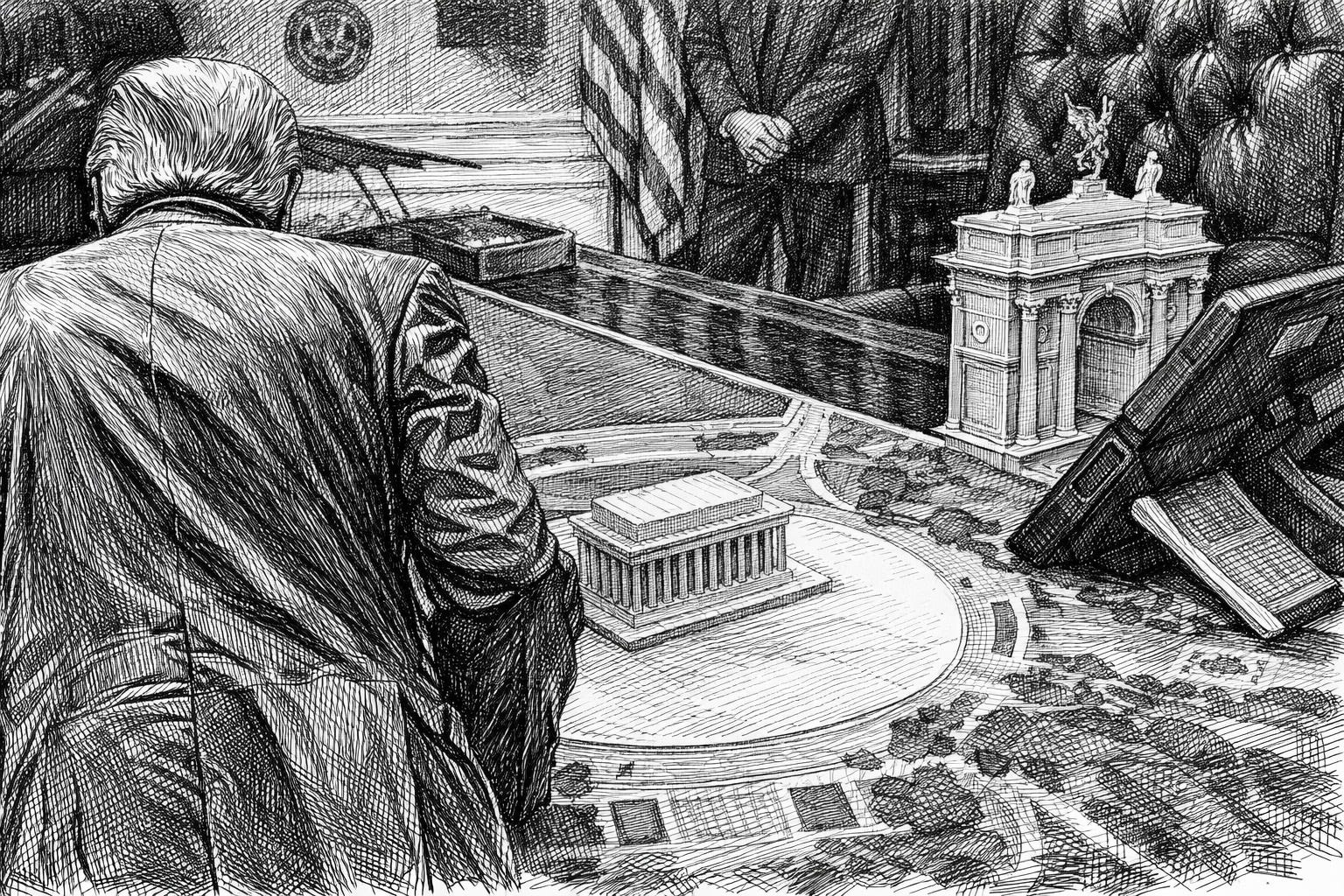
Donald Trump’s push to build a towering triumphal arch for America’s two hundred fiftieth birthday is not just another flashy idea floating around Washington. It is a real proposal he has been personally promoting, showing off in model form, and trying to place in one of the most symbolically charged pieces of national ground in the entire country. That location is Memorial Circle at the end of Arlington Memorial Bridge, directly in the line of sight and civic gravity that pulls visitors from Arlington and the Potomac toward the Lincoln Memorial.
The details being reported make it clear this is not meant to be subtle. The arch as described is envisioned at roughly two hundred fifty feet tall, a scale that would compete with and visually dominate nearby landmarks. Trump has framed it as an American counterpart to monuments like the Arc de Triomphe, except bigger, louder, and designed to become its own unavoidable landmark in the heart of the capital’s most solemn corridor.
That location matters. Memorial Circle is not a random patch of land. It is a gateway, a funnel, a forced passage point where people arrive at the Lincoln Memorial side of Washington or leave Arlington’s grounds, and placing a triumphal arch there does not simply add beauty to the city, it rewrites the visual story America tells about itself at the exact moment people are approaching the memorial that carries Abraham Lincoln’s name, his words, and the moral weight of the country’s deepest constitutional rupture.
Trump’s supporters will call that symbolism patriotic. They will say it is a fitting way to celebrate the semiquincentennial and will wrap it in the language of national pride. But a triumphal arch is a specific kind of object, historically a marker of power, victory, and permanence, and that is precisely why it fits so naturally into Trump’s political instincts.
He has always been drawn to the architecture of dominance. He believes scale equals legitimacy, and that if something is big enough, gold enough, and placed prominently enough, people will have no choice but to absorb the message. This proposal follows that pattern perfectly.
So when you ask what his plans are, the honest answer is that the plans are still moving and still being shaped. They lack the publicly released details you would expect for a national monument at that site. Reporting makes clear that approvals have not been secured and that major practical barriers remain, including federal stewardship, stringent review requirements, and the absence of formal green lights that would make the project inevitable.
Even the origin story tells you what is happening. Reporting traces the concept back to a smaller idea pushed by an art critic who envisioned a temporary structure. Once Trump took interest, it evolved into something far larger and permanent, because that is what he does, taking an idea and stretching it until it becomes less about the event it claims to honor and more about the imprint it leaves.
Now let’s talk about money. This is where patriotism often becomes performance. The most responsible answer right now is that the funding mechanism is still unclear, and that matters.
Trump has suggested using leftover private money connected to other projects, but there is no finalized public accounting that makes this a done deal. Remember “We’ll build a wall and Mexico will pay for it.”
The clearest public cost figure in recent reporting is an estimate of around one hundred million dollars, which is not trivial even before considering long term maintenance, security demands, traffic engineering, and the inevitable costs that follow any major structure placed in a high security national corridor.
This is where motive becomes the real story. For Trump, the two hundred fiftieth anniversary is not primarily a civic lesson. It is a branding opportunity.
It is a chance to fuse himself to the national narrative and to create a physical object that forces every visitor to look at something associated with his vision, his taste, and his era. One of the most revealing moments in the reporting comes when Trump is asked who the arch is for, and his answer strips away the varnish and leaves the truth sitting in daylight.
When Trump has been asked who this arch is for and why it should exist, his answers have been revealing not because of a single dramatic quote, but because of the pattern in how he frames the project. Reporting from outlets including AP and The Washington Post shows that instead of grounding the idea in public demand, historical consensus, or a clear civic mission, Trump consistently presents the arch as something Washington has “waited two hundred years” for and something he personally believes should be built.
He casts himself as the leader finally delivering what others failed to do, positioning the monument as a correction to history rather than a response to it. In doing so, the patriotic language gives way to something more personal, a legacy project justified through national symbolism, where the structure becomes inseparable from the individual who commissioned it and the era he wants permanently etched into the capital’s landscape.
This is why this has not happened before in Washington in this form. America builds monuments, but it does not have a tradition of sitting presidents commissioning triumphal architecture that reads like a ruler’s signature. When Trump claims the city has been waiting two hundred years for something like this, historians and reporting push back, noting that this supposed longstanding public desire is not supported the way he implies.
That matters. It shows a familiar play, a bold claim of historical inevitability used to justify a project driven by a present day personal agenda.
If you want to know how else that money could be spent, you do not have to strain for examples. One hundred million dollars could fund real, measurable improvements in people’s lives.
It could expand mental health treatment access. It could support veterans in crisis. It could repair aging infrastructure that actually keeps communities safe. It could strengthen civic education programs that teach the Constitution instead of turning it into a stage prop.
This is not about being anti history. It is about being pro reality. It is about understanding the difference between remembrance and self memorialization.
The United States does not need an emperor’s arch to celebrate its birthday. It needs a functioning democracy worthy of celebration. It needs leaders who understand that service is not measured by how large your structure is, but by how well you protect the rights and lives of the people who have to live under whatever you leave behind.
So yes, skepticism is warranted. When you place a towering triumphal arch in the exact spot where Americans process sacrifice, memory, and national identity, you are not quietly honoring the past. You are grabbing the camera and stepping into the frame.
The reporting shows a clear throughline. Trump wants this arch because it is big, because it is permanent, because it will be seen, and because it converts a national milestone into a personal imprint. That is the motive Americans should be talking about, because it forces the real question, whether at two hundred fifty years we want to invest in people, or invest in monuments to the powerful.
Mitch Jackson, Esq.
No, just no. Taxpayers must not allow it. If built, which would make everyone in America look like idiots, it will be removed. Stop the money and construction before the project begins. I can't take much more. All this is too surreal for the human mind to deal with.
Pure DESPOTIC symbolism... A symbol of tRUMP-ian flavor IMPERIALISM!
UNamerican to the CORE.