

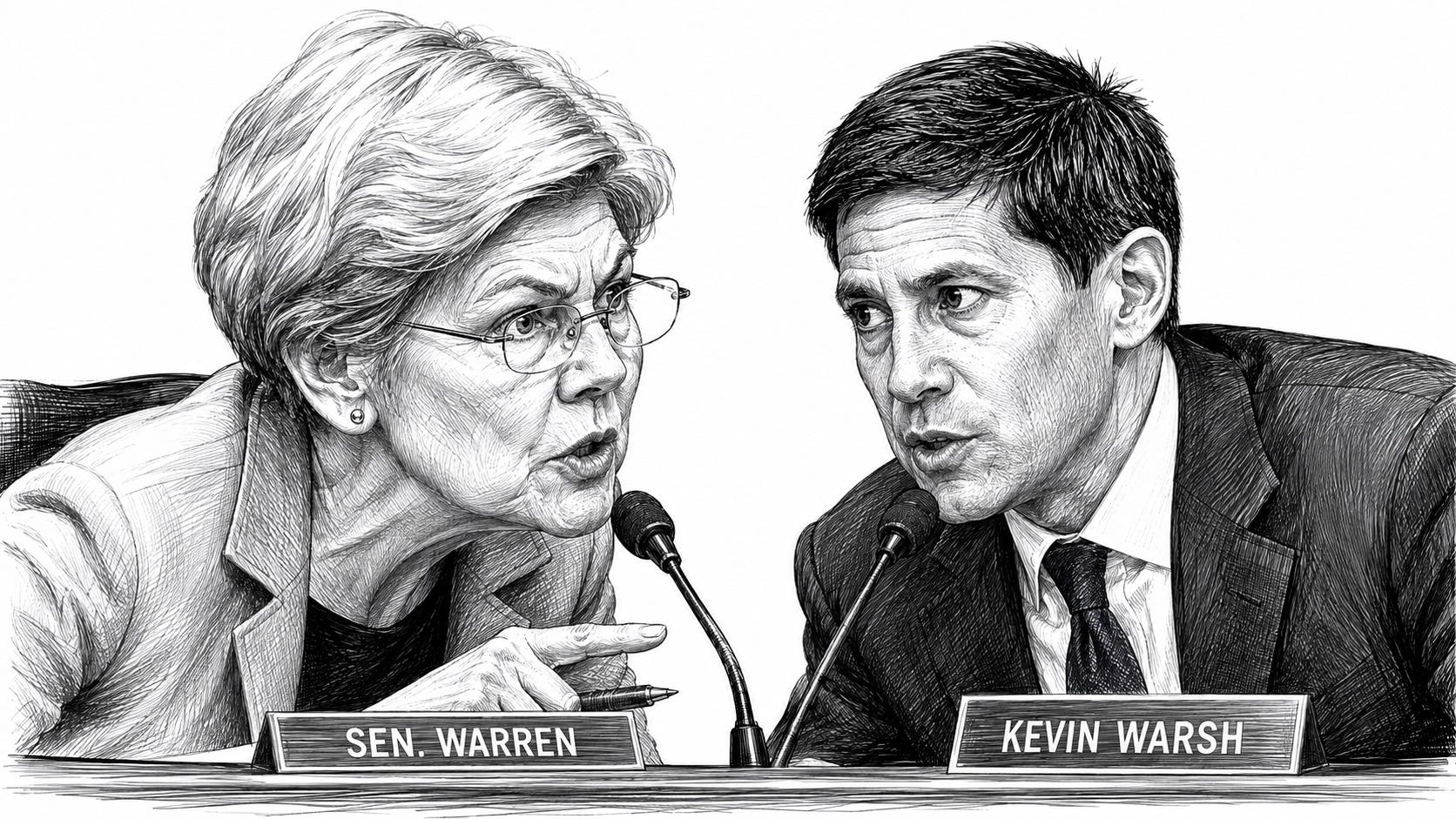
Someone wired the Chairman of the Federal Reserve more than $100 million days before he took the oath of office. He will not tell you who. No law requires him to. That gap is the story.
What Happened, On The Record
Kevin Warsh is the Chairman of the Federal Reserve. He was nominated earlier this year by Trump and confirmed by the Senate. The Federal Reserve is the central bank of the United States, responsible for setting monetary policy, supervising and regulating banks, maintaining the payment system, and acting as lender of last resort to keep the financial system stable.
During the process, Warsh filed a 69-page financial disclosure with the Office of Government Ethics listing two positions in Juggernaut Fund LP, each valued at more than $50 million. The underlying assets carried a caveat: not disclosed, due to pre-existing confidentiality agreements. Alongside those, 85 series of an entity called THSDFS LLC and two DCM Investments vehicles. His April 10 ethics agreement confirms every one of them is a Duquesne Family Office entity.
Duquesne is Stanley Druckenmiller’s family office. Druckenmiller serves as its Chairman and CEO. Warsh has worked there as an advisor since leaving the Fed in 2011, and he reported $10.2 million in income from that role in the prior year alone.
At his April 21 confirmation hearing before Senate Banking, Warsh told the committee that what he disclosed was all the information that was his to disclose.
Senator Elizabeth Warren, ranking Democrat on that committee, wrote to Druckenmiller on May 4. She asked him to release Warsh from the confidentiality agreements. She asked whether he, Duquesne, or any affiliate planned to redeem Warsh’s shares. She noted that Juggernaut had held a financial interest in the parent company of Berkshire Bank in December 2024 and the parent of Investar Bank in August 2025, which matters because federal law bars Fed governors from holding stock in any bank, banking institution, or trust company. Neither Warsh nor Druckenmiller responded publicly.
Then the clock compressed. The Senate confirmed Warsh to the Board on May 12 and as chairman on May 13. OGE issued Certificates of Divestiture dated May 16. Warsh filed his first round of sales on May 19, including the Juggernaut positions. He took the oath on May 22 from Justice Clarence Thomas at the White House.
Nine days. More than $100 million in illiquid venture positions, gone.
The filings show no dollar amount, no date of sale, and no buyer. Warsh is deferring capital gains on those sales under the tax provision built for forced divestitures. He got the tax benefit. You got nothing.
The July 15 Exchange
Warsh returned to Senate Banking on July 15 for semiannual monetary policy testimony, his second day on the Hill after House Financial Services the day before. This was routine testimony, not a hearing convened about him. Warren had five minutes.
She opened by noting that at least six senior Fed officials had been implicated in ethics scandals over the prior five years, and said Warsh appeared to be embracing that culture rather than repairing it. Then she asked the question directly.
“Who gave you $100 million right before you were sworn in? Was it a billionaire who has business with the Fed? Was it Stanley Druckenmiller, who’s made billions of dollars betting on what the Fed does?”
His answer: he had fully honored his obligations under his agreement with the Office of Government Ethics.
She asked again. Same answer. She told him the tone he was setting seemed to invite corruption.
Warren spent the rest of her time on a second thread, pressing whether Warsh had asked Vice Chair for Supervision Michelle Bowman about reports she attended a bankers’ meeting during the Fed’s blackout period. He would not confirm that he had, citing the inspector general’s ongoing review.
My Read On Where the Money Came From
This next part is my analysis, not established fact. No public document names the buyer. It’s premised around 40 years of experience practicing law. Read it as informed opinion and weigh it yourself. We used our law firm’s AI to do a more detailed deep dive from which I analyzed and wrote this section. It’s worth looking at and I’m sharing it here in this footnote.1
I believe the Duquesne-controlled entity redeemed those interests, on Druckenmiller’s authority. The mechanics leave almost no alternative.
Duquesne Family Office LLC is the general partner of Juggernaut Fund LP. Private fund interests are not freely transferable, and standard partnership agreements require general partner consent for any transfer. No outside buyer can price a $100 million position when the confidentiality agreements bar anyone from showing them what is inside it. And no arms-length secondary sale of illiquid venture stakes closes in nine days. That process runs months. A general partner redemption runs on a signature.
One precision point. A redemption pays out of fund assets, which in a family office means family capital, not Druckenmiller’s personal checking account. The accurate claim is that Druckenmiller-controlled entities executed the exit. Whether his own capital, family capital, or an affiliate funded it remains unknown.
Why do it? Start with necessity. Warsh could not legally take office holding those assets, and the confidentiality wall Duquesne built made an outside sale impossible on the available clock. Add fifteen years of relationship and $10.2 million in annual advisory income. The firm cleaned up its own partner’s exit.
The uncomfortable part is what it costs. Facilitating a close associate’s exit days before he assumes control of the interest rate cycle costs the firm nothing and preserves a fifteen-year relationship intact. Druckenmiller runs a macro book whose returns turn on Fed policy. The asymmetry runs one direction.
Why Warsh Stays Silent
Four reasons, and they stack.
He is contractually bound. The confidentiality agreements belong to Duquesne, they survive his exit, and naming the counterparty would expose him to liability to the entities that just paid him.
Nothing compels him. OGE requires proof of sale, not counterparty disclosure. The certificates omit price, date, and buyer by design. His answer at the hearing was technically accurate and entirely unresponsive.
Confirmation validates the attack. “Druckenmiller entities cashed out Warsh” is a devastating headline even if the transaction was clean, because Druckenmiller is precisely the billionaire who profits from Fed decisions. Silence costs one bad news cycle. Confirmation costs four years.
And the price may be worse than the name. Redeeming an opaque venture position requires marking illiquid assets. A generous mark turns a divestiture into a farewell payment wearing a sale’s clothing. That is hypothesis, not finding. But it is the question nobody is asking.
Trump’s Relationship with Warsh
Warsh married Jane Lauder in 2002. Her father is Ronald Lauder, who has known Trump since they were undergraduates together at Wharton, and the two have remained close friends and confidants ever since. Lauder is widely credited with sparking Trump’s interest in acquiring Greenland in 2020 and has continued to advise him on it. Lauder also donated to Trump’s 2016 presidential campaign. That makes Warsh the son-in-law of one of Trump’s oldest personal allies, which is the relationship that draws the most scrutiny.
It’s interesting to note that Warsh was the runner-up for Fed chair in 2017, when Trump chose Powell instead. Trump has since said he was given bad advice about Powell. Trump nominated Warsh in late January 2026 after months of open frustration with Powell over the pace of rate cuts. And of course, Trump called Warsh “central casting” for the job.
Potential Benefits to Duquesne
The Fed chair shapes the reaction function that tells markets when policy moves, sets the tone on bank capital rules and merger approvals, and steers the balance sheet and reserve levels that determine how much liquidity sits under risk assets. On the other side of that sits Duquesne. Its disclosed equity book ran $3.4 billion at the end of Q1 2026, led by Natera at 18.1 percent and a Brazil ETF at 8.7 percent, a position that moves on the dollar, which moves on the Fed. That filing is only a window, since a 13F reports listed stocks and options and shows nothing of the currencies, bonds, commodities, and shorts where a macro trader actually lives.
The private side matters more. The Juggernaut and THSDFS vehicles Warsh held carried stakes in over 200 startups across AI, crypto infrastructure, defense, and biotech. Those are the longest-duration assets in finance, and their valuations are discount-rate math. Signal a lower terminal rate and the whole book marks higher without a single trade. Warren also flagged that Juggernaut held interests in the parent companies of Berkshire Bank and Investar Bank, tying the fund directly to the sector Warsh now regulates.
None of that is happening right now, and you deserve the whole picture. Warsh has run hawkish since day one. He held the funds rate at 3.5 to 3.75 percent at his first FOMC meeting, told Congress the committee has no tolerance for persistently elevated inflation, and refused to treat a June CPI drop to 3.5 percent as a victory. Nine of eighteen officials project higher rates this year. Traders put an 86 percent chance on another hold. Trump asked for cuts and has not gotten them.
No evidence shows a single improper contact between Warsh and Duquesne since he took office. That is precisely why the disclosure gap matters. Ethics rules exist to eliminate the opportunity and the appearance before either becomes a live question. Warsh met the letter of those rules by selling. He has not said who bought, at what price, or on what terms. The problem is not that Duquesne is profiting from his chairmanship. On this rate path it plainly is not. The problem is that if it ever does, the record has been built so you will never be able to tell.
What Actually Needs To Happen
Warren cannot fix this. As ranking member she controls neither the agenda nor subpoena authority. Letters that recipients ignore and five-minute question rounds are the full extent of her leverage. That is by design, and it is why the same question keeps producing the same non-answer.
The fix is structural and it is not complicated. Amend the Ethics in Government Act to require counterparty and price disclosure on any divestiture executed under a Certificate of Divestiture. If you take the tax deferral, you disclose who paid you and what they paid. A public official who wants the benefit of a forced-sale tax provision can accept the burden of telling the public who wrote the check. Otherwise, don’t take the job. Full stop.
Call your senators. Ask them where they stand on divestiture counterparty disclosure. Then watch whether Warren’s request for buyer details and transaction terms ever gets answered, and hold the record when it does not.
Mitch Jackson, Esq.
Most people watch a hearing and hear noise. Subscribe to Uncensored Objection and you will see it the way a trial lawyer does, catching the answer that dodged the question and knowing exactly what it costs you.
Where Did The $100 Million Come From?
With a probability of over 90%, it came from a Duquesne-controlled entity, on Stanley Druckenmiller’s authority as Chairman and CEO, redeemed the interests. Not a third-party buyer. Not a secondary market sale. The fund side of the table cashed him out. Here is why that is the only answer that fits the mechanics.
The structure permits no one else. Duquesne Family Office LLC is the general partner of Juggernaut Fund LP. Warsh’s ethics agreement confirms the 85 THSDFS series and the DCM vehicles are all Duquesne Family Office entities, and one analysis of his disclosure puts the combined Juggernaut and THSDFS holdings at roughly $148 million, about 82% of his personally held assets, all flowing through the Druckenmiller relationship. An LP interest in a closed private fund is not freely transferable. Standard fund practice is that transfers require GP consent and the GP holds a right of first refusal. The underlying assets are shielded by pre-existing confidentiality agreements. No outside buyer can diligence a $100 million position whose contents are contractually hidden.
Next, look at the clock. The Senate confirmed Warsh May 12 and 13. His swearing-in was conditioned on documentation showing he had sold certain assets. He took the oath May 22. The sales closed inside nine days. In this markets, a genuine arms-length secondary sale of illiquid venture LP stakes takes months of diligence and price negotiation. A GP redemption takes a signature. The timeline tells you which one happened. One precision note: a redemption is paid from fund assets, which in a family office fund is substantially family capital rather than Druckenmiller’s personal account, so the accurate claim is that Druckenmiller-controlled entities executed the exit, not that he personally wired the money.
Why Druckenmiller’s side did it. Three reasons, in descending order of weight. First, necessity: Warsh could not legally take office holding these assets, the confidentiality wall Duquesne itself built made an outside sale impossible on the clock available, and letting the nomination stall over paperwork served nobody at the firm. Second, the relationship: Duquesne employed Warsh as an advisor for fifteen years, and he reported $10.2 million in income from that role in the prior year. This was the firm cleaning up its own partner’s exit. Third, the cheap option value. Warren’s stated concern, as reported, is that a buyer writing Warsh a $100 million check right before he starts as Fed chair raises questions about what access that buyer might have during his term. Druckenmiller runs a macro book whose returns depend heavily on Fed policy. It is doubtful the redemption was priced to buy anything. But facilitating your close associate’s exit days before he takes control of the rate cycle costs the firm nothing and leaves a fifteen-year relationship fully intact. The asymmetry all runs one direction.
This just shows, yet again, that the financial insiders continually game the system in their favor, making ungodly amounts of cash just for being "in the club" while the rest of us get stuck with the bill. To say that systematic reform of our government and financial system is overdue is the grossest understatement.
The best government money can buy. Once again.