

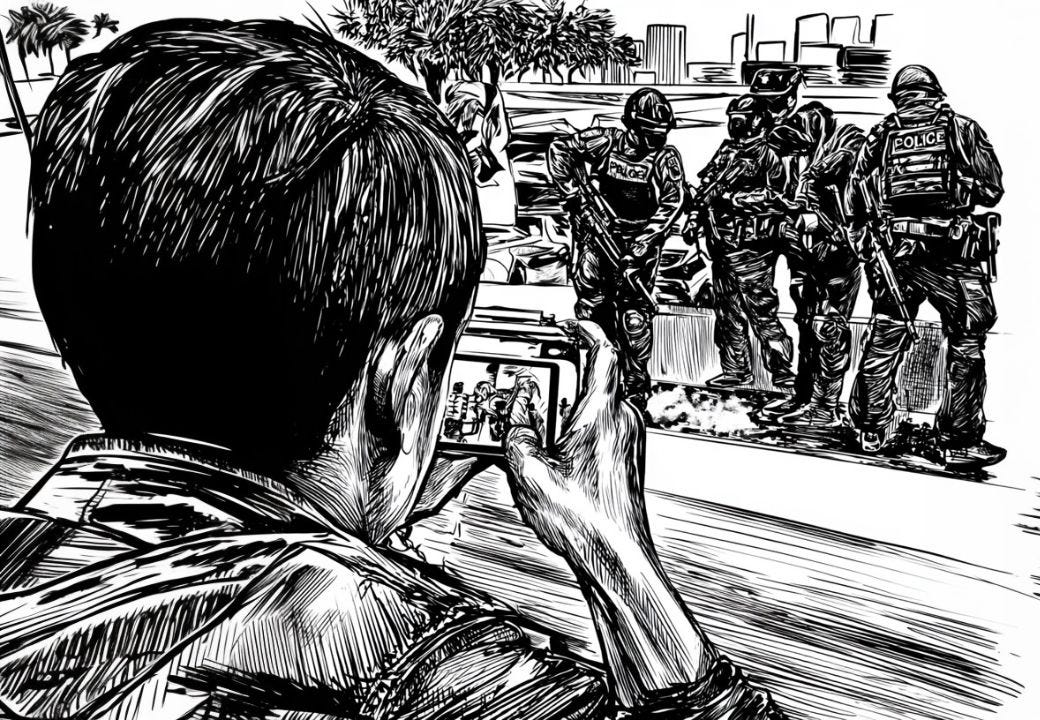
There is a moment that freezes people.
You see ICE agents surround someone on a sidewalk, outside a workplace, or during a protest. Dark jackets. Faces covered. No visible names. No explanation. Your heart rate jumps. Your instincts kick in. You want to do something. And then the doubt hits.
Am I allowed to record this?
Yes. You are. And in this moment in American history, you should.
Taking video is not about confrontation. It is about documentation. It is about truth. It is about making sure power knows it is being watched.
Silence is what abuse depends on. Video disrupts that.
Your Right to Take Video Is Real and Protected
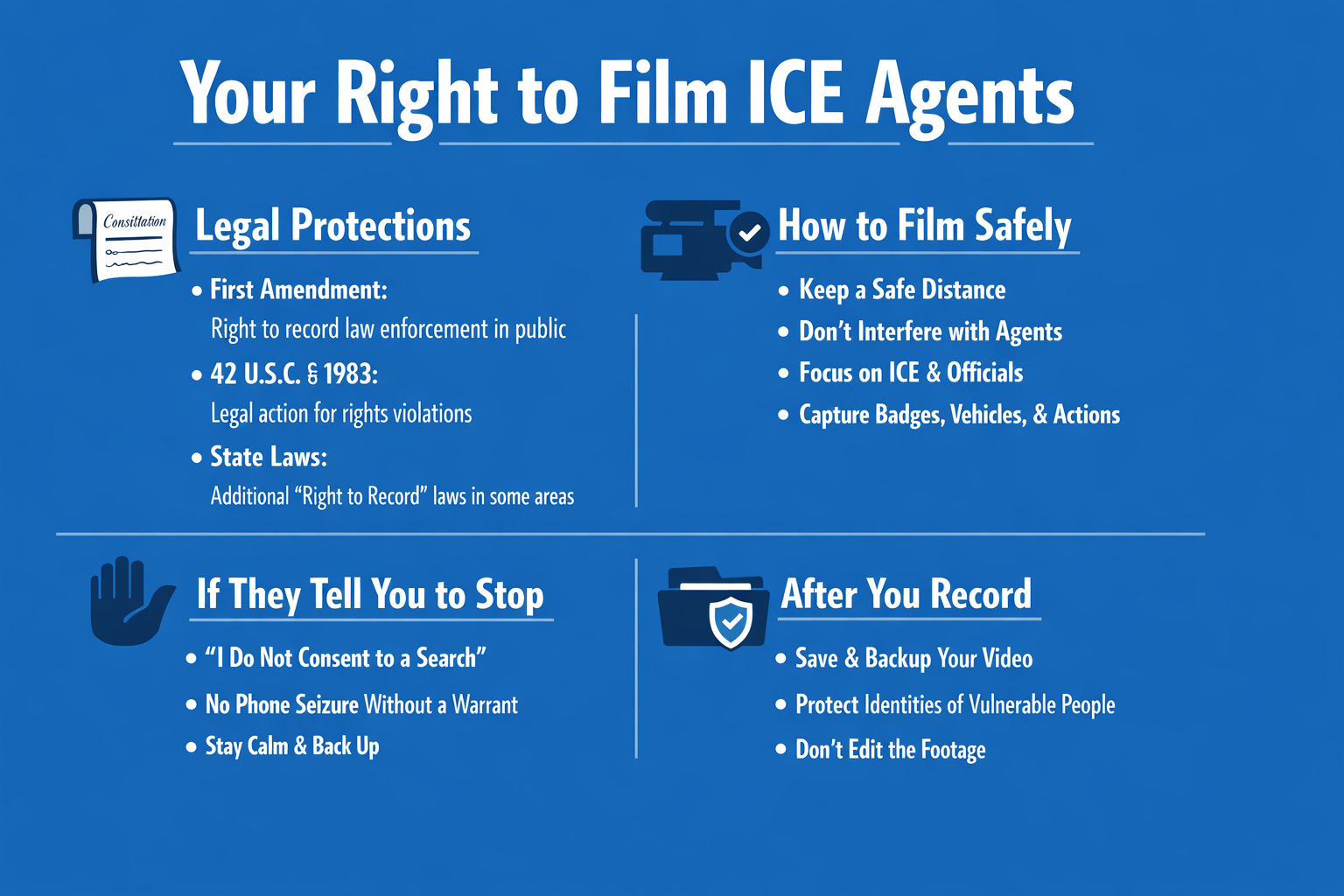
You do not need permission to record ICE agents or any other law enforcement officer performing their duties in public spaces. Sidewalks. Streets. Parks. Outside courthouses. Outside your home. During protests. All of it.
Federal courts across the country have been clear. The First Amendment protects your right to record government officials in public as long as you are not interfering with what they are doing.
That protection applies whether the agents are in uniform or plain clothes. Whether they have visible badges or not. Whether they like being recorded or not.
Your phone is not a threat. It is a record. And no officer has the legal right to order you to delete footage or to take your device without a judge signed warrant.
Some states have even stronger protections written directly into law. Others try to narrow the edges. None of them erase the core constitutional rule. Public officials doing public work in public spaces can be recorded.
State Laws and the Myths That Scare People Silent
You may hear officers cite state laws to intimidate you into stopping. Distance rules. Audio recording laws. Vague claims about safety.
Here is the reality.
Some states have attempted buffer laws that require people to stand back a certain distance. These laws are being challenged and blocked across the country because they collide with free speech. Even where they exist, they do not give officers the right to silence recording altogether. You can comply with distance instructions and keep recording.
Some states have two party consent laws for audio recording. Those laws do not override your right to record officers in public. Courts have been clear that law enforcement officers do not have a reasonable expectation of privacy while performing their jobs in public. Video with audio is allowed.
Private property changes the analysis slightly. If you are legally present, you can record. If the property owner tells you to leave or stop, comply or move to public space. Never trespass to get footage. That creates a separate legal problem and gives officers leverage.
Minnesota Governor Tim Walz agrees:
How to Take Video the Right Way
When you record, you are a witness. Not a participant. Your power comes from staying calm, steady, and observant.
Keep your distance. Do not block officers. Do not touch anyone. Do not shout instructions. You are there to document, not escalate.
Film the agents, not the person being detained. Focus on conduct, not vulnerability. Capture uniforms, faces, badge numbers if visible, agency markings, weapons, vehicles, and how force is used.
Get context. Street signs. Landmarks. Storefronts. License plates. Say the date and time out loud if you can. These details turn a clip into evidence.
Hold your phone horizontally when possible. A wide frame captures more truth. More officers. More actions. More context.
Stay steady. Keep filming even when nothing dramatic is happening. Silence and waiting often reveal more than chaos.
What to Do When They Tell You to Stop
Being told to stop filming is not the same as a lawful order.
If an officer tells you to turn it off, take a step back and keep recording from a safe distance. Calmly say you are not interfering and that you are exercising your right to record. Do not argue. Do not lecture. Do not get pulled into a street debate.
If the situation escalates and you sense danger, your safety comes first. There is no courage prize for getting hurt. Sometimes the smartest move is to step away and immediately write down everything you saw. Names. Times. Locations. Actions. Witnesses.
If you or someone close to you has immigration vulnerabilities, weigh that risk carefully. Knowing your rights also means knowing your situation.
What If They Demand Your Phone
This matters.
Officers need a warrant to search or seize your phone in almost every situation. They cannot force you to unlock it. They cannot demand your passcode. Say clearly and calmly, I do not consent to any search or seizure.
Use a strong passcode. Avoid biometric locks. A fingerprint or face unlock can be physically forced. A memorized code is far harder to compel.
Do not make sudden movements. Keep your hands visible. If you need to put your phone away, say what you are doing and move slowly.
Remember details. Badge numbers. Names. Descriptions. Vehicles. Time and place. Write it all down as soon as you are safe.
If they take your phone without a warrant, that act itself may be unlawful. Documentation matters.
After the Video Is Taken
Do not rush to post.
Ask yourself who could be harmed if this goes public. Faces of detainees. Bystanders. Protesters. Video can protect people or expose them. Be intentional.
Save the raw file. Do not edit it. Do not rename it. Back it up immediately. Cloud storage. Email it to yourself. Send a copy to someone you trust. Treat it like evidence, because it is.
Consider sharing first with a journalist, lawyer, or legal aid organization. They know how to use footage responsibly and effectively.
If you share publicly, do it to inform and hold accountable, not to chase attention. Clean, unedited truth is powerful.
Why This Matters Right Now
We are living through a moment where intimidation is a tool of governance. Masked agents. Unmarked vehicles. Aggressive street enforcement. Protests met with militarized responses.
This is not normal. And it only becomes normalized when no one documents it.
Power behaves differently when it knows it is being watched. Video creates accountability where silence creates abuse.
When officials deny misconduct, video cuts through lies. When stories are dismissed, video anchors truth. When fear spreads, video reminds people they are not alone.
The Bottom Line
You have the right to take video of ICE agents and other officials in public. Use it.
Stay calm. Stay back. Stay focused.
Do not hand over your phone without a warrant.
Protect vulnerable people when you share.
Save your footage. Back it up. Use it wisely.
Every time you hit record, you are doing something simple and profound. You are preserving truth. You are drawing a line. You are refusing to disappear.
History does not just happen in courtrooms or headlines. It happens on sidewalks, at protests, outside homes, in ordinary moments when someone decides not to look away.
When that moment comes, take videos.
Mitch Jackson, Esq. | links
Related:
Yes, You Can Photograph ICE Agents—And Here’s Exactly How to Do It Without Getting Silenced
No Kings, No Silence: Why You Must Take Pictures and Videos Now
¡Bravò, Mitch, bravò! Another example of your clear and concise guidance in face the scheiße careening around our computers, iPhones, and streets.
https://x.com/RonFilipkowski/status/2009628909525160386 (thank you, Mr Hannes Fassold)
Here is one fine example of standing up to storm-trumpers (thank you, Jimmy Kimmel), though the verbal escalation was gratuitous, perhaps intended to provoke yet another misdeed from the I.C.E.-man scummeth.
What every American needs to know before a police officer, ICE agent, Border Patrol officer, or TSA agent demands access to your phone. 👇
https://www.linkedin.com/pulse/what-every-american-needs-know-before-police-officer-ice-jackson-uo86f