

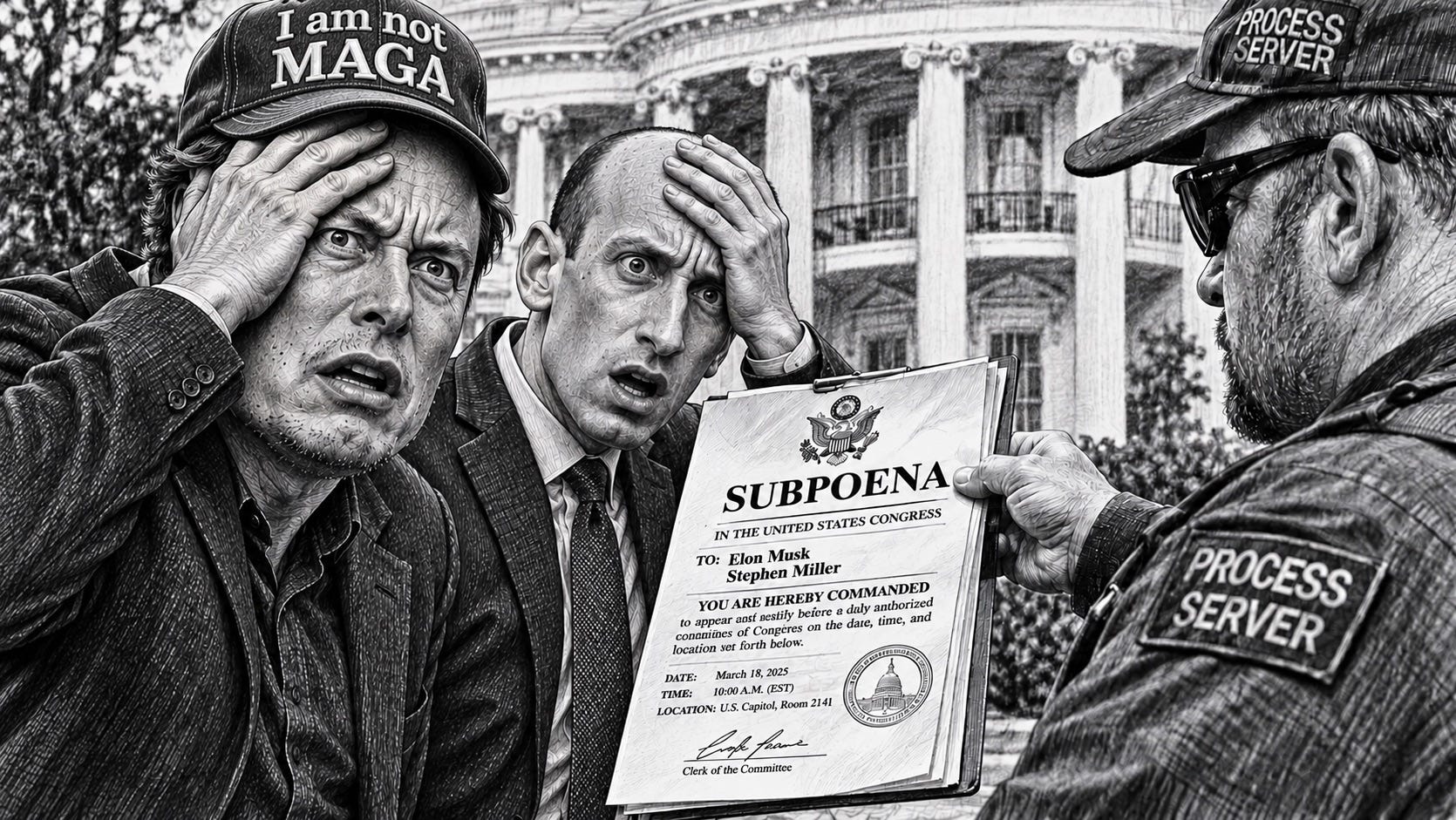
A Straight Answer Before the Gavels Drop
On January 3, 2027, the 120th Congress takes the oath of office, and for the first time since Donald Trump returned to the White House, Democrats will hold the gavels in both the House and the Senate. Voters handed them that power on November 3 in a midterm rout that flipped nine Senate seats, the most since 1958, and gave Democrats a 56 to 44 Senate majority. House Democrats hold at least 256 seats, with a handful of races still being counted. Within days, the man in line to chair the House Oversight Committee, Representative Robert Garcia of California, posted a blunt two word warning to the people he plans to question. “Lawyer up.”
That warning has teeth.
I’ve been a guest on a handful of shows since the election and watched plenty more. The same question keeps landing in my inbox, the live chat and in the comments. People want to know what subpoena and oversight muscle this new majority carries once it gets to work, and what happens when somebody tells Congress to pound sand. You deserve a straight answer, so I’m giving you the long one, the same one I’d give a client sitting across my conference table the week before a deposition.
I’m a trial lawyer, and I’ve spent forty years serving subpoenas, fighting over subpoenas, preparing witnesses to testify under oath, and cross examining the ones who lied. The congressional version of this game follows its own rules, and those rules split in two directions depending on whose name sits on the paper. A private citizen like Elon Musk or Nvidia chief executive Jensen Huang stands in one spot, and a government official, past or present, like White House Chief of Staff Stephen Miller, Defense Secretary Pete Hegseth, former Homeland Security Secretary Kristi Noem, or former Attorney General Pam Bondi, stands somewhere else entirely, with different shields to hide behind and different pressure points for Congress to squeeze.
Here’s the plan. I’ll start with where Congress gets the authority to make anyone talk and why the Constitution hands it that job. Then I’ll walk you through every stage of a subpoena, from the day it’s drafted to the moment a witness raises a right hand, and at each stage I’ll show you the private citizen first and the government official second. After that comes the part everyone wants to hear about, meaning what happens when a witness refuses and every enforcement tool the House and Senate hold. We’ll finish with how this Congress keeps the Justice Department from shoving its referrals into a dark corner of an unlit office.
Where Congress Gets Its Power to Ask
You won’t find the word subpoena anywhere in the Constitution. Article I hands Congress “all legislative powers,” and the Supreme Court decided long ago that the power to write laws carries with it the power to gather the facts those laws depend on.
The case that settled this grew out of the Teapot Dome bribery scandal of the 1920s. The Senate wanted to know why the Justice Department under Attorney General Harry Daugherty had failed to go after the wrongdoers in Teapot Dome and other scandals, and when the Attorney General’s brother, a banker named Mally Daugherty, ignored a Senate subpoena, the Senate sent its deputy sergeant at arms to Ohio to arrest him and haul him to Washington. In 1927, in McGrain v. Daugherty, the Supreme Court upheld that arrest and announced a rule that still governs today: the power to investigate, backed by the ability to force answers, is an essential part of the job of making laws. A Congress forced to rely on volunteers would legislate blind, the Court reasoned, because the people with the most to hide are the last ones to volunteer anything.
Think of Congress as the board of directors of a company you own. You and every other voter are the shareholders. A board that never audits the books, never questions the executives, never reads the contracts, and never asks where the money went has stopped doing its job, and the shareholders pay for it.
The power has limits, and every good investigator respects them, because a witness’s lawyer will look for every one of them. In Watkins v. United States in 1957, the Court said Congress has no general authority to expose people’s private affairs for the sake of exposure. Every subpoena needs a valid legislative purpose, meaning it must connect to a subject on which Congress writes laws or spends money, and that includes checking how the government carries out the laws already on the books. Each question asked of a witness must be pertinent to that subject. Congress is also no court and no police force, so it has no power to convict anyone of a crime, and the Bill of Rights travels with every witness into the hearing room. The Court repeated these principles in 2020 in Trump v. Mazars, the fight over Trump’s financial records, and added extra care for subpoenas aimed at a sitting president’s personal papers.
Here’s the part the witnesses’ lawyers hate. In Eastland v. United States Servicemen’s Fund in 1975, the Supreme Court held that once a committee acts within that legitimate legislative sphere, the Constitution’s Speech or Debate Clause bars lawsuits asking judges to stop the committee itself from enforcing its subpoena. Courts still weigh in when a witness fights back another way, by suing the bank or accountant holding the records, the way Trump did in Mazars, or by raising defenses once Congress goes to court to enforce. A judge looks at whether the purpose is legitimate. A judge does not second guess whether the investigation is wise or politically convenient for the target.
Why the Founders Built a Watchdog Into the Checkbook
The men who wrote the Constitution had lived under a king, and they refused to trust any single set of hands with all the power. So they split it up and set each branch to watch the others. James Madison put it in seven words in Federalist No. 51: “Ambition must be made to counteract ambition.” Congressional oversight is that idea in action. The president runs the government day to day, and Congress checks whether the president runs it honestly and inside the law.
The second reason sits in the money. The Constitution says no dollar leaves the Treasury unless Congress passes a law spending it, which means every salary at the Pentagon, every ICE detention contract, every Justice Department prosecutor, and every White House staffer gets paid with money Congress approved. Picture hiring a contractor to remodel your kitchen with your savings. You’d want the receipts. You’d walk through the work before you wrote the next check, and you’d ask hard questions if the new cabinets showed up crooked and the contractor’s cousin got paid twice. Congress writes checks worth trillions of dollars every year, so before it signs the next round of spending bills, it has every right, and in my view every duty, to see what the last round bought.
Oversight feeds Congress’s other big powers too. The House needs facts before it votes on impeachment. The Senate needs facts before it confirms a cabinet nominee or a federal judge. Woodrow Wilson, decades before he became president, wrote that Congress’s job of informing the public about how its government works deserves to rank even ahead of passing laws, because voters have no way to hold anyone accountable for things they never learn.
Private citizens fall inside this circle whenever their business touches laws Congress writes or money Congress spends. SpaceX holds billions of dollars in federal contracts with NASA and the Pentagon, and its Starlink satellite network became a lifeline on the battlefield in Ukraine, so Congress has a direct legislative interest in how Elon Musk runs it. Nvidia sells its advanced chips under export control laws Congress wrote, and the company’s dealings with China go straight to national security. Being rich never exempts anyone. Being connected to federal money and federal law puts you squarely in the frame.
Congress writes the checks, so Congress gets to see every receipt before it signs another one.
The Committees That Will Carry the Load
Congress does almost none of its investigating as a full body. Committees do the work, and each one owns a slice of the government.
In the House, the Committee on Oversight and Government Reform has the widest reach, because House rules let it investigate any matter at any time, and that’s the committee Robert Garcia is set to run. The Judiciary Committee covers the Justice Department, the FBI, immigration courts, and impeachment. Armed Services watches the Pentagon and Homeland Security watches DHS and ICE. The Permanent Select Committee on Intelligence handles the spy agencies behind closed doors. Foreign Affairs, Energy and Commerce, Financial Services, and Ways and Means each carry their own subpoena power over their own turf, and Ways and Means holds a special federal law that lets it obtain anyone’s tax returns. Then there’s Appropriations, the committee that writes the spending bills and therefore holds the leash. The House also has the power to create a select committee for one big investigation, the way it did with the January 6 committee.
The Senate mirrors that structure. The Committee on Homeland Security and Governmental Affairs houses the Permanent Subcommittee on Investigations, the Senate’s best known investigative unit, which traces its roots to Harry Truman’s World War II committee that chased fraud in military contracts. Senate Judiciary, Armed Services, Commerce, Foreign Relations, Intelligence, Finance, and Banking each hold subpoena power too, and Elizabeth Warren, in line to lead Banking, has already told corporate executives to get ready.
Who signs the subpoena matters. House rules allow every standing committee to issue subpoenas, and each committee’s own rules decide whether the chair signs alone or needs a committee vote. Several House chairs, including the Oversight chair, have held the authority to sign alone after giving notice to the top member of the minority party. Senate committees write their own rules, and those rules vary widely; some require a committee vote, and others let the chair act with the agreement of the ranking member. A new majority writes new committee rules at the start of every Congress, so watch those organizing meetings in January, because they decide how fast the subpoenas fly.
House rules also let committees take sworn depositions run by staff lawyers, and that’s where the real evidence gets built. A televised hearing gives each member five minutes and a camera. A deposition gives trained investigators hours, sometimes days, to walk a witness through every document and every text message. On a personal note, depositions are one of my favorite tools, because they let me sit across the table from a witness and watch their eyes while they answer. Almost every one I’ve taken has turned up facts nobody else knew, and those facts have won me case after case.
Timing matters even more. The new members take the oath on January 3, and the House usually adopts its rules that same day or within days. Then the party caucuses fill committee seats and the committees meet to adopt their own rules and staff budgets. Only after that do chairs start signing subpoenas. Expect letters first, because courts look favorably on a committee that asked politely before it compelled, and Democrats have already sent stacks of letters as the minority party, letters that now become the paper trail a judge will read if any of these fights end up in a federal courtroom. Realistically, the first subpoenas land in late January or February.
One more rule shapes everything that follows. A House subpoena dies when the Congress that issued it ends, and committees in both chambers routinely reissue their unfinished demands when a new Congress begins. The Republican led Oversight Committee subpoenaed Pam Bondi in March 2026, and that subpoena expires at noon on January 3, 2027, so the new majority has to issue a fresh one. The same clock runs against this Congress, which ends on January 3, 2029, and every witness’s lawyer knows it. When the House sued Harriet Miers, George W. Bush’s White House counsel, in 2008, it won in the trial court and then watched the appeal run out the clock as that Congress ended. Miers finally testified in 2009, and only after a negotiated deal. Don McGahn, Trump’s first White House counsel, got his subpoena in April 2019 and didn’t sit for questioning until June 2021. Bottom line, stalling is a strategy.
Two Witnesses, Two Rulebooks
Every witness Congress calls lands in one of two camps, and the camp decides which shields the witness holds and which pressure points Congress gets to press.
A private citizen like Elon Musk or Jensen Huang owes Congress the same thing any of us would owe if a subpoena showed up at our door, which is obedience to a lawful order, and the private citizen keeps every constitutional right we all carry. A private citizen has no executive privilege to claim, because that privilege belongs to the president and the presidency alone. Steve Bannon learned this the hard way. He was a private citizen in October 2021 when he ignored a subpoena from the January 6 committee. A jury convicted him of contempt of Congress, and he served four months in federal prison in 2024.
A government official carries all of that plus an extra layer of armor. The president’s executive privilege, the Justice Department’s own legal opinions about what officials owe Congress, agency lawyers who sit beside the witness, and a long tradition of negotiation between the branches all come into play. And the official knows something no private witness gets to count on: the prosecutor who decides whether to charge contempt works for the same president the official serves.
