


What Happened
Late on October 13, Ukrainian soldiers sent their interceptor drones up to hunt Russian attack drones racing toward their cities, and somewhere far above them the rules changed without a word of warning. Any Starshield terminal moving faster than about 100 miles per hour lost its satellite link, and some units lost signal at speeds as low as 45 miles per hour.
Nobody warned them. Ukraine’s military learned of the cap, of all places, from SpaceX customer support after filing a complaint.
Given everything Trump has handed Russia lately, I don’t believe for one second this was a coincidence.
Start here
You need the basics first. Starlink is the commercial satellite internet service owned by Elon Musk’s company, SpaceX. Starshield is the military version sold to governments, riding the same satellites with tougher encryption. Ukraine’s army runs on both.
An earlier deal through US European Command put 500 Ukrainian terminals on Starshield, and an August 2024 Pentagon contract added 2,500 more. Poland has said it pays about 50 million dollars a year toward Ukraine’s Starlink service, and Germany says it pays for some of the equipment too. Soldiers use these links to fly drones, move supplies, spot targets and talk to headquarters. Russia’s newest attack drones run on jet engines and fly fast. Ukraine’s interceptors have to fly faster to catch them.1
Connections under the cap started coming back on the evening of October 14, and on Saturday President Zelensky said the satellites still were not tracking antennas on anything moving faster than 161 kilometers per hour, which is about 100 miles per hour and far slower than the jet drones his pilots chase.
Everyone Points Somewhere Else
I’m a trial lawyer, and I have watched plenty of defendants point at each other. This case has the whole cast doing it.
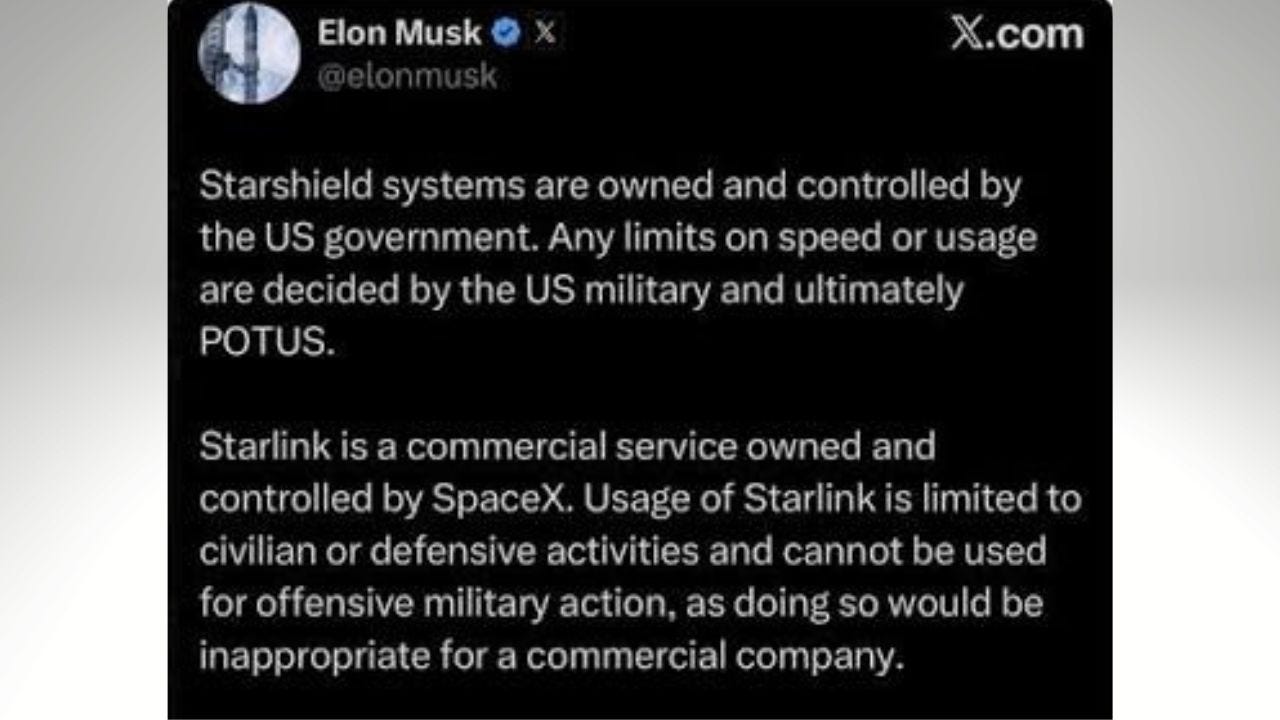
Musk says Starshield belongs to the US government and that any limits on speed come from the military and, in the end, the president. Note that Musk doesn’t deny it happened or, that he was directly indirectly involved with making recommendations to the people in charge.
Two American officials and a Western official say the order came from inside the White House as a message to Pentagon leaders, and a senior Ukrainian official says Kyiv was told the same thing. A senior US official answers that the president never gave such an order. Four people familiar with the talks say Musk pitched the slowdown to Trump, and one says Trump agreed.
Trump says “it wasn’t me” and that he doesn’t think it was Elon. Rubio calls the White House reports “categorically false” and insists the slowdown was not deliberate.
Read that again. The President of the United States says it wasn’t him, and he doesn’t think it was Elon. Somebody made this call, and every American deserves to know who made it and why. The one man who can get that answer with a single phone call sits in the Oval Office. Trump knows, or he can find out before lunch. Full stop.
Rubio added a twist on Saturday, telling reporters that Ukraine has no access to Starshield “at this moment” and that its request to use the system for deep strikes inside Russia is under discussion, a claim that runs straight into Ukraine’s own defense ministry, which says its Starshield connection is working again under the speed cap.
Here is what I tell juries when every witness points at the next guy: a speed limit nobody admits setting did not write itself, and the people who control that system owe this country a straight answer under oath. Somebody touched that dial.
Moscow’s Devastating Response
Russia did not wait. The night the cap hit, Moscow launched 39 missiles on ballistic paths and 128 drones, 77 of them jet-powered Shaheds, at targets around Kyiv and Kharkiv, knocking out power for 600,000 people in the capital. Zelensky said plainly that the Russians were trying to exploit the Starlink problems because Ukraine’s interceptor drones depend on that connection.
One artillery soldier near the front put it simply: “We felt it straight away.” War analysts tracking the fighting found that Ukrainian strikes on Russian supply trucks dropped sharply that day.
On October 9, Trump announced a deal with Putin to ease sanctions and let Russian diesel flow into world markets. The next day he called for Ukraine to get a new president and warned Zelensky to stop hitting Russian refineries. Three days later the drones went deaf. I researched and wrote about the Russian deal here.
Call Today
Silence is how a kill switch becomes normal. Your phone call is how it stops.
This fight reaches well past Ukraine. When one man owns the satellites and one White House holds the leash, every ally who bought in learns that American help comes with strings attached in secret, and Poland, which helps pay for Ukraine’s service, has already warned Musk that his European customers are watching him. Europe’s top diplomat admits her continent has no short-term replacement, and its own satellite network won’t launch until 2029 or run at full strength until 2030.
Musk’s company helped Ukraine in February 2026 by cutting off Russian troops who were using black market terminals. In 2022 Musk personally refused Kyiv’s request to switch on coverage near Crimea for a drone strike on Russia’s fleet. Wartime power should never rest in one private inbox.
Democrats, who are in the minority right now and who don’t have subpoena power, have formally asked the Pentagon’s inspector general to investigate. Four Republican senators, Thom Tillis, Susan Collins, Lisa Murkowski and John Cornyn, joined them. Their letter says American diplomats and security staff in Ukraine could not reach bunkers during Russian air raids amid the disruptions. The senators asked for a first briefing by November 1.
Tell your senator today that you want the inspector general’s findings made public, along with a law that bars any president or contractor from quietly throttling an ally at war, and hand this article to one friend who still thinks this fight belongs to somebody else.
Mitch Jackson, Esq.
Governments have paid Elon Musk’s SpaceX hundreds of millions of dollars to keep Ukraine connected, and nobody outside the company and the Pentagon knows the full number. USAID opened the tab in 2022 by buying 1,333 Starlink terminals at $1,500 apiece. The Pentagon followed with a $23 million contract in 2023 and a $14.1 million extension in 2024, which Bloomberg reports pushed the total past $40 million. An August 2024 Pentagon deal moved 2,500 more terminals onto Starshield, the military version, at a price the government has never disclosed. Industry analysts at Quilty Space put one US contract for Ukraine’s military at $537 million, a figure no official has confirmed. The State Department approved a possible $150 million Starlink sale to Ukraine in August 2025, with no public confirmation that it closed. Poland says it pays about $50 million a year and spent roughly $84 million in its first two years covering more than 24,500 terminals and their monthly fees. It now funds over 29,000 of the more than 50,000 terminals active in Ukraine. Germany pledged €20 million in 2023, promised a significant share of the funding in 2025, and confirmed this month that it still pays for part of the equipment. SpaceX also sells Starlink commercially inside Ukraine through the carrier Kyivstar and doesn’t report what that earns.
All of these people against Zelensky and Ukraine remind me of the old, patricians of the Gilded Age who never took the blame for any evil they clearly created, and then nestled themselves back into their corrupt little cozy cocoon. The world would be a better, safer place without them.
Unbelievably believable that Elon and Donald are lying and supporting Russia. More grounds for impeachment ! Let’s hope Americans will turn on Elon before it is too late for the Ukraine.🇺🇦