

Every Tuesday I take one thing everyone is talking about and break it down the way I would for a jury. What it actually means, where the story falls apart, and how to talk about it at your own kitchen table or barbecue. Read it, study the 10 talking points at the end, then send it to someone who needs it.
What is Communism and Socialism?
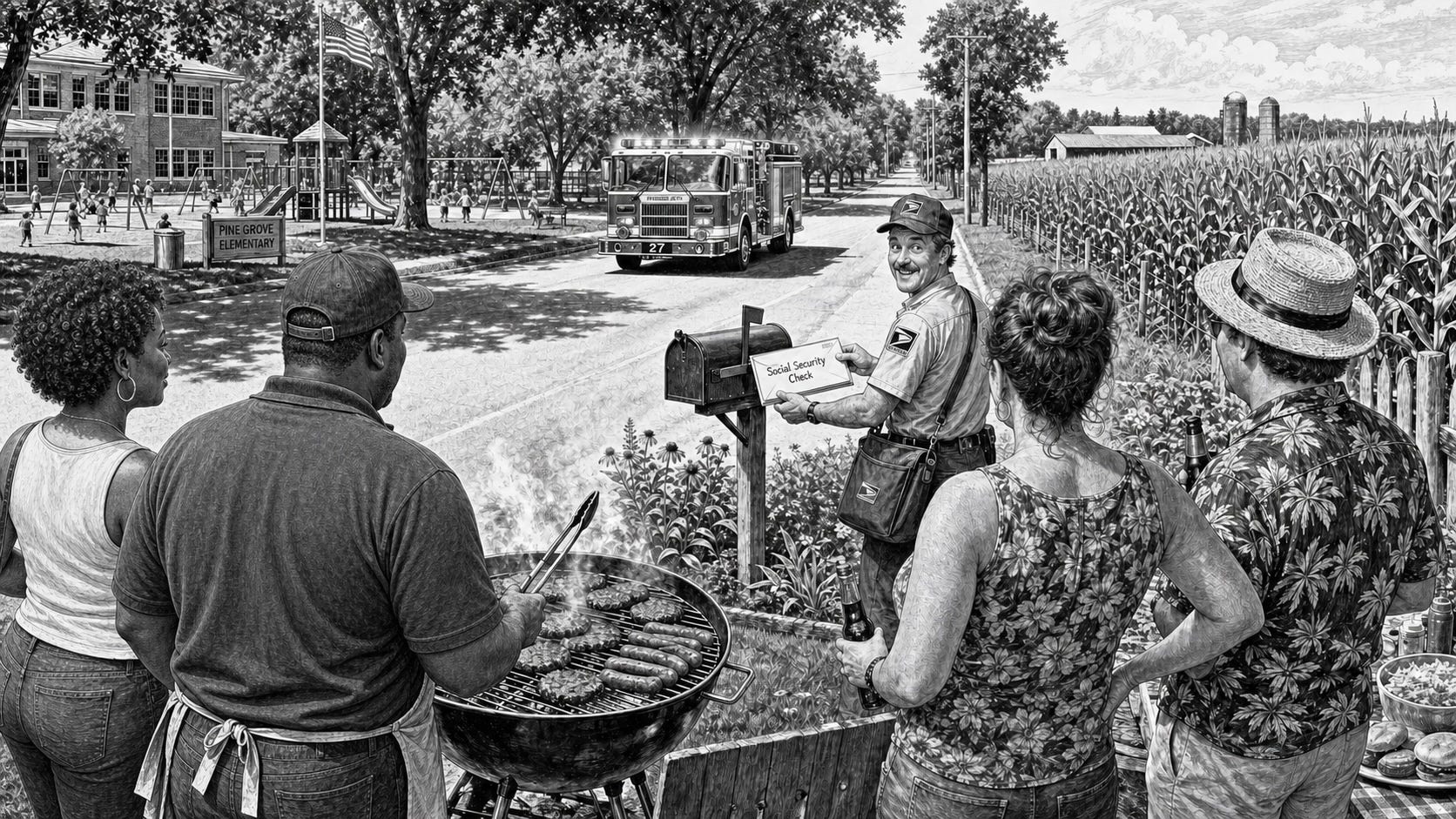
You are standing in a driveway on a warm Sunday afternoon, a paper plate in one hand and a cold drink in the other. A neighbor works the grill. Kids tear across the grass in the little park at the end of the block, the one the whole street pays to keep mowed. A phone leans against the cooler playing the news, and the man on the screen jabs his finger at half the country and says the word one more time. Communist. Your uncle nods along. The guy who helped you move your couch last spring says yeah, sounds about right. Then everybody looks at you.
You feel the answer climb up into your chest. Nothing comes out. The moment slides past, and the lie pulls up a chair at your table like a guest nobody asked to stay.
I have spent my career taking weak arguments apart in front of juries. This one comes apart faster than most. Let me hand you the words, so the next time the room goes quiet, you are the one who fills the silence.
Start with this. One word hides two very different ideas. Communism is the command version, the one with the body count. Democratic socialism is the everyday version, the one already stitched into your Tuesday. Keep the two apart in your head and the whole insult collapses.1
What Communism Actually Means
Communism hands the government the keys to everything a country makes. The farms. The factories. The corner stores. The newspapers and the printing presses. You own none of it. A family living under communism does not pass a hardware store down to a daughter, because the state holds the deed, stocks the shelves, sets every price, and picks who stands behind the counter.
One party runs the whole operation. Elections become a stage play with the ending written in advance. Speak against the men in charge and you lose your job, then your freedom, and sometimes far more than that. Stalin took the farms by force and starved millions in the taking. Cuba shut down tens of thousands of small private shops in a single sweep in 1968 and called it a victory.
Communism is a locked house with an armed guard at the door. He owns the house, the food inside it, and the only key. That’s not your world. Hold onto that picture.
What Democratic Socialism Actually Means
Democratic socialism is simple. We pool our money through taxes and use it to run the things everyone depends on, like roads, schools, and fire departments. It allows you to keep your home, your car, your business, your paycheck, your savings and your future. The country pools a slice of what everyone earns and buys something no single family buys alone. As mentioned in the footnote above, scholars separate social democracy from democratic socialism, and the version on your ballot this fall, whatever you choose to call it, keeps private business, private property, and free elections fully intact, and only asks the public to own or fund the shared basics we all use.
Norway shows the ownership side of this idea living happily inside a thriving market democracy. The Norwegian state owns 67 percent of Equinor, its largest energy company, and the money from that stake flows back to the public through the government and a national savings fund that belongs to every citizen. Denmark shows the safety net side. Its own prime minister stood on a stage at Harvard, looked out at a room full of Americans, and called his country a market economy with one of the strongest public safety nets on earth. He was right on both counts. A market economy that carries strong public programs is the thing your uninformed neighbor keeps calling communism, and the word does not fit.
Democratic socialism looks like a barn raising. The whole town turns out, everybody lifts together, and by sundown one family has a barn standing and every other family knows the same hands will show up when the storm comes for their place.
Some folks hear the word and picture empty shelves and bread lines. Look at the actual thing on the table. A big city recently decided to build five publicly run grocery stores that will sell a basket of staples at a thirty percent discount, opening over the next couple of years, one in each borough. Those handful of stores are opening alongside thousands of privately owned bodegas and supermarkets, every one of them still setting its own prices and keeping its own profits. A handful of shared stores is a long way from a locked house with a guard at the door. Nobody is taking your business. You are free to call an idea a poor one and still know exactly what it is.
Five Places Democratic Socialism Already Lives In Your Life
Now walk through your own day, because this is where the whole scare campaign falls to pieces.
One. The road under your tires. You drove somewhere this morning on a road you did not build and do not own. No company billed you at the on ramp and no gate charged you by the mile. Your taxes and your neighbor’s taxes laid that asphalt, and now it carries the delivery van, the yellow school bus, the ambulance running lights, and the worker headed to a double shift, all of them, all day, no charge at the point of use. We pooled our money and we bought ourselves the freedom to move. Adam Smith, the father of the free market himself, argued for publicly built roads and bridges back in 1776. Nobody has pinned a red star on him yet.
Two. The school at the end of the street. A child walks into a public school on the first morning of kindergarten and the door opens whether the family is rich, broke, or somewhere in the middle. There is no tuition bill or credit check. The town decided generations ago that an educated kid grows into a stronger neighbor and a steadier citizen, so the town pays for the teacher, the books, and the lights together. That is democratic socialism in one sentence, the public paying together for the thing that builds our future. We call it school and we send our kids through those doors every single morning.
Three. The fire truck. A fire breaks out at two in the morning. You dial three numbers and a truck full of trained people comes screaming to your curb, and not one of them stops on the lawn to ask for your credit card or check whether you paid a subscription this month. Everybody on the block chips in through taxes so the truck rolls for anyone, the banker and the bartender the same. You never think of it as a shared thing you all own together. It is one of the fairest deals we have.
Four. The cards in your wallet. Reach into your wallet and find the Social Security card, then picture the Medicare card your parents carry. Social Security became law in 1935. Medicare followed in 1965. The loudest voices of both eras screamed socialism at the top of their lungs. They were describing the good part. Today your mother cashes those checks and sees a doctor with that card and never gives the old insult a second thought. A whole country agreed to guard its elders together so no grandmother spends her last years choosing between heat and food. We built that on purpose, and it holds.
Five. The farm that grows your dinner. Drive out past the last stoplight into the reddest farm country in America and you land in one of the most heavily supported corners of our whole economy. Farm subsidies and crop insurance carry family farms through a drought year and a crash in prices, so the barns stay in the family and the country keeps eating through the lean seasons. The public steadies the harvest on purpose. Half the folks living out there would spit at the word socialism. They farm inside it every single season, and it keeps their land in their name.
Who This Economy Actually Works For
Here is the part they work hardest to keep you from noticing. The pieces of American life that shield regular families are the shared ones, the roads, the schools, the fire trucks, the retirement checks. The pieces squeezing you are the ones tilted hard toward the people at the very top.
Your rent climbs. Your grocery bill climbs. Your premium climbs again. The tax cuts sail to the top one percent, the medicine stays priced out of reach, and the same crowd calling you a communist has done nothing to bring the cost of your life back down to earth. A man in the top one percent loves this arrangement, because every dollar the rest of us pays lands somewhere near his account. The word communist is a magic trick. He says it loud so you look at your neighbor and stop looking at his hand in your pocket.
Why A Man Teaches You To Fear A Word
Seventy six years ago a senator from Wisconsin named Joseph McCarthy held up a sheet of paper and claimed it listed communists hidden inside the government. He never showed the list. He never had to. The accusation did all the damage on its own. Teachers lost their classrooms. Writers wrote under fake names for a decade. Neighbors turned in neighbors over gossip at a card table, and families broke apart and never healed. His own Senate condemned him in 1954, and the wreckage took a generation to clear.
The young lawyer at McCarthy’s elbow through those hearings was Roy Cohn. Two decades later Cohn became Donald Trump’s lawyer and his teacher, and he drilled one method into him. Attack first. Admit nothing. Pin an ugly name on the other person and repeat it until the crowd forgets to ask for proof. A frightened voter, sure his neighbor is the enemy, stops asking why his paycheck buys less every month. Fear moves votes and suspicion holds power. A country busy fighting itself has no attention left over for the man running the show.
The Words You Carry
Load these into your pocket and pull one out the next time the word lands at your table.
When he says the Democrats are communists and everyone knows it, you say, show me the factory the government seized, and I will wait right here.
When he says they want to make America socialist, you say, the highway you drove in on and the fire truck down the block already run on that shared model you are afraid of, so either you have been cheering for it your whole life or the word does not mean what he told you it means.
When he says give them power and they take everything you own, you say, communism is a locked house with an armed guard, democratic socialism is the shared driveway we salt together every winter, and nobody in Washington is coming for my home.
When he says somebody finally has the guts to call out the communists, you say, the last man who talked like this was Joe McCarthy, and his own party condemned him for the lives he ruined.
Say your line once. Then stop talking. The quiet after it does more work than anything you pile on top.
Your Move
The lie only survives in the quiet. So break the quiet. The next time somebody at the cookout, in the group chat, or on the job site parrots that word at you, answer with one clean line and a steady smile, and watch the whole room shift the second one person refuses to let a slur stand in for an argument.
Copy these lines into your phone. Send this to the person you love who keeps swallowing whatever the television feeds him. Then show up and vote in every election on your calendar, down to the smallest local race, because the people counting on your confusion are counting even harder on your empty seat.
The word is the weapon. You are holding the shield now. Raise it.
Mitch Jackson, Esq.
Uncensored Objection hands you the words to stop letting a slur stand in for an argument. Subscribe free for every Tuesday breakdown, go paid to fund the work, then meet us in the comments and tell us how it landed at your next barbecue.
Bonus Talking Points: Ten Lies You Will Hear Before The Midterms, And The Line That Ends Each One
Every one of these does the same job. It dresses up democratic socialism as communism and dares you to flinch. Here are the ten you will hear between now and November, and the answer that puts each one to bed. Say your line once and let the silence do the rest.
One. They say, “Socialism and communism are the same thing.”
You say, “Communism hands the government every farm, every factory, every store, and every newspaper, and leaves you owning nothing. Democratic socialism keeps your house, your car, your business, and your paycheck, and asks everyone to chip in for the roads and schools we all use. Calling those two the same thing is like calling a neighborhood potluck the same as a stranger cleaning out your refrigerator at gunpoint.”
Two. They say, “Democratic socialism is a gateway to communism.”
You say, “Denmark, Norway, Canada, and Germany have run strong public programs for generations, and not one of them woke up as the Soviet Union. The slope they keep warning you about has a fire station at the bottom of it. Democratic socialism comes with an off switch called an election, and voters throw it every few years.”
Three. They say, “Socialism killed a hundred million people.”
You say, “That number comes straight out of the communist dictatorships of Stalin and Mao, men who owned their entire countries and shot anyone who spoke up. Social Security never killed a soul. A public library has never run a firing squad.”
Four. They say, “Just look at Venezuela.”
You say, “Venezuela is an oil dictatorship that jailed its opponents and printed money until the currency died. Norway sits on the same oil wealth, runs it through a democracy, and built the richest national savings fund on the planet for its people. The thing that destroyed Venezuela was the missing ballot box and the crushed free press, the two things democratic socialism guards.”
Five. They say, “They will take your house, your business, and your savings.”
You say, “Point to the one member of Congress who has filed a bill to seize your home. That bill does not exist, and it never has. Higher taxes on billion dollar fortunes and a public option for health care leave your house, your car, and your retirement account exactly where they sit.”
Six. They say, “Socialism always fails. It has never worked anywhere.”
You say, “It works every morning you drive on a public road and drop your kid at a school that costs nothing at the door. It works in the checks your grandparents earned and the national parks your family walks on a Sunday. The parts of this country you love the most are the parts you keep calling failures.”
Seven. They say, “The government cannot run anything right.”
You say, “The same government you mock put astronauts on the moon and laid the highway running under your tires. Medicare covers your grandmother for a fraction of the overhead an insurance company burns denying your claim. You lean on a government that works before you finish your first cup of coffee.”
Eight. They say, “Socialism is un-American.”
You say, “The Founders wrote the post office into the Constitution, and George Washington signed the roads that carried the mail. Eisenhower, a Republican general, built the interstate system with your tax dollars. Shared public goods are as American as the flag hanging on your porch.”
Nine. They say, “It is a handout for people too lazy to work.”
You say, “The folks living on Social Security and Medicare worked forty and fifty years for those checks, and they earned every dollar. The nurses and firefighters running the services you call handouts outwork most of the country. Democratic socialism rewards the work and refuses to let one bad year erase a whole good life.”
Ten. They say, “Eventually you run out of other people’s money.”
You say, “Norway has managed this model for fifty years and sits on a savings account worth more than a trillion dollars, so the math runs the other direction. The billionaire class often pays a smaller share of its real income than the nurse setting grandma’s IV. Ask for a fair share from the top and watch how fast the people crying poverty turn out to be the ones sitting on the fortune.”
Now go back to that driveway. The burgers on the grill, the phone propped against the cooler, the word landing on the table while everyone waits to see what you do. These ten lines carry you through the arguments that follow, the ones running from this Sunday until the day you vote.
Scholars separate social democracy from democratic socialism, and the difference is real. Social democracy keeps capitalism and softens its hardest edges with a strong safety net. Democratic socialism, in its older textbook meaning, wants the public and workers to own more of the economy over time, always through the vote and never through a dictator. The people running under that banner in America right now campaign on the first one in practice. They want Medicare that covers everyone, taxes the wealthy actually pay, and public schools that run from kindergarten through college.
So call it what you want. The version on your ballot this fall keeps private business, private property, and free elections fully intact. It asks one thing of you, that the public own or fund the shared basics we all use, the roads, the classrooms, the fire trucks, and the care that keeps your grandmother alive. That is the whole radical plan. You already live inside most of it, and you would fight anyone who tried to take it from you.
Very well explained. I have lived in various countries in Europe. All of these had and have the things Mitch explained. Our social security pays for the doctor, the dentist, the hospital, the roads and motorways, for social housing and unemployment benefits for if or when you lose your job, for sick pay and schools and education. I would not want to live any other way. Thank you Mitch.
There is a key distinction between Democratic Socialism and Social Democracy. The latter is practiced by the Nordic countries and Canada, where I live. Don't confuse the two. Social Democracy embraces Capitalism. I view it as ‘Capitalism with GUARDRAILS’. Those guardrails are designed to prevent the billionaire class from subjugating all the other social classes.