

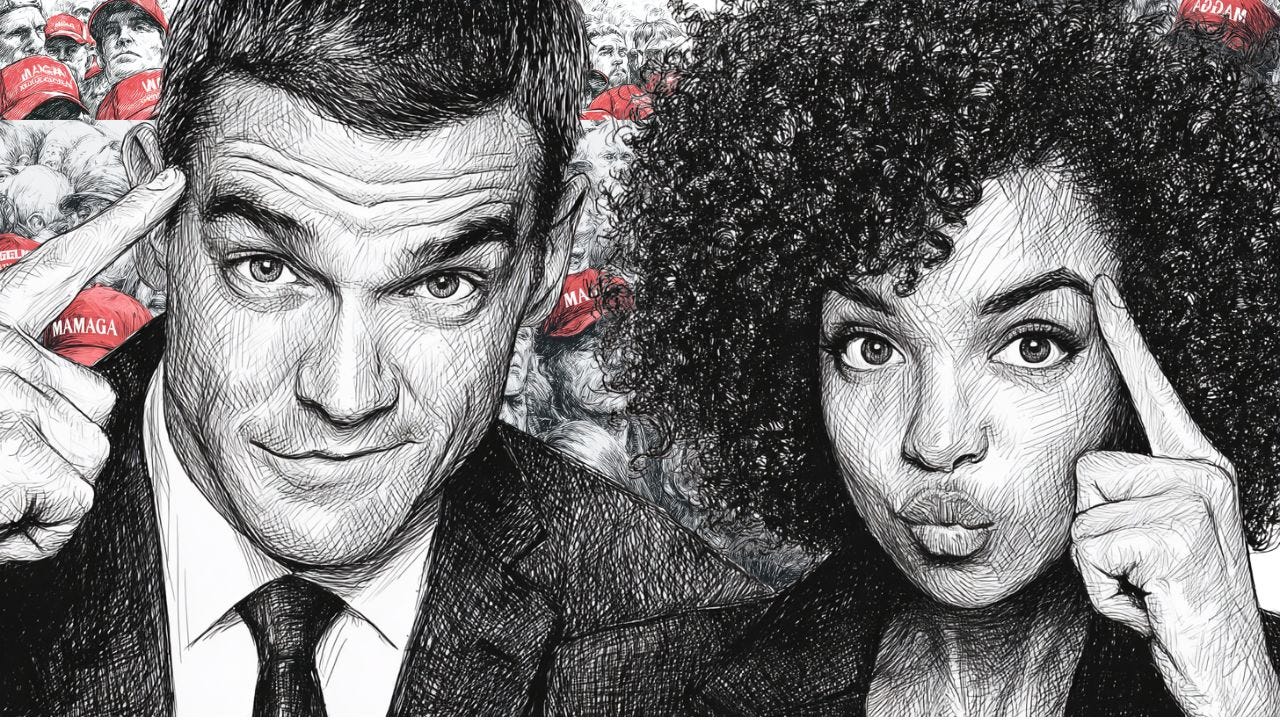
EXECUTIVE SUMMARY: A 35 year study tracking over 7,000 people from childhood into middle age, backed by research from the University of Minnesota, the University of Ghent, and British cohort studies spanning decades, found that people with higher cognitive and emotional intelligence consistently reject authoritarianism, rigid social hierarchies, and blind obedience to authority. People with lower cognitive and emotional abilities gravitate toward strong leaders who tell them what to think, who to fear, and who to blame.
You live a life full of responsibility. You make decisions that affect your family, your work, and the people who depend on you. Every day you weigh risks, judge character, sort through conflicting information, and carry competing priorities in your head at the same time. The ability to sit with complexity and still act is a form of intelligence. And it turns out that same ability shapes something else you do as a citizen of this country: how you vote.
A 35 year study recently confirmed what researchers across three continents have been finding for decades. The way your brain handles complexity directly influences your political beliefs. And the pattern is consistent, repeated, and difficult to argue with.1
This goes deeper than party loyalty. It goes deeper than which cable news channel you watch. This is about how your mind works.
What 35 Years of Tracking Over 7,000 People Revealed
In 1987, researchers at two respected German universities, Saarland University and Philipps University Marburg, launched one of the longest running intelligence studies in modern history. They started with over 7,000 third graders. They gave every one of them standardized intelligence tests that measured reasoning, speed of information processing, and cognitive performance. From that group, they identified two categories: gifted students with an IQ of 130 or above, and a matched control group with IQs around 100.
Then they did something most studies never do. They followed those children for 35 years. Into high school. Through college. Into careers and families and middle age. And when those children were in their early forties, the researchers circled back and asked them about their political views. A hundred and fifty eight of them had answered.
The results were published in the journal Intelligence and they were striking.
On a simple left to right political scale, gifted adults and average adults placed themselves in roughly the same spot. Near the center. That finding alone was interesting because it challenged the stereotype that exceptionally smart people hold extreme political views.
The real story showed up when researchers dug deeper with a detailed questionnaire that measured four distinct dimensions of political belief: economic libertarianism, socialism, liberalism, and conservatism.
On three of those four dimensions, there was no difference between the gifted and non gifted groups. Intelligence did not predict whether someone favored free markets over government intervention. It did not predict socialist leanings. It did not predict liberal attitudes in the traditional European sense.
One dimension stood apart. Conservatism. Specifically, the kind of conservatism rooted in rigid tradition, strict social hierarchy, and obedience to authority.
Among men, those identified as gifted in childhood scored significantly lower on this measure than their non gifted peers. Non gifted men were far more likely to endorse values tied to social order, tradition, and authority. Gifted men were far less likely to adopt those same positions.
Among women, no significant difference appeared.
The researchers called this the Cognitive Complexity Openness Hypothesis. It means that people with higher intelligence tend to be more open to new experiences and more comfortable sitting with ideas that contradict each other. They can evaluate both sides of an argument without needing to collapse one into the other. That cognitive flexibility makes rigid, authority driven political frameworks feel restrictive. It does not feel like strength to them. It feels like a ceiling.
The Study That Took the Debate Out of the Lab and Into the Living Room
Critics of the German study pointed out an obvious question. What if smart people are liberal because they went to college? What if the environment shaped them, not their brains?
A team at the University of Minnesota answered that question in 2024 with what many researchers consider the most definitive study ever conducted on this topic.
Led by Tobias Edwards, a behavioral genetics researcher, the study examined more than 300 families, including both biological and adoptive siblings. The design was intentional. Siblings raised in the same house, by the same parents, in the same neighborhood, attending the same schools. Same dinner table. Same rules. Same environment.
The researchers measured each sibling’s IQ using standardized tests. They also measured something called polygenic scores, which are genetic markers associated with cognitive performance. Then they assessed each person’s political beliefs across multiple dimensions.
The results were direct. Even within the same family, the sibling with the higher IQ and the higher genetic markers for intelligence was consistently more likely to hold socially liberal beliefs and score lower on authoritarianism. This held true even after the researchers controlled for the family’s income, education, and social class.
Edwards himself was careful to point out that intelligence is only one factor among many. He said his study cannot prove that the beliefs of high IQ people tell us what is right to believe. It only tells us what smart people choose to believe. He also warned against drawing sweeping conclusions, noting that extraordinarily intelligent people have supported all sorts of beliefs across history.
That caution is worth respecting. And it does not erase what the data shows.
The sibling design eliminated the biggest criticism in this entire field: the idea that environment explains everything. These siblings shared their environment. They did not share their IQ. And the sibling with the sharper mind consistently moved in a more socially liberal, less authoritarian direction. That pattern held regardless of whether the siblings were biologically related or adopted.
What Your Brain Knew About Politics When You Were Ten Years Old
The British Cohort Studies tracked over 17,000 people born in 1970. Researchers measured their general intelligence at age 10 and then followed them into their thirties and forties, assessing their social attitudes, voting behavior, and political engagement along the way.
The finding was clear. A child’s score on an intelligence test at age 10 was a remarkably accurate predictor of their social values two decades later. Children who scored higher grew into adults who were more likely to support racial equality, gender equity, civil liberties, and trust in democratic institutions. They were more likely to vote. They were more politically engaged. They were more likely to attend rallies, sign petitions, and express interest in how their government operated.
The association between childhood intelligence and liberal social attitudes held even after the researchers accounted for educational attainment and occupational class. Smart kids went to good schools and got good jobs, yes. And something deeper was at work too. Something about how their brains processed information at ten years old predicted how they would see the world at thirty.
This study also found an interesting wrinkle that lines up with the German data. Higher childhood intelligence predicted socially liberal attitudes with consistency. It did not predict economic attitudes in the same direction. Some of the smartest participants in the British cohorts grew up to favor free markets and individual economic responsibility. Intelligence, in other words, does not sort people neatly into left or right. It sorts them away from rigidity and toward openness on social questions, and it leaves their economic views largely up for grabs.
When Emotional Intelligence Enters the Picture
In 2019, a study published in the journal Emotion by researcher Alain Van Hiel at the University of Ghent took the question in a different direction. His team measured the emotional abilities of nearly 1,000 participants using three separate tests: emotional understanding, emotion management, and emotion recognition. They also assessed each person’s political views.
The results were consistent with every other study in this space. Participants who scored lower on emotional intelligence were significantly more likely to score higher on two specific measures: right wing authoritarianism and social dominance orientation.
Right wing authoritarianism describes a tendency to submit to authority figures and show hostility toward people outside your group. Social dominance orientation describes a preference for inequality and discomfort with the idea that all people deserve equal treatment.
People who struggled to read emotions, manage their own emotional responses, and understand what other people were feeling gravitated toward political structures that told them what to do and who to fear.
Van Hiel was responsible in framing his conclusions. He said you cannot discredit an ideology based on these results alone. Emotionally and cognitively sharp people can make wrong decisions too. That is a fair and necessary point. And the pattern he found is consistent across multiple decades of research, across multiple countries, across multiple types of intelligence testing.
What All of This Means When You Look at American Politics Right Now
The studies cited here come from Germany, the United Kingdom, Belgium, and the United States. They span from 1987 to 2024. They include longitudinal tracking, sibling comparisons, genetic analysis, and emotional intelligence testing. And they all converge on the same core pattern.
People with higher cognitive ability tend to reject social traditionalism and authoritarian political structures. They gravitate toward civil liberties, independent thought, and social openness. They do not need someone to tell them what to think. They can hold contradictions without panic.
People with lower cognitive and emotional abilities tend to gravitate toward rigid social hierarchies, strong authority figures, and simple narratives about who belongs and who does not.
Now look at the political reality in the United States in 2026. One major political movement has built its identity around obedience to a single leader. It rejects the findings of scientists. It dismisses the conclusions of legal experts. It mocks complexity. It tells its followers exactly what to believe, who to blame, and what to fear. It frames every question as a simple binary: us or them, strong or weak, loyal or traitor.
This is not a coincidence. The research explains exactly why this type of messaging works on the audience it reaches and why it repels the audience it does not.
Data from multiple U.S. election cycles confirms that the base of the current far right movement in America is disproportionately made up of voters without college degrees. This is not a slur. It is a demographic fact, confirmed by Pew Research, exit polling, and the candidates’ own public statements. Donald Trump has repeatedly said, on camera, that he loves the poorly educated.
He was telling the truth. His movement depends on them.
Why This Matters to You
You did not build your business and life by following orders. You built it by thinking. By reading situations. By adapting when the facts changed. By tolerating uncertainty long enough to find the right answer.
Every quality that made you successful is the same quality that the research links to socially liberal, anti authoritarian political thinking. The ability to sit with nuance. The willingness to question authority when authority gets it wrong. The capacity to see people as individuals instead of categories.
You already think this way. The question is whether you are applying that same intelligence to how you engage with politics.
Because the people who want your vote are counting on you not to. They are counting on fear to override your judgment. They are counting on tribal loyalty to replace critical thinking. They are counting on exhaustion to make you stop paying attention.
And every study cited in this article says the same thing: the smarter you are, the less likely that strategy works on you.
The Pattern Is Clear
Decades of data, across multiple nations, using different research methods and different populations, point in the same direction. Intelligence, both cognitive and emotional, predicts a specific political orientation. Not left versus right in every dimension. The picture is more specific than that. Higher intelligence consistently predicts the rejection of authoritarianism, the rejection of rigid social hierarchies, and a deep preference for independent thought and social openness.
The political movement that asks you to stop thinking, stop questioning, and start obeying is not designed for you. It is designed for people who find thinking painful. People who need a strong figure to tell them what the world means. People who cannot tolerate the discomfort of an unanswered question.
You are not that person. You prove it every day in how you run your life and your business.
Now prove it during the midterms in how you vote.
Mitch Jackson, Esq.
Related
MAGA Is a Cult and Professor Robert Lifton Proved It 63 Years Ago
Free readers get the verdict. Paid subscribers get the cross-examination — the filings, the language, and what it actually means. If this newsletter has ever kept you from being misled, that’s what your upgrade funds.
1. The 35-Year German Gifted Children Study
Saarland University & Philipps University Marburg (published ~2025–2026)
2. University of Minnesota Sibling/Polygenic Study (2024)
Tobias Edwards et al. — “Predicting Political Beliefs with Polygenic Scores for Cognitive Performance and Educational Attainment”
3. The 1970 British Cohort Study
Deary et al. (2008) — “Childhood Intelligence Predicts Voter Turnout, Voting Preferences and Political Involvement in Adulthood”
4. University of Ghent Emotional Intelligence Study (2019)
Alain Van Hiel et al. — “The Relationship Between Emotional Abilities and Right-Wing and Prejudiced Attitudes”
Um, excuse me but this was mentioned and ignored:
“Non gifted men were far more likely to endorse values tied to social order, tradition, and authority. Gifted men were far less likely to adopt those same positions.
Among women, no significant difference appeared.”
Typical to ignore how women think but given we make up half the voters and participants-shouldn’t you explain?
Does this finding mean that women, even those not considered gifted in IQ tend not to lean authoritarian or does it mean women of all IQ’s do lean authoritarian?
Why does this article treat male intelligence as the default?
It’s barely a revelation that stupid men also tend to be authoritarian. Even a dumb guy can see that that system of brute force tends to favor him especially if he’s stupid.
But what about women? What does this study say that’s important and you still fail to mention it?
I’m feeling extremely untrusting in your conclusions as they are literally only half expressed or understood.
We've ALWAYS known that the totalitarian coup d'etat is preceded by a DUMBing-down of the polity. The 'chicken in every pot' (ONLY IF YOU VOTE for ME) is infallible when staged for an 'eligible* voter' majority.
Bottom line: Today's Average American 'Eligible' Voter probably REMAINS Pro-Democracy... However, should maga get the HR 22 SAVE Act signed into Law, the Average American 'Eligible' Voter will reflect MUCH MORE of the DUMBed-down segment. The SAVE Act is DESIGNED to convert OUR USA into a Totalitarian State.
The SAVE Act MUST BE DEFEATED in the Senate if America is to remain a Democratic Republic. A maga win signifies a white-christian fundamentalist totalitarian take-over.