

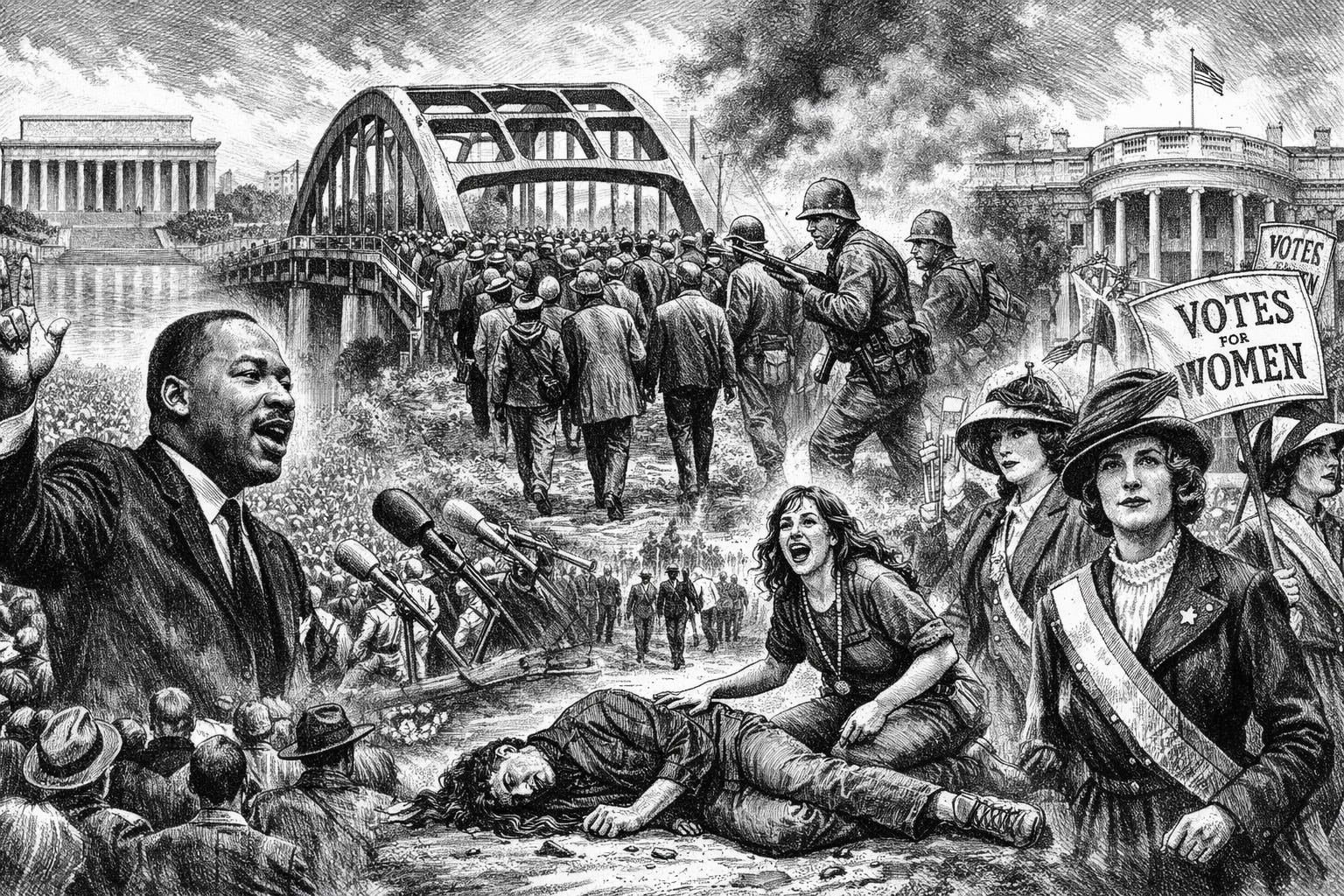
There are moments in our national story that don’t just make headlines, they make history. They stir emotions, they reshape policy, transform politics, and redefine what citizenship actually means. The March on Washington, the Selma to Montgomery marches, the Kent State protests and the Women’s Suffrage Movement. These weren’t accidents. They were inflection points, when everyday Americans said “enough” and moved the needle of our country toward justice and accountability.
Today, as Americans fill the streets from Minneapolis to Los Angeles, and from Portland to New York, demanding accountability and respect for constitutional rights in the wake of unconstitutional ICE activities and deadly federal enforcement actions, that same spirit of principled resistance is alive. And it matters.
The March on Washington- A Moral Call That Changed the Nation
On a late August day in 1963, more than a quarter million people converged in Washington, D.C., drawn by a shared conviction: civil rights for Black Americans wasn’t merely a political issue, it was a moral imperative. They came from every corner of the country . They were dockworkers and teachers, students and grandparents, ministers and factory hands. And they didn’t shout slogans from the sidelines. They stood together, shoulder to shoulder, demanding an end to segregation, voting discrimination, job inequality, and systemic injustice.
It was from that crowd, in front of the Lincoln Memorial, that Dr. Martin Luther King Jr. delivered the speech that changed how the nation saw itself. “I have a dream…” he said, not as an abstraction, but as a challenge to America’s conscience. The march influenced public opinion and set in motion the Civil Rights Act of 1964 and the Voting Rights Act of 1965. It was protest that forced policy. It was moral clarity that guided lawmakers. Change didn’t trickle down, it was pushed up by the people.
Selma to Montgomery. When the Right to Vote Became Non-Negotiable
In March 1965, the fight narrowed to the most fundamental right in a democracy: the right to vote. Black citizens in the South were legally eligible to vote, but systemic barriers such as literacy tests, poll taxes, and intimidation, made that right a hollow one.
On what became known as “Bloody Sunday,” peaceful marchers heading from Selma to the Alabama capital were met with beatings, tear gas, and horses at the Edmund Pettus Bridge. That brutality was televised into living rooms across America, triggering outrage and forcing the nation to confront its own hypocrisy.
Rather than retreat, the movement persevered. The continued marches, protected by federal authorities, galvanized public support. Within months, Congress passed the Voting Rights Act of 1965, erasing many of the most egregious barriers to minority voting. The arc of history moved closer to justice because people stood in the gap peacefully, courageously, persistently.
Kent State Was When Young People Said “No More” to Unchecked War Power
Fast forward to May 1970. The Vietnam War had stretched a generation’s patience to its limit. On college campuses across the country, students organized teach-ins, sit-ins, and marches. They weren’t seeking disorder. They were seeking accountability and an end to a conflict that had cost thousands of American lives and countless more abroad.
At Kent State University in Ohio, National Guard troops fired into a crowd of unarmed student protesters, killing four and injuring nine. The tragedy shocked the American public and broadened opposition to the war. It injected urgency into a national debate that was already boiling, pushing more Americans to demand a course correction in foreign policy and executive power.
In the months that followed, public pressure helped accelerate negotiations. The war didn’t end overnight, but the outrage altered the political landscape. Lawmakers, voters, and the executive branch reckoned with the human cost of prolonged conflict.
The Women’s Suffrage Movement. When Democracy Was Forced to Expand
The fight for women’s suffrage is another clear example in American history of what happens when people refuse to accept exclusion as permanent. For more than seventy years, women organized, marched, wrote, petitioned, and protested because a nation that called itself a democracy denied them a voice in it. It began in 1848 at the Seneca Falls Convention, where women publicly named the contradiction between American ideals and American practice. They were mocked, dismissed, and ignored by those in power. Newspapers ridiculed them. Politicians laughed them out of rooms. The legal system turned its back. And still, they kept going.
As the decades passed and nothing changed, the movement grew louder and more visible. Women marched down Pennsylvania Avenue. They stood outside the White House day after day demanding equal citizenship. They were arrested for peaceful protest. Many were beaten in jail. Some went on hunger strikes and were force fed by the state. Change did not come from polite requests being suddenly honored. It came from sustained pressure that made inaction politically and morally impossible.
In 1920, the pressure finally broke the system. The 19th Amendment was ratified, guaranteeing women the right to vote and permanently reshaping American political life. It strengthened democracy by expanding participation and accountability. The suffrage movement proves that progress often feels uncomfortable in real time and obvious in hindsight.
History Isn’t Neutral, It’s a Mirror
Here’s what these four watershed moments have in common: ordinary people reached a point of frustration so deep that they chose action over resignation. They chose nonviolent resistance because they knew silence would be acceptance. And their protests made noise and change.
Today, Americans are reacting to a different form of governmental overreach. Federal ICE immigration enforcement operations in Minneapolis that have resulted in the deaths of two U.S. citizens this month alone, including ICU nurse Alex Pretti and mother Renée Nicole Good. Both killed during confrontations with federal agents.
Across the country, thousands have marched, chanted, and held vigils, in Minneapolis, San Francisco, New York City, Los Angeles, Boston and beyond, demanding accountability, transparency, and reform in how federal powers are deployed against everyday Americans. These protests are peaceful, lawful, and rooted in a basic principle of American democracy: government exists to serve the people, not to terrorize them.
And Here’s What History Teaches Us Now
When the people are compelled to protest, it’s not because they seek chaos. It’s because they’ve watched systems fail, voices ignored, and rights eroded. They march because every American, regardless of background, deserves protection under the Constitution.
If we learned anything from Washington, Selma, Kent State and the Women’s Suffrage Movement , it’s that peaceful, organized, determined protest can expose injustice, shift public opinion, and force policymakers to act. It can pressure lawmakers to write better laws, hold authorities accountable, and uphold the rights guaranteed to all citizens.
But history also teaches something else: reforms that matter don’t happen after a single rally or a single headline. They happen when citizens turn their outrage into civic engagement, and their demonstrations into votes.
So What Comes Next?
Your elected officials work for you. Every police officer, governor, elected representative, and senator swore an oath to uphold your rights. And right now, millions of Americans are demanding they honor that oath.
Peaceful protest is not just a constitutional right, it’s an obligation in a democracy when constitutional rights are at risk.
But protesting without voting is like shouting without an echo. To enact real, lasting change, to elect leaders who protect our civil liberties and hold federal power in check, we must show up at the ballot box. This year’s midterms aren’t distant or abstract. They are the next step in the same arc of history that brought us civil rights legislation, voting protections, and limits on executive overreach.
The question isn’t whether you care. It’s whether you will act. Be louder. Be visible. Be engaged. Be informed, and then vote.
History doesn’t just admire courage. It rewards it.
Mitch Jackson, Esq.
If this piece stirred something in you, that reaction matters because engaged citizens shape outcomes and silence hands power to people who abuse it. As a premium subscriber to Uncensored Objection, you become part of this community and can engage in the comments. You get deeper analysis, unfiltered commentary, and writing that connects history to the responsibility we carry right now, while supporting independent work that speaks plainly and challenges power without apology. If you want to stay informed, stay engaged, and stand with a growing community that believes democracy survives through participation, become a premium subscriber and help carry this work forward.
Agree! How do we get our scientists back, vaccines to save lives, money back from AI, return Smithsonian, NARA, stop Musk and Thiel and get our privacy back, honor those who have died from this regime, take down Flock and Aerodome, return real websites from all sectors, codify the Constitution and create new laws,gain trust from allies who were forced to back off, Find pathways to insurance and build up safety net for all those in need, force Dept of Labor to break down doors preventing those who want work to get work, bring back retirement plans and profit sharing, not connected to Wall Street fraudsters, return freedom, set fair wages for Americans, demand guardrails on AI, stop runaway profits for billionaires and stop their march to take over America, Set free trade and remove tariffs, stop crypto, Stop Trump hotels and his money tree, etc a thousand times?