

“And when you’re a star, they let you do it. You can do anything. Grab ’em by the p*ssy. You can do anything.”- Donald Trump ( Access Hollywood tape)
So how’s it feel America?
Let’s get this straight: the White House is our house. The East Wing is part of a symbol, a national landmark, a public trust. It belongs to the American people, not to one man who feels like he can do whatever he wants.
Why is Trump bulldozing the East Wing for a privately funded ballroom, and doing it without a shred of meaningful oversight, public input, or congressional review? Because he’s treating the People’s House like a private resort, exploiting loopholes, stacking commissions with loyalists, and daring anyone to stop him, confident that by the time the dust settles, the damage will be permanent and the accountability impossible to rebuild.
Ownership, Control and the Idea of “The People’s House”
The White House complex, including the Executive Residence, East Wing, West Wing, is owned by the United States of America and managed by the federal government on behalf of the people. It is not the president’s personal property. There is no deed listing Donald Trump as owner. There is no “sole proprietor” running the show.
Yet, here we are: demolition begins, major alteration proceeds, and you’re told: “Relax. We’ve got it covered. It won’t cost taxpayers a dime.”
That framing is seductive: because it “costs nothing” (so we’re told) the argument goes: you don’t need a say. But that logic is hollow. Funding alone doesn’t give wholesale control over public property and civic legacy. If I privately funded the demolition of my neighbor’s house without their permission to build a pickleball court, and then claimed, “It cost my neighbor, and everyone else in the neighborhood, nothing,” the law wouldn’t just shrug. Ownership and trusteeship matter.
The question isn’t just who pays? It’s who holds the title? Who has the responsibility? Who must answer to the public? On all of those, the president is not the private owner, but the role of stewards for all Americans demands procedures, transparency and accountability. That’s the part of this story that’s missing.
Authority Claimed, But Legitimacy Absent
The Trump White House claims that because the ballroom is “privately funded,” Congress isn’t involved. It claims parts of the review process don’t apply. It’s technically clever; it’s deeply flawed ethically.
For example: Will Scharf, Chair of the National Capital Planning Commission (NCPC), the federal body that oversees major construction in the Washington region, has stated that demolition and site-preparation are outside its jurisdiction, only “vertical build” (actual new building) is within its remit. So it claims that destruction can begin even though the full plan hasn’t been submitted. That means that the project proceeds first, accountability catches up later. That is backwards.
Scharf was appointed by Trump to serve as Chair of the National Capital Planning Commission (NCPC) in 2025. His dual role as both White House Staff Secretary and NCPC Chair has drawn significant criticism from ethics and planning experts, who argue it represents a conflict of interest, since the NCPC is the very body tasked with reviewing and approving federal construction projects in Washington, including the controversial East Wing demolition and ballroom project initiated by Trump’s own administration. In short, Trump appointed him, and Scharf now oversees (or insulates) the very project Trump wants pushed through.
No oversight. No problem.
Again: “I own it, I fund it, I’m doing it” sounds appealing, but with a building that is not your house. It is public property. The fact that funding might be private does not automatically confer personal dominion or bypass democratic oversight.
Stop Falling for the ‘It Didn’t Cost You Anything’ Lie”
Private funding doesn’t relieve Trump of public accountability. The White House says the $200 to $250 million ballroom will be privately funded and thus taxpayers won’t foot the bill. Trump’s myth that private dollars make it exempt from public scrutiny, is troubling and misguided. Whether or not the money comes from donor coffers, the building and land remain public. The context (historic, symbolic, civic) demands transparency.
Imagine a private company offering to pay for a major renovation of a city hall wing in your city, but the city council is told: “No need to review, no need for public hearings, because the donors are footing the bill.” Would we accept that? Of course not.
The fact that the White House tries to have it both ways, to claim private funding and yet full executive discretion, is disingenuous. Funding doesn’t erase the duty of the president as trustee of the people’s house.
Even if Trump’s donors are footing the bill for the demolition and rebuild, let’s be honest about what happens next. The American people will still be paying for everything that keeps his “gift” standing.
Every month, taxpayers will cover the maintenance crews, electricians, security teams, HVAC techs, and custodial staff. They’ll pay for the Secret Service expansion needed to protect the new addition, for lighting and climate control in the 90,000-square-foot ballroom, for landscaping, water, and utilities. They’ll pay for federal employees who clean, operate, and manage the space. Add in insurance, compliance inspections, historic preservation monitoring, cybersecurity, and 24-hour operational costs, and suddenly this “privately funded” project looks more like a long-term public expense disguised as a personal vanity project.
Running the projected numbers on this 90,000-square-foot ballroom, and if we assume even a moderate multiplier (say, 2× to 4×) of the existing maintenance baseline (current White House facility), given the expanded space, event-usage intensity and enhanced finishes/security, it can reasonably be projected that new additional annual costs to the tax payer will be in the range of $5 million to $10 million. Over 10 years that becomes $50 million to $100 million; over 20 years $100 million to $200 million. And that doesn’t include major capital repairs or modernization down the road. Given the lack of transparent item-by-item budgets, the public is essentially asked to absorb risk without visibility.
The construction may be private, but the upkeep is forever public, and that’s a bill every taxpayer will keep paying long after Trump and the cameras are gone.
The Rushed Demolition and Bypassing of Review
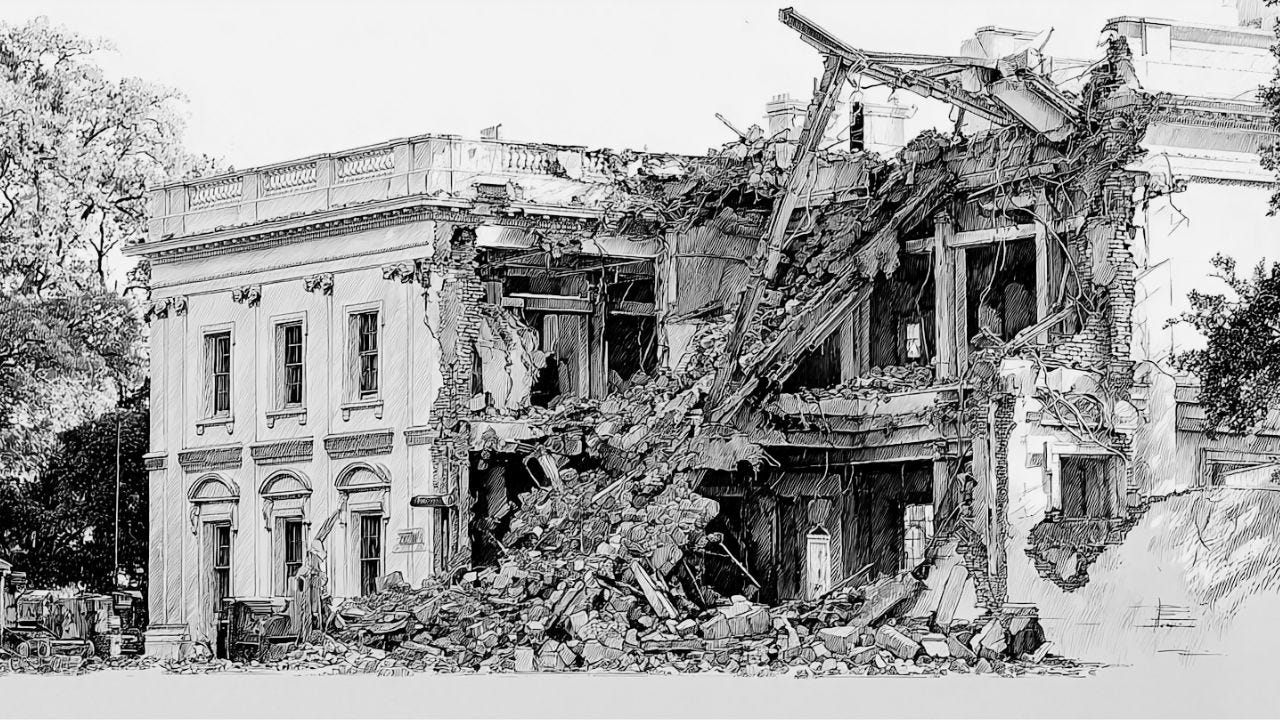
This isn’t hypothetical. The demolition of the East Wing began in October 2025, right as the plans were still not submitted to the NCPC. It’s being reported the demolition may be completed by this weekend.
On July 31st he promised America:
“It won’t interfere with the current building. It will be near it but not touching it, and pays total respect to the existing building, which I’m the biggest fan of. It’s my favorite. It’s my favorite place. I love it.”
This week, heavy machinery is tearing down historic façade, offices of the First Lady, the guest-entrance wing of the White House, all despite prior assurances the existing building would be untouched. Watch with your own eyes.
Citizens, preservationists, watchdogs are asking: how did we get here? The typical pattern for massive federal construction is design, review, public comment, regulatory approval, and only then demolition. Here the order is reversed: demolition begins, review catches up later. That is governance in reverse.
Justice and accountability are not about what gets built, they’re about how decisions are made. And the process here undermines the latter. I guess that when you’re a star, they let you do anything.
Let’s Talk About the Laws They Might’ve Just Broken
Even though the president’s team may argue that the White House renovation is privately funded, that doesn’t erase the legal responsibilities tied to public ownership. Federal law protects property owned by the United States from damage or destruction, no matter who claims to foot the bill.
Under 18 U.S.C. § 1361, anyone who willfully injures or commits any depredation against U.S. property may be prosecuted, especially when that property is a landmark with deep civic significance. The fact that the building sits on federal land and is used for public purposes means oversight and statutory protections apply, regardless of who signs the construction contract.
If the demolition or alteration of a federal landmark proceeds without necessary review, approval or valid legal authority, then the question isn’t merely “Who paid?” but “Who gave permission?” and “What laws were followed?” The absence of transparent process, historic-preservation review, or congressional oversight may signal more than a policy failing, it may point toward a violation of laws meant to safeguard public property and trust. Ultimately, even a privately financed project executed within a public asset must align with the statutes that protect that asset; when it doesn’t, it puts accountability, and the integrity of our institutions, at risk.
I threw on my lawyer hat and started digging, and what I found will make your jaw drop. There are several laws Trump and his team may have trampled right over. And do I think this Congress or the current DOJ will lift a finger? Not a chance. At least not until after the 2026 midterms, when Democrats take back the majority, start issuing subpoenas, and finally hold real oversight and impeachment hearings. But until then, buckle up. You’re about to see exactly what I found, and it’s worse than you think.
Misuse of Federal Property or Funds
31 U.S.C. § 1301 & § 1341 – The Antideficiency Act and Purpose Statute: These govern how federal funds and resources can be used. Even if Trump claims private money covers construction, federal resources such as Secret Service staff, maintenance crews, utilities, GSA engineers, NPS personnel, etc., are inevitably involved. If those resources are diverted or used for purposes outside what Congress has appropriated, that could violate these statutes. The Government Accountability Office (GAO) has previously found that misusing federal staff or property for unauthorized projects violates appropriations law.
Federal Property and Historic Preservation Statutes
The National Historic Preservation Act of 1966 (NHPA), 16 U.S.C. § 470f: The White House is listed as a National Historic Landmark, and substantial changes to federally owned historic property generally trigger a Section 106 review by the Advisory Council on Historic Preservation (ACHP). That review requires consultation with preservation experts and public notice before demolition or alteration.
National Capital Planning and Oversight Regulations
40 U.S.C. § 8722 – National Capital Planning Commission Act: This statute requires that federal construction projects within the District of Columbia be submitted to the National Capital Planning Commission (NCPC) for review and approval.
Federal Ethics and Conflict-of-Interest Laws
18 U.S.C. § 208 – Acts Affecting a Personal Financial Interest: If any private donor, contractor, or Trump-owned entity financially benefits from the project, and White House officials or appointees participated in decisions affecting those interests, it raises serious conflict-of-interest issues. The same applies if federal employees (including the NCPC chair or staff) have overlapping roles that create dual loyalties, for example, serving both as a White House official and as the head of a federal oversight body.
Federal Property Management and Disposal Law
40 U.S.C. § 102 & § 541–§ 559 – Federal Property and Administrative Services Act: These provisions govern use, alteration, and disposal of federal property. Permanent structural changes normally require compliance with General Services Administration (GSA) policies and recordkeeping. If the East Wing was altered or destroyed without GSA authorization or record, it could be deemed improper disposal or modification of federal property.
Other Potential Violations and Oversight Gaps
The Federal Records Act (44 U.S.C. § 3101 et seq.): if documentation or communications regarding approval, cost, or donors were deleted or withheld.
The Ethics in Government Act: if donors or contractors were offered access or influence in exchange for funding.
Presidential Records Act: if the administration attempts to classify or conceal planning documents improperly.
The bottom line is that even if the president claims the project is “privately funded” and “within executive authority,” those arguments don’t erase the legal obligations attached to public ownership, federal stewardship, and historic preservation.
Why This Matters Beyond This Project
Because precedent matters. If the president can repurpose, rebuild or demolish major parts of the White House on his own initiative, circumventing public review and congressional oversight, we’ve lowered the barrier for future overreach.
We set a dangerous standard: presidential whim meets public foreshortening. The White House might still remain, but its protections, its status as a shared space, its transparency, you risk eroding those. The real issues we’re seeing play out right before our eyes is about governance, accountability, the relationship between citizen-owner and executive steward.
It’s Time to Speak Up — Loudly
Here’s what we must do:
Demand full disclosure of the plans, the donors, the contracts, the oversight regime. Contact your representatives via the resources here.
Require meaningful review by independent bodies (historic-preservation agencies, NCPC, public hearing) before demolition proceeds any further.
Affirm that funding does not equate to unreviewed control, even privately-funded changes to public property deserve public oversight.
Reinforce the principle that public ownership equals public voice, especially on iconic landmarks.
Take back majority control of Congress by voting in the 2026 midterm elections.
In short, this isn’t about opposing modernization or saying “never change the White House.” It’s about how we decide change happens. The demolition and rebuild of the East Wing is being rushed, shrouded, and isolated from public input and congressional review, all under the guise of private funding and executive discretion.
One man’s desires should not eclipse the public’s trust. The White House is our house. And when someone comes in and says “Trust me, I’ll take care of it,” we have every right to ask: On what authority? For whose benefit?
Because if we don’t ask now, we risk one day coming back and seeing the People’s House turned into the single owner’s trophy, with no accountability, no transparency, and no recourse.
Stop letting him grab what belongs to you. Your voice, your house, and your say. He’s not in charge. You are.
Mitch Jackson, Esq.
Subscribe (Free or Paid) — This Is Our House
When a president treats the People’s House like a private resort and bulldozes the East Wing without oversight, it’s not just bad policy, it’s a test of how much silence we’ll tolerate. Every American deserves to see what’s happening behind the fences and the photo ops.
If truth and accountability matter to you, hit subscribe, free or paid, and help more people see what power is trying to hide. Paid support keeps this work independent, fearless, and public. Because the White House doesn’t belong to any president. It belongs to us. And the truth should too.

The public trust horse left the barn a long time ago as Trump continues to lie or at least shade things in his favor. This man is a pathetic excuse for a president. I almost wish I had died during COVID so I did not have to live through something I never envisioned possible in the United States of America. I'll continue to vote but am feeling more inclined to believe that only a violent solution will work to excise this malignancy from our political landscape. Let them all go live in Argentina when the flights begin. Remind you of anything from the past?
https://www.thoughtco.com/why-did-argentina-accept-nazi-criminals-2136579