

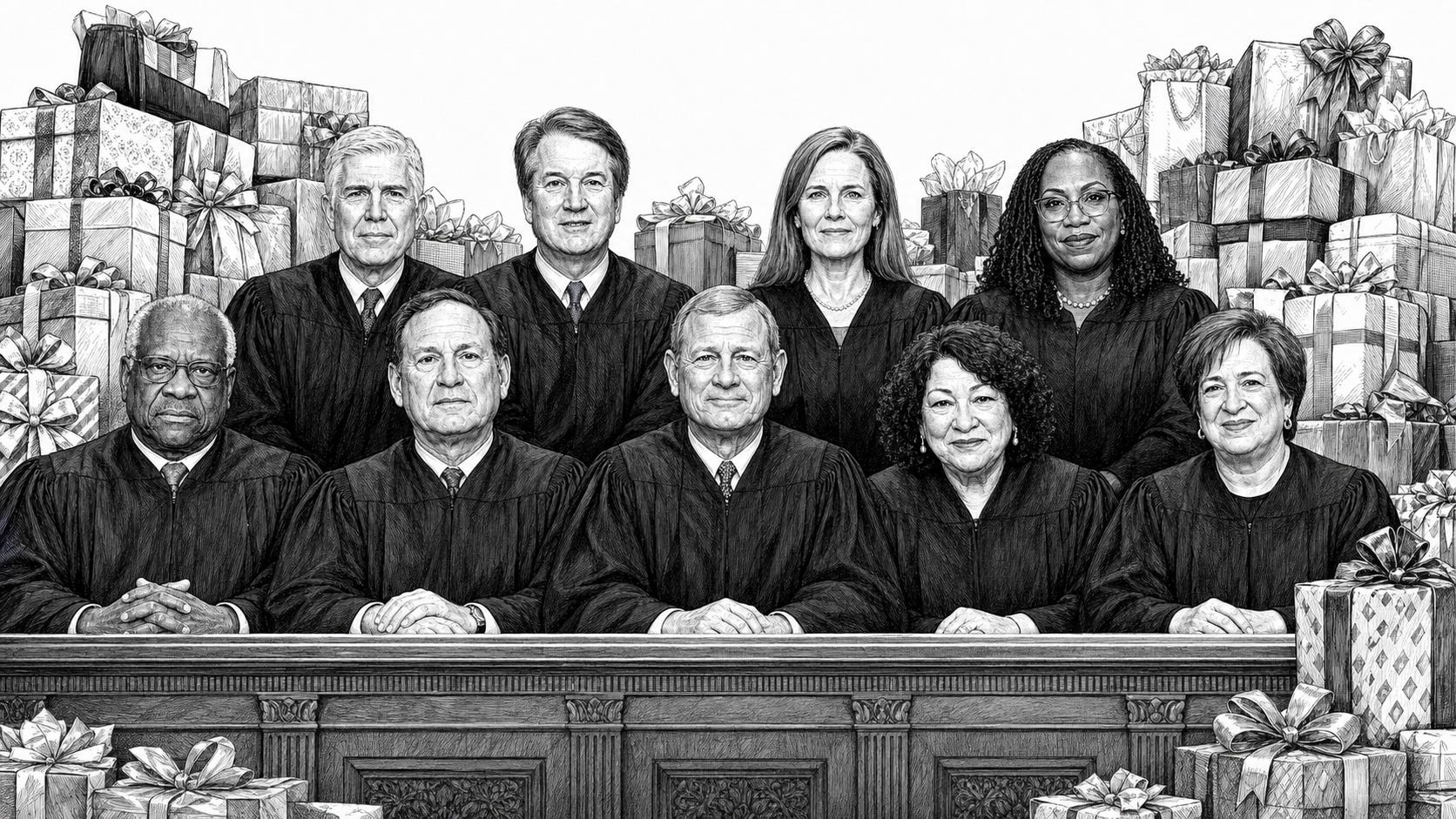
The Numbers
A watchdog group called Fix the Court keeps a running tally of every gift and free perk handed to the people who sit on the Supreme Court, and the newest version of that tally counts 515 gifts and complimentary benefits worth an estimated $3.62 million from 2004 forward, pieced together from the justices’ own financial disclosure forms, investigative reporting, public records requests and a Senate investigation. Stretch the count across every year the database touches, including older records that are patchy and incomplete, and the total climbs to 735 gifts worth roughly $4.69 million.1
That figure covers 17 people. Nine of them are the justices deciding cases right now. Eight are recent former justices who have left the bench. That distinction is the single most important thing on this page, and I will show you why in about sixty seconds.
Now get this. One justice accounts for almost all of it
Clarence Thomas alone accounts for roughly $3.064 million of the $3.616 million total. Do the division. That comes to 84.7 percent of everything the group tallied for all seventeen justices across more than twenty years.
Narrow the lens to the nine justices on the bench today and the picture gets sharper still. Their tally since 2004 is 307 gifts worth about $3.231 million, and Thomas accounts for roughly 94.8 percent of that dollar figure, which means that if you set one man aside, the entire gift controversy at the current Supreme Court shrinks down to something around $166,412 spread across his eight colleagues over two decades.
Every other justice in the database, sitting and retired, adds up to about $551,425 combined.
What the Money Bought
The benefits credited to Thomas were not gift cards. Reporting has described private jet flights, cruises on a superyacht, resort vacations and lodging supplied mostly by Harlan Crow, a billionaire Republican donor, along with other wealthy businessmen. Crow paid private school tuition for a grandnephew Thomas was raising as his own son. Crow also bought Georgia property that Thomas owned together with his mother and other relatives. That deal came to $133,363. It was a sale, and a sale like that belongs on a disclosure form. He left it off. He acknowledged the omission later.
Fix the Court attributes 130 gifts to Thomas after 2004 and treats 120 of the gifts he received through 2025 as reportable under its own reading of the disclosure rules, and by its count he reported 14 of them, which works out to 11.7 percent, a number that generously includes items he disclosed late and items he tucked into the reimbursement section of the form.
Across all the years the database reaches, Thomas is credited with 206 gifts worth about $4.023 million. Note that the records before 2004 have holes in them and a large share of the values are estimates.
When it comes to Antonin Scalia, who died in 2016, he sits a distant second by dollar value, with 61 gifts after 2004 worth roughly $181,756. And Samuel Alito drew his own criticism for an Alaska fishing vacation he took without reporting the private jet seat that carried him there, a seat supplied by the hedge fund billionaire Paul Singer, whose fund later had a case land in front of the Supreme Court. Alito has maintained that the guidance in effect at the time did not require him to report the flight or the hospitality. Democratic staff on the Senate Judiciary Committee wrote in a majority staff report that he misused the personal hospitality exemption and violated disclosure law. That is a congressional staff finding. No court has said it.
The list, as it applies to all justices, goes on and includes artwork, the robes and hoods that come with an honorary degree, trophies, clothing, concert tickets and free travel. A $200 ceremonial hood counts as one gift. A single leg on a private jet counts as one gift, so a round trip shows up in the tally as two, and the meals and the lodging on that same trip might be counted as their own separate line items on top of the flights.
When a group supplied no value, the tally sometimes assigns $249 to a trophy or statuette and around $200 to honorary degree regalia. Travel gets valued by looking at the aircraft or the yacht involved and comparing market prices. Take the $3.62 million figure for exactly what it is. An advocacy organization built it in good faith, corrected its own double counting and date errors along the way, and keeps updating it. Nobody audited it. No agency certified it. But the group isn’t under the microscope, the court is so let’s stay focused.
The Rules are Messier Than a Slogan
You have heard someone say that Supreme Court justices are never allowed to take gifts. The real rule is messier. Federal disclosure law generally requires a justice to report gifts from someone who is not a relative once the qualifying gifts from that same source pass a dollar threshold for the year. Small individual gifts might drop out of that adding up entirely. The law treats gifts from relatives differently, and it carves out certain food and drink along with hospitality such as meals and lodging offered at a private home.
Current guidance from the federal judiciary shuts a door that used to sit open. Transportation that stands in for a commercial flight, including a seat on a billionaire’s private plane, does not count as personal hospitality under the guidance the judiciary has now spelled out, and it generally has to be reported once the threshold rules are met. The meals and the lodging on that same trip might qualify for the exception. The plane ride is its own thing and it belongs on the form. The judiciary called this a clarification of what the rules always meant. Thomas, Alito and others have disputed how the earlier guidance should have been read.
Now look at the second rulebook. A gift might have to appear on a form without being forbidden. Federal law separately limits officers and employees from accepting things of value from people seeking official action from them, people doing business with the courts, people whose activities the courts regulate and people whose interests their official work would substantially affect, subject to exceptions written into the regulations. Whether any particular yacht cruise or plane ride crossed that second line depends on facts and legal readings that a spreadsheet does not settle. A spreadsheet is not a verdict.
We Need a Better Way
The Court adopted its first formal written ethics code in late 2023. The code tells justices to avoid impropriety and the appearance of it, and to follow the Judicial Conference restrictions on accepting and requesting gifts. Read the whole thing and you will notice what is missing from it. There is no independent body anywhere with authority to investigate a complaint against a justice and impose a consequence for breaking that code, which leaves the justices policing themselves on the conduct the code alone governs, a setup that should bother you no matter which president put the person under scrutiny on the bench. That gap is the whole ballgame. Their disclosure duties under statute do run through review processes that sit outside the code.
Fix the Court identified 37 gifts worth about $16,588 from 2024 into 2026, the years after the code came out, and for the 2024 and 2025 gifts covered by reports already public, the group says every identified gift above the disclosure threshold made it onto the forms. The recent list leans heavily toward awards, artwork and concert tickets. The superyachts are gone from it.
That might mean behavior changed. That might mean reporting got better. Two years is a thin sample, Alito’s 2025 disclosure was still outstanding under an extension, and the disclosures covering 2026 do not come due until 2027, so anyone declaring this problem solved is reading the tea leaves awfully early.
What to do with all of this
The $3.62 million figure is real and it belongs to 17 justices, current and former, going back to 2004. One justice drives about 85 percent of it. Among the nine sitting today, that same justice drives close to 95 percent.
The deeper problem sits underneath the dollar signs. It is the extraordinary value of some of these benefits, the exceptions in the rules broad enough to fly a private jet through, the long list of benefits that never made it onto a disclosure form for the years they belonged in, and an ethics code with nobody assigned to enforce it. A posted sign that no one enforces is a suggestion.
My fix for this mess is simple. Congress passes a law. Ban Supreme Court justices from accepting gifts of any kind from any source, and bar them from owning stock or holding any investment in a company with a stake in litigation that reaches their courtroom, whether that stake runs directly or through a parent company, a subsidiary, a trade group or a fund bankrolling the case. The standard gets written in plain words. Avoid every conflict of interest and every appearance of impropriety. Then hand oversight to a congressional committee built with Democrats and Republicans in equal number, with real authority to investigate a justice who breaks the rule and discipline the ones who do.
Congress holds the authority to set real gift limits for the highest court in this country, the same kind of limits that already bind members of Congress and the people working at every federal agency in America, and that authority gets used when enough of us make enough noise to make ignoring it uncomfortable.
Call your senators and your representative. Send this to the person in your life who assumes the Court sits above all of it, then keep your eyes on what shows up on next year’s disclosure forms, because sunlight only does its work when somebody is standing there looking.
Mitch Jackson, Esq.
Sunlight only works when somebody stays at the window, and Uncensored Objection is me at that window, week after week, digging through the disclosure forms and the fine print so you get the facts before the spin arrives. Subscribe, and bring a friend who still assumes somebody else is watching.
See Fix The Court
We need term limits!!! I'd impeach Clarence. He's no good in so many ways. He's more racist toward blacks than the KKK..
Is there an accounting of gifts related to recusals and rulings? That is, which justices benefitted fron gift and ruled in gifter's favor?