

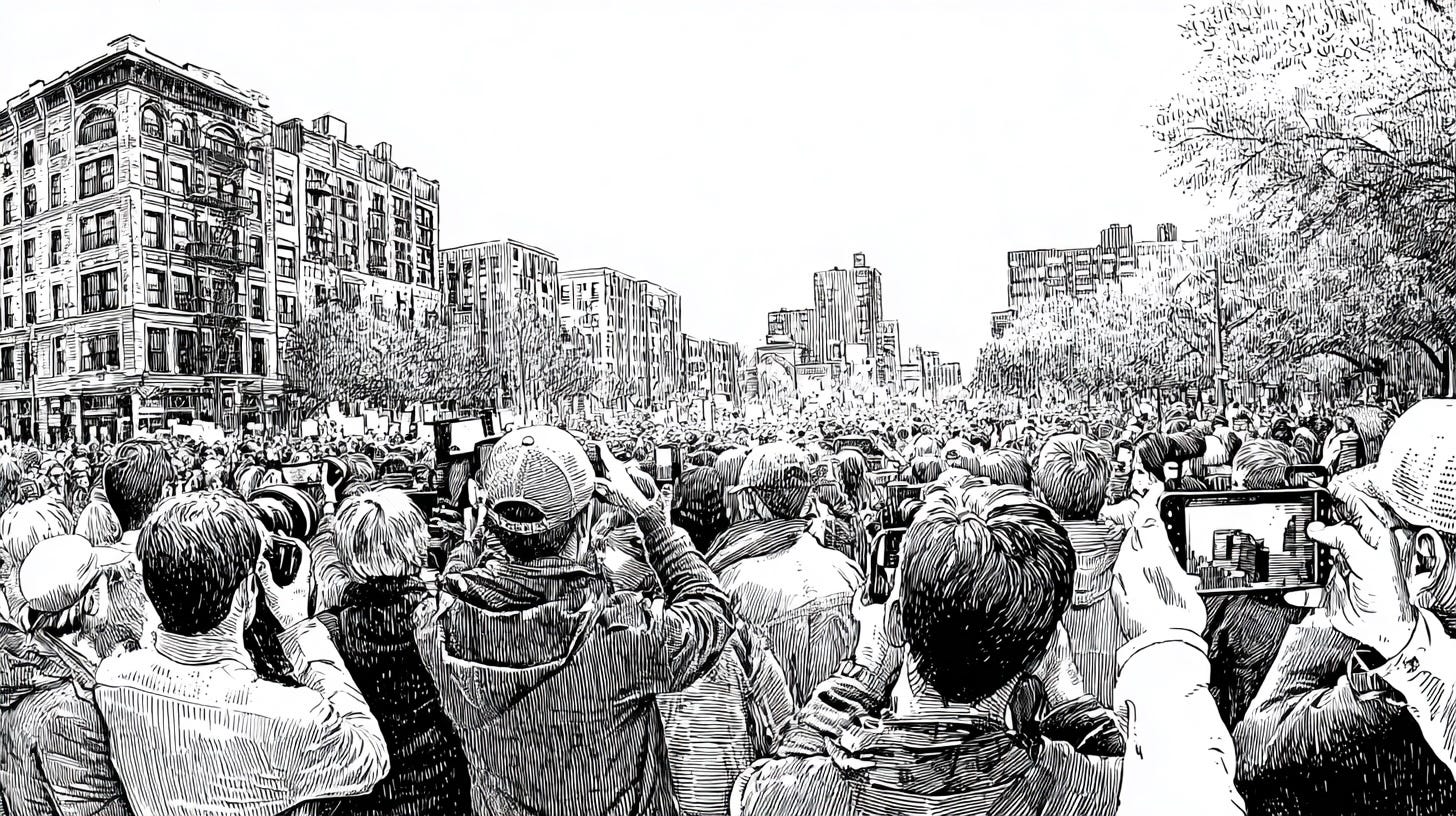
You’re at a protest and you see officers grabbing someone on the street. Sometimes they are ICE agents, with their faces covered in dark jackets with no name tags. Sometimes they are police in riot gear, or even National Guard troops patrolling our city like an occupying force.
Your heart pounds. You feel that urge to step in or at least to pull out your phone and hit record. Then a sliver of doubt creeps in: Are you even allowed to film this? What if they get angry? What if you get in trouble?
Here is the truth: Yes, you can film. Yes, you should film. In fact, in moments like this, you have both the right and the responsibility to document what is happening. Doing so protects the person in danger in front of you and protects something even bigger: our democracy. Silence and darkness are what those abusing their power count on. By recording, you shine a light.
Your Right to Record Is Protected by Law
You do not need anyone’s permission to take photos or videos of law enforcement officers performing their duties in public spaces. This is true whether they are city police, federal ICE agents, immigration officers, National Guard soldiers, or any other government agent. On the sidewalk, in the street, outside a courthouse, in a public park, or even on your own front lawn, you are on solid legal ground to hit that record button.
Federal courts across the country have repeatedly upheld that the First Amendment of the Constitution protects the act of recording police and officials in public as long as you are not actively interfering with their work. Some places, such as New York, have even passed explicit laws affirming this right to record.
Wherever you live, remember that your phone in your hand is not a threat. It is a shield for truth. No officer or agent has the right to make you delete your footage or to confiscate your device without a court order signed by a judge.
Where State and Local Rules Come In
Some states have tried to impose extra rules on the right to record. It is important to know about them so you can avoid unnecessary trouble. For example, some states have tried to impose distance requirements. In Louisiana, a controversial law was passed that would allow police to order anyone filming to stand back at least twenty-five feet. Lawmakers in a few other states have floated similar “buffer” rules.
These attempts have faced heavy challenges in court for violating free speech, and judges have already blocked some of them from being enforced. The bottom line is that as long as you are not in the officer’s face or obstructing what they are doing, you have the right to keep filming.
There are also laws about audio recording in some states. California and Massachusetts, for instance, normally require the consent of everyone involved before you can record audio of a private conversation. Those laws do not override your right to record police or agents who are out in public doing public work. Courts have made it clear that officers have no reasonable expectation of privacy while they are doing their jobs in public spaces. So you are allowed to capture audio as well as video of these encounters, again provided you are not interfering.
If the action is happening on private property, the rules get a little more complicated. On private property, the owner of that property sets the boundaries. If you are at a business, a store, or someone’s home and you are allowed to be there, you can record what law enforcement is doing. If the property owner or an agent of the owner tells you to stop filming or to leave, you should either stop or step outside to public property.
Never trespass to get footage; that can land you in legal trouble separate from anything the officers are doing. If ICE agents or police come crashing through the door of your workplace or your apartment building, and you are legally there, you have every right to document it.
How to Film Misconduct Safely and Effectively
When you decide to record an arrest or a confrontation, you are stepping into an important role: a witness. You are not there to fight or interfere directly; you are there to observe and document. Think of yourself as a citizen journalist or a legal observer capturing evidence. Here is how you can do that without getting pulled into the fray:
Stay at a safe distance. Do not crowd the agents or officers, do not touch them, and do not physically obstruct them. You want to be close enough to capture everything clearly. Remain far enough away that it is obvious you are not part of the incident. Many bystanders find that a distance of ten or fifteen feet works. If an officer orders you to step back further, do so. You can still zoom in or move to a better vantage point while keeping your distance.
Keep your focus on the officials, not the person being detained. Your goal is to hold the agents accountable, not to create embarrassing footage of someone in distress. Point your camera at the officers or soldiers involved, capturing their faces, their badge numbers (if visible), their uniforms, and their actions. If an ICE agent or police officer is interacting with a person, film the authority figure, not the vulnerable individual. You want to document what the enforcers are doing: how they are treating people, what weapons they have, and how they conduct themselves.
Capture all the details. You never know what will matter later. Try to get shots of things like name tags or badge numbers, agency markings on jackets or vehicles, and any paperwork or warrants they present (or fail to present). If an officer is waving a document around or reading a warrant, it can be useful to have that on video.
Record the license plates or identifying numbers on any police cars, ICE vans, or military vehicles. Show the context. Include street signs, storefronts, or notable landmarks in your video if possible so it is clear where this took place. Say the time and date out loud while filming or capture a clock or watch if you can. These little details can become crucial evidence.
Whenever possible, hold your phone horizontally (landscape orientation) when filming. A wider frame gives more context to what is happening around the main action. You will pick up more of the scene: multiple officers, bystanders, or surrounding conditions in one shot. It paints a fuller picture of the event. It is also easier to view on larger screens if the footage is later used on the news or in court.
Be mindful of protecting people’s privacy and safety when you share or show the footage. If your video has bystanders or particularly the person who was detained, consider blurring or obscuring their faces or any unique identifying details before you post it publicly.
This is not about censorship; it is about protecting people from retaliation. An undocumented immigrant or a protester identified in a video can become a target for ICE or other hostile actors if you are not careful. The same goes for witnesses who happen to be in your shots. You can be all for transparency and still use common sense about not needlessly exposing vulnerable people.
Quick and Easy Slide Deck You Can Share
[click here or image below]

When Authorities Tell You to Stop Filming
Let us say the officer you are recording notices you and barks at you to turn off your camera. Or a police officer starts marching toward you with an intimidating glare, saying you are not allowed to film. What do you do? This can be scary. Remember your rights and remember your purpose.
You are allowed to keep recording. Being told “stop filming” by a law enforcement officer is not the same as a lawful order, unless you truly are interfering or posing a safety risk. Often, officers do not know the law, or they hope you do not know it. Stay calm, take a step back to increase the distance if you need to, and continue documenting from that safer position. Say clearly and calmly that you are exercising your First Amendment right to record. You do not need to get into a debate on the street. Making a calm statement that you are not interfering and will keep a safe distance can sometimes make them back off.
Your safety and the safety of others must come first. If an officer becomes aggressive and you sense that continuing to film will provoke them, you must use your judgment. There is no shame in self-preservation. The footage is important, and so is your well-being and the well-being of people around you.
In some tense situations, the smartest move can be to stop openly filming and either keep recording discreetly or, if that is not possible, step away and immediately write down everything you witnessed. Being a witness is not always about holding up your phone; sometimes it is simply about holding on to the truth of what you saw and heard so you can report it later.
Everyone has their own risk level to consider as well. For example, if you or a family member have an immigration issue or another vulnerability, directly confronting agents by filming carries extra risks. Know your rights; know your personal situation as well.
If you decide you need to step back for your own safety (or your family’s), you can still be a huge help by noting details of the event and sharing them with someone who can publicize or use the information. Even without video, a written affidavit or testimony of what happened can make a difference. The key is not to be silenced completely. Use whatever tools you have, whether it is a camera or a pen and paper, to document wrongdoing.
When They Try to Take Your Phone or Camera
In some cases, agents or police do not stop at telling you to turn it off. They demand that you hand over your phone. Sometimes they even grab for it or threaten you with arrest if you do not comply. You should be prepared for this possibility so it does not catch you off guard.
First of all, the law is on your side here as well. Officers need a warrant to seize or search your phone in almost every situation. They cannot walk up and take your device or force you to unlock it without legal authorization from a judge. That does not mean they will never try; some will bluff or intimidate you in the heat of the moment. You can politely and firmly say, “I do not consent to any search or seizure of my phone.” Make sure those words are on the record (and yes, your recording is still running if possible).
Do not volunteer your passcode. You are not legally required to unlock your phone for them. In fact, it is better if your phone is secured by a strong passcode or password rather than a fingerprint or face unlock. Why? Because an officer can physically force your finger onto the sensor or hold the phone up to your face to unlock it, which is a grey area legally. A passcode that you memorize is protected by your right to remain silent in many jurisdictions, meaning they cannot force you to reveal it. So take a moment right now to check your phone’s settings. If you use easy biometric unlock methods, consider switching to a numeric code or at least have a strong backup code.
Always take note of the officer’s identity if they confront you in this way. Look for a badge number or a name tag. If they refuse to identify themselves, note any distinguishing features: what agency they were with, what they looked like, whether they were in uniform or plain clothes, and the time and exact location of this encounter.
As soon as you are safe, write this all down. This kind of information can be crucial later if you need to file a complaint or if there is a legal case. There have been instances where authorities tried to delete videos or confiscate cameras, only to end up in hotter water because that itself is a violation of rights. Knowing the culprits by name or badge number helps hold them accountable.
If an officer demands your phone, it is natural to reflexively pull it close or put it away. Avoid sudden moves. If you move too quickly, they will claim you were resisting or that they “felt threatened.” Keep your hands visible and your movements deliberate. If you need to put your phone in your pocket or bag, say out loud what you are doing (“I’m putting my phone away now”) and do it slowly. The sad reality is that some officers are trained to react with force at the slightest hand movement, so do not give them an excuse.
After the Recording: Using Your Footage Wisely
Suppose you managed to film a confrontation or arrest. The danger has passed. The agents have left. You have this valuable video on your phone. What now? In our age of social media, the instinct is often to upload it immediately for the world to see. Sometimes that is the right call. Take a moment to think it through first.
Ask yourself: What is on this video? Does it show a person’s face who would be put in danger if they are identified? Would posting this footage help ICE or the police identify someone to target? If the answer is yes, consider sharing it more carefully or not at all publicly.
One option is to show it privately to a journalist or a lawyer before blasting it online. Or you can blur faces and other identifying details of people in the video (there are apps and software that make this easier than it looks). Remember, the purpose of your video is to expose misconduct and protect people, not to accidentally put anyone in harm’s way.
Consider reaching out to a local legal aid organization or an activist group if you are unsure about what to do with the footage. They can advise you on how to post it or whom to send it to. In many cities, there are hotlines or volunteers who collect evidence of police and ICE misconduct. This can help ensure it gets used effectively. It also helps you stay a bit more in the background if you prefer, rather than becoming the center of a viral news story overnight.
Critically, do not edit or alter the footage if it shows something important. Editing, even if done innocently to cut for time or to add music or effects, can cast doubt on the authenticity of the video. Upload or save the raw file. Do not even rename the file, because sometimes the original file name contains a timestamp or other metadata. Back it up in a safe place: upload a copy to a secure cloud service or email it to yourself or a trusted friend. If your phone gets lost or taken later, you want that evidence to survive. If what you captured is truly egregious misconduct, your video is now evidence. Treat it like evidence. That means keep it safe and don’t tamper with it.
Sharing the video can spark outrage and bring attention to the issue, which is often the goal. We have all seen how a single video of abuse can wake up the public. For example, think of the bystander footage of police brutality that ignited nationwide protests in the past. Your video can play that kind of role. Make sure that when you share it, you are doing so to inform and seek justice, not to chase online attention. A clear, unedited, responsibly shared video has the power to change minds and even save lives.
Why This Matters So Much Right Now
It is October 2025. We are in the midst of a moment in history that will be remembered for either the defense of democracy or the slide into something else entirely. Donald Trump is in the second year of his second term as President, and the things we are seeing in our country are unlike anything in living memory.
Federal immigration agents are roaming city streets and neighborhoods with an arrogance and aggression that is designed to terrify. They show up early in the morning or late at night, sometimes with masks covering their faces and uniforms stripped of name patches, loading people into unmarked vans. We have National Guard units and even active-duty military personnel patrolling American cities under the pretext of maintaining order. They were sent in the name of “stop chaos” or “protecting communities.” In reality, their presence is a show of force, an intimidation tactic straight out of an authoritarian playbook.
These extreme measures are not normal, and we must never allow ourselves to treat them as normal. They do not represent the United States that we want our children and grandchildren to inherit. I am a lawyer, and I will tell you that many of these actions push the limits of constitutionality or flat-out defy our laws. I am also an American husband and father who cares about the future of our country. It breaks my heart to see our country sliding backwards on fundamental freedoms. The right to speak out, to assemble, and yes, to hold our government accountable: these are cornerstones of who we are. When those in power send armed agents into our streets to silence and intimidate, the only effective antidote is sunlight and truth. That is where your camera comes in.
Some people on the sidelines still say things like, “If you do nothing wrong, if you simply obey the law, you have nothing to worry about.” They have never experienced what happens when power goes unchecked. They have not felt the fear of a community that wonders whether a simple walk to school or the store will end with a loved one being taken away without explanation. They do not see the slippery slope we are on when leaders ignore the Constitution and encourage a culture of fear. Authoritarianism creeps in when nobody is watching. By watching and recording, you make sure that somebody is always watching.
No Kings Day on October 18, 2025, is fast approaching. This nationwide protest is a stand against the idea of an untouchable ruler. It is called “No Kings” for a reason. We do not crown kings in America, and we do not bow to dictators. On that day, in cities all across the country, ordinary people will come together to protest the abuses and overreach of this administration.
If you are one of those protesters, know that your presence matters. And so does your power to document what happens. When you head out into the streets on No Kings Day, bring your phone or camera and be ready to use it. You can capture images of peaceful demonstrators holding signs, singing, and marching, images that show the world our spirit. You can also capture images of officers or troops who cross the line, and that recording will be evidence. It can help bring justice, or at least force public scrutiny of their actions.
We have seen in recent months that when videos of misconduct surface, they make a difference. They provide proof that can cut through the lies. When officials deny using excessive force, a video can show the batons and rifles being pointed at unarmed citizens. When an agent claims someone “resisted arrest,” a video can reveal that the person was tackled without provocation.
This is how we keep public officials honest; if they are dishonest, it is how we expose them to the public. It is much harder for them to get away with abuses when there are recordings all over social media and the news. The world will know the truth of what happened in the streets of Los Angeles, Chicago, Portland or New York, or wherever, because brave people pulled out their phones and recorded.
The Path Forward: Record, Save, Share (and Stand Together)
Here is the bottom line. You have the right to film ICE agents, police officers, National Guard soldiers, or any other officials in public when they engage with our community. Use that right. Keep yourself safe by maintaining distance and not interfering physically. Do not let them intimidate you into putting your phone away.
Hold onto your device unless they pry it from your hands. If they do seize it without a warrant, you have one hell of a legal case against them. Think before you publish anything that would put someone vulnerable at risk. Protect your files and make backups so that no twist of fate or act of sabotage can erase what you saw.
This is how we fight back against a climate of fear. We do it with evidence and truth. Every time you press record, you are doing more than capturing a moment. You are making a statement. You are saying that we see what is happening, and we will not let it go unanswered. You are drawing a line that power must not cross. You are refusing to sit quietly while our American values are trampled.
Your courage to film can inspire someone else to speak up. Your footage can become the proof that spares someone from jail or finally holds a bad actor accountable. At least your act of watching and recording tells those in power that they are seen. That matters, because silence is exactly what those in power are counting on. If we deny them that, if we document the truth and share it far and wide, we take away the biggest weapon they have: the cover of darkness.
So when you go out on No Kings Day, or the next time you witness an immigration raid or a protest turning ugly, remember this advice. Charge your phone. Hold it steady. And when history happens in front of you, do not hesitate to hit record. None of us alone can change everything. Each of us can shine a light on the truth. Together, those lights become a blaze of justice that cannot be ignored.
In the end, taking a picture or video can seem like a small act. It can feel like all you did was tap a screen. That small act can ripple outward in ways you cannot even imagine. It can protect your neighbor. It can educate a voter. It can challenge a leader. It can move a nation.
Do not underestimate that power. Use it. And encourage those around you to use it too. Our future depends on ordinary people refusing to be intimidated into silence. Pick up that camera and show the world what is going on. In doing so, help make things right.
Mitch Jackson, Esq. | links
Step Up. Speak Out. Hold Them Accountable.
Every time you stay silent, the people in power win. Every time you speak out, document, and share, you chip away at their grip. This moment demands courage. Our kids and grandkids are counting on us to step up, call out the lies, and hold wrongdoers accountable.
If you believe in truth, in action, and in protecting our democracy, join me. Subscribe to Uncensored Objection (free and premium options), share it with your friends, and let’s raise a collective voice loud enough that it cannot be ignored.

What every American needs to know before a police officer, ICE agent, Border Patrol officer, or TSA agent demands access to your phone. 👇
https://www.linkedin.com/pulse/what-every-american-needs-know-before-police-officer-ice-jackson-uo86f