

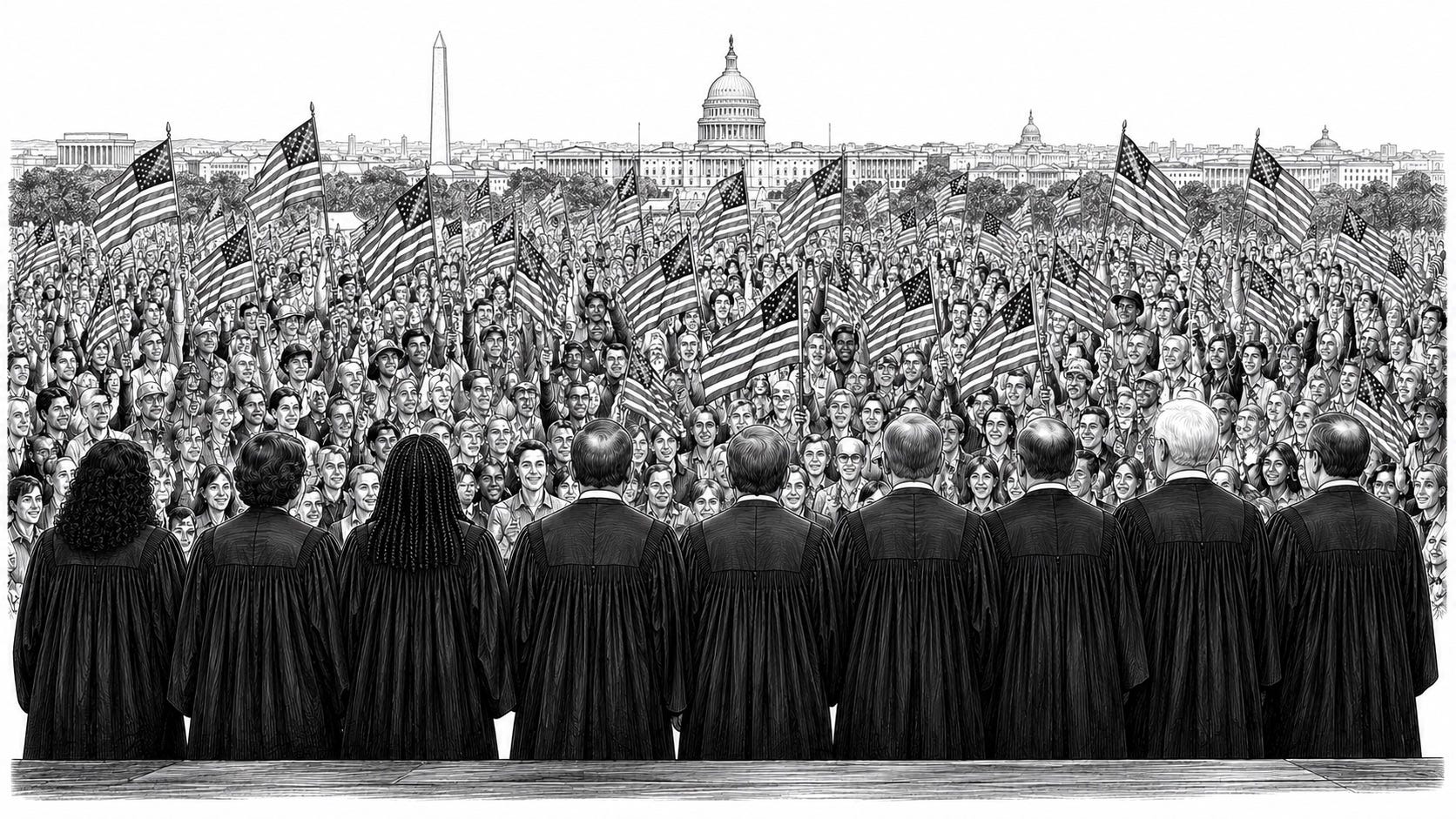
Right now there is a job in America with more power over your actual life than the presidency, and you have never cast a single vote for the people who hold it. Think about that for a second. Nine people, sitting in a room you will never enter, decide whether your daughter controls her own body, whether your ballot counts as much as your neighbor’s, whether a president obeys the law or rises above it. One of them can hold that seat for thirty years. Answerable to no one. Removable by almost no one.
And consider this. Not one of them earned that seat by winning your vote. They got it by raw luck, by being in the right place the moment somebody else happened to die. And right now they shape your daily life with more force than the Congress you choose every two years.
This is not okay, and deep down you already know it. We have all felt it, the friction this creates across every part of the country, the sense that something at the core of our system is rigged against ordinary people.
A clean, simple fix to all this already sits on the table. Roughly two thirds of Republicans support the idea. Even larger shares of independents and Democrats agree. The founders would recognize the design on sight. The Constitution has plenty of room for the change. By the end of this piece you will know the fix, you will know why the plan protects the exact thing the founders cared about most, and you will know the one move this fall that starts the clock.
The Job You Never Voted For
Start with the size of the prize. The nine justices of the Supreme Court sit at the top of American law. They get the final word on your rights. When they settle a question of constitutional law, the president holds no power to undo the ruling, and no ordinary act of Congress climbs high enough. Their decisions reach into your doctor’s office, your kid’s classroom, your paycheck, your privacy, and the ballot box itself.
Now look at how long they keep the prize. Justices appointed in the modern era have served around twenty eight years on average, the longest tenures in the Court’s history. One sitting justice has held his seat for more than three decades. Two more have passed the twenty year mark. These are lifetime appointments in the fullest sense. A person sworn in at fifty keeps a grip on your constitutional rights into their eighties.
And here is the strange engine running underneath everything. A president’s power over the Court depends almost entirely on luck. One president gets four vacancies. Another gets none across a full term. Nothing about merit, nothing about the will of voters, decides who reshapes the Court. Timing decides. Death decides. A gamble decides.
What the Founders Actually Built
The founders were not careless about this. They wrote in Article III that federal judges hold their offices during good Behaviour, language understood ever since as a seat for life unless a judge resigns, retires, dies, or gets impeached and removed. They chose those words on purpose, and their purpose deserves real respect.
They had watched kings fire judges for ruling the wrong way. They wanted American judges free to follow the Constitution without fear of losing their jobs, without begging a president or a Senate for another term. Independence was the goal. A judge who owes nothing to the politicians, who carries no fear of punishment for an honest ruling, protects your rights even when the powerful want them crushed. Stability was the goal too, and continuity, and a bench with deep memory of the law.
Honor the goal. Keep the goal front and center. The plan in these pages delivers the founders’ goal. The broken system flying their flag today fails the goal.
How the System Broke
The goal was sound. The machine built to deliver the goal has broken down.
Look at what life tenure produces in the real world. Justices now time their exits like chess players. A justice waits to retire until a friendly president sits in the Oval Office, so the seat stays in friendly hands. The decision about when to leave becomes a political act, calculated to lock in power for a generation. Your rights ride on the retirement scheduling of someone you never chose.
Confirmation fights have turned into total war. Each opening might shape the law for forty years, so each opening becomes a scorched earth battle. Senators block nominees, change the rules, rush votes, and torch every norm in reach, because the stakes feel infinite. A single seat feels like the whole country up for grabs, and people behave accordingly.
And capacity becomes a quiet crisis. A brilliant judge at sixty might sit on the bench at eighty five, and no mechanism exists to manage the slow fade of any human mind across a quarter century in the same chair. The country ends up with aging justices clinging to seats long past the moment the public’s values, and sometimes their own sharpness, have moved on.
One President, Three Seats, Forty Years
Watch the luck and the hardball combine, and you see the danger up close.
In a single term, one president named three of the nine justices and locked in a six to three majority built to outlast him by decades. Part of how he got there was timing. Part was raw power politics. A sitting president’s nominee got blockaded for most of a year on the excuse of a coming election, then a different seat got filled in a frantic rush days before the next election, on the opposite principle. The rule bent whichever way served the people holding the gavel.
Sit with the result. A president who has shown again and again how little the Constitution restrains him, a man happy to test every limit and shatter every guardrail, got to stamp the highest court in the land for forty years on the strength of a few lucky vacancies and a willingness to break the rules. Your reproductive rights, your voting rights, the reach of presidential power itself, all of them now rest in part on seats won by those means.
The threat here runs deeper than one man. A system this random and this winner take all hands enormous, durable power to whoever shows up at the right moment willing to do anything. Today the beneficiary wears one party’s colors. Some future demagogue from any direction inherits the same loaded weapon. A healthy republic does not leave a weapon like this lying around.
The Fix the Founders Would Recognize
So here is the plan. One term of eighteen years for every new Supreme Court justice. One new justice appointed every two years, like clockwork. After eighteen years of full service, a justice steps back into a senior role, still a judge, still honored, no longer gripping an active seat for life.1
Run the math and the elegance becomes clear. Nine seats, a new one every two years, eighteen years to cycle through all nine. Every president elected to a four year term names two justices. Not five. Not zero. Two. The luck drains out of the system. The gamble ends. Each election carries a clear, equal, predictable stake. No more random jackpot.
Notice what this design protects. A justice still serves a long term, eighteen years, plenty of room for independence and deep knowledge of the law. No justice has to fear a president or beg a Senate for another term, because no reappointment exists anywhere in the plan. The independence the founders fought for stays fully intact. The plan keeps their promise. The plan stops the promise from curdling into a forty year grip no human being should hold over a free people.
Over the transition, the lopsided majority built by a few lucky years gives way to a bench refreshed on a steady rhythm, balanced over time by many presidents and many elections, never again frozen by a single roll of the dice.
And the politics cool on their own. When every president gets two seats no matter what, and the next appointment always sits only two years away, no single confirmation feels like the last helicopter out of the country. The temperature drops. The scorched earth incentive fades. People stop torching the rules over a prize no longer worth burning the house down to win.
The Honest Worries, Answered
Strong ideas earn hard questions. This one survives every one of them.
Some people worry any term limit threatens judicial independence. Look closely and the worry dissolves. Independence means a judge rules without fear of losing the job over an honest decision. Under this plan no justice ever faces reappointment, ever campaigns for the seat, ever answers to a politician for a ruling. Eighteen guaranteed years with no reelection is independence in its purest form. No reappointment, no campaign, no leash.
Some people raise a simple retirement age. An age cap helps with the capacity worry alone. The random vacancy lottery keeps rolling, the confirmation wars keep raging, and one lucky president still lands four seats in a single term. Term limits untangle the whole knot at once.
Some people back a different route, adding more justices to the Court. The expansion of the number of justices opens an arms race with no finish line. One party adds two seats, the next adds four, and the bench becomes a political football kicked back and forth forever. Term limits steady the Court for good. The reform calms the whole system.2
Some people ask whether a simple law might do the job, no amendment needed. A simple law walks straight into a wall. The justices losing their active seats would sit in judgment of the very law stripping those seats. Picture asking the defendant to deliver the verdict in his own trial. Even apart from the conflict, the lawsuits would crawl through the courts for years and probably collapse. A clean amendment closes every escape hatch. No court gets to strike down the Constitution itself.
We Banned Alcohol, Then We Unbanned It
Anyone who says amending the Constitution is impossible has forgotten the country’s own history.
In 1919 the United States wrote a nationwide ban on alcohol directly into the Constitution. The Eighteenth Amendment outlawed the manufacture and sale of your beer, your wine, your whiskey, coast to coast. Fourteen years later the country looked hard at the wreckage, admitted the whole experiment was a mistake, and passed the Twenty First Amendment to wipe the ban away. The nation added a sweeping social policy to its founding document, then reversed course and removed the ban, all through the amendment process, all by the rules.
Hold this fact next to today’s question. A country with the will to ban a drink and later repeal that very ban, both times by rewriting the Constitution itself, has every tool in hand to add a sensible eighteen year term for the nine judges who hold the most power in the land. The amendment path is steep by design. The founders left twenty seven amendments worth of proof that steep does not mean impossible. The country has climbed this exact hill before, and over something far less central to the survival of a free republic.
The Move This November
Here is where you come in.
This November every seat in the House and a third of the Senate land on your ballot. The midterms will not finish this reform by themselves. The midterms start the engine. They settle a single, decisive question. Does this amendment get real hearings, a real floor vote, and a real push to the states. Or does the amendment sit in a drawer for another decade as the random jackpot machine keeps running.
A Congress willing to move sends the amendment out with two thirds of the House and two thirds of the Senate behind it. Three quarters of the states, thirty eight of them, then vote to ratify. None of this happens without the right people in those seats, and you decide who fills them. The path runs straight through the choice you make this fall.
So choose with the Court in mind. Vote for candidates who pledge plainly, on the record, to pass an eighteen year term and send the amendment to the states. Ask every person courting your vote where they stand on ending lifetime power. Make them answer in public.
This is no partisan trick, and the numbers prove the point. Two thirds of Republicans want this. Big majorities of Democrats and independents want this. A reform with this kind of cross party backing is no fringe dream. A reform like this is a national consensus waiting for the courage to act.
Your Move
You do not have to accept a system where nine unelected people rule your life for forty years on the luck of a calendar. You do not have to accept a Court reshaped for a generation by whoever proves most willing to break the rules. The founders handed you the tools to fix this. The country has used those tools before, over far smaller things you pour over ice and sip while watching the World Cup. The American people, across every party, already agree on the answer.
The only missing piece is movement. Share this with the people in your life who feel the same unease and have never heard a clear path forward. Raise the subject at dinner. Bring the idea up at every town hall. Demand a yes from every candidate who wants your vote this November. Eighteen years, one new justice every two years, every president the same fair share, the independence the founders prized fully protected, and the lifetime grip finally broken.
Nine people should not hold your future for life. Starting this fall, you hold the power to take your future back. Use your vote, raise your voice, and refuse to hand any nine human beings a forty year grip on a free people ever again.
Mitch Jackson, Esq. [recommendations]
This is where you come in
You just learned how to end lifetime power on the Supreme Court, and that is exactly the kind of fight Uncensored Objection digs into every single day. Subscribe now, upgrade to support the work, and let’s stop watching democracy slip away and start taking it back together.
The Process: Nothing forces the current nine out. They keep their seats and their lifetime protection. The new eighteen year clock applies only to justices appointed after the amendment starts. So the transition is not a firing. It is a slow shift change, where the new system fills in around the people already there as those people leave on their own over the coming years.
Picture a nine seat table. Today every chair holds someone with a lifetime appointment. The amendment does not yank anyone out of a chair. Instead, every two years on schedule, the president seats one new justice with an eighteen year term. For a while the table is crowded, because you have the old lifetime justices still sitting plus the new term limited ones arriving on the clock. To keep the active Court at nine, the rule says the nine most junior justices in regular service hear the cases, and the most senior leftovers from the old system move into a senior role. They stay federal judges for life, keep the salary, sit on lower courts, and fill in if a Supreme Court seat opens early. They simply rotate off the front line of the active nine.
Then time does the rest. The old lifetime justices retire or pass away one by one, the way they always have. Each time one leaves, no scramble follows, because the next appointment was already coming on the regular every-other-year schedule. After roughly eighteen years, the last of the old lifetime justices is gone, and the table is full of nine justices who each got a single eighteen year term, staggered two years apart, refreshing on the clock forever after.
Here is the one honest tradeoff, so you are not surprised by it. Because the current justices stay put, the lopsided majority sitting today does not vanish the day the amendment passes. The fix is a steady cure, not an overnight one. The payoff is what makes it work politically and constitutionally. No president gets to purge the Court, no justice gets thrown out, the “good Behaviour” promise stays honored, and the random luck of vacancies ends for good going forward.
There is a competing design worth knowing about. A few proposals would apply the term limit to the sitting justices too, retroactively, which would reshape the Court much faster. That version picks a bigger fight, because pushing current justices off their lifetime seats invites the strongest constitutional challenge and makes ratification by thirty eight states much harder. The prospective version I describe here is the one most reformers favor, precisely because it changes the Court for good without handing opponents an easy way to kill it.
Some people say the real fix is more justices. Add a few seats, tilt the balance, problem solved. That answer treats a symptom and feeds the disease. The sickness is a Court run by luck and raw power, with seats won by the timing of a death and the nerve to break every norm in reach. Adding justices changes none of that. Whoever holds the Senate and the White House in a given year stacks the bench, and the next party to win stacks it right back, and the number climbs while the Court grows more political with every round. Remember, nine is not in the Constitution. Congress set that number by ordinary law in 1869, and the size has swung between five and ten across our history, so a packing fight needs only a simple bill and a single good year at the polls. That is the trap. Fast and easy is exactly how we ended up with a Court that lurches with whoever grabs power. Term limits take the slower, sturdier road. Eighteen year terms rotate the bench on a fixed schedule, hand every president the same two seats, and settle the question for good, because neither party can undo an amendment with one vote the way they can undo a statute. Expansion chases the prize. Term limits remove the prize. We do not need more justices. We need justices who serve their time and rotate out, so no president and no party ever seizes the Court again.
This must be a mandate - every candidate must take a stand - and we the people must support those who are willing to end this insanity.
Yes, the Supreme Court must be fixed, but I'd like to see the ones who helped get us in this mess booted out sooner.