

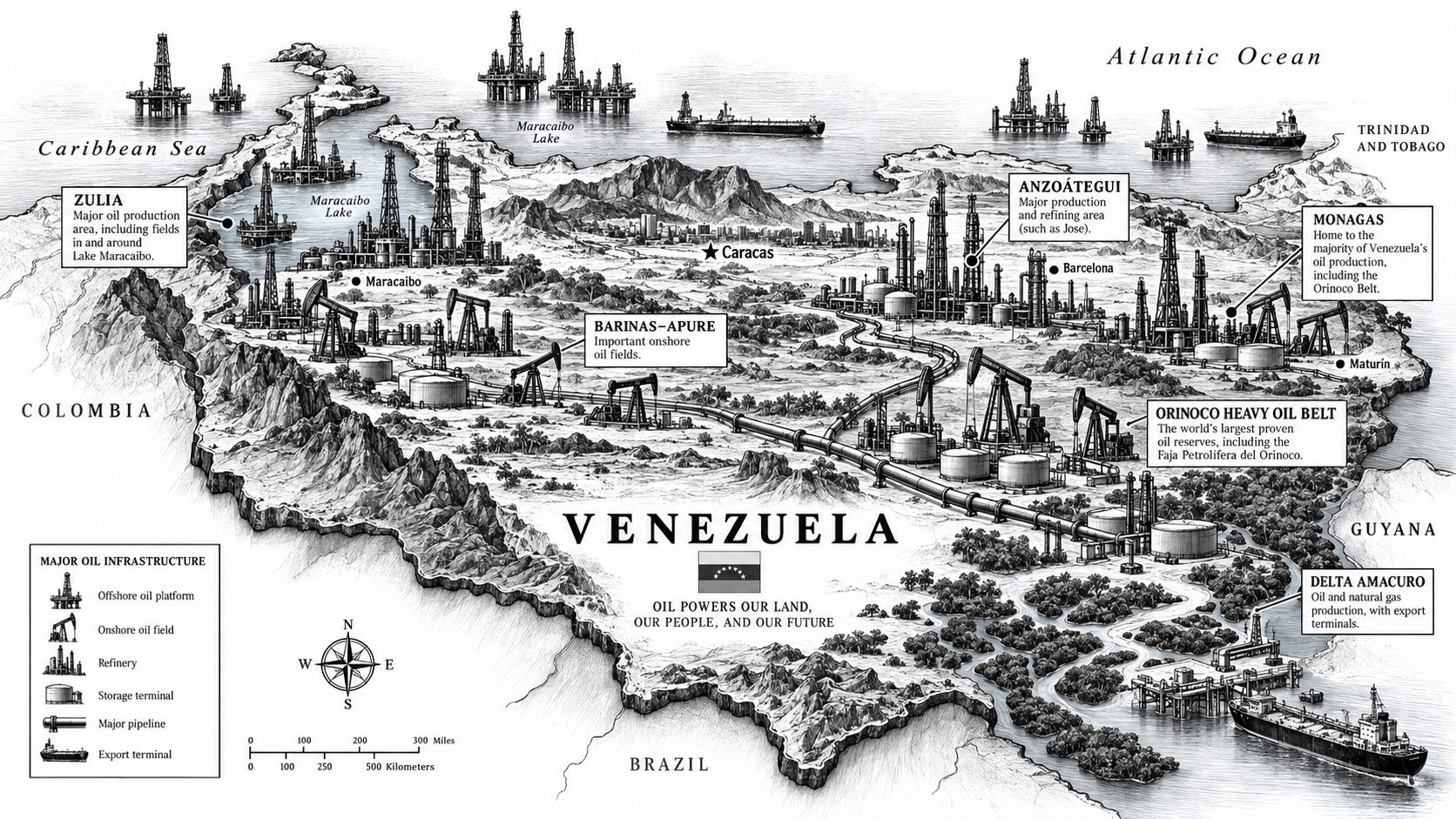
More than $13 billion has moved through accounts the U.S. government controls. Nobody in Washington will show you the balance.
In the everyday world, imagine hiring a trustee to hold your money. The trust document says the money is yours and the trustee holds it “solely in a custodial capacity.” Then the trustee goes on television and tells the country your money paid for his own project many times over. To the victor belong the spoils, he says.
You would fire that trustee before the broadcast ended. You would demand a full accounting by the end of the week. If he refused, you would probably hire my firm and be in court on Monday.
Now replace “trustee” with the United States Treasury. Replace “your money” with Venezuela’s oil revenue. Replace “television” with Air Force One and a Las Vegas casino stage.
This is where we are in September 2026, and the paper trail is worse than the speeches.
How the money got here
On January 3, U.S. forces captured Nicolás Maduro in Caracas. Three days later, Trump announced that Venezuela’s interim government would hand over 30 to 50 million barrels of oil to be sold at market price, and that the money “will be controlled by me, as President of the United States of America.” The Energy Department said it had engaged the world’s leading commodity marketers and key banks to execute the sales, with proceeds settling in U.S.-controlled accounts.
Then came the legal scaffolding. On January 9, Trump signed Executive Order 14373. The order declares a national emergency [national emergency?] and creates a legal regime protecting Venezuelan oil revenues held in designated Treasury accounts from attachment or other judicial process, centralizing U.S. government control over any transfers. It directs the Treasury Secretary to hold the funds in a “custodial and governmental capacity” and to follow disbursement instructions from the Secretary of State.1
Treasury licenses followed. Buyers could purchase Venezuelan oil, with one condition: payments cannot go directly to sanctioned Venezuelan entities such as PDVSA, but must be sent instead to a special U.S.-controlled account. Washington permits the trade. Washington holds the cash.
The volume exploded. Tanker-tracking data put U.S.-controlled exports at $600 million in January and about $3.7 billion in April alone. By July, the Financial Times calculated the administration had collected more than $13 billion. Asked about that number aboard Air Force One, Trump answered, “I think even more than that.” No official figure exists.
Where the money sits
The custody path has moved once. The administration initially deposited $500 million in sales to an account in Qatar that was controlled by the U.S. government, then set up a Treasury account and stopped sending money to Qatar. Energy Secretary Chris Wright gave the purported reason plainly: Venezuela owes so many creditors that a quickly opened U.S. bank account risked being frozen.
The Qatar chapter never closed on paper. Rubio testified in January that $300 million had flowed through the Qatar account and been disbursed to Venezuela, while another $200 million was “still sitting” there. The next month, Wright said the full $500 million had been transferred. The administration has yet to provide a public accounting of the Qatar account.
Rubio told Congress in June that the money is held in a Citibank account and that “every single disbursement is audited by KPMG.” Treat that as a claim, not a finding. Nobody from KPMG has confirmed it publicly, and no findings exist in the record. The State Department has not published either the written agreements or the results of the audits.
Here is what has been publicly disclosed about outflows. State Department official Michael Kozak told Congress in April that around $3 billion had been disbursed for Venezuelan government salaries, oil industry supplies, and other approved uses. Venezuela’s own transparency website lists one entry, a $300 million transfer in March. The U.S. sent $386 million in disaster relief after the June 24 earthquakes. Kozak did not know how much money remained in the U.S. Treasury accounts. Treasury has not released account balances, audit reports, detailed disbursement records, or information on management fees.
The executive order authorizes Treasury to submit six-month reports to Congress. No such report appears to have been sent.
Who owns it
Read the executive order. The funds are sovereign property of Venezuela held by the United States in a governmental custodial capacity. They are exempt from private claims by judgment creditors or commercial actors. The order exists to shield the assets from creditors pursuing an estimated $170 billion in claims from Venezuelan defaults and expropriations.
Ownership and control are two different things. Treasury holds the money, the Secretary of State decides authorized disbursements, and Venezuela cannot move the funds as if it had unrestricted access to an ordinary bank account. Rubio described the mechanism as Washington defining allowable expenditures while Caracas submits budget requests.
There is precedent for shielding the money. In 2003, President Bush issued an executive order protecting Iraqi oil revenues from creditor lawsuits. What is unprecedented is the United States assuming a decisive role in determining how another country’s sovereign revenues may be used. Congress has asked Treasury Secretary Bessent for the specific statutory authority Treasury is relying on to custody and exercise control over Venezuela’s sovereign assets. He agreed to provide it in February. The lawmakers are still waiting.
The contradiction in one paragraph
On August 5, Trump told a Las Vegas crowd, “We paid for the war with what we’ve taken out many, many, many times. It’s the old fashioned way. To the victor belong the spoils.” His own executive order, signed seven months earlier, says the United States holds this money solely as a custodian and owns none of it.
Both statements cannot be true. Either the President is misdescribing a fiduciary arrangement his own lawyers drafted, or the arrangement operates differently from what the order says. A trial lawyer cross-examining that witness would need one question.
What you do with this
The Government Accountability Office has confirmed it is reviewing the fund and will examine the roles of State, Treasury, and Energy, as well as contractors involved in administering the fund. That report is the next document that matters.
Until it lands, do four things. Read Executive Order 14373 yourself. It runs a few pages and it is the controlling document. It’s in the footnotes below.
Write down the two numbers nobody has produced: the current balance in the Treasury-controlled account, and the total sold to date. Ask your representative for both, in writing, and ask for the written agreement Bessent promised.
Custodians account for the money. Owners spend it. Washington has to pick one.
Mitch Jackson, Esq.
If I could navigate AI, I would produce a video of the mango menace at the helm of the Black Pearl, with a hook for one hand, an eye patch, and a tricorner hat.
Executive order 14373, read first was surprising in that it hits on every excuse the administration gives for killing fishermen, kidnapping leaders, starting wars, etc. but following the money(my phone wants to suggest laundering as the next word I need) is not going to be outlined there and that seems to be intentional. Story to be continued, I guess. Following the money, the oil, and subsequent legal actions.