

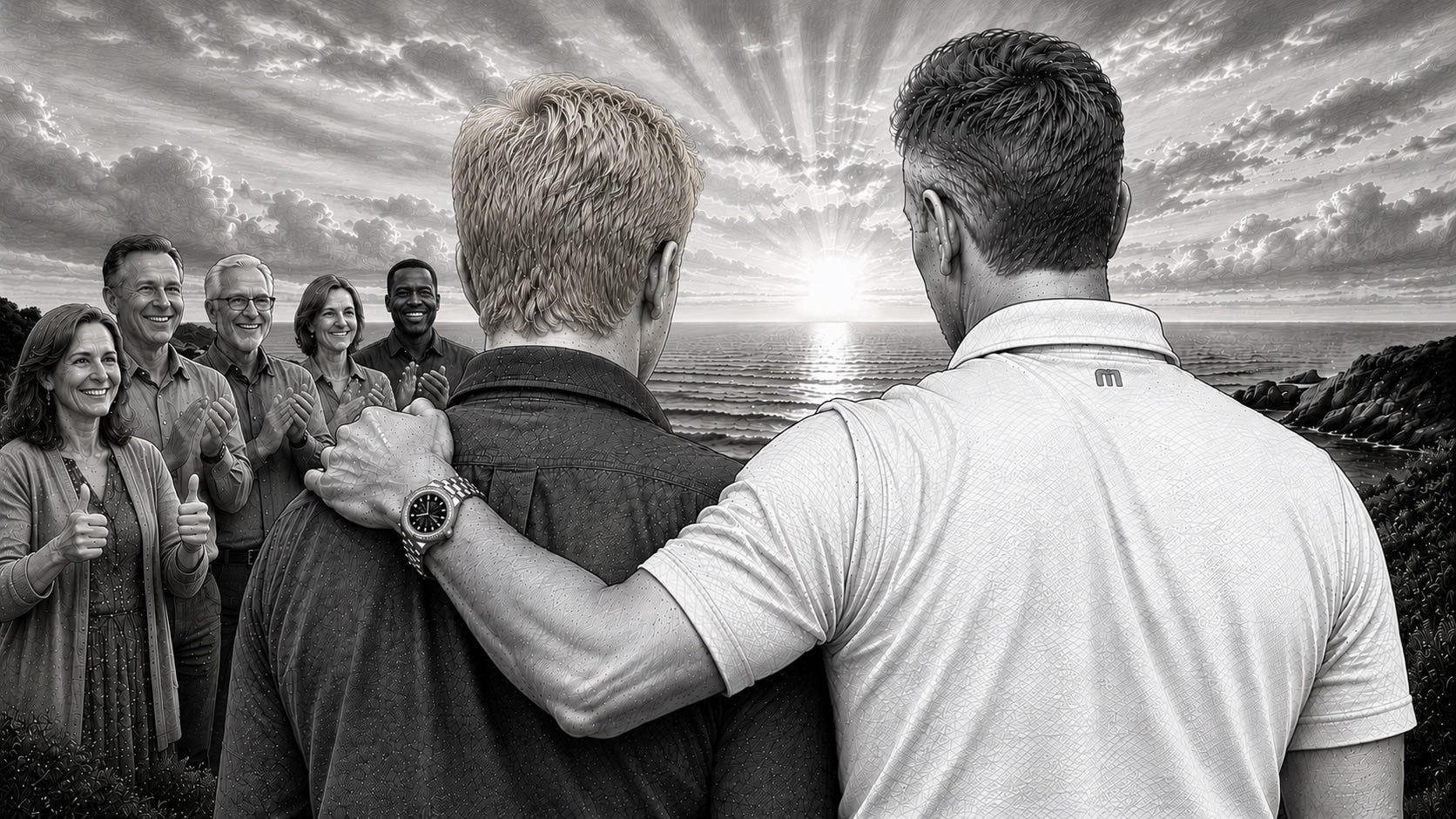
I am writing to you as a friend.
Not as a stranger on the internet. Not as some anonymous account yelling into a feed at two in the morning. I am writing as someone who has known you for years, who has sat across a table from you, who has watched you build a business and raise a family and earn a reputation you have every right to be proud of.
And I am worried about you.
I am not worried about your politics. I am worried about your name. I am worried about what people are going to say about you in five years, in ten years, at your retirement party, at your funeral, and in the quiet moment when your granddaughter looks up what you posted in 2026 and asks her mother what you were thinking.
This is not a disagreement over tax policy. This is not a fight about the border or trade deals or who should sit on a school board. Those are the arguments we have always had, and we have always come out the other side still willing to grab dinner. This is different, and somewhere deep down I believe you already know it.
Look At The Record Instead Of The Feed
Set aside every opinion you have heard on cable news. Set aside mine. Look at what courts and juries have found after hearing evidence under oath.
A Manhattan jury convicted this man on thirty four felony counts. Twelve ordinary Americans sat through weeks of testimony, examined the documents, and returned a unanimous verdict on every single count. He has been appealing ever since. The convictions stand.
A federal jury found him liable for sexually abusing a woman in a department store dressing room and then defaming her when she went public. He appealed. He lost. He appealed again. He lost again. Last month the Supreme Court of the United States, with three justices he personally appointed, refused to even hear his case. The verdict is now final. There is no court left to take it to.
I have spent decades in courtrooms. I have tried more cases to verdict than most lawyers. I want you to understand what a unanimous jury verdict actually represents. Twelve strangers, drawn at random, with nothing to gain, listened to sworn testimony and cross examination and reached agreement. Our entire system of justice rests on that process. You have defended that system your whole life. You have called it the greatest legal system in the world.
You defended it right up until the moment it returned verdicts you did not like.
The People Who Worked Beside Him Are The Ones Sounding The Alarm
Put aside all of his lying and name calling. In my opinion, here is what should stop you cold.
The loudest warnings are not coming from Democrats. They are coming from the people who sat in the room with him. His own vice president would not endorse him. His own secretary of defense called him a threat to democracy. His own national security adviser called him unfit. His own chief of staff, a retired four star Marine general who buried a son killed in combat in Afghanistan, went on the record to say this man meets the definition of a fascist and spoke admiringly of Hitler’s generals.
That general has no book to sell you and no seat to win. He gave his life to this country and lost a child doing it. He looked at the man he served and decided the risk of staying quiet was greater than the cost of speaking.
Business leaders who wrote him checks have walked away. Military officers who spent careers avoiding politics have started giving interviews. Influencers who built entire audiences on defending him have gone public with their regret and eaten the loss of followers to do it. Republican senators are breaking ranks. Longtime Republican voters are changing their registration.
Every one of those people paid a price for speaking. They spoke anyway.
Ask yourself what they see from the inside that you have been told not to look at.
Your Name Is Attached To All Of This
You need to hear this part plainly, because nobody else in your life is going to say it to your face.
Your family remembers. Your neighbors remember. Your clients and your employees and the people in your congregation remember. They remember the posts. They remember the arguments at Thanksgiving. They remember the flag on the truck and the hat in the office and the moment you told your own daughter she had been brainwashed by her college professors.
The internet does not forget, and neither do people.
I have watched a lot of you go quiet over the last seventeen months. The posts slowed down. The bumper sticker came off. The profile picture changed. I understand the instinct, and I want to be honest with you about what silence accomplishes.
Silence does not undo the record. Silence reads to everyone watching as a calculation rather than a change of heart. Going quiet protects you from a fight today and leaves the whole record standing tomorrow. The people who love you are waiting for something more than a quiet retreat. They are waiting for you to say out loud that you got this one wrong.
Silence is complicity, and complicity is what history writes down.
The Excuses Have Run Out
I have heard all of them.
You tell me you are a single issue voter. You tell me the economy matters more. You tell me you never liked the man personally and only supported the policies. You tell me both sides are corrupt and everybody lies.
I am telling you as your friend that nobody is buying it anymore.
You do not get to hand a man the power of the presidency and then disclaim responsibility for how he uses it. You do not get to cheer the demolition and then walk the site and say you only wanted the one wall moved. You handed him the keys knowing exactly who he was, because he told you exactly who he was, out loud, at every rally, for a decade.
The corruption is not hidden. The self dealing is not subtle. The contempt for the Constitution is announced from a podium and then defended by lawyers on television as though the rest of us are children. Our alliances are shredded. Our institutions are hollowed out. Our neighbors are afraid in ways I have never seen in my lifetime in this country. Families in my own town have stopped speaking to each other.
Repairing this will take years. Some of it will take a generation.
What I Am Asking You To Do
I am not asking you to become a Democrat. I am not asking you to abandon a single value you actually hold. Small government, personal responsibility, strong defense, faith, family, the rule of law. Keep every one of them.
I am asking you to notice that the man you have been defending has spent a decade betraying every item on that list.
So here is my ask, friend to friend.
Take a breath. Turn off the channel for one week. Step back from the feed for one week. No talk radio, no podcast, no rage clip served up by an algorithm designed to keep you angry enough to stay watching. Read the actual court decisions. Read what the generals said. Read what his own appointees said under oath.
Then say something. Out loud. In public. In your own words.
Tell your spouse. Tell your kids, especially the ones who stopped calling. Tell your friends at the club and your buddies in the group chat where this stuff gets passed around like gospel. Post it under your real name where the same people who watched you defend him will see you walk it back.
You do not need a long speech. Something like this will do. I supported this man. I was wrong. I looked at the evidence and changed my mind. I am not doing this anymore.
That is all. Nine seconds of courage.
Then vote like you mean it in November, and bring somebody with you.
You Have Room To Be Remembered Well
I know what I am asking costs you something. Admitting you were misled feels like admitting you were foolish, and pride is a hard thing to set down at our age. Your instinct will be to dig in and defend the position because reversing course in front of people who watched you take it feels like a small death.
Let me offer you a different way to see this moment.
Nobody remembers the person who was wrong for a while. Everybody remembers the person who had the guts to stand up and say so. Changing your mind in public when the evidence demands it is one of the rarest and most respected things a human being ever does. Your kids will remember the day you said it. Your grandchildren will tell that story about you.
There is still time. Not much of it, but there is still some.
The version of you I have known for twenty or thirty years is a decent person who got worked over by a machine built by people who never cared about you and only cared about their own power and their own money. I still believe that person is in there.
Come back. Say it out loud. Bring somebody with you.
Mitch Jackson, Esq
PS. If you have time, you will enjoy Red Hat, Blue Heart, One House: A Story of Quiet Resistance.
Send this to the one person you don’t want to lose over this, because the text takes ten seconds and the friendship took decades to build. Subscribe to Uncensored Objection and stand with the people willing to say this out loud in public, because silence never changed a single vote and your voice still can.
If this sober-minded call-to-action🙏 — even inaction undoing hurtful action🛑 — does not crack the cult of personality, then nothing will.⚖️ Good job, @Mitch Jackson!✌️
Mitch,
Your letter has been rattling around in my head because I've been wrestling with a version of this question for more than twenty-five years.
Unlike you, I don't have the luxury of speaking entirely as a private citizen.
I've spent nearly thirty years in the United States Air Force. My father was actually my recruiter. My military career has been unusual. I started in the Reserve, one weekend a month and two weeks a year. After Don't Ask Don't Tell was repealed and President Obama was reelected, I fulfilled a dream I'd carried for years and entered Active Duty. The military has been extraordinarily good to me. It gave me opportunities, purpose, lifelong friends, and a career I am deeply proud of.
Ironically, some of my deepest political convictions were shaped long before that.
When the Supreme Court decided Bush v. Gore, I genuinely believed George W. Bush was going to be the worst president in modern American history. Around that same period I came out to my father, a lifelong Fox News viewer and my own Air Force Reserve recruiter. He disowned me. He justified it by saying my being gay threatened his livelihood because he had recruited me.
I carried that hurt everywhere.
During the Bush years, my opposition consumed me. This was before Facebook gave everyone a megaphone, but I found ways to make my opinions known. Every drill weekend I pushed boundaries. Every conversation became political. I was convinced I was fighting for what was right.
Looking back, I don't regret caring.
I regret becoming consumed.
The anger didn't persuade anyone. It didn't heal my relationship with my father. It didn't make me happier. It didn't make me a better Airman, a better friend, or a better human being.
It just made me angry.
When President Obama was elected and Don't Ask Don't Tell was finally repealed, I honestly believed our country had turned a page. I thought we had acknowledged painful mistakes and were choosing to become a little kinder to one another.
Then came 2016.
I still remember the atmosphere inside the Pentagon after the election. It genuinely felt like a funeral. People were hugging in hallways. Some wore black. There was a profound sense that something fundamental had changed.
Then one of my coworkers, someone whose backyard wedding I had photographed only weeks earlier, walked into my office and said, "I don't understand why everyone is so upset. They're acting like just because you support him people think you're racist, xenophobic, or homophobic."
I remember sitting there stunned.
Not because she had supported him.
Because I realized I had completely misunderstood someone I thought I knew.
That moment taught me something uncomfortable. Politics has an incredible ability to reveal differences we never imagined existed, but it also has an incredible ability to convince us that every disagreement must become a permanent fracture.
This time, I made myself a promise.
I would not become the version of myself I had been during the Bush years.
Not because I cared any less.
Because I had learned that constant outrage had accomplished almost nothing except making me miserable.
Today, I occupy an even stranger place.
As a member of the military, I swore an oath to support and defend the Constitution, not any individual president. At the same time, I have professional obligations that limit what I can publicly say about the Commander in Chief. That isn't oppression. It's part of serving in an institution that must remain politically neutral.
So while others are free to post, argue, and protest however they choose, I often remain silent.
Some people mistake that silence for agreement.
It isn't.
Sometimes it's simply duty.
I'm also three years away from retirement. That retirement means a pension, health care for my husband and me, and the security we've spent decades building together. Throwing all of that away for one angry Facebook post wouldn't serve either of us.
So here's the question I've been wrestling with.
If someone believes democracy, constitutional norms, or the character of our leaders truly matter, but they're also bound by professional obligations that require restraint, what does responsible citizenship actually look like?
How do you educate without becoming consumed?
How do you persuade without becoming self-righteous?
How do you remain engaged without allowing politics to become your entire identity?
I've already lived one version of political obsession.
I don't want to live another.
You wrote your letter as a friend.
So let me ask, friend to friend:
What would you tell someone in my position?
Someone who cares deeply.
Someone who cannot simply say whatever he wants.
Someone who has learned that outrage is emotionally satisfying but rarely persuasive.
What does effective citizenship look like then?
Because after thirty years of serving this country, that's the question I'm still trying to answer.