

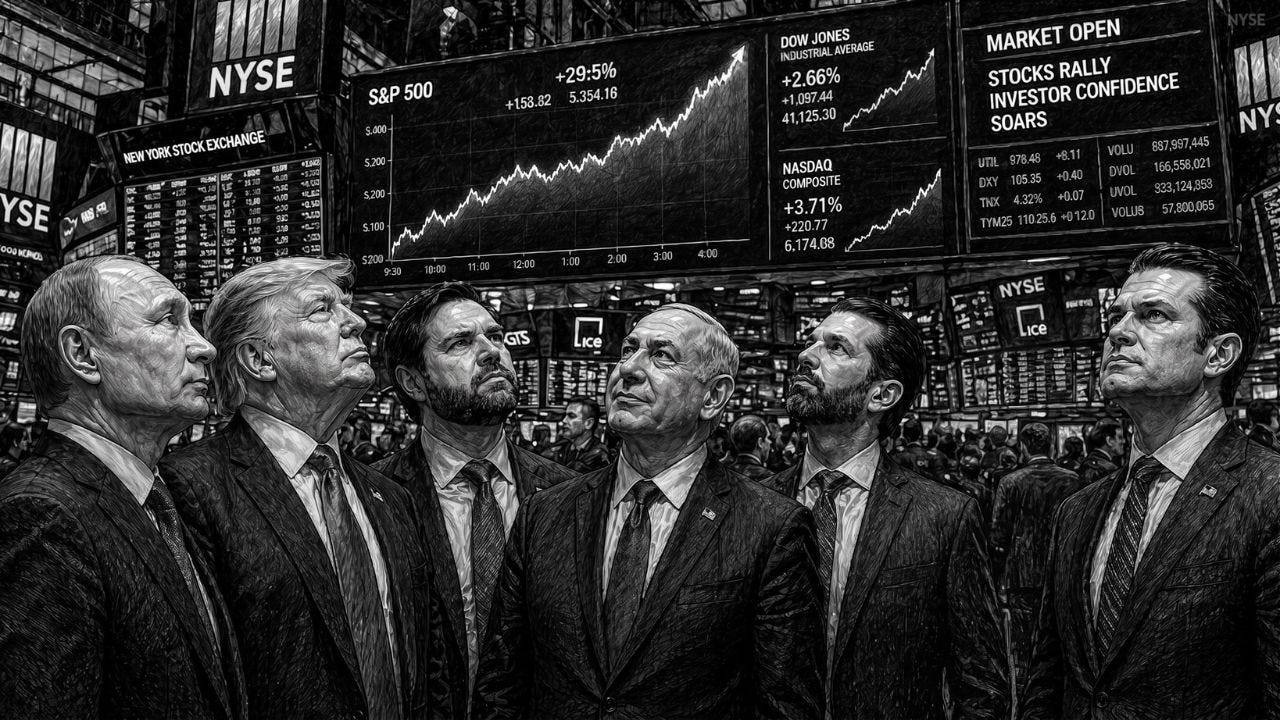
Forty-seven minutes. That is how far ahead of the public someone placed a surge of bets on falling oil prices before CBS posted Donald Trump’s interview on March 9, the one where he said the Iran war was “very complete, pretty much.” Brent crude, one of the two main global benchmarks for oil pricing, dropped around 25% the moment the public finally saw the quote. The bets were already stacked. The winners were already paid.
Fourteen minutes. That is the head start the second time, on March 23, when Trump posted about a “COMPLETE AND TOTAL RESOLUTION” to hostilities with Tehran. Oil trading volumes on Brent futures jumped from 41 contracts at 10:30 GMT to 1,619 at 10:49 GMT, roughly 14 minutes before his Truth Social post hit at 11:04. The price fell 11% one minute later.
Eighteen minutes. That is the window on April 9, 2025, when traders loaded up on S&P 500 contracts right before Trump announced his 90-day tariff pause and sent the index to one of its largest single-day gains since World War II.
The BBC pulled the receipts this week. A report by Business reporter Nick Marsh, published April 20, 2026, examined volume data across major financial markets and matched it against the president’s most significant market-moving statements. The result is not ambiguous. The result is a pattern. Somebody, or somebodies, keep landing on the right side of the trade exactly when Donald Trump is about to move the world.
You deserve to know who. You deserve to know how. And you deserve to know why the agencies responsible for stopping this are already on pace to do nothing about it.
The Five Trades That Should End Careers
The BBC laid out five examples. Take them in sequence and the pattern becomes impossible to dismiss as coincidence.
Example one. March 9, 2026. Oil futures, Brent crude. At 18:00 GMT, Brent was trading a modest volume of 884 contracts. Each contract represents 1,000 barrels. Around 18:29 GMT, volume spiked to 4,141 contracts. That surge came 47 minutes before a CBS reporter posted the Trump interview on X at 19:16 GMT. One minute after the post went public, the price dropped 25%. The traders who were already short made millions.
Example two. March 23, 2026. Oil futures, same setup. Between 10:48 and 10:50 GMT, bets surged. At 11:04 GMT, Trump posted his “VERY GOOD AND PRODUCTIVE CONVERSATIONS” message. At 11:05 GMT, oil fell 11%. An oil analyst told the BBC the trading looked “abnormal, for sure.”
Reuters later pegged the scale of that March 23 move at roughly $500 million in crude oil futures bets placed 15 minutes before Trump’s post. Rep. Ritchie Torres wrote to the SEC and CFTC on April 8 calling it potentially one of the largest instances of insider trading in history. Read that sentence again. A sitting member of Congress on the House Financial Services Committee used those exact words in an official letter.
Example three. April 9, 2025. “Liberation Day” tariff pause. A week after Trump’s April 2 tariff announcement tanked the market, traders started piling into S&P 500 contracts at 18:00 BST. Contracts jumped to over 10,000 per minute. Earlier that day the number had been in the hundreds. At 18:18 BST, Trump posted the 90-day pause. At 18:19 BST, the market began a historic surge. The S&P 500 gained 9.5% on the day. Some traders bet over $2 million on the rally even after seven consecutive losing sessions. The potential profit was close to $20 million.
That same morning, at 9:37 a.m. Eastern, Trump posted on Truth Social: “THIS IS A GREAT TIME TO BUY!!! DJT.” The signature doubled as his initials and the stock ticker for Trump Media. Less than four hours later, the pause was announced. Trump Media closed up nearly 23% that day.
Example four. January 3, 2026. Nicolás Maduro seized. In December 2025, a Polymarket user created an account named “Burdensome-Mix.” Starting December 30, the account wagered $32,500 on Maduro being out of office by the end of January. U.S. special forces seized Maduro on January 3. Burdensome-Mix collected $436,000. The account changed its username and has not placed a bet since.
Example five. February 28, 2026. U.S. strikes on Iran. Six accounts, all created on Polymarket in February, wagered that the U.S. would strike Iran by February 28. When Trump confirmed the attacks in the early hours of February 28, those accounts collected $1.2 million. The pattern came from blockchain analytics firm Bubblemaps. Five of the six accounts went silent. One of them came back to win another $163,000 on correctly calling the April 7 U.S.-Iran ceasefire.
The president’s eldest son, Donald Trump Jr., is an investor in Polymarket, sits on its advisory board, and serves as a strategic advisor to Kalshi. The BBC reported contacting him for comment.
The Hegseth-BlackRock Bombshell
The BBC report is the starting point. The ugliest single allegation sits in reporting by the Financial Times dated March 30, 2026.
A Morgan Stanley broker managing money for Defense Secretary Pete Hegseth contacted BlackRock in February 2026 to make a multimillion-dollar investment in the iShares Defense Industrials Active ETF. That fund, with roughly $3.1 billion under management, holds RTX (formerly Raytheon), Lockheed Martin, and Northrop Grumman. The inquiry was flagged internally at BlackRock as tied to a high-profile prospective client.
The trade happened in the weeks before the February 28 U.S.-Israeli strikes on Iran. Hegseth is described in reporting as among the chief architects of the Iran war and one of the administration’s most vocal advocates for military action. The investment did not close because the fund had not been made available to Morgan Stanley clients at that point.
Pentagon spokesman Sean Parnell denied the report, calling it “entirely false and fabricated” and demanding a retraction. The Financial Times stood by the reporting.
Senator Elizabeth Warren, Ranking Member of the Senate Banking, Housing, and Urban Affairs Committee, sent a formal letter to SEC Chairman Paul Atkins on April 20, 2026, requesting an investigation. Her letter cited the STOCK Act of 2012 and federal securities law, noting that executive branch employees owe a duty of trust and confidence to the United States with respect to material nonpublic information from their positions. Warren set a deadline of May 15, 2026, for SEC responses to five specific questions, including whether the SEC has investigated Hegseth or any individual associated with him.
Thirteen U.S. service members have been killed in the Iran war to date. More than 300 have been wounded. Thousands of civilians have died across the Middle East. The sitting Secretary of Defense, the man who helped plan the strikes, had a broker trying to buy defense stocks in the weeks before the bombs dropped.
Let the weight of that land.
The Liberation Day Roster: Names, Dates, Dollars
The BBC investigation did not surface the Liberation Day trades in isolation. ProPublica broke the roster of administration officials who sold stock before Trump’s April 2, 2025 tariff announcement crashed the market. Read the list:
- Attorney General Pam Bondi sold between $1 million and $5 million worth of Trump Media shares on April 2, 2025. That is the same day the Liberation Day tariffs were announced after the market closed. Her ethics agreement required her to sell by early May. Why she sold on that exact day remains unanswered. The Justice Department has not responded to reporters.
- Transportation Secretary Sean Duffy sold 34 stocks worth between $90,000 and $650,000 on February 11 and 13, 2025. Trump announced plans for reciprocal tariffs on February 13. The S&P 500 fell almost 19% in the weeks that followed.
- Stephanie Syptak-Ramnath, then-U.S. Ambassador to Peru, sold between $255,000 and $650,000 in stocks on March 24 and 25, 2025, and moved the proceeds into bonds and treasuries. On March 31, two days before Liberation Day, she sold another $15,000 to $50,000 of a broad-based stock fund.
- Gautam Rana, now Ambassador to Slovakia, sold between $830,000 and $1.7 million in stock on March 19, 2025. The shares were largely broad-based index funds. He sold two weeks before Liberation Day.
- A key official in the U.S. Trade Representative’s office sold Target and Freeport-McMoRan shares on March 25 and 27, 2025, after purchasing them less than a week earlier. Target dropped 17% after Liberation Day. Freeport-McMoRan dropped 25%.
- A White House lawyer sold shares in nine companies just before a significant tariff announcement.
Add the congressional piece. Rep. Marjorie Taylor Greene bought between $21,000 and $315,000 of stock the day before and the day of the April 9, 2025 tariff pause announcement. Ryan White, chief of staff to Sen. James Risch, an Idaho Republican, bought between $2,000 and $30,000 in shares of two precious metals mining companies, Hecla Mining and Coeur Mining, two days before Liberation Day. Two days after White’s last April purchase, a Senate committee advanced a bill introduced by his boss that would make it easier for mining companies like those to operate on public lands.
ProPublica counted more than a dozen high-ranking executive branch officials and congressional aides making well-timed trades since Trump took office in January 2025. Most of them sold before the market plunged on tariff news.
The official talking point is always the same. An outside manager made the trades. The official had no input on the timing. Ethics experts consider that defense one of the strongest against insider trading allegations. The defense is strong because insider trading cases are almost impossible to prove when the government official can always point to a broker and say “they did it.”
That is the loophole. That is the feature, not the bug.
The Polymarket Problem
Prediction markets sit at the center of the story because they accept anonymous crypto wallets, operate largely outside U.S. jurisdiction for their offshore products, and pay out instantly. Put another way, if you have advance information on a U.S. military strike and you want to convert it to cash without leaving a SEC-traceable brokerage paper trail, Polymarket is a dream tool.
The BBC report, CNN reporting, and congressional letters have surfaced additional patterns:
- At least 50 Polymarket accounts placed heavy “Yes” bets on an April 7 U.S.-Iran ceasefire as their first-ever wagers, just hours before Trump announced the conditional agreement. One account placed about $72,000 and profited $200,000.
- Three Polymarket accounts collected more than $600,000 by correctly betting on the timing of the Iran ceasefire.
- An account trading under the handle “Magamyman” made $553,000 on Polymarket through bets placed on the eve of the Iran war, including a wager that Ayatollah Ali Khamenei would be out of power just before an Israeli strike killed him on February 28. The account’s first position came approximately 71 minutes before news of the strikes broke publicly.
- A Harvard study estimated that $143 million in Polymarket profits may have been generated through insider information.
- Polymarket apologized earlier this month for briefly offering markets on the fate of U.S. service members shot down over Iran.
Remember who has the financial interest. Donald Trump Jr. is on Polymarket’s advisory board as an investor. He is a strategic advisor to Kalshi. The president’s son is personally positioned to benefit from the growth of the platforms where his father’s announcements produce six- and seven-figure payouts for anonymous accounts.
On March 24, 2026, the White House Management Office sent a staff-wide memo warning that using nonpublic information to place bets on prediction markets is a criminal offense. The memo cited press reports. It went out the day after Trump paused military strikes against Iran on March 23, the very announcement that moved roughly $500 million in oil futures 15 minutes in advance.
A White House that feels the need to remind its own staff in writing not to commit insider trading on prediction markets is a White House that already knows what is happening inside its building.
Spokesman Davis Ingle responded to the BBC with the line that allegations against administration officials are “baseless and irresponsible reporting.” Ingle’s statement is now a reusable document in the administration’s public relations folder. You will see it again.
The Regulators Who Will Not Regulate
The agencies that should be enforcing the law are sending clear signals about what they plan to do.
The SEC. Chairman Paul Atkins has a history with Senator Warren. She has publicly accused him of conflicts of interest tied to the financial services industry. When the BBC asked whether the SEC is looking into any of the allegations, a spokesman declined to comment. The SEC’s top enforcement official recently resigned after clashing with agency leadership over pursuing cases tied to people in Trump’s orbit. The SEC has now tapped David Woodcock, a Gibson Dunn lawyer and former agency official, as the next enforcement director.
The CFTC. Bloomberg reported on April 15, 2026, that the CFTC has opened an investigation into suspiciously well-timed oil futures trades before Trump’s Iran policy shifts. The probe is reportedly focused on the March 23 and April 7 episodes, covering activity on CME Group’s NYMEX and the Intercontinental Exchange. The regulator is requesting “Tag 50” identity data from the exchanges, which identifies the entity or person behind each trade. It declined to comment publicly. Chairman Michael Selig told a congressional committee the agency has “zero tolerance” for fraud and insider trading. Those are the right words. History says the follow-through almost never matches.
The DOJ. The Public Integrity Section, created in the wake of Watergate to prosecute corrupt officials, has been reduced from 36 lawyers to 2. Read that number again. Two lawyers. In the entire unit designed to prosecute federal public corruption. That is not a policy choice. That is a message.
Rep. Torres put the problem in plain English when he said he has lost confidence in our market regulators and has to agitate for accountability because nothing else is working.
The Law On Paper And The Law In Practice
Here is what federal law says.
The Securities Act of 1933 has prohibited insider trading for more than nine decades. The Stop Trading on Congressional Knowledge Act of 2012, the STOCK Act, extended those prohibitions explicitly to executive branch officials including the president, vice president, and cabinet members. Under Section 9, executive branch officers owe a duty of trust and confidence to the United States government and to the American public regarding material nonpublic information derived from their positions.
Penalties are severe on paper. Individual fines can reach $5 million. Entity fines can reach $25 million. Securities fraud convictions under 18 U.S.C. 1348 carry up to 25 years per violation. Attempts to commit securities fraud are criminalized alongside completed acts. The SEC can demand disgorgement of gains and impose civil penalties up to three times the profit gained or loss avoided. Public officials convicted of such conduct can lose security clearances, face impeachment, and be barred for life from serving as officers or directors of public companies.
Here is what federal law does in practice.
Zero executive branch officials have ever been prosecuted under the STOCK Act. Not one, since 2012. Paul Oudin, a professor specializing in financial regulation law at ESSEC Business School, told the BBC that authorities will not bring a prosecution if they cannot identify the source of the leaked information. That is the whole game. The same feature makes insider trading inside government nearly impossible to prove in practice.
A trader can place a $500 million oil futures bet through a shell entity 15 minutes before a market-moving White House post. The SEC and CFTC can trace the trade to a brokerage. The brokerage can point to an offshore corporate customer. The offshore corporate customer can point to a nominee. The nominee can point to nobody. And the criminal case dies there, in the sand.
This is not a bug. This is how the wealthy and the connected have always played it. Trump, his family, and the officials around him inherited a system built to protect insiders. They are using it.
Why This Matters To You
When the Secretary of Defense’s broker reaches toward defense stocks weeks before a war, you are paying for that conflict with lives and taxes. When oil futures move on advance knowledge of a Truth Social post, you are paying at the pump as gasoline prices swing on political announcements. When stocks in Trump Media or Target or Freeport-McMoRan gyrate on tariff news, you are watching your 401(k) get front-run by people with government jobs and government information.
Market integrity is not an abstraction. It is the thin line between a free economy and a kleptocracy. When the public believes the game is rigged, the public disengages. When foreign investors believe the game is rigged, capital flees. When small investors believe the game is rigged, the retirement savings of ordinary Americans become the feedstock for a small circle of insiders.
Integrity at the top produces integrity at the bottom. Corruption at the top produces corruption everywhere.
What Comes Next
Track these five markers over the next 60 days.
One. Whether the SEC responds to Senator Warren’s April 20, 2026 letter by her May 15 deadline. Real answers to her five questions would be a first step. Stonewalling would be an answer of its own.
Two. Whether the CFTC publicly confirms its investigation into the March 23 and April 7 oil trades or continues to operate only through anonymous Bloomberg sources. A public confirmation under oath would force the administration’s hand.
Three. Whether any of the Polymarket accounts flagged by Bubblemaps get tied to a real identity through blockchain analysis and legal process. The technology exists. The political will is the question.
Four. Whether the Senate Banking Committee holds a formal hearing with testimony under oath, or the demand letter sits in a file cabinet. Schumer, Warren, Wyden, Schiff, Kelly, Gallego, Whitehouse, Blumenthal, and Kim have all put their names on letters. Letters are not hearings. Hearings are not subpoenas. Subpoenas are not indictments.
Five. Whether Donald Trump Jr. answers any question about his financial relationships with Polymarket and Kalshi as those platforms pay out millions to anonymous accounts betting correctly on his father’s military decisions.
Save this article. Save the names. Save the dates. When the administration tries to rewrite the timeline, you will have the receipts.
The Bottom Line
The BBC investigation is not a British government probe. That is important to say clearly. The investigation is a piece of journalism produced by BBC reporter Nick Marsh using public market volume data cross-referenced against the president’s public statements. The underlying evidence is open source. Any reporter, any citizen, any regulator can run the same analysis.
The evidence shows a consistent pattern of trading spikes minutes and hours before Donald Trump moves the markets with his mouth. The evidence shows Polymarket accounts appearing out of nowhere, winning huge sums on U.S. military actions, and vanishing. The evidence shows a cabinet secretary’s broker reaching for defense stocks weeks before a war he helped plan. The evidence shows more than a dozen executive branch officials selling stock days before tariff announcements that crashed the market.
The evidence is not complicated. The evidence is in the timestamps.
The people who benefit from this system will tell you the evidence is circumstantial. They will tell you traders are simply adept at reading Trump. They will tell you coincidences happen. They will tell you the free market is self-correcting. Then they will collect their money and go home.
You do not have to accept that.
You can share this article. You can call your representatives. You can demand the hearings. You can follow the Tag 50 data. You can track whether Warren’s deadline gets honored. You can refuse to look away.
The timestamps do not lie. The trades do not lie. The winners do not lie. And the silence from the SEC, the DOJ, and the White House is not an absence of facts. It is the facts, screaming.
Mitch Jackson, Esq.
Governments don’t announce what they’re doing.
They file it.
They hide it in procurement notices and sentences engineered to make you stop reading.
I don’t stop.
I read the paperwork, find what matters, and translate it into plain English.
That’s the work your upgrade funds.
i keep the front page of the WSJ open on my desktop and it’s impressive to watch the DOW and oil commodity futures go up and down round and round every time The Shitbag or Kegsbreath opens his mouth. It’s a thing. our owners are making hundreds of millions of $$$ off this war and by extension us.
Progressive policies are good for rural America. A majority of voters in rural America do not believe that Democrats and progressive policies will help them. They actually believe Republicans have been helping them. Why do voters choose not to vote or choose to vote for Republicans? Fear. They fear Democrats. Rural voters distrust Democrats. Democrats must win back trust.
How? Behave differently at all levels, in highly visible ways. The image must change for the voter’s feelings to change. To win over non voters and rural voters, invite them to take a fresh look. New leaders must send a bold message to rural voters. The message is: “We Serve You!” Democrats must change to open the doors to rural America. Make a rancher in Montana or a farmer in Idaho notice. New leaders must be credible when campaigning for the next Democratic candidate for Governor or Senator in rural America.
Take bold, visible steps. Before November, produce a list of self-imposed demands similar to these: the Party’s Presidential Nominee will not be older than 60, Senators will not seek election or reelection if the six year term will put them past the age of 68, Senators and House Members will not serve beyond eighteen years in one chamber. Introduce legislation that ends the pipeline into lobbying firms, ends stock trading by members and staff, provides all Americans the same healthcare options as members of Congress. Find other extremely popular issues critical to rural voters, include them.
Seize the initiatives begun by the No Kings protests and Anti-Ice protests. Use the new energy, organizations, and local community groups. Plans for rural areas must be flexible and repeatable. Build momentum and success quickly.