

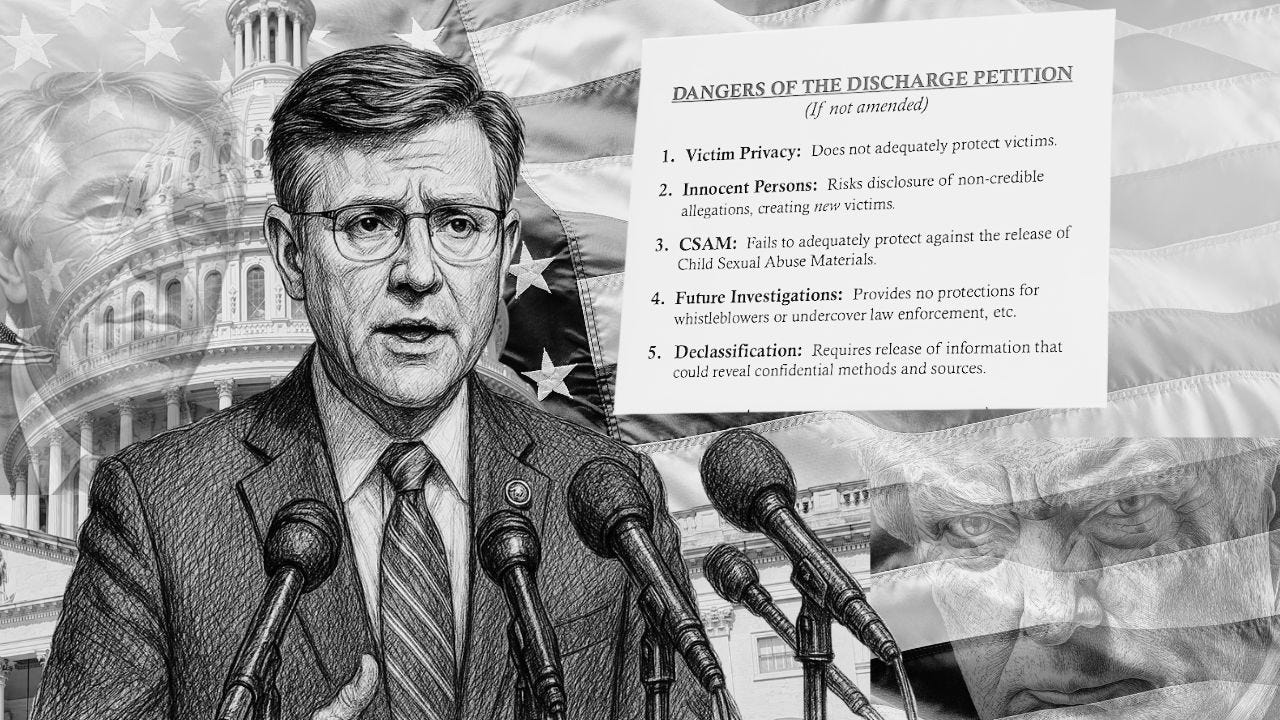
Legally the discharge petition protects victim identity, national security, and active investigative work. Secrecy has limits. The petition forces sunlight into a place that has stayed dark for far too long. This is what accountability looks like in a functioning democracy.
The public deserves honesty when it comes to accountability. This morning’s press-conference remarks by Speaker of the House, Mike Johnson, standing next to his sign “DANGERS OF THE DISCHARGE PETITION” attempted to sound cautionary and principled. Yet underneath that veneer lies a wall of misrepresentations, omissions, and distortion.
The petition he attacked is the one forcing disclosure of the Jeffrey Epstein files. Voters need clarity on why the petition matters, why opposition like Johnson’s is problematic, and why full, transparent release of the files is necessary, lawful, moral and long overdue. I will walk you through each of Johnson’s four stated concerns and show you why they’re full of bullsh*t. I’ll show show you how they fall apart under scrutiny, and explain why your voice and participation matter.
Johnson’s concern #1 – Victim privacy: “Does not adequately protect victims.”
Johnson claims the discharge petition threatens victim privacy. He depicts the release as a danger to survivors, particularly minors. He speaks of compassion for victims, so this sounds reassuring.
Reality shows that the proposed legislation includes redactions of identifying details of victims, minors, and sex-abuse materials. The petition law directs the Department of Justice to release all “unclassified records, documents, communications and investigative materials” related to Epstein. The text explicitly exempts victim identifying details and any material that depicts child sexual abuse.
Johnson omits that survivors and advocacy groups have called for transparency. To frame the petition as hostile to victims is misleading. Survivors want accountability and full exposure of how the system failed them. They have waited years. They are not opposed to redactions that protect them. They are opposed to secret systems, closed doors and power unaccountable.
Releasing the files lifts the veil. It shows how government agencies, prosecutors, law-enforcement, defense attorneys, judges, powerful elites may have allowed abuse, enabled cover-ups, or turned blind eyes. That is what victims demand.
In short, the petition does protect victim confidentiality in its language; the real protection would have been long ago if transparency were standard. This is not permission to expose their identity or harm them; this is a demand for truth and justice. If we stand for survivors, we support full disclosure with the safeguards built-in.
Johnson’s concern #2 – Innocent persons: “Risks disclosure of non-credible allegations, creating new victims.”
Johnson argues that releasing raw investigatory materials will dump unverified allegations into the public, harm reputations, create victims of false claim, and damage innocent persons. The argument appeals to fairness, but it assumes secrecy is safer.
The petition’s language accounts for that risk by requiring redactions and by dealing only with unclassified materials. Johnson’s fear ignores the fact that decades of secrecy have left the powerful question-free and the abused invisible. Transparency has standard practices: redacting names, omitting material that could compromise privacy or legal rights. What Johnson fails to mention is that the status quo already harmed countless individuals by concealing wrongdoing and letting it fester.
Moreover, the public interest in releasing those files is enormous: we learn whether prosecutors pressed charges, why immunity deals happened, how influential figures operated behind the scenes. If names of innocents appear, fairness demands that they too have recourse. It is not a moral winning strategy to block all release on fear of some reputational harm. That leads to permanent impunity.
The petition allows release under rules that protect credibility and privacy; the obstruction the Speaker advocates undermines justice. For everyday citizens this matters: your trust in the system depends on transparency. If powerful people are exempt from scrutiny while you are not, democracy suffers.
Johnson’s concern #3 – CSAM: “Fails to adequately protect against release of Child Sexual Abuse Materials.”
This concern is emotionally forceful: no one disputes that imagery of child sexual abuse must never become public. Johnson claims the petition lacks adequate guardrails.
In reality, the legislation explicitly prohibits release of material that is child sexual abuse material (CSAM). The bill text instructs the DOJ to withhold and redact any documents or records that depict or contain CSAM. The very existence of this clause undermines Johnson’s argument. His omission of that fact misleads the public into believing there is no protection at all.
In fact, the petition strikes a balance: it insists on accountability while enshrining protections. The Speaker’s use of this point is rhetorical distraction. He acts as though he is the guardian of minors, when the language of the bill already does so. If he believed the bill inadequate he should have proposed amendments earlier, instead of stalling on a political basis. For you as a voter it matters to hold leadership to truth. If CSAM is safeguarded in statute then fear-mongering about its release serves only to delay oversight and justice.
Johnson’s concerns #4 and #5 – Future investigations and Declassifications: “Provides no protections for whistleblowers or undercover law enforcement, etc.”
Johnson asserts that the petition will expose methods, sources, undercover agents, compromise ongoing investigations. Reality of the legislation: the bill allows withholding of classified information and material that could jeopardize national security or ongoing investigations. That includes source protection and law-enforcement concerns.
Thus Johnson’s claim of “no protections” is false. He ignores those built-in exceptions. He complains that the House cannot amend the bill after it is filed via discharge petition; that procedural truth does not erase the substance of protections.
The logic for release is strong: many of the investigations ended years ago or remain stalled, and the public deserves transparency about all government actions or inactions involving Epstein and his associates. If whistleblowers exist they will have stronger back-up when the files are public and scrutiny evident. If undercover operations are ongoing this statute gives the DOJ room to withhold the sensitive bits. Johnson’s portrayal suggests zero safeguards, when actual language grants those safeguards.
For you as a citizen this is about oversight of power. If the system claims it needs secrecy to protect methods but uses that claim to dodge scrutiny, the shield becomes a trap.
Why release is necessary, legal, ethical and appropriate
The petition to release the Epstein files is consistent with America’s principle of accountability. Federal law grants Congress oversight of the Justice Department. The petition forces the release of unclassified records. That is clearly within Congress’s power. The bill passed the House 427-1 and the Senate by unanimous consent on November 18, 2025. Its passage demonstrates bipartisan consensus.
Ethically the survivors of Epstein’s trafficking, exploitation and abuse deserve truth. It is a moral failing of the justice system that so many allegations, deals, immunity arrangements remain hidden. Full transparency honors their dignity, restores public trust and brings institutional accountability.
It must be remembered that the files relate to one of the worst criminal networks in recent memory. The public interest is enormous. Powerful individuals were involved. Government officials may have been complicit or negligent. When the machinery of crime touches elites and institutions trust is damaged. This release helps rebuild it.
Legally it is structured so that legitimate concerns about victim identity, national security, and investigations are respected. The legislation allows redactions and exclusions. Secrecy is not absolute. The petition opens the door to daylight. That is how democracy works.
If you believe that justice applies to everyone, that power should answer to you and your fellow citizens, you will support this petition. If you think the wealthy and connected should remain hidden behind doors closed to you, then you will follow Johnson’s caution. Choose which side you’re on.
Why the release could have happened already under President Donald Trump
When Trump began his second term in January 2025 he held full authority to order the Justice Department to publish unclassified records pertaining to Epstein. He did not. That failure is significant. Presidents sometimes claim that investigations, prosecutions, national security concerns prevent full disclosure. But delay continues to benefit those in power and delays relief for victims.
That Trump did not act earlier suggests that his administration preferred status-quo secrecy. That leaves you, the voter, asking: whose interests are being served by the delay? The public interest demands action. The petition forced Congress’s hand. Better late than never, but the fact that the nation waited until November is a failure of leadership. You deserve leaders who respond swiftly when injustice arises, not delay tactics.
Seven years after Epstein’s death and the unraveling of his network you still demand answers. Allowing extraordinary secrecy for extraordinary power bites at the heart of your democracy. If the president cannot or will not act, Congress must.
What you must do
Ask your representatives if they’ll hold the DOJ to the deadlines in the law? Will they demand no amendments that weaken transparency? Call, email, show up. Talk to friends, family, neighbors. This is your democracy, not theirs alone.
Observe how the GOP leadership frames the release. Watch for arguments that the bill is “flawed” or “rushed” or “dangerous to victims”. Those phrases are weaponized. They drown the core message: victims’ justice, accountability, sunlight.
If you believe that the powerful should not be hidden from scrutiny because they have money, fame or access then speak up. This matter is bigger than one man, one bill, one scandal. It is about whether your government belongs to the people.
Mitch Jackson, Esq. | links
One Final Point…
Johnson “falsely claimed” the bill “cites the wrong provision of the federal code” and is “unworkable.”
He’s misleading you and he knows it.
The fact is, The Epstein Files Transparency Act “correctly identifies the primary, controlling federal statutes governing and prohibiting CSAM, 18 U.S.C. 2256 and 18 U.S.C. 2252–2252A.” The act uses the same CSAM definitional approach as several recent bipartisan laws Johnson himself supported and voted for.
An outside legal analysis, released months before this vote, publicly called out Johnson’s “wrong provision” claim and lined up the citations in black and white.
In summary, Johnson’s claim centers on this sentence in the Epstein Files Transparency Act: CSAM “as defined under 18 U.S.C. 2256 and prohibited under 18 U.S.C. 2252–2252A.” That structure matches how federal law already treats child sexual abuse material. It gives the Attorney General clear authority to redact or withhold that content. It fits alongside existing criminal bans that already forbid release of CSAM to the public.
So when you hear Johnson say the petition “cited the wrong section” and forces DOJ to release child abuse images, you are hearing a technical sounding argument that collapses under basic legal scrutiny. The statute he attacks tracks the very code sections Congress and DOJ already use to define and prosecute this material.