

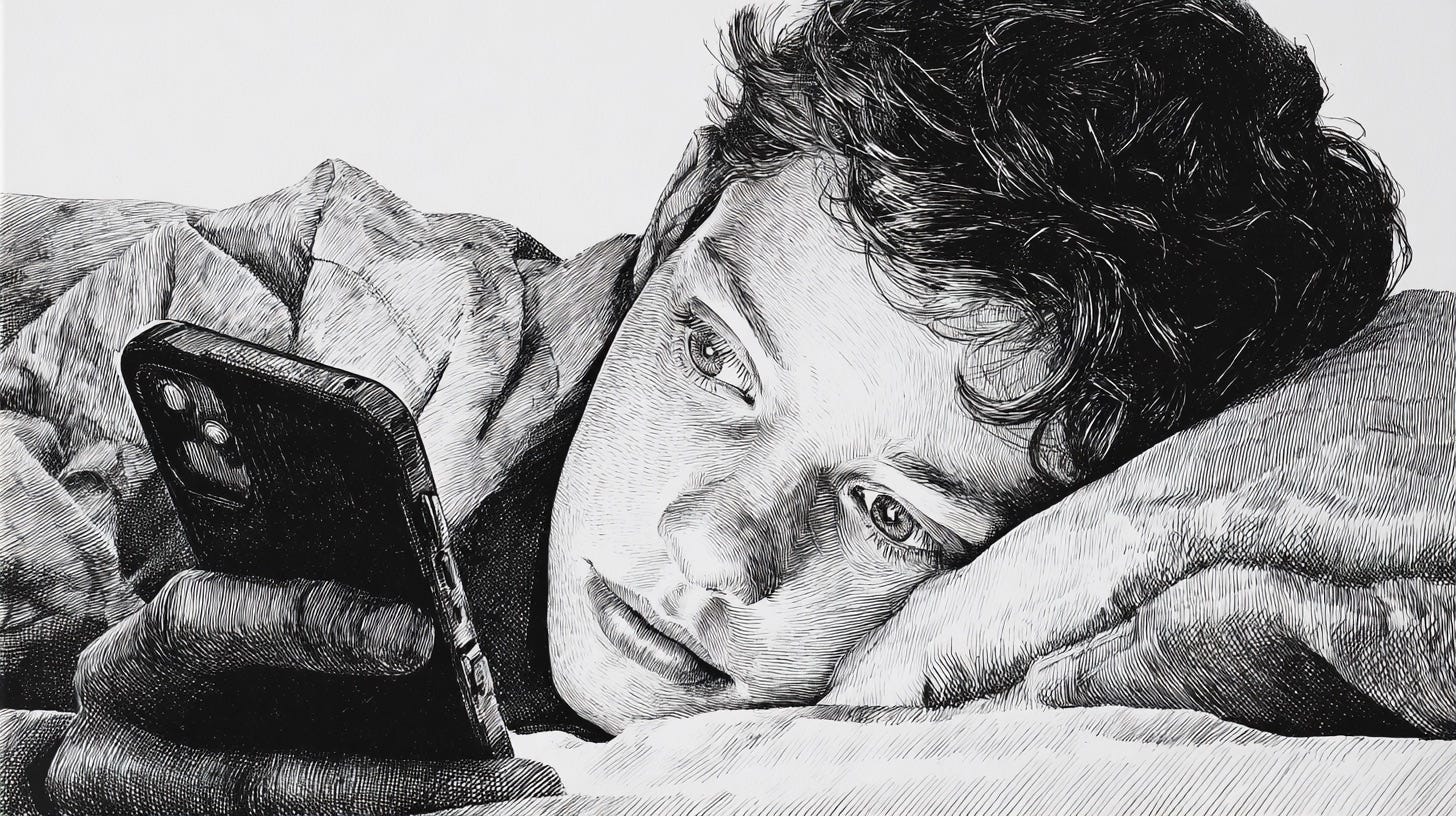
What happens when a company knows its product is wrecking children and sells it to them anyway? What if that company pulls in more than two hundred billion dollars a year and its CEO sits on a witness stand, looks a jury in the eye, and says the product is not addictive? And what if a jury says you are wrong, sir, we see you, we see your internal documents, and we are holding you accountable?
That is what happened today, March 25, 2026, in a Los Angeles courtroom. A California jury found Meta and YouTube negligent for the way they designed their platforms and determined that both companies caused direct harm to a young woman who started using their products as a child. The jury ordered them to pay a combined six million dollars.
Six million dollars.
Meta made two hundred billion dollars in revenue last year. YouTube, owned by Alphabet, helped its parent company cross four hundred billion in annual revenue for the first time. Six million dollars does not even register on their balance sheets. It is a rounding error on a rounding error.
The liability verdict is correct and important. But the dollar amount is an insult. And in a country where the people in charge seem more interested in protecting corporate power than protecting your kids, this case tells you everything you need to know about where we stand and why you need to pay attention.
What This Case Was About
A young woman from Chico, California, identified in court records as K.G.M. and known by her first name Kaley, filed a lawsuit in 2023 against Meta, Google’s YouTube, Snap, and TikTok. She is now 20 years old. She started using YouTube around age 6 and created an Instagram account at age 9, even though the platform requires users to be at least 13.
Her legal team argued that these platforms were designed the same way slot machines are designed, with features engineered to trigger compulsive behavior and keep users locked in. Infinite scrolling, autoplay videos, algorithmic recommendations that feed you more of what gets a reaction, push notifications timed to pull you back in, and beauty filters that warp how a young person sees their own face. Every single one of those features was a deliberate engineering decision. And every single one of those decisions was made to keep users on the platform longer so the company would sell more ads.1
Kaley testified that she spent hours each day on Instagram, posted hundreds of photos using beauty filters to disguise her own insecurities, and described how the platforms consumed her life. She experienced depression, anxiety, body dysmorphia, and thoughts of self harm. She described using social media as an escape from bullying at school, and it became the thing that made everything worse.
Her lawyers framed the case as a product liability claim. This is not about free speech. This is not about what users posted. This is about how the product was built. That distinction is everything.
The Defendants Who Settled Before Trial
TikTok and Snap, which owns Snapchat, were originally named in the lawsuit alongside Meta and YouTube. Before the trial started, both companies reached settlements with Kaley for undisclosed amounts.
That fact alone should tell you something. Two of the four defendants looked at the evidence, evaluated the risk, and decided they did not want to sit in front of a jury and explain themselves. TikTok and Snap made the business calculation that settling was preferable to defending their design choices in open court. They remain involved in other pending lawsuits across the country.
Meta and YouTube stayed in the fight. Their lawyers told the court they had strong defenses. They believed it would be too difficult for Kaley to prove that social media was addictive and that it caused her specific injuries.
The jury disagreed.
What Happened to Kaley and the Challenges She Faced
Kaley’s story is the story of millions of American kids who grew up with these platforms in their hands before anyone understood what those platforms were doing to developing brains.
She started on YouTube as a small child. By the time she was nine, she had an Instagram account. She was not old enough to drive, not old enough to vote, not old enough for a PG 13 movie, and she was scrolling through algorithmically curated content designed by some of the most well funded engineers on the planet to keep her engaged.
She used beauty filters obsessively. She posted photos trying to look like what the algorithm rewarded. She described how the platforms shaped the way she saw her own body, leading to deep and lasting body dysmorphia. She described depression. She described anxiety. She described thinking about hurting herself.
Her challenges in court were real. Meta’s defense strategy was to blame her family. The company argued that Kaley’s mental health issues came from familial abuse and turmoil, not from Instagram. Meta’s lawyers presented her medical records and pointed out that social media addiction was not a central focus of her therapy sessions.
That defense strategy is something every trial lawyer recognizes. When you cannot defend the product, you attack the plaintiff. When you cannot explain away your own internal documents, you point the finger at the kid’s family and say it was their fault.
Mark Zuckerberg took the stand. So did Adam Mosseri, the head of Instagram. Both rejected the idea that Instagram should be described as clinically addictive. Mosseri acknowledged that social media use is sometimes problematic. Zuckerberg admitted that a meaningful number of underage users lie about their age to get on the platform, and the company struggles to stop it.
Cristos Goodrow, a YouTube vice president of engineering, testified that his own children use YouTube for hours every day and that he believes it is good for them.
The jury heard all of this. They saw the internal Meta documents showing that executives discussed strategies for bringing in users as young as possible, including one internal communication stating that if the company wanted to dominate with teens, it needed to recruit them as tweens. They saw evidence that 11 year olds were significantly more likely to keep returning to Instagram than users of competing platforms. They saw that Meta kept beauty filters on the platform after its own employees and 18 outside experts raised concerns about the psychological harm those filters would cause.
The Defendants Made Their Strongest Arguments. The Jury Saw Through Them.
Give the defense teams credit for doing their jobs. They brought their best.
Meta argued that the science linking social media to addiction is not settled. They pointed to the fact that the DSM 5, the standard diagnostic manual for mental health professionals, does not include a formal classification for social media addiction. They argued that the plaintiff’s injuries came from her home life. They argued that their product includes safety features and parental controls. And they leaned hard on Section 230 of the Communications Decency Act, the 1996 federal law that has served as the tech industry’s favorite shield for decades, protecting platforms from liability for content their users post.
YouTube took a different approach entirely. Google’s lawyers argued that YouTube is not even a social media company. It is a streaming platform, they said. Its features were not designed to be addictive. The data from Kaley’s own YouTube account showed limited daily usage, which they said contradicted her claims of addiction.
These are the kinds of arguments that have worked for the tech industry for years. Section 230 has killed cases before they reached to a jury. The lack of a formal DSM classification has given companies cover to deny addiction claims. And blaming the plaintiff’s personal circumstances is a classic defense tactic in product liability cases.
The brilliance of Kaley’s legal team, led by Mark Lanier, was in reframing the entire case. This was never about what people posted on social media. This was about how the product was designed. Infinite scroll, autoplay, variable reward systems, beauty filters, notification timing, engagement loops, the absence of meaningful age verification. These are engineering decisions. They are product design choices. And under California law, a company that designs a defective product and fails to warn consumers about the risks faces liability for the resulting injuries.
Judge Carolyn B. Kuhl, who presided over the trial, had already validated this legal theory when she denied Meta’s motion for summary judgment back in November 2025. She drew a clear distinction between claims about content, which Section 230 might protect, and claims about product design, which it does not. The Ninth Circuit had opened this door years earlier in a case involving Snapchat’s speed filter, ruling that design defect claims are not claims about publishing and do not fall under Section 230’s shield.
The jury deliberated for more than eight days, about 43 hours total, after a trial that lasted roughly seven weeks. Ten of twelve jurors found both companies liable. They determined that Meta and YouTube were negligent in designing their platforms, that their products harmed Kaley, and that both companies acted with malice, oppression, or fraud.
The Jury Got the Liability Right
Let me be direct. As a trial lawyer who has spent decades in courtrooms, this verdict was correct on the law and correct on the facts.
These companies knew what they were building. Their own internal documents prove it. They discussed the negative effects of their platforms on young users. They debated whether beauty filters were psychologically harmful and kept them anyway. They developed strategies to get children onto their platforms before the children were old enough to understand what was happening to them.
When you know your product poses a danger to a specific population, and you keep selling that product to that population, and you fail to warn them about the risks, you are negligent. That is black letter product liability law. It has applied to car manufacturers, pharmaceutical companies, chemical companies, and tobacco companies for generations. There is no reason it should not apply to the companies that designed the most psychologically manipulative consumer products in human history.
The argument that social media addiction has no formal diagnostic classification is irrelevant to the negligence analysis. The legal question is not whether the DSM has caught up to the science. The legal question is whether the company knew or should have known that its product design posed a foreseeable risk of harm. Meta’s own documents answer that question. The jury saw those documents and reached the obvious conclusion.
The Section 230 defense was always going to fail in this context. Section 230 protects platforms from liability for content their users post. It does not protect companies from liability for the way they engineer their products. That is a fundamental distinction, and the courts have now confirmed it at multiple levels. This is a product liability case. The product is the platform’s design. And the design is what caused the harm.
Six Million Dollars Is Not Accountability. It Is a Parking Ticket.
And now we need to talk about the number. Because the liability finding was right, and the damages were a fraction of what they should have been.
The jury awarded three million dollars in compensatory damages and three million in punitive damages. Meta owes 70 percent of the total, about $4.2 million. YouTube owes 30 percent, about $1.8 million.
Let me put those numbers in perspective.
Meta reported nearly $60 billion in revenue for the fourth quarter of 2025 alone. Its full year revenue was north of $201 billion. Its net income for a single quarter, Q4 2025, was $22.77 billion.
Alphabet, YouTube’s parent company, crossed $400 billion in annual revenue for the first time in 2025. YouTube’s combined ad and subscription revenue exceeded $60 billion for the full year.
Meta’s $4.2 million penalty is the equivalent of what the company earns in roughly eleven minutes. That is not an exaggeration. Do the math. Two hundred billion dollars spread across a year works out to more than six thousand dollars every second. The entire compensatory and punitive award against Meta represents about eleven minutes of revenue. Not eleven days. Not eleven hours. Eleven minutes. By the time you finish reading this this article, Meta will have earned back every dollar the jury ordered it to pay.
That is not deterrence. That is not accountability. That is the cost of doing business, and everyone in that courtroom knows it.Mark Lanier tried to make this point to the jury during punitive damages arguments. He held up a jar of M&M candies and told the jurors that each piece represented a billion dollars of company value. He scooped out a handful and said it would not make a difference. He scooped out two handfuls and said it still would not matter.
YouTube’s attorney, Luis Li, apologized directly to Kaley during the punitive damages phase. He told her the company was sorry for what she suffered and that YouTube hoped it had also enriched her life. Lanier responded by saying that an apology from a lawyer is not the same as accountability. Then he cracked a single M&M between his teeth and said it was like $200 million. He told the jury these companies do not want to feel any pain for what they did.
The jury deliberated on punitive damages for less than an hour and settled on three million.
Two of the jurors, who spoke publicly afterward and gave their first names as Matthew and Victoria, said they wanted to focus on the future, on the legal precedent their decision would set for what children would face going forward.
I understand that reasoning. And I respect their service. They sat through seven weeks of trial and more than a week of deliberations. They did their civic duty.
I also believe they left money on the table that would have sent a message these companies would have heard.
The New Mexico jury that found Meta liable one day earlier, in a case brought by that state’s attorney general over the company’s failure to protect children from predators, ordered Meta to pay $375 million. That case involved a state attorney general with the full resources of state government behind the prosecution. It involved different claims under consumer protection law. The contexts are different.
The principle is the same. When a company with two hundred billion dollars in annual revenue and nearly twenty three billion in quarterly profit injures a child through a product it knew was dangerous, the financial penalty needs to carry enough zeros to create actual discomfort. Six million dollars creates no discomfort. It creates no incentive to change. It creates no reason for Meta or YouTube to rethink a single feature, reassign a single engineer, or delay a single product launch.
Punitive damages exist to punish and to deter. The word punitive comes from the Latin word for punishment. A punishment that costs a company less than eleven minutes of revenue is not a punishment. It is an invitation to keep going.
This verdict needed more zeros. Many more.
This Is Bigger Than One Case
This trial was the first of nine bellwether cases scheduled in Los Angeles under California’s coordinated proceedings. Eight more individual plaintiff cases are lined up. This summer, a separate set of federal cases will go to trial in Oakland at the U.S. District Court for the Northern District of California, where school districts and state attorneys general will argue that social media is a public nuisance and that public institutions have been forced to absorb the costs of treating an entire generation of young people suffering from platform induced mental health injuries.
There are approximately 1,600 consolidated cases in the federal multidistrict litigation. Thousands more are pending in state courts across the country.
The K.G.M. verdict validates the legal theory that makes all of those cases possible. The theory that platform design, not user content, gives rise to product liability. The theory that Section 230 does not protect companies from the consequences of their own engineering decisions. The theory that a social media company is negligent for building a product that it knew was harming children.
Every one of those pending cases got stronger today.
Both Meta and YouTube have said they plan to appeal. Meta issued a statement saying it respectfully disagrees with the verdict. Google’s spokesperson called the case a misunderstanding of YouTube. These companies will fight this on appeal for years. They have the money to do it, because six million dollars is not enough to slow them down.
Moving Forward
We are living in a moment when accountability is under attack from every direction. The current administration is dismantling regulatory agencies, going after the independence of the judiciary, and sending every possible signal that the powerful should not be held to account. The people running this government are more interested in settling personal scores and rewarding political allies than in protecting the people who live in this country.
Your kids are growing up with devices in their hands that are running software specifically designed to keep them scrolling, tapping, and engaging for as many hours as possible. The companies that build those products have known for years that the design is harmful to young users. They have internal documents proving they discussed it, debated it, and decided to keep selling the product anyway because the revenue was too good to walk away from.
And right now, in this political moment, there is almost zero chance of meaningful federal regulation of these companies. The U.S. Surgeon General called for warning labels on social media in 2024, citing the mental health risks to adolescents. Australia banned children under 16 from social media. Spain, Malaysia, and Denmark are considering similar measures. The United States has done nothing. Congress has failed to pass a single significant social media safety law. The current administration is not going to change that. The people who are supposed to be looking out for your family are too busy dismantling the government from the inside to care about what is happening to your children online.
That is why the courtroom matters. When the legislature fails and the executive branch is busy torching institutional norms, the courts become the last line of defense. A jury of ordinary citizens in Los Angeles did what Congress has refused to do. They held two of the most powerful corporations on the planet accountable for designing products that harmed a child.
The amount they awarded was not enough. Not close. The principle they established was everything.
Final Thoughts
The Big Tobacco comparison keeps coming up for a reason. In the 1990s, Philip Morris and R.J. Reynolds denied for years that cigarettes were addictive and that they targeted young people. Internal documents eventually proved both claims were lies. The resulting master settlement with more than 40 states totaled $206 billion and forced the industry to stop marketing to minors. Federal regulation followed. Smoking rates dropped.
Social media litigation is on the same track. Internal documents. Corporate knowledge of harm. Strategies to recruit underage users. Public denial of known risks. And now, jury verdicts confirming liability.
The difference is that the tobacco settlement came with numbers that created real consequences. Two hundred and six billion dollars changes corporate behavior. Six million dollars does not.
The next juries will have the benefit of this precedent. They will know that a prior jury already found Meta and YouTube negligent. They will see the same internal documents and the same executive testimony. And they will have the opportunity to send a louder message with a bigger number.
If you are a parent, know that a jury of twelve Americans confirmed what you have been feeling in your gut for years. These platforms are designed to addict your children, and the companies that build them know it.
If you are a voter, understand that the people who are supposed to protect your family through legislation and regulation have failed. Your representatives have not passed meaningful social media safety laws. The current administration is not going to prioritize your kids over corporate donors. The courts are doing the work that your elected officials refuse to do. Protect the courts. Pay attention to who sits on the bench. Vote for people who take this seriously.
If you are someone who cares about accountability in this country, share this story. Talk about it at dinner. Post about it on the same platforms that are the subject of these lawsuits. Make noise. Because the only language these companies understand is financial pain, public pressure, and legal liability.
Today, a jury got the first part right. They confirmed the liability. Now the rest of us need to make sure the next verdict carries enough zeros to make these companies feel it.
Your kids deserve better than a eleven minute penalty from a company that made two hundred billion dollars last year. Your country deserves better than leaders who look the other way as corporations profit from harming children. And you deserve to know the truth about what is happening, who is responsible, and what you need to do about it.
This fight is only beginning.
Mitch Jackson, Esq.
This Anderson Cooper’s 60 Minutes segment on brain hacking stopped me in my tracks years ago, and it is absolutely worth 14 minutes of your time.
"Her legal team argued that these platforms were designed the same way slot machines are designed, with features engineered to trigger compulsive behavior and keep users locked in. Infinite scrolling, autoplay videos, algorithmic recommendations that feed you more of what gets a reaction, push notifications timed to pull you back in, and beauty filters that warp how a young person sees their own face. Every single one of those features was a deliberate engineering decision. And every single one of those decisions was made to keep users on the platform longer so the company would sell more ads.¹"
We all knew that, though - that's the foundation of behavioral design oriented towards engagement. I do get that the courtroom requires a different evidentiary standard than a blog post or a Netflix documentary, so I'm glad this is happening. But, again, we/you/they could just ask any behavioral scientist if this is the case, because it is absolutely the case both formally and informally (whatever language is used internally will still surface strategic language/choices regarding the optimized reward). And variable ratio reinforcement schedules in gambling are already regulated = because the design itself arguably constitutes a form of manipulation, yes.
These companies employ said scientists, of course, because who else would be designing that? Pre-LLM (pre-bro-with-LLM-era), anyway. Nowadays the tech sector is rediscovering its own science, and quite frankly they had collectively likely ran many more true A/B behavioral experiments than the entirety of behavioral researchers.
I'm really, really glad there is now precedent.
Thank you for bringing this up / writing this up.
Anyone who reads Careless People by the fired Meta executive Sarah Wynn-Williams, understands that the rot starts at the top. Zuckerberg denied under oath that Facebook's algorithms, lax moderation, tolerance of misinformation, and marketing tools for wanna-be tyrants made a difference in who got elected. He was shocked---shocked!--that anyone would suggest so. https://www.amazon.com/Careless-People-Cautionary-Power-Idealism/dp/B0DZ8KM7RR/