

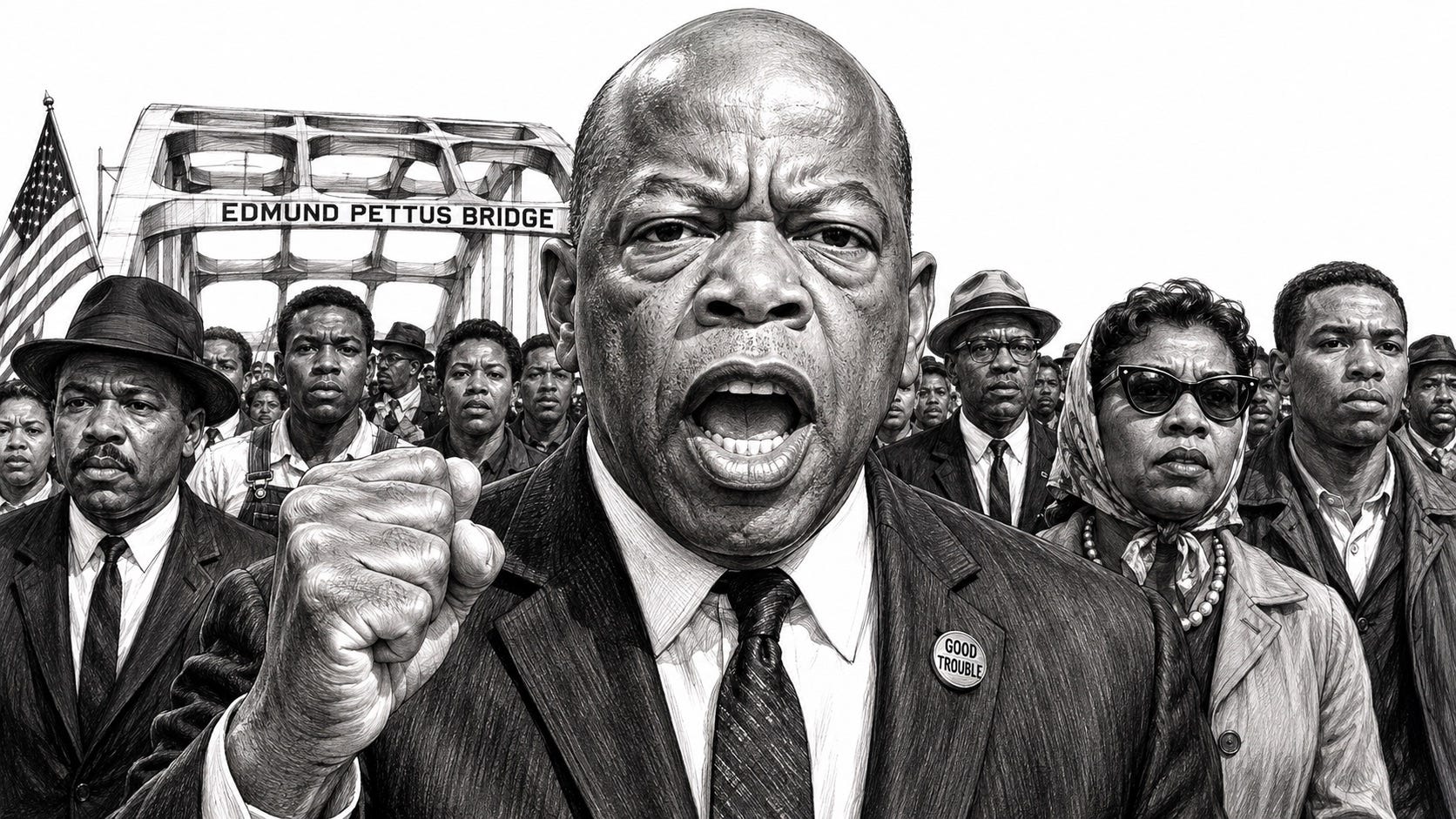
What do you do when the people running your country are counting on you to stay home, stay quiet, and stay scared?
You make good trouble.
Those words belong to John Lewis, and six years after his death they have turned into the most feared idea in America. Feared by the men in Washington who would love nothing more than a nation of citizens too tired and too frightened to show up. John Lewis spent his whole life proving them wrong. He got beaten, arrested more than forty times, and nearly killed, and he kept showing up, because he understood a truth the comfortable never want you to learn. Ordinary people, standing together, refusing to back down, are the strongest force this country has ever produced.
Right now, in Donald Trump’s second term, you are living through a stress test of everything Lewis fought for. The vote. The right to protest without fear. The promise that no person stands above the law and no person falls beneath its protection. Trump and the people around him are treating the Constitution like a suggestion and treating your fellow Americans like targets. The damage is piling up, and the repair bill will land on your kids and your grandkids.
Here is the part they do not want you to hear. You hold the same power Lewis held. You hold it in November, and you hold it every single day between now and then. Let me show you how he used his, and how Americans like you are using theirs today.
Who John Lewis Was
He was born to sharecroppers in Alabama and preached to the chickens on his family’s farm as a boy. He grew into one of the Big Six leaders of the civil rights movement, standing alongside Martin Luther King Jr. He believed in nonviolence as a discipline and a weapon.
He served seventeen terms in Congress representing Atlanta, and received the Presidential Medal of Freedom from Barack Obama in 2011. After he died in 2020, his body lay in state in the Capitol Rotunda, an honor reserved for the rare few. His life connected the street to the seat of power, the marcher to the lawmaker. Walk through what he did, and you will see your own marching orders.
He Rode Into Danger. Today You Stand On Your Own Block.
In 1961 John Lewis was one of thirteen original Freedom Riders. Black and white passengers boarded buses together and rode straight into the segregated South to test whether the law meant anything. In Rock Hill, South Carolina, Lewis tried to walk into a whites only waiting room, and a mob beat him to the ground. He was the first rider bloodied. He was twenty one years old. He climbed back on the bus.
He did it because a law on paper means nothing when armed men feel free to ignore it. He did it because somebody has to be the witness.
The same courage is alive today. Masked federal agents now pull neighbors from cars, workplaces, and homes across Minneapolis, Chicago, Los Angeles, and beyond. This year ICE announced a surge to roughly double its force, adding more than twelve thousand agents. People have died. Two died in Minneapolis seventeen days apart, both thirty seven, both citizens.
On January 7, ICE agent Jonathan Ross shot Renee Nicole Good, a mother of three and a poet, in her SUV. She had stopped to warn neighbors and bear witness as agents worked her block. Video shows her turning away. Ross fired three times, hitting her arm, chest, and head. Officials called it self defense and claimed she drove at an agent. The mayor watched the footage and called the claim a lie, as do her family and state investigators. They blamed her before any investigation began.
Seventeen days later, federal agents killed Alex Pretti, a thirty seven year old ICU nurse who cared for veterans at the Minneapolis VA. At a protest against the raids and Good’s killing, he filmed agents with his phone and directed traffic. When an officer shoved a woman down, Pretti stepped in to shield her. Agents pepper sprayed him, forced him to his knees, and surrounded him. Bystander video reviewed by major outlets appears to show an agent pulling a gun from Pretti’s own holster, then another officer firing four shots into his back. He held a phone the whole time and never drew a weapon. Officials branded this licensed nurse a would be assassin. The video says otherwise. A state senator called it an execution.
Both were citizens. Both were unarmed. Both were doing something decent, one watching her block, one shielding a stranger. Masked agents killed them with almost no accountability, then the government smeared the dead to protect the living. None of this had to happen. This is the cost of doubling an armed force and telling it the rules do not apply.
Ordinary Americans answered. They built rapid response networks. They carry whistles to warn a block the moment agents arrive. They film everything. They learn the law and hand out Know Your Rights cards in three languages. They ask a detained father the one question that changes a family’s future, who do you want me to call. None of this requires a title or a badge. It requires you, your phone, and the nerve to stand on your own corner and refuse to look away. This is a Freedom Ride for 2026.
He Led At Twenty Three. Today You Lead From Where You Stand.
In 1963, at the age of twenty three, Lewis became chairman of the Student Nonviolent Coordinating Committee. He organized voter drives, sit ins, and some of the riskiest fieldwork in the movement. Leadership found him young because he raised his hand and did the work nobody else wanted.
You do not need to wait for permission to lead. Across the country, regular people are running one of the largest peaceful protest movements in American history. The No Kings rallies have filled streets in all fifty states. On a single Saturday this past March, by organizers’ count, more than eight million Americans turned out across thirty three hundred locations, ranking the day among the largest single days of protest the country has ever seen. Retirees, teachers, veterans, students, and first time marchers stood shoulder to shoulder in red towns and blue cities alike.
Behind every one of those crowds sits quiet, unglamorous work. Somebody booked the park permit. Somebody made the calls. Somebody trained the marshals and printed the signs. Groups like Indivisible, the 50501 movement, and your local democratic clubs run on volunteers who give a few hours a week. Bill McKibben built a whole wing of this movement, Third Act, out of Americans over sixty who refuse to spend their retirement watching the country slide. Lewis raised his hand at twenty three. You raise yours at whatever age you are, in whatever town you live in, starting this week.
He Refused To Be Toned Down. Today You Speak Plainly.
In August 1963, Lewis stood at the March on Washington as the youngest speaker on the program, the same day Martin Luther King Jr. shared his dream. Lewis had written a fiery speech. Older organizers, nervous about offending the Kennedy White House, pressured him to soften it at the last minute. He trimmed the sharpest lines for the sake of unity. He carried the lesson with him for the rest of his life, and he spent decades making sure his voice was never muffled again.
Your voice matters the same way, and the pressure to soften it is everywhere. This administration has worked to brand journalists as enemies, punish critics, and make plain speech feel risky. Teachers and students rallied together on May Day this year to defend their schools and their right to learn. Young people picked up the same phrase Lewis lived by. A brass band in Austin named itself the Good Trouble Brass Band and played at a No Kings march. Across America, people are saying the true thing out loud, in town halls, on porches, in posts their neighbors share.
Say it plainly. Name what you see. Call cruelty cruelty and corruption corruption. The country does not need you polished. It needs you honest and loud.
He Bled For The Vote. Today You Protect It.
On March 7, 1965, John Lewis walked at the front of more than six hundred marchers across the Edmund Pettus Bridge in Selma, Alabama. State troopers met them with clubs and tear gas. A trooper cracked Lewis’s skull. The country watched the footage of Bloody Sunday in horror, and the outrage helped push the Voting Rights Act of 1965 into law months later. Lewis gave his blood so the ballot would belong to every citizen.
Sixty one years later, the right he bled for is under open attack. The Supreme Court gutted the heart of the Voting Rights Act, clearing the way for state legislatures across the South to redraw maps designed to erase Black and Brown voting power. Politicians redrew district lines in the middle of the decade to lock in their own majority before a single vote gets cast in November. This administration moved to choke mail in voting and demanded sensitive voter data from states. The goal is simple and old as Selma. Make your vote harder to cast and easier to throw away.
Americans are meeting the moment. They register new voters at fairs and churches and football games. They run votercades and voter education drives. They sign up as poll workers and poll watchers. They sue in court to defend fair maps. The League of Women Voters, Black Voters Matter, and dozens of grassroots crews are turning Lewis’s sacrifice into registration cards and turnout. You protect his bridge by making sure you, and everyone you know, is registered, ready, and impossible to turn away on Election Day.
He Took His Fight Into Congress. Today You Take Yours To The Ballot Box.
In 1986 the people of Atlanta sent John Lewis to the United States House of Representatives. He served seventeen terms and earned a nickname few politicians ever deserve, the conscience of the Congress. He proved the street and the statehouse are two halves of one fight. He marched, and he legislated. He protested, and he passed laws.
The ballot box is where your good trouble turns into lasting power. On November 3, 2026, every seat in the House of Representatives is on the line. The men who have trampled the Constitution since January 2025 are counting on a tired, distracted, discouraged public. They rigged maps and bent rules precisely because they fear the one thing they fail to control, a flood of voters who show up anyway.
You break their plan with turnout. You break it by voting in every race down to school board and county clerk, the local offices in charge of running elections. You break it by helping five friends make a plan to vote, and by running for something yourself if the seat in your town sits empty of decent options. Lewis took his fight from the bridge to the floor of Congress. You carry yours from your kitchen table to the ballot box, and you take back the House.
He Earned The Nation’s Highest Honor. Today You Honor Him By Acting.
In 2011, President Barack Obama placed the Presidential Medal of Freedom around John Lewis’s neck. When Lewis died in 2020, his body lay in state in the Capitol Rotunda, carried one last time across the Edmund Pettus Bridge on a horse drawn caisson. The nation honored a man who got into trouble for sixty years and called it good.
Through every beating, every arrest, every long odds campaign, Lewis held to one discipline above all, nonviolence. He chose it on purpose, again and again, as a strategy and a creed. He understood the moral high ground is the highest ground there is, and he never surrendered it.
You honor him the way he would want, by acting. The movement built in his name is already here. Good Trouble Lives On returns July 17 through 19 this year, a national weekend of nonviolent action, voter registration, and community organizing held every July on the anniversary of his death. Three weeks from now, in towns across all fifty states, Americans will teach, register, march, and organize in his spirit. Your name belongs on the list of participants.
Your Good Trouble Starts Now
John Lewis handed you a job before he left. Find the unjust thing in front of you, the cruel thing breaking the country you love, and get in the way of it. Peacefully. Loudly. Without apology.
Stand on your block when your neighbors are threatened. Volunteer the hours nobody else will. Speak the plain truth in rooms where silence feels safer. Register voters, protect the vote, and run if you have to. Show up on November 3 and bring everyone you know.
The men in power want you to believe you are alone and too late. You are neither. Eight million Americans in the streets in a single day says otherwise. The whole arc of John Lewis’s life says otherwise.
Make good trouble. Necessary trouble. Make it this week, make it in November, and make it until this country looks like the one he bled to build.
Now share this with someone who needs to hear it, and tell me in the comments what good trouble you are about to make.
Mitch Jackson, Esq.
If someone has not been properly elected president due to foreign interference, ballot stuffing, voter intimidation, fraud .. etc … then that person is NOT the president…
That person should never be called “President”
Any criticism of that imposter is patriotic.
Any backing of that imposter is treasonous.
John Lewis was an awesome man.