

This article is an opinion piece based on publicly available facts, reported information, open source intelligence, financial and corporate filings, government records, and reasonable assumptions and inferences drawn from those materials. It is not presented as a statement of proven fact, readers are encouraged to conduct their own independent due diligence and verification, and nothing herein should be relied upon as legal, financial, or investment advice or as a definitive account of undisclosed conduct.
Introduction: The Heist Disguised as Justice
The Official Narrative vs. The Uncomfortable Truth
On the surface, the events of Saturday, January 3, 2026, play out like a Hollywood script tailored for a prime-time victory lap. In a daring, middle-of-the-night operation codenamed “Operation Absolute Resolve,” U.S. special forces descended upon Caracas, cut the power to the entire city, and extracted President Nicolás Maduro and his wife, Cilia Flores, from their steel-reinforced panic room inside the presidential palace.
The headline, splashed across every major network, was simple: The United States had captured a “narco-terrorist” leader, indicted by the Department of Justice for flooding American streets with cocaine, and brought him to face justice in the Southern District of New York.
But if you are reading this report, you know that the official narrative is rarely the whole story. In the world of high-stakes geopolitics, justice is often a convenient byproduct of interest, and in this specific case, the interests involved are measured in billions of barrels and trillions of dollars.
This was not merely an arrest; it was a hostile corporate takeover of a sovereign nation, executed with military precision and justified by a legal framework that stretches the definition of “war” to its breaking point. The capture of Maduro is the kinetic culmination of a strategy that began not in the Situation Room, but in the private dining rooms of Mar-a-Lago, where promises were made to oil executives in exchange for campaign war chests. It is the realization of what President Donald Trump has brazenly branded the “Donroe Doctrine” which is a policy that asserts not just American influence, but American ownership over the Western Hemisphere.
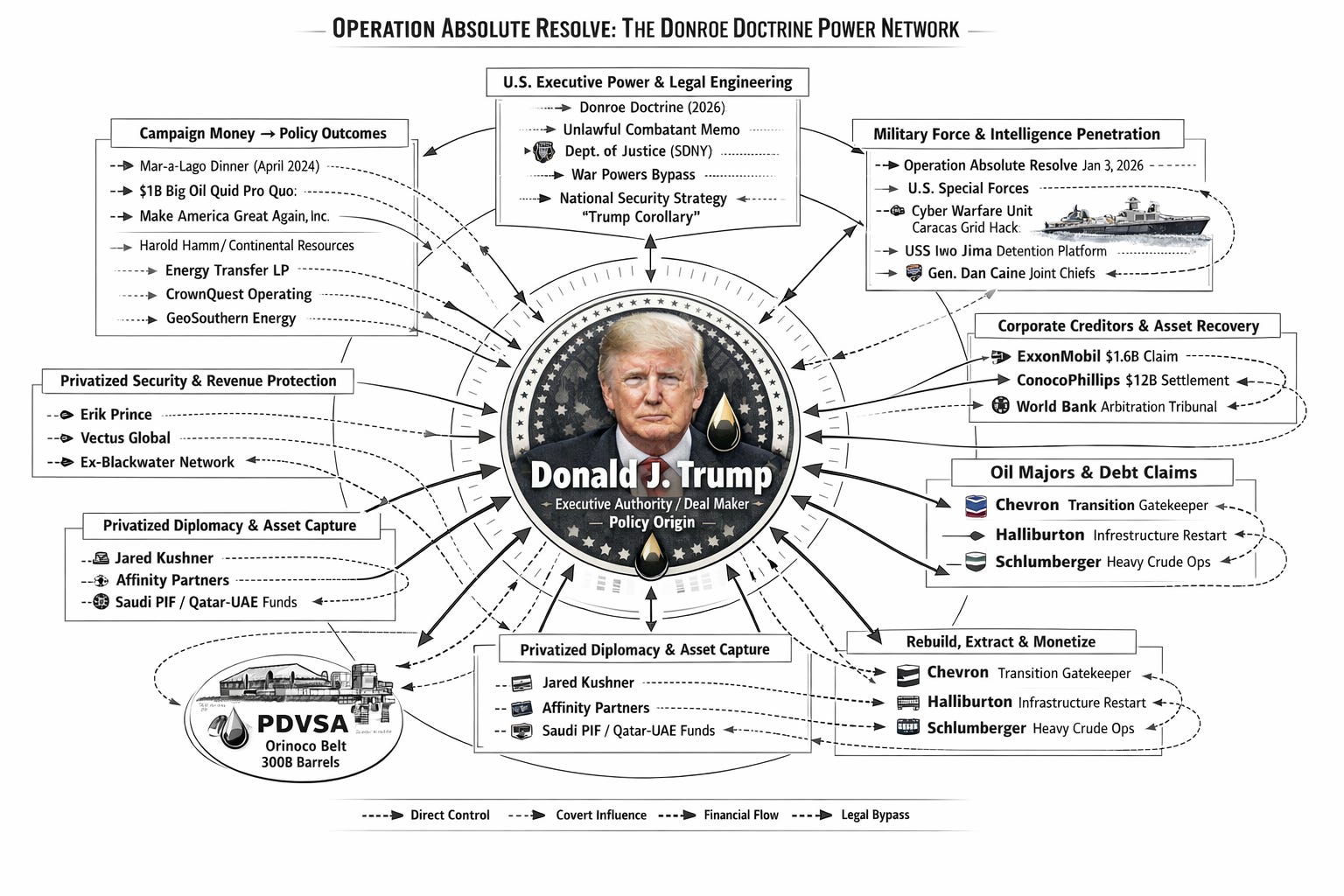
In this article we dig beneath the press releases and the “narco-terrorism” rhetoric. We are following the money. We are connecting the dots between a $1 billion campaign solicitation, the resurrection of private security contracts for administration cronies like Erik Prince, the shadow diplomacy of Jared Kushner’s Saudi-backed investment firm, and the massive reconstruction contracts awaiting companies like Halliburton and Chevron.
This is the story of how the machinery of the U.S. government was leveraged to secure the largest oil reserves on the planet, disguised as a war on drugs.
The Scope of the Investigation
Over the course of this extensive analysis, we will dismantle the components of this geopolitical seizure. We will examine:
The Quid Pro Quo: The direct line between Trump’s April 2024 demand for $1 billion from Big Oil executives and the subsequent “Donroe Doctrine” policy that opens Venezuelan fields to them.
The Legal Gymnastics: How the administration used an “unlawful combatant” designation to bypass Congress, turning a law enforcement matter into an unconstitutional war.
The Reconstruction Racket: The specific financial pathways for Chevron, ExxonMobil, and ConocoPhillips to recover debts and seize assets under U.S. military protection.
The Shadow Cabinet: The roles of Jared Kushner and Erik Prince in privatizing the “transition,” turning Venezuelan security and finance into a family business.
The evidence suggests that the arrest of Nicolás Maduro is merely the first step in a much larger transaction, one where the assets of a nation are liquidated to pay the debts of the past and fuel the profits of the future.
Part I: The Setup – The Mar-a-Lago “Quid Pro Quo”
The Dinner That Changed Foreign Policy
To understand why U.S. Black Hawks were hovering over Caracas in 2026, we must rewind to April 2024. The setting was the Mar-a-Lago Club in Palm Beach, Florida. The guests were a who’s who of the American fossil fuel industry, executives from companies that had felt the pressure of environmental regulations and saw an opportunity in a second Trump term.
According to reports that surfaced shortly after the event, Donald Trump made a proposition that was breathtaking in its transactional simplicity. He didn’t ask for support; he named a price. He told the assembled oil tycoons that they should raise $1 billion to return him to the White House. In exchange, he promised to deliver their entire “wishlist.”
At the time, the media focused on the domestic implications: the rolling back of electric vehicle mandates, the opening of federal lands for drilling, and the dismantling of the EPA’s regulatory power. But the “wishlist” of Big Oil has never been confined to the borders of the United States. The holy grail for companies like Chevron, ExxonMobil, and ConocoPhillips has always been access to the super-giant fields of the Global South, secured by a friendly political environment.
Venezuela, home to the Orinoco Belt and its 300 billion barrels of heavy crude, has been the ultimate prize locked behind a wall of sanctions and socialist resource nationalism. The “deal” struck at Mar-a-Lago was not just about drilling in the Permian Basin; it was about unleashing American corporate power to reclaim assets lost abroad.
The Donors and the Deliverables
The response to Trump’s $1 billion solicitation was emphatic. Following the meeting, the money began to flow, creating a direct financial tether between the campaign and the industry that now stands to benefit from the Venezuelan intervention.
Continental Resources & Harold Hamm: Harold Hamm, the billionaire wildcatter and founder of Continental Resources, has been a central figure in this orbit. Reports indicate that following the quid pro quo solicitation, Continental Resources contributed $1 million to the pro-Trump “Make America Great Again, Inc.” Super PAC. Hamm himself, an informal adviser to Trump on energy policy, reportedly gave $1.6 million personally. Hamm has long advocated for an aggressive U.S. energy dominance policy, one that views oil not just as a commodity, but as a strategic weapon.
Energy Transfer LP: The pipeline giant contributed $5 million to the cause. While their primary business is domestic transport, the global liquidity of oil markets means that bringing Venezuelan crude online, specifically heavy crude needed by U.S. Gulf Coast refineries, benefits the entire midstream ecosystem.
Crownquest Operating: Another $5 million donation came from this Midland-based operator.
Geosouthern Energy: Contributed $1 million.
These contributions were not charity; they were investments. The return on investment (ROI) was expected in the form of policy. When President Trump stood at the podium at Mar-a-Lago on January 3, 2026, and declared that “We’re going to have our very large United States oil companies... spend billions of dollars, fix the badly broken infrastructure... and start making money,” he was effectively announcing the dividend payment on those 2024 contributions. The policy had been bought and paid for two years prior.
The “Wishlist” Goes Global
The “wishlist” discussed in 2024 included standard deregulatory items, but the subtext was always “Energy Dominance.” The industry has long complained that U.S. sanctions policy, while politically popular, had the adverse effect of handing Venezuelan oil fields to Russian and Chinese firms while locking American companies out.
ExxonMobil and ConocoPhillips, in particular, have been carrying massive “bad debt” on their books regarding Venezuela, assets expropriated by Hugo Chávez in 2007 without adequate compensation. For these companies, a “friendly” government in Caracas was not enough; they needed a government that would prioritize their debt repayment over Venezuelan social spending.
The Trump administration’s solution, piloted in the “Donroe Doctrine,” serves this specific corporate need. By asserting that the U.S. will “run” the country, the administration bypasses the messy reality of Venezuelan internal politics and installs a receiver, a bankruptcy trustee in the form of the U.S. military, whose mandate is to ensure the creditors are made whole. This is the globalized version of the Mar-a-Lago promise: using the full force of the American executive branch to clear the ledger for Big Oil.
Decades of Deals: Trump’s Fossil Fuel Friends
To fully grasp this moment, we must examine Trump’s long, cozy relationship with Big Oil. This is not a new development born of Venezuela; it is the culmination of a pattern. From the start of his political career, Trump has surrounded himself with oil industry allies and has consistently traded favors with fossil fuel executives. In fact, he literally put Big Oil in the highest reaches of government.
Who did Trump pick as his first Secretary of State in 2017? Rex Tillerson, the CEO of ExxonMobil, the world’s largest private oil company. It’s hard to imagine a more blatant symbol of oil influence over U.S. foreign policy than installing Exxon’s chief as America’s top diplomat. Tillerson had zero government experience but decades of oil deals (including a multi-billion-dollar Exxon venture in Russia stymied by sanctions). Under his tenure, the State Department’s approach to Venezuela hardened, with early moves to sanction Venezuela’s state oil company in 2019. The oil industry’s wish list had effectively been given a seat at the table of U.S. diplomacy.
Trump’s cabinet and advisers read like a who’s-who of fossil fuel proponents. His Energy Secretary was former Texas Governor Rick Perry, who, notably, had sat on the board of Energy Transfer Partners (ETP), a pipeline company. ETP’s CEO, Kelcy Warren, happened to be a major Trump donor and ally. In 2016, as Trump campaigned, Warren donated over $100,000 to support him. Within days of taking office, Trump delivered a huge gift to Warren: he reversed the Obama-era halt on the controversial Dakota Access Pipeline, allowing ETP’s project to move forward. Warren’s company “notched a major win” thanks to Trump, and Warren reciprocated by hosting a $10 million fundraiser at his Dallas mansion for Trump’s re-election in 2020. The bonding was mutual, Perry as Energy Secretary even rejoined the board of Warren’s company after leaving office, underscoring the revolving door between Trump’s team and Big Oil interests.
Trump’s “friends in Big Oil” don’t end there. Consider Harold Hamm, the shale fracking billionaire behind Continental Resources. Trump has called Hamm “my original oil guy” and said, “this guy knows more about oil and gas… we love Harold”, Trump gushed at a fundraiser. Hamm was an early supporter who helped shape Trump’s energy policy in 2016, and he became a conduit between the oil industry and Trump’s campaign. In 2024, Hamm emerged as Trump’s “point person” for extracting money from oil barons and “relaying to the ex-president what the industry wants”. When Trump audaciously asked oil executives to kick in $1 billion to his campaign war chest, it was Hamm who worked the phones, rallying his fellow oil moguls to pony up.
The effort paid off: by late 2024, oil and gas interests had poured over $20 million into Trump’s campaign and super PACs. In return, Hamm expects policy favors and he handed Trump a “wish list” of industry-friendly moves (more drilling on federal lands, slashing environmental rules) that Trump is eager to oblige. This quid pro quo is baldly transactional: Trump explicitly told oilmen that their $1 billion in donations would be a “deal” because of all the taxes and regulations they’d avoid under his leadership.
Meanwhile, a flotilla of other fossil-fuel tycoons opened their wallets for Trump. The Guardian reported that by mid-2020, Trump’s affiliated super PAC had received millions from oil and coal magnates: $1 million from Harold Hamm and Continental Resources, $1 million from coal baron Robert Murray, $750,000 from Texas oilman Javaid Anwar, $500,000 from oil investor John Catsimatidis, and so on. Another Texas oil billionaire, Jeffrey Hildebrand of Hilcorp, gave at least $775,000 to Trump’s causes.
Why were they so generous? As one energy analyst put it, “the fossil fuel industry and its leaders will continue to support Donald Trump because he will do anything he can to continue fossil fuel dominance of the American energy sector.” Trump proved this over and over: he rolled back environmental regulations at breakneck speed, slashed corporate taxes, opened pristine lands to drilling, and even tried to bail out oil companies during the 2020 price crash. In April 2020, with oil prices in freefall, Trump summoned a group of oil CEOs (Hamm, Warren, Hildebrand and others) to the White House to brainstorm support, later vowing to “make funds available to these very important companies” suffering from low prices. In short, Trump has long behaved like a wholly-owned subsidiary of Big Oil, eagerly aligning U.S. policy with oil company interests and receiving political and financial support in return.
Oil Money in the Family Business
The Trump family itself is deeply enmeshed in these fossil fuel dealings. Start with Trump’s son-in-law, Jared Kushner. Just months after leaving the White House in 2021, Jared clinched a massive $2 billion investment for his new private equity firm, cash coming directly from Saudi Arabia’s sovereign wealth fund controlled by Crown Prince Mohammed bin Salman. This stunning infusion (for a novice fund) raised countless ethical red flags. A Saudi advisory panel actually objected to giving Kushner so much money, but MBS personally overruled them to push the deal through. Why? Observers suspect it was a payback for Kushner’s and Trump’s coziness with the Saudi regime.
During Trump’s presidency, Kushner cultivated an unusually close relationship with MBS, to the point that the young prince bragged in 2018 that Kushner was “in his pocket”. Trump’s White House shielded MBS from consequences after the Jamal Khashoggi murder and eagerly sold the Saudis weapons; now the Saudis have handsomely rewarded the Trump orbit. That $2 billion is oil money by another name, the Saudi Public Investment Fund is fueled by the kingdom’s petrodollars. It effectively made the Trump-Kushner clan business partners with the House of Saud. It’s not hard to imagine that such financial ties could translate into preferential treatment for Saudi (and OPEC) oil interests in Trump’s policies.
Then there’s Trump himself and his business empire, which have openly profited from foreign fossil-fuel patrons. Consider the Saudi-funded LIV Golf tour. In 2022 and 2023, Saudi Arabia’s PIF spent billions launching LIV Golf, and Trump eagerly offered up his golf resorts for their tournaments. Multiple LIV events have been hosted at Trump-owned courses (Bedminster, Doral, and others), “more than at any other golf brand’s properties worldwide,” and the Saudis have shown an “eagerness to pay” handsomely for the privilege.
Investigations revealed that this arrangement funneled tens of millions of dollars of Saudi money directly into Trump’s coffers in the form of event fees. According to one analysis, as of mid-2023 Trump had been paid at least $100+ million by Saudi and other foreign sources for these events and similar business deals. In effect, the oil-rich kingdom has been bankrolling Trump properties, keeping his business empire flush. Small wonder Trump gushes praise about Saudi Arabia and even defended LIV Golf by saying it’s bringing “billions of dollars” into the U.S. (and into his pocket).
Fast forward to today and these personal financial entanglements cast a lurid light on Trump’s Venezuela moves: it’s the same pattern of oil money greasing Trump’s palms. Whether via campaign donations or business deals, Trump and family have consistently sought to enrich themselves through partnerships with oil barons and petrostates.
Even Trump’s new administration appointments reflect this oil favoritism. His second-term Energy Secretary, for example, is Chris Wright, a Colorado oil-and-gas executive who runs a fracking services company. Wright is a staunch fossil fuel advocate who denies that climate change is a crisis and derides clean energy efforts as “Soviet-style” overreach. In November 2024, Trump touted Wright, a political donor with no government experience, as the perfect man to “maximize production of oil and gas” across America. The Senate confirmed Wright, signaling that Big Oil literally has a seat running U.S. energy policy.
Similarly, Trump tapped North Dakota’s former governor Doug Burgum to lead the Department of Interior (which oversees oil leases on millions of acres of public land). Tellingly, Burgum has a lucrative personal oil deal with Harold Hamm’s Continental Resources, his family earns royalties from oil wells on his land in a partnership with Hamm. Burgum even co-hosted an oil fundraiser at Mar-a-Lago with Hamm in 2023 after ending his own presidential bid. These are the people now running the show: officials who will profit if oil profits, tightly interwoven with the industry. Trump’s administration is, in essence, Big Oil in government clothing.
Part II: Operation Absolute Resolve – Anatomy of a Hostile Takeover
The Night the Lights Went Out in Caracas
The execution of “Operation Absolute Resolve” was a masterclass in asymmetrical dominance, designed to showcase the terrifying reach of U.S. power. It was not a “raid” in the traditional sense; it was a systemic shutdown of a nation’s capital.
At 10:46 p.m. EST on Friday, January 2, 2026, President Trump gave the final order. Within hours, the effects were felt in Caracas. The operation leveraged advanced cyber-warfare capabilities to sever the electrical grid in the capital. President Trump later bragged about this specific capability, noting that the lights were “largely turned off due to a certain expertise that we have”.
This blackout served two purposes:
Tactical Advantage: It blinded the Venezuelan air defenses and sowed confusion among the loyalist military forces at the Fuerte Tiuna complex, which was simultaneously targeted by airstrikes.
Psychological Shock: It demonstrated to the Venezuelan population and the military elite that the Maduro government could no longer provide the most basic utility, light, let alone security.
The Intelligence Penetration: “We Knew His Pets”
The most chilling aspect of the operation was the depth of the intelligence penetration. General Dan Caine, Chairman of the Joint Chiefs of Staff, revealed that U.S. forces had been rehearsing the extraction for months. They didn’t just know the layout of the presidential palace; they knew Maduro’s diet. They knew his sleeping habits. They even knew details about his pets.
This level of granularity suggests a compromised inner circle. It implies that the “Donroe Doctrine” was not just a military strategy but an intelligence coup, likely facilitated by months of bribery and coercion of high-ranking Venezuelan officials, perhaps the very same ones who are now being transitioned into the new U.S.-backed administration.
When the Delta Force teams landed, they moved with the certainty of actors on a stage. They breached the “safety space”, a steel-reinforced bunker designed to withstand a siege, using “massive blowtorches” before Maduro could even lock the door. The image of the President of Venezuela, captured in a gray sweatsuit and blindfolded aboard the USS Iwo Jima, was the intended final product: a visual confirmation of total submission.
The “Unlawful Combatant” Loophole: Defining the Enemy
How does a President order a military assault on a sovereign nation without a declaration of war from Congress? The answer lies in a meticulously crafted legal fiction.
In October 2025, the Trump administration issued a classified memo declaring that drug cartels operating in the Western Hemisphere, specifically the “Cartel of the Suns” alleged to be run by the Venezuelan state, and the gang Tren de Aragua, were “unlawful combatants”. This term is a relic of the War on Terror, used to strip Al-Qaeda fighters of Geneva Convention protections. By applying it to a foreign government’s leadership, the administration effectively transmuted a diplomatic dispute into a counter-terrorism operation.
The Argument: The White House argued that because the Maduro regime was trafficking drugs (a claim supported by the DOJ indictments), they were not a legitimate government but a criminal enterprise. Therefore, attacking them was not “war” against Venezuela, but a police action against a “foreign terrorist organization”.
The Bypass: When asked why Congress was not notified, officials were dismissive. “Congress isn’t notified when the FBI is going to arrest a drug trafficker,” one official stated. This conflation is breathtaking. The FBI does not use B-1 bombers. The FBI does not sever the power grid of a foreign capital. The FBI does not seize a head of state.
This legal maneuvering allowed the administration to bypass the War Powers Resolution. It framed the invasion as a “large-scale strike” rather than a war, a semantic distinction with profound constitutional implications. It sets a precedent where the Executive Branch can unilaterally decapitate a foreign government simply by labeling its leaders “criminals” rather than “enemies.”
Part III: The “Donroe Doctrine” – Imperialism Rebranded
“Superseding” Monroe
In the aftermath of the operation, President Trump did not shy away from the imperial implications of his actions. In a press conference at Mar-a-Lago, he unveiled the ideological framework for this new era: the “Donroe Doctrine.”
“The Monroe Doctrine is a big deal,” Trump stated, referring to the 1823 policy warning European powers to stay out of the Americas. “But we’ve superseded it by a lot, by a real lot. They now call it the Donroe Doctrine... American dominance in the Western Hemisphere will never be questioned again”.
This is a fundamental shift in American foreign policy.
Original Monroe Doctrine (1823): Defensive. “Europe, stay out.”
Roosevelt Corollary (1904): Policing. “We will intervene to maintain order.”
Donroe Doctrine (2026): Proprietary. “We will run the country.”
The language used by the President was explicitly managerial. He referred to Venezuela not as a threat to national security, but as a failed business. “It has been a bust, a total bust for a long period of time,” he said of the Venezuelan oil industry. The solution, therefore, was a hostile takeover. “We’re going to run it, essentially... until such time as we can do a safe, proper and judicious transition”.
The Trump Corollary: Sovereignty as a Privilege
The “Donroe Doctrine” implies that sovereignty in Latin America is conditional. If a nation mismanages its resources, specifically resources that the United States deems strategic, like oil, it forfeits its right to self-governance.
This view was codified in the administration’s National Security Strategy, released weeks prior, which pundits had dubbed the “Trump Corollary.” It authorized U.S. intervention for goals such as “seizing strategic assets” and “fighting crime”. The capture of Maduro was the proof of concept.
The international reaction highlights the danger of this precedent. Brazilian President Luiz Inácio Lula da Silva condemned the operation as “an extremely dangerous precedent for the entire international community”. If the U.S. can decapitate the Venezuelan government because of “drug trafficking” allegations and “mismanagement,” what stops it from intervening in Mexico, or Brazil itself? The “Donroe Doctrine” effectively erases borders for U.S. military and corporate interests, turning the entire hemisphere into a “zone of influence” where local laws are secondary to U.S. objectives.
Part IV: The Corporate Claimants – Exxon, Conoco, and the Debt Trap
The “Donroe Doctrine” provides the political cover, but the financial engine of this takeover is the debt owed to U.S. oil corporations. This is where the true “hidden motive” of the operation becomes visible. The invasion is, in many ways, a massive, state-sponsored foreclosure proceeding.
The History of Expropriation
To understand the ferocity of the corporate pressure on Venezuela, we must look back to 2007. Under Hugo Chávez, Venezuela nationalized massive oil projects in the Orinoco Belt, forcing foreign companies to either accept minority stakes in joint ventures with the state oil company, PDVSA, or leave.
ExxonMobil: Refused the new terms and walked away from its Cerro Negro project. It has been fighting for compensation ever since, seeking billions in arbitration. The World Bank’s settlement tribunal awarded them $1.6 billion, a fraction of what they claimed, and payment has been sporadic or non-existent due to sanctions.
ConocoPhillips: Also walked away. They are owed approximately $12 billion for the seizure of their Hamaca and Petrozuata projects. This is a massive liability on their balance sheet and a constant source of friction.
The “Pay-to-Play” Restitution Scheme
In the weeks leading up to the raid, Trump administration officials reportedly held quiet meetings with executives from these companies. The message was stark: We are going to take out Maduro. If you want your money back, you have to go back in.
Sources familiar with the discussions state that the White House made it clear: U.S. oil companies would “need to front the investment money themselves to rebuild Venezuela’s oil industry”. In exchange, the U.S. government, now “running” Venezuela, would prioritize their debt repayments from the new oil revenues.
This creates a closed-loop system of exploitation:
The U.S. Military removes the sovereign obstacle (Maduro).
The U.S. Government installs a compliant transition team.
U.S. Corporations (Exxon, Conoco) invest capital to repair the infrastructure.
Venezuelan Oil is sold on the international market.
The Revenue is diverted to pay back the U.S. corporations for the old debts and the new investments.
The Venezuelan people, ostensibly the beneficiaries of this “liberation,” are effectively placed at the back of the line. Their national wealth is garnished to settle scores from two decades ago.
Market Reactions: The Bull Case for Reconstruction
Wall Street has immediately recognized this dynamic. Analysts at TradeThePool noted that “U.S. energy giants sit among the primary potential beneficiaries of this geopolitical reset”. The expectation is not just a return to the status quo, but a “green heavy-oil narrative” where U.S. service companies modernize the fields, making the oil palatable for ESG-conscious portfolios.
For ConocoPhillips ($12B owed) and ExxonMobil ($1.6B owed), the “Donroe Doctrine” is the ultimate bailout. It transforms a bad debt into a secured asset, backed by the guarantee of U.S. military occupation.
Part V: The Operators – Chevron, Halliburton, and the Rebuild
While Exxon and Conoco represent the past grievances, other companies represent the future operations. The physical reality of Venezuela’s oil industry is that it is “rotted”. It requires billions in technical work to function.
Chevron: The Incumbent Kingmaker
Chevron occupies a unique position. Unlike its rivals, it never fully left Venezuela. Through a series of special licenses granted (and occasionally threatened) by successive U.S. administrations, Chevron has maintained a foothold, operating joint ventures that produce around 200,000 barrels per day.
Because they are “already on the ground,” Chevron is the “clear frontrunner” to manage the immediate transition.
Institutional Knowledge: They have the maps, the geological data, and the personnel in place.
The Switch: Under Maduro, Chevron was forced to work with PDVSA cronies and faced strict limits on profit repatriation. Under the U.S. transition authority, Chevron will likely be granted de facto operatorship of the country’s most productive assets.
The Trump Factor: Trump had previously tightened screws on Chevron to prevent money from reaching Maduro, but with Maduro gone, the leash comes off. Chevron becomes the primary conduit for Venezuelan oil to reach U.S. refineries in the Gulf Coast, replacing Russian heavy crude imports that dried up due to the Ukraine war.
The Service Giants: Halliburton and Schlumberger
The real money in the short term, however, lies in the “fix.” Trump promised that companies would “spend billions” to repair the infrastructure. This is music to the ears of Halliburton and Schlumberger (SLB).
Halliburton: Known as the “first boots on the ground” in post-conflict zones (a reputation cemented in Iraq), Halliburton has maintained a skeleton crew in Venezuela to preserve “mothballed” equipment. They are the logistical engine required to restart the pumps.
Schlumberger: SLB specializes in the subsurface technology needed for the Orinoco Belt’s extra-heavy crude. This oil is difficult to extract; it requires heating and dilution. SLB’s technology is essential.
Market analysts have already flagged these stocks as “reconstruction plays”. The “Operation Absolute Resolve” is effectively a massive government contract for these service firms, paid for by the future oil production of the occupied nation.
Part VI: The Family Business – Jared Kushner & Affinity Partners
As mentioned above, if the oil majors are the beneficiaries of the policy, the Trump family appears to be positioning itself to benefit from the process. The role of Jared Kushner, the President’s son-in-law, raises screaming red flags regarding conflict of interest and the privatization of diplomacy.
The $3 Billion Conflict
Jared Kushner runs Affinity Partners, a private equity fund with over $3 billion in committed capital. The vast majority of this money comes from foreign sovereign wealth funds:
Saudi Arabia (PIF): $2 billion.
Qatar & UAE: Hundreds of millions more.
Kushner is not just an investor; he is an active “shadow envoy.” Reports confirm that in the days leading up to the Venezuela raid, Kushner was engaged in high-level diplomatic talks regarding Ukraine and the Middle East, acting as a representative of the President despite having no formal role that requires Senate confirmation.
The Venezuelan Angle
Why does a Saudi-backed investor matter for Venezuela? Because Saudi Arabia and Venezuela are direct competitors in the oil market.
Price Control: Saudi Arabia leads OPEC. Venezuela has the world’s largest reserves. If Venezuela floods the market, oil prices crash, hurting Saudi revenue.
The Conflict: By influencing U.S. policy in Venezuela, Kushner is in a position to manage the speed and scale of Venezuela’s return to the market. A slow, controlled return benefits his Saudi investors. A rapid flood hurts them.
Asset Acquisition: Affinity Partners has shown an appetite for massive, cross-border deals (e.g., the $55 billion bid for Electronic Arts with Saudi backing). Distressed Venezuelan assets, power plants, real estate, luxury hotels seized from chavistas, represent exactly the kind of “undervalued” opportunities Kushner targets.
If Affinity Partners or its sovereign backers take a stake in the “reconstruction” of Venezuela, it would represent the ultimate fusion of public power and private profit. The President’s son-in-law would be earning management fees on Saudi money used to buy Venezuelan assets secured by American soldiers.
Part VII: The Enforcers – Erik Prince and the Privatization of War
Finally, we must address the “boots on the ground.” Trump stated he was “not afraid” to use them. But whose boots?
The Return of Blackwater’s Founder
Erik Prince, the founder of Blackwater (now Academi) and brother of former Trump cabinet member Betsy DeVos, has been lurking in the periphery of Venezuela policy for years. In 2019, he actively pitched a plan to deploy a private mercenary army to topple Maduro, seeking $40 million and holding secret meetings with Vice President Delcy Rodríguez.
That plan was rejected then. But under the “Donroe Doctrine,” it appears to be back on the table.
Vectus Global: The Blueprint
Prince’s new firm, Vectus Global, has recently secured contracts in Haiti and Ecuador. The model is telling:
Haiti: Vectus deployed personnel to “quell gang violence” and, crucially, help the government “restore revenue collection”.
The Model: Private forces secure the revenue streams (ports, highways, oil fields), and the firm takes a cut or is paid from the proceeds.
This is the perfect model for the U.S. “occupation” of Venezuela. deploying 50,000 U.S. Army troops is politically risky and expensive. deploying 5,000 “contractors” to secure the oil fields for Chevron and Halliburton, paid for directly by PDVSA revenues, keeps the body count off the nightly news and the cost off the U.S. budget.
Reports indicate Prince has also pitched a $25 billion “deportation force” to the Trump administration. The integration of private force into state functions is a hallmark of this administration. In Venezuela, Prince’s mercenaries could become the Praetorian Guard for the new oil infrastructure, accountable to no one but their paymasters.
Conclusion: The Business of Empire
The arrest of Nicolás Maduro is not a victory for the rule of law. It is a victory for misleading everyday Americans and the rule of the deal.
When you assemble the puzzle pieces, the $1 billion Mar-a-Lago solicitation, the “Donroe Doctrine” claiming ownership of the hemisphere, the “unlawful combatant” legal loophole, the billions owed to Exxon and Conoco, and the shadow involvement of Kushner and Prince, the picture is undeniable.
“Operation Absolute Resolve” was a hostile takeover. The United States government, acting as the enforcement arm of the energy sector, has seized a distressed asset. The “narco-terrorism” charges, while likely based on real crimes, serve as the pretext for a resource grab of historic proportions.
We are witnessing the privatization of American foreign policy. The military clears the ground. The oil majors extract the wealth. The service companies rebuild the pipes. The private equity funds manage the assets. And the private security contractors guard the loot.
As the lights flicker back on in Caracas, the Venezuelan people may find their dictator gone, but they will wake up to find their country is no longer their own. It has been acquired, leveraged, and restructured. Venezuela is now under new management.
Mitch Jackson, Esq. | More about Uncensored Objection here
Thanks for reading Uncensored Objection.
This work exists because accountability does not sustain itself and democracy does not defend itself. If you believe facts still matter, power should be checked, and citizens have a responsibility to stay engaged, please comment, share and if you can, upgrade to premium to keep this work independent, relentless, and focused on what happens next.
What Happened at the Security Council Today
The Security Council convened after United States forces seized Venezuelan President Nicolás Maduro and his wife and removed them from the country. The administration sent its ambassador, Mike Waltz, to defend the operation. He stated plainly before the world that the Western Hemisphere falls under United States control and that Venezuela’s energy reserves must not remain outside American hands. No coded language. No subtle framing. A declaration of dominance delivered on a global stage.
How the World Responded
Secretary General António Guterres, through Under Secretary General Rosemarie DiCarlo, expressed deep concern over the disregard for international law. The statement underscored a basic truth. Global stability rests on adherence to the Charter, especially by permanent members entrusted with greater responsibility.
China spoke and was visibly shocked. Its representative condemned the action as illegal and coercive and warned of violations of the UN Charter.
Denmark followed with a reminder that borders carry legal meaning and do not bend under pressure. The point carried added weight as Trump escalates rhetoric toward Greenland.
Russia seized the opening Trump provided. Its ambassador accused Washington of resource theft disguised as justice and demanded Maduro’s release. The hypocrisy was obvious. The damage was real. When the United States breaks rules it once enforced with conviction, credibility evaporates. Adversaries gain room to act without restraint.
Why This Matters to You
As an American, watching today was painful. The nation once cited as a guardian of lawful order now reads as a warning. This shift touches every alliance, every negotiation, every future crisis. Democracy depends on norms upheld even when inconvenient.
This moment demands attention, conversation, and civic pressure. Share what you saw. Speak about what concerns you. Hold leaders accountable for actions taken in your name. The future does not drift into place. You shape it through engagement, memory, and a refusal to accept chaos as normal.
History records moments like today. Your response becomes part of that record.
Africa, South America - same playbook to rape countries of their resources and keep the populations struggling and poor. I'm not seeing any evidence of ExxonMobil, ConocoPhillips and the big services companies rushing in or making plans. It's fitting that Erik Prince (he of Blackwater infamy) may ultimately play a "security role" and that Trump intends to "manage the money." How the White House website recasting of January 6th is amazing. Trump just cannot let it go and truly move on. He is not happy unless he is crushing everyone. America First is utter bull. His doctrine is Trump First, everyone else can fight for a place in line all while he and Melania laugh as it all unwinds. The dude and his wife are seriously ill people.