


John Bolton’s indictment marks a serious moment in the ongoing tension between power, privilege, and responsibility in government service. The former National Security Advisor now faces 18 criminal counts for transmitting and retaining national defense information under the Espionage Act. The charges describe a long pattern of willful mishandling of some of the nation’s most sensitive secrets, information that, by law, should never have left secure channels.
To read the 26-page indictment, click here, or on the image below.

According to the indictment, Bolton repeatedly sent what he described as “diary” entries from his time in the White House to two people who had no security clearance. Those messages contained material classified as high as Top Secret and compartmented intelligence from the CIA and NSA. The emails and messages were sent using personal accounts and commercial apps like AOL and Google, outside any government-approved secure system. The indictment alleges that Bolton knew the risk and continued anyway, even after signing multiple agreements acknowledging his legal duty to protect classified information.
The case details are extraordinary. More than a thousand pages of classified material were allegedly shared over the course of his tenure as National Security Advisor. Many of those documents reportedly included descriptions of covert operations, intelligence sources, and details about foreign adversaries. Federal investigators later found printed copies of these materials in Bolton’s Maryland home, years after his security clearance had expired and his home’s secure facility had been declassified. The FBI recovered both electronic and hard copies during an August 2025 search.
Prosecutors argue that Bolton’s actions were not mistakes but conscious choices that breached his oath and endangered national security. The indictment shows he was aware of proper protocol. As recently as 2025, he publicly criticized other officials for using non-government communication apps to discuss sensitive matters, calling such actions “inexcusable.” The government now alleges he did precisely what he once condemned.
The investigation also uncovered a 2021 cyber intrusion of Bolton’s personal email account by an actor believed to be linked to Iran. According to the indictment, Bolton’s representative notified the FBI about the breach but did not disclose that classified information was stored in the compromised account or that it had been shared with unauthorized individuals. That omission, combined with years of unsecured handling of national defense information, formed part of the basis for the charges.
The Justice Department’s statements accompanying the indictment reflect a unified message: no official, regardless of title or past service, stands above the law. Attorney General Pamela Bondi emphasized that accountability extends to everyone entrusted with the nation’s secrets. FBI Director Kash Patel praised the investigation as the result of careful work by career agents and prosecutors, framing it as a defense of both law and security.
Bolton now faces eight counts of unauthorized transmission of national defense information and ten counts of unlawful retention of the same. Each count carries a potential ten-year prison sentence. Beyond the criminal exposure, the indictment also includes forfeiture provisions that could strip him of property tied to the alleged offenses.
Here are pictures of some of the files allegedly held by Bolton

Sorry, my bad. This is a picture of Trump’s classified documents at Mara Lago.
Here are the Bolton documents from his office:
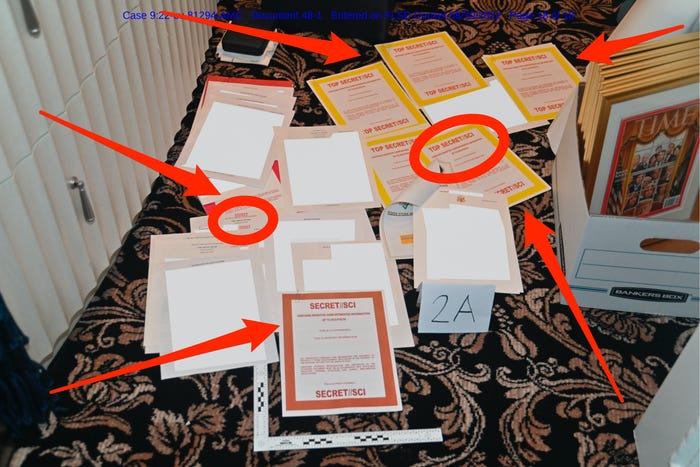
Again, sorry. These were the classified documents kept by Donald Trump in his Mar a Lago office.
On a serious note, and at its core, this case speaks to a fundamental principle. Access to classified intelligence is not a privilege of power. It is a covenant of trust. Those who hold the nation’s highest clearances are not free to treat sensitive information as personal property, regardless of intent or legacy.
Every word, every document, every communication carries weight far beyond the individual. When that trust is broken, for some, the consequences ripple through institutions, allies, and the very security the information was meant to protect.
Mitch Jackson, Esq.
In the first reaction to his indictment, John Bolton says:
"For four decades, I have devoted my life to America’s foreign policy and national security. I would never compromise those goals. I tried to do that during my tenure in the first Trump Administration but resigned when it became impossible to do so. Donald Trump’s retribution against me began then, continued when he tried unsuccessfully to block the publication of my book, The Room Where It Happened, before the 2020 election, and became one of his rallying cries in his re-election campaign.
Now, I have become the latest target in weaponizing the Justice Department to charge those he deems to be his enemies with charges that were declined before or distort the facts.
My book was reviewed and approved by the appropriate, experienced career clearance officials. When my e-mail was hacked in 2021, the FBI was made fully aware. In four years of the prior administration, after these reviews, no charges were ever filed. Then came Trump 2 who embodies what Joseph Stalin’s head of secret police once said, 'You show me the man, and I’ll show you the crime.'
These charges are not just about his focus on me or my diaries, but his intensive effort to intimidate his opponents, to ensure that he alone determines what is said about his conduct. Dissent and disagreement are foundational to America’s constitutional system, and vitally important to our freedom. I look forward to the fight to defend my lawful conduct and to expose his abuse of power."
Why is it a crime for Bolton but not a crime for Trump? Surely the outcome of this indictment would prove to support that Trump himself should be charged with the very same offence.