

You were taught that Jim Crow ended. That is the comfortable version. The honest version is that Jim Crow was a legal system, not a moment. And on April 29, 2026, six justices of the United States Supreme Court handed the architects of voter suppression a fresh set of tools.
What Jim Crow actually was
Jim Crow was a body of state laws built across the South between the late 1870s and 1965 with one purpose. Keep Black Americans away from political power.
The architects were lawyers and legislators. They wrote poll taxes. They wrote literacy tests. They wrote grandfather clauses. They drew district lines that packed Black voters into one district or cracked them across many. They closed polling places in Black neighborhoods. They purged voter rolls.
None of it required a single overt mention of race in the statute. That was the design.
Congress finally caught up in 1965 with the Voting Rights Act. Section 2 prohibited voting practices that resulted in racial discrimination. Section 5 required states with histories of suppression to get federal approval before changing election rules.
In 2013, Shelby County v. Holder struck down the coverage formula that made Section 5 enforceable. Within hours, Texas announced it would implement a strict photo ID law that had previously been blocked. Other states followed within days.
On April 29, 2026, the Court finished the job.
What the Court did in Callais
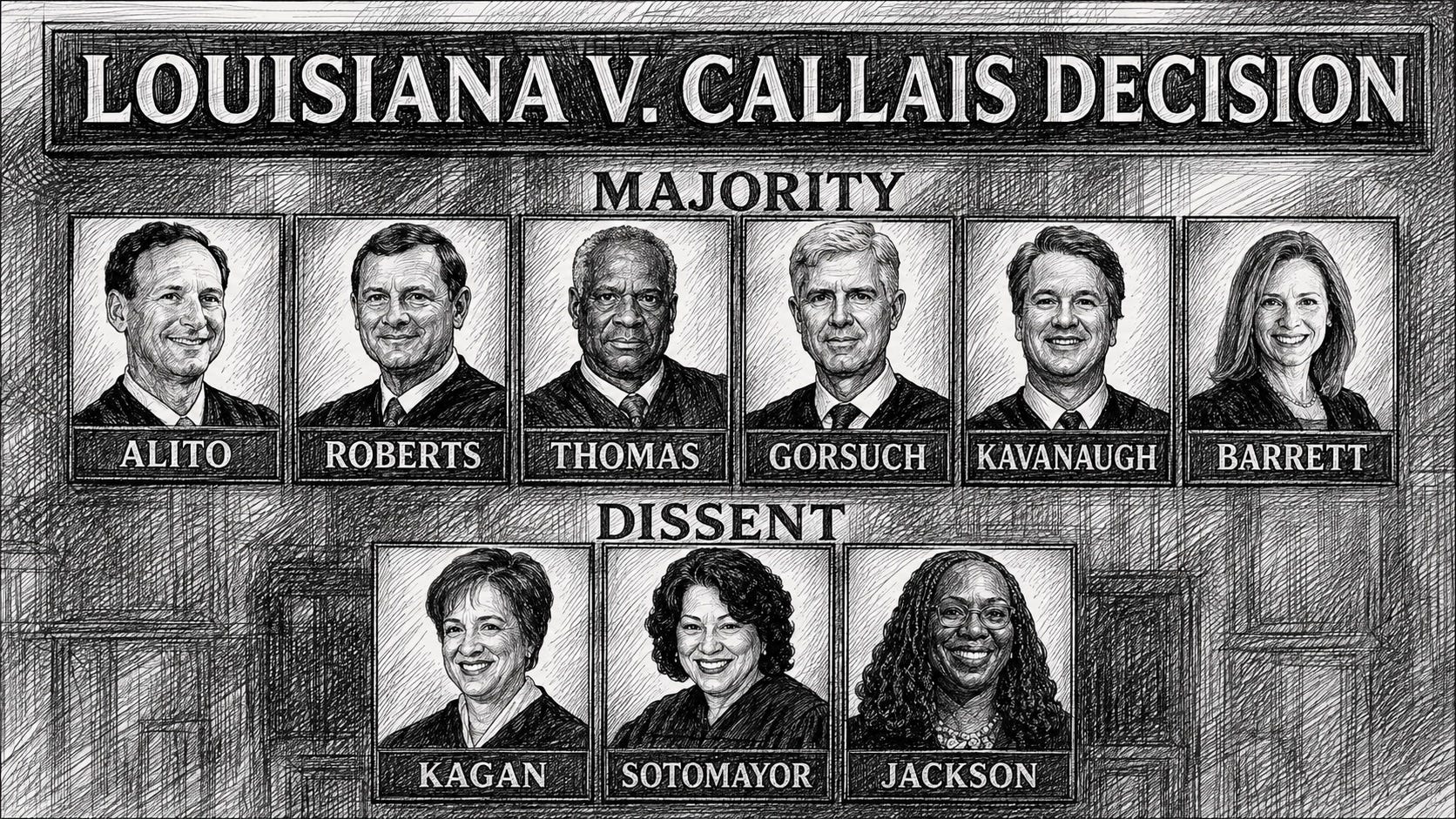
In Louisiana v. Callais, by a vote of 6-3, the majority struck down a Louisiana congressional map containing two majority-Black districts as an unconstitutional racial gerrymander. Justice Alito wrote the opinion, joined by Chief Justice Roberts and Justices Thomas, Gorsuch, Kavanaugh, and Barrett. Justice Thomas wrote a concurrence joined by Justice Gorsuch. Justice Kagan dissented, joined by Justices Sotomayor and Jackson.
Kagan said it plainly. The decision renders Section 2 “all but a dead letter.”
The Court did not formally overturn Section 2. It rewrote how plaintiffs must prove a violation, and set the bar so high that almost no one can clear it. Three changes matter most.
First, plaintiffs must now submit an illustrative alternative map that satisfies every one of the state’s political objectives, including partisan goals. The state writes the test and grades it.
Second, the totality-of-circumstances analysis now requires evidence of “present-day intentional” racial discrimination. Historical evidence receives much less weight.
Third, when race and party correlate, which they do across most of the South, a state can claim its motives were partisan rather than racial. The Court already ruled in Rucho v. Common Cause in 2019 that federal courts cannot police partisan gerrymanders. So the new rule is this. If a state dilutes Black voting power, it just has to say it did so for political reasons, and the courthouse doors close.
What is happening right now
Within days of the ruling, Republican legislatures in Alabama and Tennessee opened special redistricting sessions. South Carolina began the process. Louisiana’s Republican governor suspended the May 16 primary after early ballots had already been cast and absentee ballots returned.
A sitting election was halted so the map could be redrawn against the voters who were already voting.
Alabama, ordered by the federal courts in Allen v. Milligan in 2023 to create two majority-Black districts, immediately filed an emergency motion asking the Supreme Court to let it reinstate the map that had been struck down. Tennessee fast-tracked a map targeting Steve Cohen’s Memphis-based 9th district, the state’s only Democratic seat. Analysts at Democracy Docket estimate the post-Callais redraws could net Republicans 16 to 18 House seats before a single ballot is counted in November.
The House currently sits at roughly 217 to 212 Republican. When map drawers pick the voters, voters cannot pick the representatives. That is the definition of an unfree election.
What you do now
I am a trial lawyer. I have spent four decades watching how legal systems shift power. I will tell you what works.
Read Justice Kagan’s dissent. You will know more about the Voting Rights Act than ninety-five percent of the country.
Support the litigators carrying this fight. The NAACP Legal Defense Fund, the Brennan Center, the Campaign Legal Center, and Democracy Docket are filing the cases that will define the next decade.
Call your senators about the John R. Lewis Voting Rights Advancement Act. Congress wrote the Voting Rights Act. Congress can restore it.
Pay attention to your state. State constitutions, state supreme courts, and state ballot measures are now the front line.
Vote in every primary, every midterm, every off-year election that touches a legislature, a state supreme court, or a secretary of state.
Jim Crow ended because ordinary Americans refused to accept it. You are now living in the moment they warned you about. The question is what you are going to do about it.
Mitch Jackson, Esq.
If you want the unfiltered truth about what is happening to your vote, your rights, and your country, subscribe to Uncensored Objection. I promise to always be a straight shooter and expose exactly what is happening with breaking political news, no matter who it angers.
Mitch Jackson..here we are 160 years later…and the ignorance and discrimination are still here!!
It’s such a shameful past ..a bunch of Southern bubbas still can’t get over that 1) the South lost the war and 2) blacks are not slaves and not inferior!!
Get the hell into the 21st century!!! And that goes for the bubbas on the Supreme Court..what a stain and disgrace on the court!!