

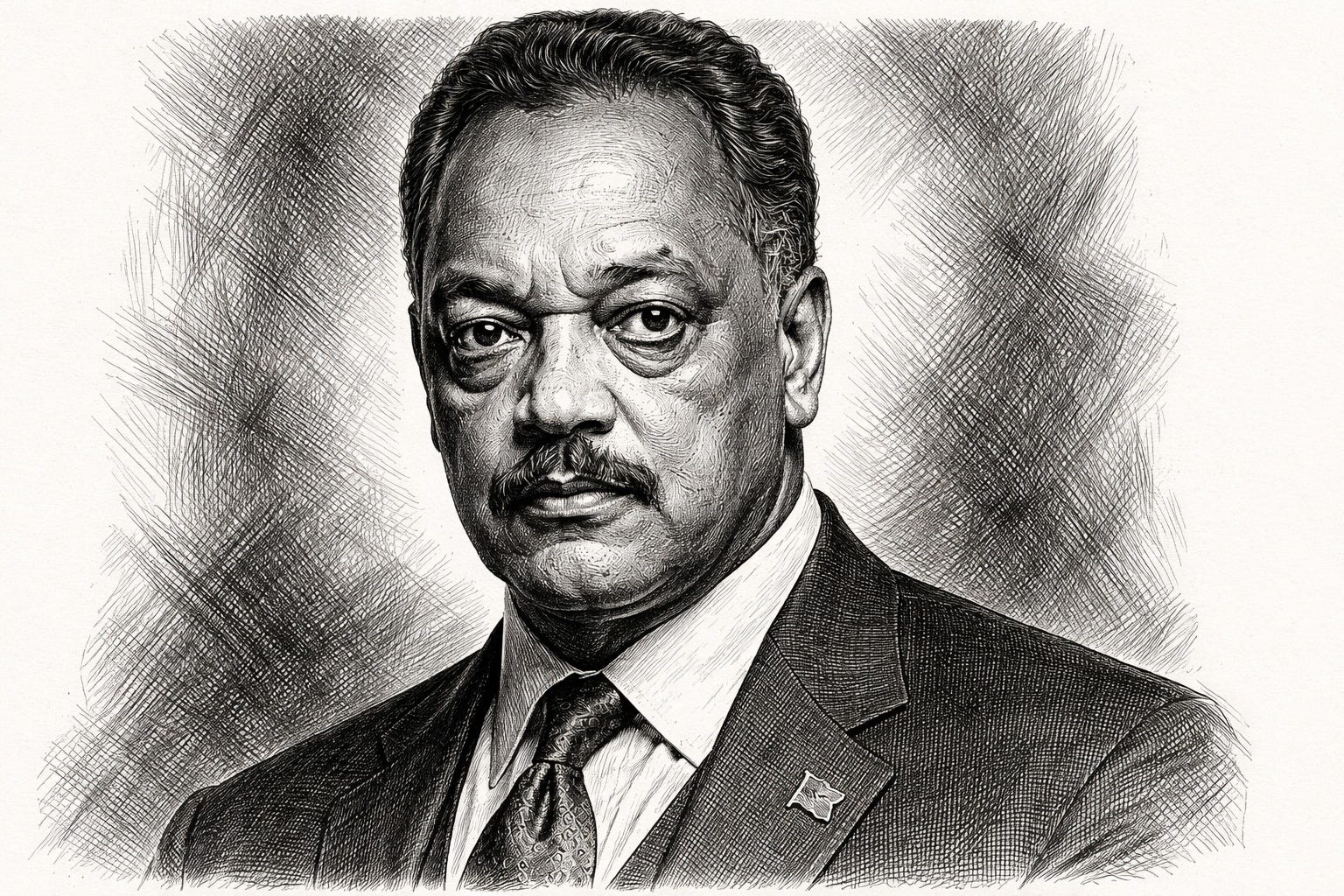
“I was born in the slum, but the slum was not born in me. And it wasn’t born in you, and you can make it.” -Jesse Jackson
This morning, the Reverend Jesse Louis Jackson passed away at the age of 84. His family confirmed his death in a statement that called him “a servant leader, not only to our family, but to the oppressed, the voiceless, and the overlooked around the world.” And that description, as simple as it sounds, tells you almost everything you need to know about what this man spent his life doing.
He was not a perfect man. Let me say that right up front because he would have said it himself. He made mistakes. He said things he had to apologize for. He carried an ego that sometimes got in the way of his message. He was fully, deeply, stubbornly human. And that is precisely what makes his story so worth telling, because the rest of us are human too, and his life proves that flawed people can still move mountains.
“My mission has been to transform the mind of America,” Jackson once told a convention of Black lawyers in Washington. That single sentence sums up a lifetime of work, a lifetime of marching, preaching, running for office, negotiating the release of prisoners overseas, registering voters, and showing up at every place where people had been told they did not matter.
So let me walk you through this life. All of it. The light and the shadow. Because if we only celebrate the highlight reel, we miss the lesson. And if we only focus on the flaws, we lose the gift.
Born Into the Fire
Jesse Louis Burns came into the world on October 8, 1941, in Greenville, South Carolina. The segregated South. His mother, Helen Burns, was sixteen years old. His biological father, Noah Louis Robinson, was a married man who lived next door and played almost no role in raising his son. That absence left a wound Jesse carried for decades.
His mother married Charles Jackson in 1943, and young Jesse took the Jackson name, though the adoption did not become official for another fourteen years. When his mother and stepfather had their own child together, Jesse was sent to live with his maternal grandmother in a small shotgun house around the corner.
Think about that for a moment. Rejected by his father. Not fully embraced by his stepfather. Taunted by other children. And all of this unfolded inside a system that told him every single day, through separate water fountains, through the back of the bus, through the very architecture of public life, that he was less than.
And still, this kid stood out. Teachers remembered him as fearless, brimming with energy and intelligence. One high school English teacher described him as “an uncommonly nervy little fellow, never abashed at all.” A childhood friend put it more colorfully: “He could talk a hole through a billy goat.”
He was a gifted athlete too. He graduated from high school in 1959 with offers for minor league baseball and a Big Ten football scholarship. He chose the University of Illinois on a football scholarship, hoping to escape Jim Crow for the first time.
What he found in Illinois was a different kind of racism. He later recalled with a dry edge that he had never been called the most degrading racial slur back home in South Carolina, but college students in the North used it freely. His confidence rattled, he transferred after his freshman year to North Carolina Agricultural and Technical State University, a historically Black institution in Greensboro. There, surrounded by the familiar rhythms of Southern life and the sound of gospel music, he thrived. He led his fraternity, became student body president, and fell in love with a young woman named Jacqueline Lavinia Brown. They married on New Year’s Eve in 1962.
Walking With King
Greenville and Greensboro shaped Jesse Jackson, and so did the early civil rights movement stirring all around him. The winter before he arrived at North Carolina A&T, four students from that very campus had sat down at the segregated lunch counter at Woolworth’s in downtown Greensboro, an act that sent shockwaves through the nation.
Jackson resisted joining the protests at first. When he finally stepped in, he stepped in all the way. In June 1963, he led a march of hundreds of students and was arrested the next day. It was, for all practical purposes, his public debut.
After graduating in 1964, he enrolled at the Chicago Theological Seminary. He considered becoming a lawyer. He chose the ministry instead. And then, in March 1965, he watched news footage of peaceful demonstrators beaten bloody in Selma, Alabama, and he could not sit still. He climbed on top of a cafeteria table at the seminary and challenged his classmates to go south with him. About twenty students and a third of the faculty said yes.
In Selma, Jackson met Dr. Martin Luther King Jr. and came home a changed man. Within months, at just twenty four years old, he became the youngest staff member of the Southern Christian Leadership Conference. King tapped him to run the Chicago chapter of Operation Breadbasket, a program that used boycotts to pressure white owned businesses to hire Black workers and purchase goods from Black contractors. By 1967, Jackson was gaining a national profile as he promoted the campaign. He quit seminary six months before graduating to throw himself into civil rights work full time.
King became his intellectual model, his spiritual guide, his father figure. The Reverend Ralph David Abernathy, one of King’s closest confidants, once observed simply that Jesse “wanted to be Martin.”
Jackson was at many of the movement’s defining moments. He attended the March on Washington in 1963, where King delivered the “I Have a Dream” speech. He joined the Selma to Montgomery marches in 1965. And he was present on April 4, 1968, at the Lorraine Motel in Memphis, Tennessee, the night Dr. King was shot and killed.
The Controversy After Memphis
What happened in the hours and days after King’s assassination became a shadow that followed Jackson for the rest of his life, and it is worth telling honestly.
Jackson was one of several aides who rushed toward King after the gunshot. Later that night, he flew back to Chicago, parts of which were erupting in the unrest that swept across the country. The next morning, he appeared on the Today show wearing the same olive turtleneck he had worn in Memphis, smeared with blood. At a memorial convocation at the Chicago City Council, he declared, “I come here with a heavy heart because on my chest is the stain of blood from Dr. King’s head.”
He suggested publicly, at least once, that he was the last person to speak with King and that he had cradled King’s head as he lay dying. Others who were present disputed that account. Over the years, Jackson’s own telling of the story shifted.
Members of King’s inner circle, including Abernathy and Hosea Williams, both of whom ran to King when the shot was fired, were furious. They viewed Jackson’s behavior as a calculated attempt to claim the spotlight and position himself as King’s true heir. Some of those critics, it should be noted, made their own bids for attention in the aftermath, and the chaos of that night produced so many conflicting accounts that certainty about anyone’s precise actions is difficult to pin down.
Jackson largely declined to engage with what he called “slanders,” suggesting they reflected longstanding fractures within the SCLC as much as anything that happened in Memphis. Abernathy himself, years later, acknowledged the passage of time. “I hope God has forgiven him,” he told The New York Times in 1987. “He has had time to pray. He is a different man now.”
This is the part of the story where most of us want to look away or pick a side. I would encourage you to do neither. Sit with the complexity. A man can be deeply ambitious and deeply committed to justice at the same time. A man can overreach in a moment of chaos and still spend the next fifty years doing meaningful work. The two truths do not cancel each other out. They coexist, the way they do in every single one of us.
Operation PUSH and a New Mission
Three years after King’s death, Jackson left the SCLC after a bitter falling out with Abernathy, who suspended him for sixty days over organizational disputes. Freed from that hierarchy, Jackson founded Operation PUSH, People United to Save Humanity, a social justice organization dedicated to improving economic conditions for Black communities across the country.
PUSH pushed. The organization fought for greater educational and employment opportunities. It pressured major corporations to adopt affirmative action policies. Jackson became a constant, visible, tireless presence on the national stage, promoting causes not just across the United States but overseas in South Africa, Haiti, and the Middle East.
And then politics called.
Running for President
“My constituency is the desperate, the damned, the disinherited, the disrespected and the despised. They are restless and seek relief.” -Jesse Jackson
As early as 1971, Jackson had toyed with the idea of starting a new political party. In 1980, he campaigned hard for President Jimmy Carter’s reelection. The experience taught him the value of registering Black voters, and he did so in numbers that made him indispensable to the Democratic Party.
In 1984, Jackson decided to run for president himself. He was only the second Black candidate from a major party to seek the office, following Congresswoman Shirley Chisholm’s groundbreaking run in 1972. Chisholm herself introduced Jackson at his campaign kickoff rally.
The 1984 campaign revealed both Jackson’s extraordinary potential and the land mines waiting for any Black candidate in American politics. His informal diplomacy abroad, most notably his role in securing the release of Navy pilot Robert Goodman from captivity in Lebanon, made him a genuine political force and an international figure. His passionate promotion of the term “African American” to honor the origins of descendants of enslaved people influenced the way the entire nation talked about race.
Three weeks into the campaign, in conversations with Black reporters, Jackson used the terms “Hymie” and “Hymietown” to describe Jewish people and New York City. The remarks, buried deep in a Washington Post article, ignited a firestorm that haunted him for years. His slow response, combined with his reluctance to distance himself from Nation of Islam leader Louis Farrakhan, who had made antisemitic comments of his own, deepened the damage. Jackson eventually apologized and described Farrakhan’s criticisms of Israel as “reprehensible,” but the wound to his relationship with Jewish voters never fully healed.
This is the part of his story that demands your honesty, both about Jackson and about the world he was operating in. What he said was wrong. The words were offensive. He knew it, and he said so. And the fallout was real and lasting. You and I do not get to erase that chapter. We do get to learn from it. Words carry weight. Apologies matter. And the consequences of careless speech can follow you for a lifetime.
Even with that controversy, Jackson stunned political observers with his showing in 1984. Fueled by Black voters he had helped register in record numbers, he finished third behind Senator Gary Hart and former Vice President Walter Mondale, who won the nomination. And his speech at the Democratic National Convention in San Francisco became one of the most electric moments in American political history.
“My constituency is the desperate, the damned, the disinherited, the disrespected and the despised,” Jackson declared in the rolling rhythm of the pulpit. “They are restless and seek relief.”
He ran again in 1988 and entered as a true contender. On Super Tuesday, he finished first or second in sixteen of twenty one contests. Nearly seven million people voted for him, twenty nine percent of the total primary vote. He won thirteen primaries and caucuses. Governor Michael Dukakis of Massachusetts eventually won the nomination, and Jackson was deeply disappointed not to be chosen as the vice presidential pick.
His convention speech in Atlanta that year became something that transcended politics. He wove together his own story of growing up poor and abandoned with the aspirations of every person watching from a forgotten corner of American life.
“When you see Jesse Jackson, when my name goes in nomination, your name goes in nomination,” he said. “I was born in the slum, but the slum was not born in me. And it wasn’t born in you, and you can make it.”
He closed with four words that became a rallying cry for a generation: “Keep hope alive!”
Carol Moseley Braun, who volunteered for Jackson’s 1988 campaign and four years later became the first Black woman elected to the United States Senate, put his impact plainly. “Nobody thought a Black person could get elected to anything but a Black district. Before Jesse, that was true. What he showed is that Black candidates with the right campaign can reach across racial boundaries.”
The Bridge Between Two Eras
After 1988, Jackson found himself in an uncertain position. He considered running for the Senate in South Carolina or for mayor of Washington. He decided against another campaign, a choice his critics used against him.
He did win one election, capturing one of two unpaid “statehood senator” seats created by the Washington, D.C. City Council to advocate for statehood in Congress. He served in that role from 1991 to 1997. The position came with no legislative power, and to some observers it reflected Jackson’s struggle to convert moral authority into traditional political office.
He became a special envoy to Africa under President Bill Clinton. In 2000, Clinton awarded him the Presidential Medal of Freedom, the nation’s highest civilian honor.
“It’s hard to imagine how we could have come as far as we have without the creative power, the keen intellect, the loving heart, and the relentless passion of Jesse Louis Jackson,” Clinton said at the ceremony.
Jackson also used his skills as a negotiator to free prisoners and hostages overseas. He secured the release of three American prisoners of war held by Yugoslav President Slobodan Milosevic in 1999 and, years earlier, the release of Lieutenant Robert Goodman from Lebanon.
He received dozens of honors over his lifetime, including the NAACP President’s Award, the Jefferson Award for public service, and, in 2021, France’s Commander of the Legion of Honor.
Stanford University professor Clayborne Carson, director of the Martin Luther King Jr. Research and Education Institute, offered what may be the most fair and insightful assessment of Jackson’s place in history. Jackson, he said, was caught between two eras: too late to be the kind of unambiguously heroic figure King was, too early to succeed at the highest levels of electoral politics the way Barack Obama would. He played a critical role in translating the voting rights gains of the 1960s into a political reality that made a Black president possible far sooner than most people expected.
“Jesse Jackson played as central a role in his era as King did in his era,” Carson said. “You’re not going to get a Nobel Prize for what Jesse Jackson did, but it took a lot of talent, initiative, energy, imagination and charisma, and he had those in full supply.”
Don Rose, a Chicago political consultant who worked with Jackson, offered a related observation. Jackson’s greatest successes created the conditions that made him less visible. By helping kick down racial barriers to electoral success for others, he narrowed his own path. “He was really a moral leader rather than an elected leader,” Rose said. “But we now look to elected leaders to address our problems.”
The Later Years
In the decades that followed, Jackson remained active. He advocated for Black economic inclusion in Silicon Valley and on Wall Street. He pushed for reauthorization of the 1965 Voting Rights Act. He participated in the United Kingdom’s Operation Black Vote to encourage minority participation in British elections. He was arrested as recently as August 2021, at age seventy nine, while protesting voting restrictions in Washington.
His personal life brought both pride and pain. His son, Jesse Jackson Jr., won a seat in Congress and became part of his father’s political legacy. That pride turned to grief when the younger Jackson resigned from Congress in 2012 and was sentenced to thirty months in prison for spending $750,000 in campaign funds on personal expenses. The elder Jackson asked President Joseph Biden to pardon his son in 2024, a request that was denied.
Jackson also fathered a daughter outside his marriage, a revelation that became public and added to the complicated portrait of a man whose personal conduct did not always match the moral authority he claimed.
In November 2017, at age seventy six, Jackson announced he had been diagnosed with Parkinson’s disease. His diagnosis was later identified as progressive supranuclear palsy, a related condition. His health declined in the years that followed.
In July 2023, he stepped down as head of the Rainbow PUSH Coalition after more than fifty years at the helm. “We’re resigning, we’re not retiring,” he said, pledging to continue his work. And he did. In 2025, he joined a boycott of Target after the company rolled back its diversity, equity, and inclusion program. In 2024, he traveled to Racine, Wisconsin, to encourage young people to vote.
The Quilt
If you want to understand Jesse Jackson’s vision for America, go back to his 1988 convention speech and listen to the story he told about his grandmother in Greenville. She could not afford a blanket. She did not complain. She took old scraps of cloth, patches of wool, silk, gabardine, croker sack, pieces “barely good enough to wipe off your shoes with,” and she sewed them together into a quilt, “a thing of beauty and power and culture.”
Jackson urged Democrats, and really all Americans, to do the same. Pull the patches together. Bind them with a common thread. Build something strong enough to keep everyone warm.
That quilt is still unfinished. It has always been unfinished. The Reverend Al Sharpton, who called Jackson his mentor and prayed with his family on the day he died, described him as “a consequential and transformative leader who changed this nation and the world.”
He did change it. He registered millions of voters. He proved a Black candidate could win primaries and compete nationally. He opened doors that others walked through. He forced America to see people it had been ignoring, and he gave those people a voice that demanded to be heard.
He was also a man who could be difficult, self promoting, and at times reckless with his words and his personal life. He was human. And the measure of a human life is not perfection. It is direction. It is effort. It is whether you left the world a little more just than you found it.
Jesse Jackson did that.
His family said it best: “His unwavering belief in justice, equality, and love uplifted millions, and we ask you to honor his memory by continuing the fight for the values he lived by.”
So here is what I want you to take from this. You do not have to be perfect to make a difference. You do not have to have all the answers or a spotless record. You just have to show up, speak up, and keep going. That is what Jesse Jackson did for sixty years. That is what his grandmother did with those old scraps of cloth. That is what you and I are called to do right now, in this moment, in this country that still has so much healing to do.
Pick up a needle. Find a thread. Add your patch to the quilt.
Keep hope alive.
Mitch Jackson, Esq.
What a thoughtful and comprehensive obituary, Mitch, replete with valuable
lessons for all of us!
Rev. Jesse Jackson taught us many lessons, none more powerful than being accountable for one’s actions and speech.
When he caused harm and pain, he took responsibility and apologized (even if belatedly).
This is a trait lacking in many public figures today - when lying, deflecting, blaming, and gas lighting are the way.
Rev. Jackson showed up and owned up.
Thanks for the tribute.