

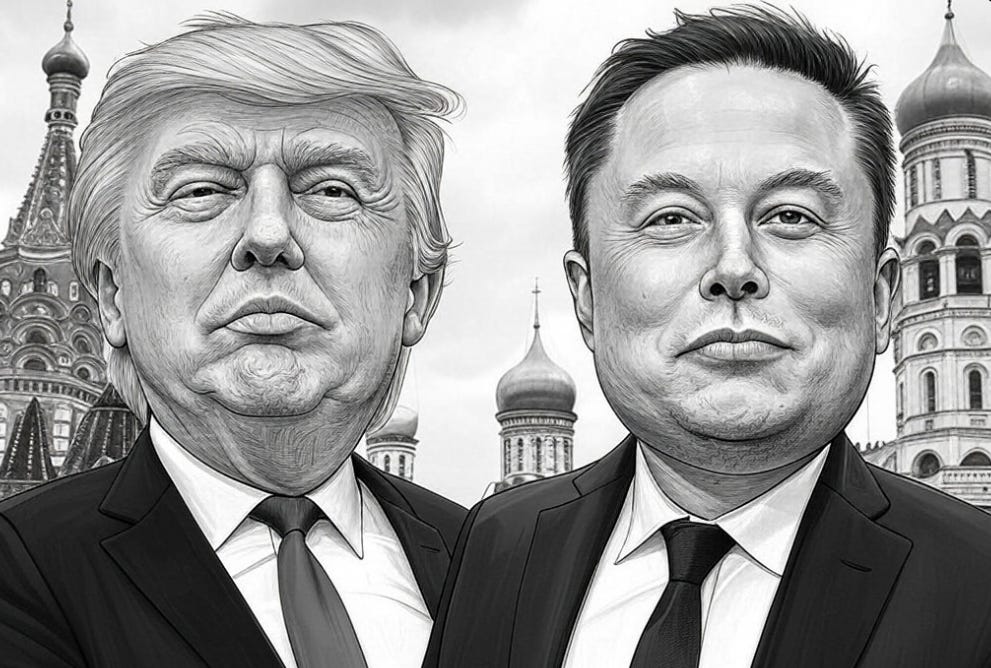
So What’s Really Going On?
Speculation runs wild when it comes to power, influence, and hidden allegiances. Some call it paranoia, others call it due diligence. With this in mind, I decided to take a different approach—I asked our law firm’s OpenAI Deep Research agent to do an exhaustive deep dive into Donald Trump and Elon Musk. The task? Research every credible piece of information available and then deliver an objective analysis: Are either of these men knowingly or unknowingly under Russian influence?
The results? Eye-opening.
At the end of each section, I took it a step further. I asked the AI to play trial lawyer and based upon its findings, make the strongest possible case for and against the idea that each of these figures are compromised.
I invite you to read the breakdown below and decide for yourself. What do you think? Please share your thoughts in the comments.
DISCLAIMER: This is an investigative opinion piece and does not provide legal, financial, tax or investment advice. Always do your own due diligence and consult with an experienced professional in your state, region or country.
Donald Trump Overview
In recent years, allegations have surfaced that former U.S. President Donald Trump may have been cultivated by Russian intelligence as an asset – even purportedly carrying the codename “Krasnov” – dating back to a 1987 trip to Moscow. A former Soviet KGB officer, Alnur Mussayev, has claimed that in 1987 the KGB “recruited 40-year-old businessman… Donald Trump, under the pseudonym ‘Krasnov’” (BREAKING CROSSPOST: Donald Trump Was Recruited by the KGB Under Codename ‘Krasnov’ Claims Former Soviet Spy Chief ). Such extraordinary allegations, if true, raise profound questions about Trump’s financial dealings, secret communications, policy decisions, and susceptibility to Kremlin influence over multiple decades. This report provides an exhaustive investigative analysis of these claims, examining historical records, intelligence findings, financial documents, and expert assessments. Key lines of inquiry include Trump’s business ties with Russian entities, undisclosed flows of money or favors, secret contacts with Russian operatives, instances of policy alignment with Moscow’s interests, signs of potential kompromat or coercion, and U.S. counterintelligence responses. The goal is to distinguish objective facts from speculation and assess whether Trump’s behavior and associations over time align with what would be expected if he had been groomed as a Russian asset. The issue carries high stakes for U.S. national security and democratic integrity, making a detailed, fact-driven inquiry critical. Below, we present findings organized into historical context, the current landscape of knowledge, future projections, and actionable insights.
Historical Context
Early Contacts and Soviet-Era Interest (1977–1980s): Trump’s connections to the Eastern Bloc began with his 1977 marriage to Ivana Zelníčková, a Czech model. Declassified records show Czechoslovakia’s communist intelligence service (StB), in cooperation with the KGB, closely monitored the Trumps for years (BREAKING CROSSPOST: Donald Trump Was Recruited by the KGB Under Codename ‘Krasnov’ Claims Former Soviet Spy Chief ) (BREAKING CROSSPOST: Donald Trump Was Recruited by the KGB Under Codename ‘Krasnov’ Claims Former Soviet Spy Chief ). Ivana’s father was pressured into reporting on the couple, and the StB’s surveillance files (later shared with Moscow) tracked Trump’s burgeoning business career and the couple’s communications (BREAKING CROSSPOST: Donald Trump Was Recruited by the KGB Under Codename ‘Krasnov’ Claims Former Soviet Spy Chief ) (BREAKING CROSSPOST: Donald Trump Was Recruited by the KGB Under Codename ‘Krasnov’ Claims Former Soviet Spy Chief ). Soviet intelligence interest in Trump appears to have been piqued by the late 1980s, when he was an emerging Manhattan real estate mogul. In July 1987, Trump traveled to Moscow and Leningrad for the first time, ostensibly to explore a luxury hotel development in partnership with the Soviet government (Russia Began Cultivating Trump As Asset 40 Years Ago, Ex-KGB Spy Says - Business Insider) (Russia Began Cultivating Trump As Asset 40 Years Ago, Ex-KGB Spy Says - Business Insider). This trip was not a typical tourist venture – it was arranged by Intourist, the Soviet state travel agency widely known to be a front for the KGB. In fact, high-level Soviet diplomatic officials, with KGB assistance, orchestrated Trump’s 1987 Moscow visit (The Hidden History of Trump’s First Trip to Moscow - POLITICO Magazine). According to multiple former Soviet operatives, KGB agents used Trump’s 1987 stay to flatter his ego and seed ideas that he should enter U.S. politics (Russia Began Cultivating Trump As Asset 40 Years Ago, Ex-KGB Spy Says - Business Insider) (Russia Began Cultivating Trump As Asset 40 Years Ago, Ex-KGB Spy Says - Business Insider).
Trump returned from the USSR notably enthusiastic about foreign affairs. In September 1987 – just weeks after his Moscow meetings – Trump took out full-page ads in major U.S. newspapers promoting an isolationist view of American defense policy. In the ads (titled “There’s nothing wrong with America’s Foreign Defense Policy that a little backbone can’t cure”), Trump argued that the United States should stop paying to defend allies like Japan and Saudi Arabia and let them assume more of their own defense costs (Russia Began Cultivating Trump As Asset 40 Years Ago, Ex-KGB Spy Says - Business Insider). Seasoned U.S. intelligence veterans were struck by how closely Trump’s message tracked Soviet strategic interests: namely, weakening U.S. defense commitments and sowing discord between the U.S. and its NATO allies (Russia Began Cultivating Trump As Asset 40 Years Ago, Ex-KGB Spy Says - Business Insider) (Russia Began Cultivating Trump As Asset 40 Years Ago, Ex-KGB Spy Says - Business Insider). Yuri Shvets, a former KGB officer who later defected to the West, noted that Trump’s 1987 statements were considered in Moscow an “unprecedented success” – essentially, a Western businessman echoing USSR talking points in the American press (Russia Began Cultivating Trump As Asset 40 Years Ago, Ex-KGB Spy Says - Business Insider) (Russia Began Cultivating Trump As Asset 40 Years Ago, Ex-KGB Spy Says - Business Insider). This episode planted one of the earliest public signals of a possible influence operation. According to ex-KGB General Oleg Kalugin, by the late 1980s the KGB had likely collected compromising information (“kompromat”) on Trump’s personal behavior during his visits, including reports of his “sexual relationships with women,” which could be used to pressure or blackmail him (BREAKING CROSSPOST: Donald Trump Was Recruited by the KGB Under Codename ‘Krasnov’ Claims Former Soviet Spy Chief ). In Kalugin’s words, Trump had been “on the radar” of Soviet intelligence since the 1980s (BREAKING CROSSPOST: Donald Trump Was Recruited by the KGB Under Codename ‘Krasnov’ Claims Former Soviet Spy Chief ).
Business Dealings and Financial Ties (1990s–2000s): Throughout the 1990s, Trump’s real estate empire suffered severe financial distress, leading him to seek capital outside traditional U.S. banks. By the 2000s, an influx of Russian money helped rescue Trump’s business. His son Donald Trump Jr. acknowledged in 2008 that “Russians make up a pretty disproportionate cross-section of a lot of our assets… We see a lot of money pouring in from Russia” (Yes, there is evidence Trump does business with Russians - POLITICO). Public records substantiate this: a Reuters investigative report found at least 63 individuals with Russian passports or addresses invested nearly $100 million in Trump-branded condos in South Florida alone (Russian elite invested nearly $100 million in Trump buildings) (Russian elite invested nearly $100 million in Trump buildings) during the 2000s. Many such buyers were wealthy Russian businessmen, including former executives from a state-run construction firm and associates of sanctioned Russian organizations (Russian elite invested nearly $100 million in Trump buildings). While buying luxury real estate is a common way for elites to move money offshore, the volume of Russian capital flowing into Trump’s projects was striking, especially given Trump’s own claims around this time that he “had no dealings in Russia” (Russian elite invested nearly $100 million in Trump buildings). In 2008, Trump achieved a sudden financial windfall by selling a Palm Beach mansion for $95 million – more than double what he paid just four years prior – to Russian oligarch Dmitry Rybolovlev (U.S. Sen. Ron Wyden Asks for Records on Trump’s $95 Million Property Deal With a Russian Oligarch) (U.S. Sen. Ron Wyden Asks for Records on Trump’s $95 Million Property Deal With a Russian Oligarch). The transaction’s inflated price and timing (during a U.S. real estate downturn) raised eyebrows. Senator Ron Wyden later noted that in 2008, when credit was scarce, Trump’s “precarious financial position” was dramatically improved by this Russian purchase, warranting scrutiny for potential money laundering or hidden strings attached (U.S. Sen. Ron Wyden Asks for Records on Trump’s $95 Million Property Deal With a Russian Oligarch) (U.S. Sen. Ron Wyden Asks for Records on Trump’s $95 Million Property Deal With a Russian Oligarch). (Rybolovlev never lived in the property, which was later torn down, further suggesting the sale was less about the real estate and more about moving money (Maison de L'Amitie - Wikipedia).) Such capital infusions coincided with Trump’s public pivot in the mid-2000s toward a more Russia-friendly business stance – for example, he licensed his name to the Trump SoHo project financed by ex-Soviet oligarchs, and he actively courted Russian investors for new deals.
Moscow Outreach and “Kompromat” Allegations (2013–2015): Trump’s interactions with Russia intensified in the early 2010s. In November 2013, he traveled to Moscow to host the Miss Universe pageant, partnered with Russian real-estate mogul Aras Agalarov (a Kremlin-connected billionaire). During that visit, Trump openly mused about befriending President Vladimir Putin – even tweeting, “Do you think Putin will be going to The Miss Universe Pageant… and, if so, will he become my new best friend?” The hoped-for meeting with Putin did not materialize, but Putin did send Trump a handwritten note and a gift of a traditional decorative lacquered box as an apology for not attending (LakersGround.net :: View topic - THE Political Thread (ALL Political Discussion Here - See Rules, P. 1)). This personal gesture from Putin was an unusual courtesy to a private citizen. Subsequent reports – including the unverified dossier compiled by former MI6 officer Christopher Steele – alleged that during the 2013 pageant visit, Russian security services obtained compromising footage of Trump engaging in sexual activities in his Moscow hotel suite (PolitiFact | Did Vladimir Putin know Donald Trump was in Moscow in 2013?). While those specific claims remain unproven, they underscore the longstanding KGB/FSB practice of surveilling VIP visitors (hotel rooms in Moscow are routinely bugged) and gathering “kompromat” for potential leverage. Notably, in 2018 Putin was directly asked whether Russia had such material on Trump; he denied it, but U.S. media pointed out that the mere question “called to mind unverified suggestions” that the Kremlin possessed compromising information on Trump from the 2013 trip (PolitiFact | Did Vladimir Putin know Donald Trump was in Moscow in 2013?). Regardless of the veracity of any tapes, the circumstances of Trump’s Moscow stay – facilitated by a Putin-aligned oligarch, filled with opportunities for surveillance, and capped with a personal gift from Putin – fit the profile of a potential cultivation effort by Russian intelligence.
Around the same period, Trump’s rhetoric toward Russia grew conspicuously friendly. He praised Putin as “a strong leader” and began floating a presidential run. Behind the scenes, Trump’s company actively pursued a lucrative real estate project in Moscow. In late 2015, as Trump campaigned for the presidency, his organization signed a Letter of Intent to develop a Trump Tower Moscow. Michael Cohen (Trump’s lawyer) and Felix Sater (a Russian-born associate) engaged in months of secret negotiations with Russian officials. In January 2016, Cohen even emailed Vladimir Putin’s spokesperson, Dmitry Peskov, seeking the Kremlin’s help to advance the Trump Tower Moscow deal (Fuzzy on Trump Tower Moscow? Here's what we know so far | MPR News). Cohen spoke with a Peskov aide by phone for 20 minutes to discuss land and financing arrangements (Fuzzy on Trump Tower Moscow? Here's what we know so far | MPR News). Sater, who boasted “I can get Putin on this program,” urged Cohen that securing Kremlin backing for the project would help Trump win the presidency, emailing, “Our boy can become president of the USA and we can engineer it” (as later revealed in congressional investigations). Plans were made for Cohen or even Trump to visit Moscow during the campaign, and Sater conveyed that Peskov had personally invited Cohen to Moscow to discuss the project (Fuzzy on Trump Tower Moscow? Here's what we know so far | MPR News). This Moscow deal – never ultimately consummated – is a critical piece of context: it meant that during the election campaign, Trump stood to profit from Putin’s favor (a massive real estate payday in Moscow), a potential conflict of interest kept hidden from voters at the time. Cohen later admitted he lied to Congress about the project’s timeline (falsely claiming it ended by January 2016) to downplay the Trump Organization’s contacts with Russia during the campaign (Fuzzy on Trump Tower Moscow? Here's what we know so far | MPR News) (Fuzzy on Trump Tower Moscow? Here's what we know so far | MPR News). In sum, by 2015 Trump had a decades-long trail of business ties to Russia and was secretly entangled in a prospective Kremlin-assisted venture, even as he struck an increasingly pro-Russia tone in public. These historical developments set the stage for the extraordinary events of the 2016 election and Trump’s presidency, where the intersection of Trump’s circle with Russian interests would draw intense scrutiny.
Current Landscape
2016 Election Interference and Trump’s Campaign: The nexus between Trump and Russia came under U.S. investigation in 2016 when American intelligence detected an intensive Kremlin operation to sway the presidential election. Russian military intelligence (GRU) hacked the Democratic National Committee and Clinton campaign emails, then released stolen documents to damage Trump’s opponent, according to unanimous findings of U.S. agencies and multiple indictments. Trump’s campaign, meanwhile, had an unusual number of contacts with Russians and Kremlin-linked intermediaries. The most infamous was the June 2016 Trump Tower meeting, where Trump’s son, son-in-law, and campaign chairman met with a Russian lawyer after being promised “official documents and information that would incriminate Hillary.” While that meeting did not ultimately yield dirt, it showed the campaign’s openness to Russian help. At the same time, high-level Trump advisers were interacting privately with individuals tied to the Russian government. Campaign chairman Paul Manafort maintained a relationship with Konstantin Kilimnik – identified by the Senate Intelligence Committee as a Russian intelligence officer – and even shared internal polling data with him during the campaign (Russians discussed how to influence Trump via his aides - NYT | Reuters) (Russians discussed how to influence Trump via his aides - NYT | Reuters). Advisor Michael Flynn had been courted by Russian contacts since 2015 and was paid to attend a Moscow gala. In fact, U.S. spies later learned that senior Russian officials were overheard discussing ways to influence Trump through Manafort and Flynn, whom they viewed as points of leverage (Russians discussed how to influence Trump via his aides - NYT | Reuters) (Russians discussed how to influence Trump via his aides - NYT | Reuters). Intercepted conversations in summer 2016 showed Russian intelligence and political operatives boasting about their connections to Trump’s team – one reason CIA Director John Brennan grew alarmed that Moscow was guiding Trump associates “down a treasonous path,” as he testified (Russians discussed how to influence Trump via his aides - NYT | Reuters). These intelligence intercepts were so concerning that in 2017 the FBI opened a counterintelligence investigation into whether Trump himself was working on behalf of Russia against U.S. interests ( On What Grounds Can the FBI Investigate the President as a Counterintelligence Threat? | Lawfare ). This extraordinary step – effectively probing a sitting president as a national security threat – was prompted by Trump’s own behavior (more on that below).
Special Counsel Robert Mueller’s investigation (2017–2019) ultimately documented extensive links between the Trump campaign and Russia, but did not charge a criminal conspiracy. Mueller confirmed that Russian state actors hacked and leaked Democratic emails to benefit Trump, and that the Trump campaign welcomed this help (Trump: ‘I don’t see any reason why’ Russia would have interfered with election - POLITICO). For example, when WikiLeaks (serving as a cut-out for Russian hackers) released stolen emails, Trump publicly cheered them and privately strategized about using them. Multiple Trump aides (Papadopoulos, Stone, Manafort, Flynn, Cohen) had clandestine interactions with Russians or their proxies during the campaign and transition. Although Mueller did not find evidence that Trump himself coordinated election crimes, the bipartisan Senate Intelligence Committee report went further in 2020, describing the Trump campaign’s Russia contacts as a “grave” counterintelligence risk – especially Manafort’s dealings with Russian agents. Notably, the investigations revealed that Trump was identified in Russian communications using an alleged code name. According to former KGB officer Yuri Shvets, Soviet spies in the 1980s referred to Trump with a certain moniker and saw him as an asset to be developed (BREAKING CROSSPOST: Donald Trump Was Recruited by the KGB Under Codename ‘Krasnov’ Claims Former Soviet Spy Chief ) (BREAKING CROSSPOST: Donald Trump Was Recruited by the KGB Under Codename ‘Krasnov’ Claims Former Soviet Spy Chief ). (Mussayev’s recent “Krasnov” claim appears to corroborate the idea that Trump had a Soviet code name in KGB files (BREAKING CROSSPOST: Donald Trump Was Recruited by the KGB Under Codename ‘Krasnov’ Claims Former Soviet Spy Chief ), though no official archives confirming this have been released.) U.S. allies also picked up signals; for instance, European intelligence services reportedly provided tips in 2015–2016 about meetings between Trump associates and Russians in Europe, underscoring that Trump-related Russian chatter was on the radar of multiple allied agencies.
Trump’s Foreign Policy Tilt Toward Russia: During his presidency (2017–2021), President Trump repeatedly took positions that aligned with Moscow’s strategic interests, often against the advice of U.S. advisors or the consensus of American intelligence. Some notable examples:
Undermining NATO and Alliances: Trump openly criticized NATO, at times calling the alliance “obsolete” and even privately discussing withdrawing the U.S. from NATO (Russia Began Cultivating Trump As Asset 40 Years Ago, Ex-KGB Spy Says - Business Insider) (Russia Began Cultivating Trump As Asset 40 Years Ago, Ex-KGB Spy Says - Business Insider). (Such a move would be a geopolitical windfall for the Kremlin, which has long sought to weaken NATO.) In 2018, at the G7 summit, Trump argued that Russia should be readmitted to the group (after having been expelled over its invasion of Crimea) (Trump Says Crimea Is Part of Russia Since Most People There Speak Russian - Business Insider). He went so far as to tell G7 leaders that Crimea was part of Russia because “everyone there speaks Russian,” and questioned why they sided with Ukraine over Putin (Trump Says Crimea Is Part of Russia Since Most People There Speak Russian - Business Insider) (Trump Says Crimea Is Part of Russia Since Most People There Speak Russian - Business Insider). This rationale – effectively endorsing Russia’s 2014 annexation of Crimea – echoed the Kremlin’s narrative and shocked U.S. allies. Trump also repeatedly spoke disparagingly of the EU and supported Brexit, aligning with Putin’s goal of a divided Europe.
Softening Stance on Russian Aggression: As a candidate, Trump voiced admiration for Putin and promised improved relations. As president, he was notably reluctant to criticize Russian malign activities. In one infamous instance at the July 2018 Helsinki summit, Trump stood next to Putin and publicly sided with Putin’s denial of election interference over the U.S. intelligence community’s unanimous conclusion that Russia had interfered. Trump said, “I have President Putin; he just said it’s not Russia… I don’t see any reason why it would be [Russia],” directly contradicting his own intelligence officials (Trump: ‘I don’t see any reason why’ Russia would have interfered with election - POLITICO) (Trump: ‘I don’t see any reason why’ Russia would have interfered with election - POLITICO). (He later offered a half-hearted retraction under pressure.) In private, Trump went even further: multiple reports emerged that Trump consistently avoided raising the topic of Russian cyberattacks or aggression in calls with Putin, and even expressed sympathy for Putin’s grievances. For example, it was revealed that Trump took no action after being briefed that Russian military intelligence paid bounties to Taliban fighters to kill U.S. troops in Afghanistan (White House U-Turn on Blaming Russia for SolarWinds Cyberattack: AP - Business Insider) (White House U-Turn on Blaming Russia for SolarWinds Cyberattack: AP - Business Insider), effectively letting Moscow off the hook for targeting American soldiers.
Policy Decisions Benefiting Russia: Trump’s administration at times took hard actions against Russia (often at Congress’s behest, such as implementing sanctions and expelling some diplomats), but Trump himself frequently sought to dilute or delay punitive measures. He was reportedly angry when Congress passed new Russia sanctions in 2017 by veto-proof majorities, and his White House slow-rolled their implementation. In 2017, Trump unilaterally ended a CIA program assisting Syrian rebels fighting Russia’s ally, the Assad regime, a move welcomed by the Kremlin (Russia Began Cultivating Trump As Asset 40 Years Ago, Ex-KGB Spy Says - Business Insider). In 2019, Trump abruptly announced a withdrawal of U.S. troops from Syria, effectively ceding ground to Russian and Assad forces (though he partially reversed under criticism). And throughout his term, Trump pressed to normalize relations with Putin – inviting him to the White House, suggesting Russia rejoin the G7, and resisting efforts to hold Putin accountable for various violations. Even within the U.S., Trump often attacked institutions investigating Russian threats. He fired FBI Director James Comey in May 2017, later admitting it was because of “the Russia thing,” and lambasted the Mueller probe as a “witch hunt,” actions that senior FBI officials viewed as impeding U.S. counterintelligence objectives ( On What Grounds Can the FBI Investigate the President as a Counterintelligence Threat? | Lawfare ). One former FBI general counsel testified that by firing Comey to possibly obstruct the Russia inquiry, Trump “hurt our ability to figure out what the Russians had done,” constituting a threat to national security ( On What Grounds Can the FBI Investigate the President as a Counterintelligence Threat? | Lawfare ).
Secret Communications and Counterintelligence Concerns: A hallmark of Trump’s approach to Russia was an unusual level of secrecy and use of backchannels in communications with Russian officials, which alarmed U.S. security professionals. During the presidential transition in December 2016, Trump’s son-in-law Jared Kushner met with Russian Ambassador Sergey Kislyak and proposed establishing a private, encrypted communications channel using Russian diplomatic facilities (Why Would Jared Kushner Want a Secret Channel to Moscow? - The Atlantic) (Why Would Jared Kushner Want a Secret Channel to Moscow? - The Atlantic) – essentially suggesting that the Trump team and Kremlin talk via secure lines on Russian soil, evading U.S. monitoring. U.S. intelligence intercepted Kislyak’s report of this request back to Moscow, flagging that Trump’s top aide sought to cloak communications from American intelligence (Why Would Jared Kushner Want a Secret Channel to Moscow? - The Atlantic). (This backchannel was never finalized, but the mere attempt raised red flags about why the incoming administration felt the need for secrecy with an adversary.) Around the same time, Trump ally Erik Prince (informally representing the transition) held a secret January 2017 meeting in the Seychelles with Kirill Dmitriev, the head of a sanctioned Russian sovereign wealth fund close to Putin. According to a cooperating witness, this meeting was arranged in advance specifically to create a backchannel between the incoming Trump team and the Kremlin and discuss future relations (Report: Evidence Of Trump Efforts To Set Up Back Channel With Kremlin) (Report: Evidence Of Trump Efforts To Set Up Back Channel With Kremlin). Such an off-the-books conduit – far from official diplomatic channels – is consistent with an effort to avoid U.S. intelligence scrutiny.
Even after taking office, President Trump continued to bypass normal protocols in communications with Putin. He insisted on one-on-one meetings with Putin with only interpreters present, and took the extraordinary step of confiscating the interpreter’s notes after a 2017 meeting in Hamburg, directing the linguist not to brief anyone on the discussion (Lawsuit over Administration’s Unlawful Seizure of Trump-Putin Meeting Notes Moves Forward - American Oversight) (Lawsuit over Administration’s Unlawful Seizure of Trump-Putin Meeting Notes Moves Forward - American Oversight). In 2018 in Helsinki, Trump met Putin with no aides, and again no detailed record for U.S. files exists (Lawsuit over Administration’s Unlawful Seizure of Trump-Putin Meeting Notes Moves Forward - American Oversight). These unusual measures left U.S. officials in the dark about the substance of Trump’s exchanges with Putin – a situation former intelligence officers described as unprecedented. It meant that if Putin did privately pressure Trump or offer inducements, only the Russians would know. Moreover, in an infamous Oval Office meeting in May 2017, Trump welcomed Russian Foreign Minister Sergey Lavrov and Ambassador Kislyak – excluding U.S. media – and in that closed-door conversation Trump revealed highly classified counterterrorism intelligence obtained from an ally (Lawsuit over Administration’s Unlawful Seizure of Trump-Putin Meeting Notes Moves Forward - American Oversight). He also told the Russian envoys that firing Comey had relieved “great pressure” on him, implicitly signaling that the FBI probe into Russian meddling was a burden now lifted. This pattern of secrecy and candor with Russian officials, contrasted with hostility and stonewalling toward his own intelligence and law enforcement, fueled suspicions among U.S. counterintelligence professionals about Trump’s motives and vulnerabilities. Little wonder that FBI counterintelligence officials were actively examining Trump’s personal ties to Russia and whether Moscow had leverage over him. As noted, the FBI inquiry opened after Comey’s firing probed “whether President Trump had been working on behalf of Russia against American interests” ( On What Grounds Can the FBI Investigate the President as a Counterintelligence Threat? | Lawfare ). Although that investigation was absorbed by Mueller’s probe and no definitive public conclusion was reached, the very fact it occurred underscores how seriously the government took the possibility of a compromised president.
Continuing Investigations and Expert Views: As of now, no “smoking gun” proving Trump was an outright Russian agent has emerged in declassified materials. Trump himself vehemently denies any secret loyalties, famously tweeting in 2017: “I HAVE NOTHING TO DO WITH RUSSIA - NO DEALS, NO LOANS, NO NOTHING!” (Russia Began Cultivating Trump As Asset 40 Years Ago, Ex-KGB Spy Says - Business Insider). However, objective analysis of Trump’s record reveals an extraordinary alignment of Trump’s actions with Russian interests, and a decades-long trail of associations that fit the pattern of a cultivated asset – even if Trump was an unwitting asset influenced via flattery and financial inducements rather than a recruited spy who received tasks. Many intelligence experts (including former KGB officials) believe Trump became a classic “agent of influence.” Yuri Shvets, the ex-KGB operative, assessed that Trump was groomed over 40 years through business incentives and ego-stroking, calling him “the perfect target… his vanity and narcissism made him a natural target to recruit” (Russia Began Cultivating Trump As Asset 40 Years Ago, Ex-KGB Spy Says - Business Insider) (Russia Began Cultivating Trump As Asset 40 Years Ago, Ex-KGB Spy Says - Business Insider). Shvets and author Craig Unger have pointed out that what might have begun as low-level cultivation in the late Soviet era paid off enormously when Trump unexpectedly rose to the presidency (Russia Began Cultivating Trump As Asset 40 Years Ago, Ex-KGB Spy Says - Business Insider) (Russia Began Cultivating Trump As Asset 40 Years Ago, Ex-KGB Spy Says - Business Insider). The circumstantial evidence is undeniable: Trump’s policies (attacking NATO, appeasing Putin), rhetoric (echoing pro-Kremlin talking points), personal habits (secrecy with Putin, hostility toward U.S. intel), and finances (repeatedly propped up by Russian money) all tilt in a consistent direction. This convergence led even some Republican lawmakers to privately express concern. By contrast, Vladimir Putin publicly praised Trump as someone who wanted good relations and even in 2022 (after Trump left office) remarked that Trump is “an extraordinary individual” while criticizing current U.S. policy – a signal that the Kremlin still views Trump as a preferable partner. In summary, the current landscape is one of lingering suspicions and substantial evidence of inappropriate ties, even if direct proof of a Kremlin recruitment code-named “Krasnov” remains elusive. Multiple congressional committees, journalists, and academics continue to sift through records from Trump’s term to determine just how far Russian influence may have gone.
Thoughts Moving Forward
Ongoing Investigations and Unresolved Questions: Looking ahead, several avenues could yield further insight into Trump’s Russia connections. U.S. and allied intelligence agencies likely hold still-classified information on intercepted communications and financial transactions that could either corroborate or refute the asset allegations. As time passes, there may be new leaks or authorized disclosures. For instance, Congress has signaled interest in obtaining Trump’s communications with Putin (such as translator accounts or diplomatic cables) and his financial records. If political conditions change in Russia – say, in a post-Putin era – internal KGB/FSB archives might surface that detail Trump’s Soviet-era file, potentially confirming codename “Krasnov” and the extent of any cultivation operation. Already, fragments from defunct Eastern Bloc agencies (like the StB files and East German Stasi records) have shed light on how Trump was viewed by communist intelligence; more could emerge through international research collaborations.
On the U.S. legal front, Trump’s finances remain under scrutiny. Prosecutors in New York and elsewhere have combed through Trump Organization records for unrelated fraud investigations, and those could inadvertently expose previously unknown Russian-linked transactions. Any “unexplained shifts in wealth” – for example, the puzzling surge in cash purchases of Trump properties by shell companies in the mid-2010s – might be explained if investigators trace the ultimate sources of those funds (which could lead back to Russian oligarchs or banks). Additionally, the question of whether Russian state actors laundered money through Trump’s ventures (such as the 2013 Miss Universe pageant or luxury condo purchases) could be answered with deeper forensic accounting. Financial intelligence units (like FinCEN) and international partners are increasingly focused on illicit Russian money flows, especially in light of sanctions against oligarchs. Future reports might reveal whether Trump’s businesses were unwitting conduits for dirty money or channels to curry favor. Senator Wyden’s ongoing inquiries into transactions like the Rybolovlev mansion sale indicate that this line of investigation remains active (U.S. Sen. Ron Wyden Asks for Records on Trump’s $95 Million Property Deal With a Russian Oligarch) (U.S. Sen. Ron Wyden Asks for Records on Trump’s $95 Million Property Deal With a Russian Oligarch).
Geopolitical Implications: If Trump (who as of this writing remains an influential figure in U.S. politics and has hinted at future campaigns) were to return to office or remain a kingmaker, the issue of his Russian ties will resurface with intensity. U.S. allies will be watching closely for any policy shifts that favor Moscow. The Kremlin, for its part, may attempt to further exploit divisions in U.S. domestic politics that the Trump-Russia saga has opened – for example, by promoting narratives that the “Russia hoax” was a Deep State fabrication, thereby inoculating Trump’s base against any new evidence that might emerge. The 2024 U.S. presidential election (if Trump is a candidate) could prompt another wave of Russian active measures, given how successful their 2016 interference was. We can expect Russian cyber units to continue probing U.S. campaigns and perhaps attempting to hack or release information related to Trump’s opponents (or even Trump’s camp, if they seek leverage over him). Cybersecurity experts warn that Russian hackers are persistently trying to access U.S. political networks; any such intrusions might be aimed at influencing candidates’ behavior, not just stealing data. For instance, if Russia still holds kompromat on Trump, they may not need to release it – the mere knowledge that they have it could be enough to influence behind-the-scenes actions.
Intelligence Community Stance: Within the U.S. intelligence and law enforcement community, the Trump-Russia experience has already prompted reforms, and more are likely. The FBI and CIA may refine how they flag and handle major-party candidates who present counterintelligence risks. It’s a delicate balance, as overt investigation can be seen as election interference, yet not investigating could risk national security. We may see new protocols requiring aggressive vetting of security threats after elections – for example, the FBI’s decision to open a case on Trump only after he fired Comey was unprecedented; in the future they might brief Congress earlier if a president appears compromised. Allied intelligence agencies, too, might be more forthcoming with warnings: there were reports that the UK’s GCHQ and others passed along concerns about Trump’s contacts pre-2016, but these were largely kept classified. In the future, such early warnings could spur congressional oversight or even public alerts.
In summary, the question “Was Trump a recruited Russian asset code-named Krasnov?” remains officially unanswered. However, ongoing investigations and future disclosures seem likely to further illuminate the web of interactions between Trump and Russia. Each new financial record or intelligence intercept could add a piece to the puzzle. While it’s impossible to predict a “smoking gun,” the trajectory of evidence has steadily corroborated many elements of the long-suspected narrative of Russian cultivation. The coming years will determine whether this remains a shadowy suspicion or is definitively proven (or debunked) by hard evidence. Regardless, the legacy of this saga is already influencing how the U.S. guards against foreign espionage and interference.
Actionable Insights
1. Strengthen Transparency in Financial Dealings: One clear takeaway is the need for far greater financial transparency for political candidates and officeholders. Unexplained infusions of foreign money – such as those observed in Trump’s business career from Russian sources (Yes, there is evidence Trump does business with Russians - POLITICO) (Russian elite invested nearly $100 million in Trump buildings) – can pose severe counterintelligence risks. Requiring candidates to disclose extensive financial information, including business partners and real estate transactions, would help expose potential foreign entanglements before they become national security problems. For example, if Trump’s extensive Russian business ties had been public and scrutinized earlier, safeguards or disclosures might have been implemented. Legislation could mandate tax return releases and beneficial ownership transparency for any business linked to a President or candidate. This would make it harder for adversarial money to flow covertly into influence-building ventures (such as property purchases or loans via cut-outs). Financial regulators should also tighten monitoring of luxury asset purchases by foreign nationals – as was done in the Reuters inquiry that flagged nearly $100 million in Russian purchases of Trump condos (Russian elite invested nearly $100 million in Trump buildings) (Russian elite invested nearly $100 million in Trump buildings) – and promptly share red flags with counterintelligence officials.
2. Bolster Counterintelligence Vetting and Oversight: The fact that the FBI had to open a case on whether the sitting President was working for Russia ( On What Grounds Can the FBI Investigate the President as a Counterintelligence Threat? | Lawfare ) is alarming. To avoid reaching that crisis point, earlier vetting of candidates and their inner circles for foreign influence is crucial. The intelligence community and congressional oversight committees should develop protocols to assess significant foreign ties of candidates (especially for President) in a way that respects civil liberties but ensures security. This might include defensive briefings: e.g., informing a candidate that foreign spies have an eye on them (reports suggest the FBI did provide a defensive briefing to the Trump campaign in 2016 about foreign contacts, but perhaps a more forceful approach was warranted). Additionally, once in office, presidents should be subject to some form of bipartisan oversight when interacting with high-risk foreign adversaries. Policies could require that at least one U.S. official or note-taker be present in all meetings with leaders like Putin, to prevent secret deals or promises, and that records of such meetings be preserved as official property (addressing the issue of Trump seizing the interpreter’s notes (Lawsuit over Administration’s Unlawful Seizure of Trump-Putin Meeting Notes Moves Forward - American Oversight)). Congress may consider updating the Federal Records Act or passing new laws to bar sole-private meetings that bypass institutional memory.
3. Enforce Strict Limits on Backchannels and Sensitive Communications: The Trump case highlights how unauthorized backchannels can undermine official U.S. policy and security. Kushner’s attempt to use Russian diplomatic comms (Why Would Jared Kushner Want a Secret Channel to Moscow? - The Atlantic) and the Seychelles meeting (Report: Evidence Of Trump Efforts To Set Up Back Channel With Kremlin) were essentially shadow diplomacy that cut out U.S. intelligence. Going forward, any transition team member or official who attempts to establish secret communications with foreign powers in a manner designed to evade U.S. monitoring should face legal consequences or loss of security clearance. The Logan Act (prohibiting unauthorized citizens from negotiating with foreign governments) could be enforced more rigorously in such scenarios. Training for incoming administrations on the counterintelligence dangers of off-the-record contacts is also advisable. Likewise, the State Department and NSC should develop channels for early reporting of any such attempts. Using secure U.S. government communication lines should be the norm, and any deviation (like seeking to use a foreign embassy’s cipher line) should ring loud alarm bells.
4. Close Loopholes on Foreign Money in U.S. Politics: The 2016 election exposed vulnerabilities in campaign finance where foreign funds can be laundered into U.S. politics – for instance, via the NRA or straw donors. In Trump’s case, the FBI and Congress investigated whether Russian-linked money found its way to his campaign through the NRA and other intermediaries (NRA got more money from Russia-linked sources than earlier reported - POLITICO) (The N.R.A. Spent $30 Million to Elect Trump. Was It Russian Money? | Vanity Fair). To prevent such covert support, laws and enforcement must be tightened. The Federal Election Commission (FEC) should increase oversight of organizations (like nonprofits or lobbying groups) that spend heavily in elections and might receive foreign donations. One idea is to require certifications from major campaign spenders that no foreign funds were accepted, with criminal penalties for false statements. The NRA admitted in 2018 to receiving more money from Russia-linked sources than initially reported (NRA got more money from Russia-linked sources than earlier reported - POLITICO) (NRA got more money from Russia-linked sources than earlier reported - POLITICO), illustrating how disclosure needs improvement. Moreover, DOJ should aggressively prosecute straw donor schemes (as it did with Lev Parnas and Igor Fruman funneling a Russian’s money to U.S. campaigns (U.S. charges Russian oligarch with making illegal political donations - POLITICO) (U.S. charges Russian oligarch with making illegal political donations - POLITICO)) to deter others. Financial institutions can assist by flagging suspicious wire transfers to political committees. By choking off illicit foreign funding, we reduce the leverage those foreign actors might gain over candidates down the line.
5. Fortify Cyber Defenses and Attribution: Russia’s cyber espionage and influence operations were a key component of the Trump-Russia saga – from hacking campaigns to online propaganda. Continuing to strengthen cybersecurity for political targets (campaigns, think tanks, parties) and improving rapid attribution of foreign hacks is essential. The U.S. government did attribute the DNC hacks to Russia and indicted GRU officers, but more timely exposure might have blunted their impact. Investments in threat intelligence sharing between government and campaigns (through programs like DHS’s election security initiative) should be expanded. Additionally, when major breaches do occur, the U.S. must speak with one voice. In the SolarWinds hack of 2020, for example, there was confusion when President Trump contradicted his own officials by suggesting China might be responsible, despite evidence implicating Russia (White House U-Turn on Blaming Russia for SolarWinds Cyberattack: AP - Business Insider) (White House U-Turn on Blaming Russia for SolarWinds Cyberattack: AP - Business Insider). This undermined the response and signaled division. Going forward, administrations should defer to the technical experts to identify culprits swiftly and accurately, and respond accordingly – not downplay findings for political reasons (White House U-Turn on Blaming Russia for SolarWinds Cyberattack: AP - Business Insider) (White House U-Turn on Blaming Russia for SolarWinds Cyberattack: AP - Business Insider). Clear consequences for state-sponsored hacking (sanctions, diplomatic expulsion, or even offensive cyber measures) will help deter interference aimed at boosting any candidate, Trump or otherwise.
6. Public Awareness and Resilience: Finally, an informed public is a crucial line of defense. The Trump experience proved that foreign influence operations exploit societal divisions and individual weaknesses (like a target’s greed or vanity). Civics education should include modules on how foreign propaganda and active measures work, so citizens and future leaders can recognize attempts to manipulate them. Trump’s willingness to embrace and amplify Russian-crafted narratives – for instance, the idea that NATO allies “rip off” the U.S., or that Ukraine (not Russia) interfered in 2016 – shows the power of repeated misinformation. Building media literacy and a habit of cross-checking sources can reduce the effectiveness of such influence. Moreover, political parties should commit to a norm: if offered assistance by a foreign government, don’t accept it – report it. Had the Trump campaign immediately reported the June 2016 overture (“Russian government attorney… part of Russia and its government’s support for Mr. Trump”) to the FBI instead of welcoming it, they would have set a strong precedent. Bipartisan congressional leadership could draft a pledge or even a law requiring campaigns to notify federal authorities of any foreign election aid offers.
Strongest Argument In Favor of Trump Being a Russian Asset
The Case Against Donald Trump: A Russian Asset in Plain Sight
Let’s strip this down to the truth, free from excuses, distractions, or blind loyalty. You want to talk about whether Donald Trump was compromised? The evidence isn't just circumstantial—it’s a glaring, neon-lit roadmap to how Russian intelligence plays the long game, how they cultivate assets, and how they expertly exploit the weaknesses of narcissists with money problems. We have a man who has spent decades benefiting from Russian financial support, welcoming secret meetings with Kremlin operatives, echoing Moscow’s talking points, and undermining U.S. national security—all while taking extraordinary steps to hide his actions. Trump’s first major Russia connection began in 1987, when his trip to Moscow was orchestrated by the KGB. He returned a changed man, suddenly obsessed with U.S. foreign policy and demanding that America abandon its allies—something only the Soviets wanted at the time. Fast forward: when his businesses were collapsing in the 1990s and no American bank would touch him, Russian money came pouring in. His own son, Donald Trump Jr., admitted in 2008 that “Russians make up a pretty disproportionate cross-section of our assets.” By 2013, Trump was in Moscow again, openly courting Putin’s favor, staying in a hotel known for FSB surveillance, and, according to multiple sources, being compromised. That same year, he sold a mansion to a Russian oligarch for an absurdly inflated price, suggesting money laundering or a financial favor. But here’s the kicker—when he ran for president, the pattern continued. His campaign welcomed Russian interference, lied about contacts, and worked in secret to make backroom deals, including negotiating a Trump Tower Moscow project while he was running for office. The FBI was so alarmed by what they saw that they opened a counterintelligence investigation into a sitting U.S. president. That doesn’t happen unless something is very, very wrong.
And let’s be clear—Trump didn’t just “like” Russia. He served its interests, knowingly or not, at every turn. As president, he weakened NATO, defended Putin against his own intelligence agencies, and pushed policies that only helped Moscow. He met with Putin in secret, confiscated notes from his own interpreter, and took unprecedented steps to ensure no American official knew what was discussed. When Russia attacked our democracy, he publicly sided with Putin over U.S. intelligence. When Russian operatives offered dirt on Hillary Clinton, his campaign jumped at the chance. When Russia paid bounties to kill American troops, he did nothing. When asked about Putin’s brutality, he shrugged and said, “You think our country’s so innocent?” That’s not patriotism. That’s a compromised man rationalizing his loyalty to a foreign power. And here’s the reality: Trump may not have carried a KGB badge, but he walked, talked, and governed like the most valuable Russian asset in modern U.S. history. This isn’t politics. This is a national security crisis that played out in real-time, under our noses. A man propped up by Russian money, praised by Russian officials, shielded by Russian propaganda, and protected by a party too afraid to admit the truth. You don’t need to believe in secret code names or spy novels. Just look at the facts. Every move he made was a gift to Moscow. Every lie he told covered for Putin. Every time America needed him to stand up to Russia, he bent the knee. If that’s not the definition of a compromised leader, what is?
The Case for Donald Trump: A Political Target, Not a Russian Asset
Enough with the conspiracy theories. If Donald Trump were truly a Russian asset, wouldn’t we have rock-solid proof by now? We’re not talking about whispers in dark corridors—we’re talking about decades of public scrutiny, multiple congressional investigations, and a full-scale FBI counterintelligence probe that found zero evidence of a covert Russian recruitment. Let’s get real: Trump’s business dealings with Russian nationals? No different than those of countless other global real estate moguls. His 1987 Moscow trip? Arranged by the Soviets to court American business—not enlist secret agents. His campaign’s contacts with Russian figures? Standard political networking, blown out of proportion by media hysteria. The so-called “Trump Tower Moscow” project? It never happened. And let’s not forget—every decision he made as president, from arming Ukraine to expanding U.S. energy independence, cut against Russian interests. A Kremlin puppet doesn’t push for higher military spending, call out NATO members to contribute more, or impose record-breaking sanctions on Russian oligarchs. Yet here we are, with critics desperately piecing together scattered business ties, policy moves, and sensationalized headlines, pretending it adds up to espionage. It doesn’t. Because if Trump was a Russian asset, he was the worst one in history—constantly acting in ways that harmed Russia’s geopolitical goals.
Now, let’s talk about what’s really going on. The Trump-Russia narrative wasn’t about national security—it was about politics. The moment Trump won in 2016, Washington insiders who couldn’t stand an outsider in the Oval Office needed a way to undermine him. Enter the “Russia collusion” myth, fueled by opposition-funded dossiers, politically motivated investigations, and media outlets desperate for a scandal. They took routine diplomatic meetings and normal business transactions and twisted them into something sinister. And when nothing stuck, they doubled down—because the truth was too inconvenient. The reality is, Trump wasn’t compromised—he was hunted. And why? Because he threatened the establishment, refused to play by their rules, and shattered the political order. If Trump were truly working for Russia, there wouldn’t be a trail of speculation—there would be hard evidence. But there isn’t. Because the entire narrative is a house of cards built on partisan fantasy, not reality. If there’s one thing Trump’s presidency proved, it’s this: Washington’s biggest fear isn’t foreign influence—it’s a leader they can’t control.
ELON MUSK
Overview
Elon Musk, as the CEO of SpaceX, Tesla, and owner of X (Twitter), wields significant influence in technology and even geopolitics. This report investigates potential connections between Musk (and his close family) and Russia, focusing on financial, business, and political links or influences. Key questions include whether Musk has had financial dealings with Russian entities, undisclosed communications or assistance from Russian sources, or has taken actions aligning with Russian interests. Given Musk’s high-profile role – from aerospace contracts with the U.S. government to providing Starlink satellite internet in war zones – any undue Russian influence could have national security implications.
Key Findings:
Financial/Business Links: Historically, Musk had limited business dealings with Russia. Notably, in 2001 he traveled to Moscow attempting to buy rockets for a private space venture (When SpaceX Tried to Buy ICBMs from Russia: Vodka and a Run-Around). While no purchase materialized, it was an early direct interaction with Russian entities. Years later, a venture fund led by Russian-born investor Yuri Milner (who had Kremlin-linked funding) quietly invested ~$10 million in Musk’s SpaceX in 2013 (How does a Russian tycoon distance himself, very carefully, from Vladimir Putin - Infobae). More recently, Musk’s 2022 Twitter buyout was partly financed by a firm with past ties to Russian oligarch-backed networks (Vy Capital) (Musk’s Twitter bid leans on financier linked to Russian tycoon - The Jerusalem Post ). However, there is no evidence of Musk or his family receiving undisclosed loans, gifts, or funding directly from the Kremlin or sanctioned oligarchs.
Travel and Communications: Musk’s known travel to Russia is limited to the early-2000s rocket deal attempts. In recent years, most interactions have been virtual. He invited President Vladimir Putin to a dialogue on the Clubhouse app in 2021 (the Kremlin showed interest but the talk never happened) (Kremlin says Elon Musk's Clubhouse invitation to Putin came to nothing | Reuters). Musk has denied meeting Putin in person, though he acknowledged one phone conversation about “space” ~18 months prior to October 2022 (Elon Musk Spoke to Putin Before Tweeting Ukraine Peace Plan: Report). Notably, reports emerged in late 2024 that Musk has been in regular private contact with Putin and other Kremlin officials since late 2022 (Musk has been in contact with Putin, Russian officials since 2022, WSJ reports). These alleged backchannel communications (which Musk has not confirmed) are said to cover personal, business, and geopolitical topics (Senators Call for Investigation Into Elo... | U.S. Senator Jeanne Shaheen). They even reportedly included Sergey Kiriyenko – Putin’s deputy chief of staff in charge of propaganda operations (Musk has been in contact with Putin, Russian officials since 2022, WSJ reports). Such contacts, if true, were kept secret from U.S. authorities (Musk has been in contact with Putin, Russian officials since 2022, WSJ reports). Aside from Elon, there are no public reports of Musk’s close family (such as his siblings or mother) meeting Russian officials or operatives.
Political Stance and Influence: Musk initially supported Ukraine after Russia’s 2022 invasion by supplying Starlink terminals to maintain internet access (Musk has been in contact with Putin, Russian officials since 2022, WSJ reports). But later, he put forward a “peace plan” that would have granted Russia permanent control of Crimea and parts of Eastern Ukraine – positions aligning closely with Moscow’s demands (Elon Musk Spoke to Putin Before Tweeting Ukraine Peace Plan: Report). Around the same time, analysts noted Musk’s rhetoric shifting: he used his platform to oppose additional U.S. aid to Ukraine and declared “no way in hell” Russia could lose the war (Musk has been in contact with Putin, Russian officials since 2022, WSJ reports). He also imposed limits on Starlink usage for Ukrainian military operations, reportedly thwarting a Ukrainian drone strike on Russian forces – a decision Russian officials praised (Musk biographer tries to ‘clarify’ details on Starlink in Ukraine after outcry – POLITICO). U.S. observers have questioned whether these actions, which favor Russian strategic interests, were driven by Russian influence or simply Musk’s own views. No evidence has surfaced of Musk being blackmailed or coerced by Moscow (and Musk himself quipped that Putin “can’t afford” to buy his loyalty) – but his behavior has drawn increasing scrutiny (Senators Call for Investigation Into Elo... | U.S. Senator Jeanne Shaheen).
Cyber and Intelligence Aspects: Musk and his companies have indeed been targets of Russian cyber and espionage efforts. In 2020, a Russian national attempted to bribe a Tesla employee $1 million to install malware, aiming to steal data for ransom; the employee reported it and the FBI foiled the plot (A Tesla Employee Thwarted an Alleged Ransomware Plot | WIRED) (A Tesla Employee Thwarted an Alleged Ransomware Plot | WIRED). During the Ukraine war, Russian hackers and jammers tried aggressively to disrupt SpaceX’s Starlink network – but SpaceX quickly adapted and “resisted Russian cyberwar jamming & hacking attempts,” according to Musk (Elon Musk Says Russia Has Ramped up Efforts to Jam SpaceX's Starlink - Business Insider). There’s no public evidence that Russian intelligence obtained sensitive Musk data or kompromat, but U.S. security officials remain vigilant. In fact, the Wall Street Journal reported that Musk’s secret contacts with Putin have been a “well-kept secret” inside the U.S. government due to concerns about his access to classified projects (Musk has been in contact with Putin, Russian officials since 2022, WSJ reports). Top NASA and defense officials have voiced concern that any unmonitored Musk-Putin communications could pose a counterintelligence risk (Senators Call for Investigation Into Elo... | U.S. Senator Jeanne Shaheen).
In summary, while no clear proof has emerged of illicit Russian financing or coercion of Elon Musk, there have been multiple points of contact and coincidence that raise questions. Musk’s early business foray in Russia, a small investment from a Russian-linked fund, and recent private conversations with the Kremlin form a trail of ties – albeit not a smoking gun of wrongdoing. His public statements and decisions (like the Ukraine “peace” proposal and Starlink limitations) sometimes align with Russian interests, but could also be explained by Musk’s personal strategic calculus or fear of escalation. Given Musk’s outsized role in critical industries and communications, any potential Russian influence – even informal – is taken seriously by observers. The following sections delve deeper into the historical context of these interactions, the current landscape of Musk’s Russia links, expected future developments, and recommendations to address any risks.
Historical Context
Elon Musk’s interactions with Russia date back to the early days of his entrepreneurial journey. In the early 2000s, Musk looked to Russia as a potential business partner in pursuit of his space ambitions. Fresh off the sale of PayPal, Musk conceived a project to spark public interest in space by sending experiments (like plants or mice) to Mars. Lacking rockets of his own, in 2001 Musk and colleagues traveled to Moscow to attempt to purchase intercontinental ballistic missiles (ICBMs) that could be repurposed for orbital launches (When SpaceX Tried to Buy ICBMs from Russia: Vodka and a Run-Around). Over the course of three trips, Musk negotiated with Russian aerospace officials and middlemen – a colorful series of meetings often accompanied by vodka toasts (When SpaceX Tried to Buy ICBMs from Russia: Vodka and a Run-Around). Ultimately, the talks fell through: the Russians brusquely raised the price to an exorbitant $21 million per rocket, mocking Musk as a “little boy” who couldn’t afford it (When SpaceX Tried to Buy ICBMs from Russia: Vodka and a Run-Around). Frustrated, Musk walked away without a deal – an outcome that directly prompted him to start SpaceX in 2002 to build rockets domestically (When SpaceX Tried to Buy ICBMs from Russia: Vodka and a Run-Around). This failed negotiation is the first known direct financial dealing between Musk and Russian entities. While it was a legitimate business attempt (not a clandestine tie), it established early contact with Russia’s space industry.
Throughout the 2000s and 2010s, Musk’s companies had minimal reliance on or collaboration with Russia. In fact, SpaceX’s rise helped end U.S. dependence on Russian rockets. After 2011, the U.S. had been buying Russian Soyuz launches to send NASA astronauts to the ISS. SpaceX’s Crew Dragon capsule restored American launch capability in 2020, which Musk touted alongside the fact that SpaceX uses no Russian rocket engines or parts (a pointed contrast to other launch providers) (How does a Russian tycoon distance himself, very carefully, from Vladimir Putin - Infobae). Musk even engaged in a bit of banter with Russian officials; when a Russian space chief scoffed that NASA might need trampolines to reach orbit without Russian rockets, Musk jokingly retorted “the trampoline is working” after a successful SpaceX launch. These dynamics positioned Musk more as a competitor to Russia’s space sector than a partner.
However, there were instances of Russian investment intersecting Musk’s ventures. A notable example surfaced in the 2010s involving Yuri Milner, a Russian-born tech investor. Milner’s venture fund DST Global had backing from Kremlin-linked sources (including investments from Gazprom and oligarch Alisher Usmanov) (Russian Money in Silicon Valley - The Atlantic). In 2013, Milner quietly invested about $10 million into SpaceX, according to later reports, and even chatted with Musk on topics like space travel and extraterrestrial life (How does a Russian tycoon distance himself, very carefully, from Vladimir Putin - Infobae) (How does a Russian tycoon distance himself, very carefully, from Vladimir Putin - Infobae). He exited that stake in 2015, more than doubling his money as SpaceX’s valuation rose (How does a Russian tycoon distance himself, very carefully, from Vladimir Putin - Infobae). At the time, this stake was not publicized – and Milner was distancing himself from his Russian backers – so it did not raise alarm. Still, it represents indirect Russian capital reaching Musk’s company (via an intermediary fund). Beyond SpaceX, Musk’s other early ventures (Tesla, SolarCity, PayPal) do not appear to have had significant Russian investors or partners in their foundational years. Tesla did not source major funds from Russia nor depend on Russian materials; its key backers were from the U.S., Europe, and China.
On the political front, before the mid-2010s Musk had little involvement with Russia. One exception was Musk’s father, Errol Musk, who in 2002 planned to broker South African arms to Russia – a venture Elon reportedly advised him against, straining their relationship (no deal occurred in the end). Elon Musk himself kept his focus on business, not international politics, for most of the 2000s.
By the late 2010s and early 2020s, as Musk’s profile grew, he showed a tentative openness to engaging with Russia in non-adversarial ways. In 2021, Musk made headlines by inviting Vladimir Putin to join him in a public conversation on Clubhouse (an audio-based social app). Musk tweeted the invitation in Russian, and the Kremlin responded with interest, calling it a “very interesting” proposal while seeking details (Kremlin says Elon Musk's Clubhouse invitation to Putin came to nothing | Reuters). Ultimately, the chat never happened – Moscow said the follow-up “came to nothing” and considered the matter closed (Kremlin says Elon Musk's Clubhouse invitation to Putin came to nothing | Reuters) – but the episode demonstrated Musk’s willingness to personally reach out to Putin in a friendly manner. Around the same time, in May 2021, Musk virtually attended a Russian forum and stated that Tesla was close to establishing a presence in Russia, even considering building a factory there (Elon Musk says Tesla eyeing Russia as a potential production hub | Reuters). The Russian Ministry of Trade welcomed the idea and publicly invited Musk to visit and discuss incentives (Elon Musk says Tesla eyeing Russia as a potential production hub | Reuters). These overtures occurred before Russia’s invasion of Ukraine, at a time when such engagement was not yet fraught. They signaled Musk’s view of Russia as a potential market and interlocutor for his businesses.
In summary, the historical context reveals sporadic and pragmatic interactions between Elon Musk and Russia: an early business negotiation (rockets) that went nowhere, a minor venture investment via a Russian-connected fund, and cordial communications about possible tech collaborations. Throughout these years, there were no known political entanglements or personal ties between Musk (or his family) and the Russian state. If anything, Musk’s work in the 2010s – reducing NASA’s reliance on Russian space tech – put him somewhat at odds with Russia’s interests, albeit indirectly. By 2021, Musk’s flirtation with inviting Putin to talk and expanding Tesla to Russia suggested a neutral-to-positive stance toward Russia, driven by business curiosity and Musk’s penchant for high-profile interactions. There was little hint at this stage of any malign influence – Russia was simply another arena in which Musk might expand his enterprises or bolster his public persona. All of this set the stage for the much more consequential interactions that would emerge once geopolitical tensions spiked in 2022.
Current Landscape
The Russian invasion of Ukraine in February 2022 created a new, high-stakes context for Elon Musk’s relations with Russia. In the war’s early phase, Musk positioned himself as a supporter of Ukraine’s resistance: within days of the invasion, he sent SpaceX Starlink satellite internet terminals to Ukraine in response to a plea from a Ukrainian official (Elon Musk Says Russia Has Ramped up Efforts to Jam SpaceX's Starlink - Business Insider). This gave Ukrainian forces and civilians resilient communication capabilities, undermining Russia’s attempt to cut off Ukrainian connectivity. Musk was initially lauded for this aid, which directly countered Russian interests on the battlefield (Musk has been in contact with Putin, Russian officials since 2022, WSJ reports). Russian hackers and electronic warfare units quickly took note – they targeted Starlink with jamming and cyber attacks, but Musk reported that Starlink resisted these “cyberwar” attempts even as Russia ramped up its efforts (Elon Musk Says Russia Has Ramped up Efforts to Jam SpaceX's Starlink - Business Insider). Western governments confirmed Russia’s aggressive hacking campaigns against satellite networks (e.g., the Viasat hack on invasion day), but Starlink proved robust and continued operating (Elon Musk Says Russia Has Ramped up Efforts to Jam SpaceX's Starlink - Business Insider). This put Musk, unexpectedly, in the middle of a cyber conflict with Russia, effectively on the Ukrainian/U.S. side. Russian media and officials grew hostile to Starlink, and by extension Musk, during this period (Elon Musk Says Russia Has Ramped up Efforts to Jam SpaceX's Starlink - Business Insider).
As the war dragged on into late 2022, Musk’s public stance began to shift in ways that drew both curiosity and criticism. In October 2022, Musk tweeted a controversial “Ukraine-Russia peace plan.” His proposal suggested that Ukraine concede Crimea to Russia permanently and hold new referendums (under U.N. supervision) in other Russian-occupied regions – terms heavily favoring Moscow’s position after its invasion (Elon Musk Spoke to Putin Before Tweeting Ukraine Peace Plan: Report). The plan also urged Ukraine’s neutrality. Many observers noted that Musk’s ideas echoed Kremlin talking points, essentially rewarding Russia with territorial gains it sought by force. The timing raised eyebrows: shortly before Musk’s tweets, Ian Bremmer (a geopolitical analyst) claimed that Musk told him he had spoken directly with Putin, who conveyed Russia’s “red lines” regarding Ukraine (Elon Musk Spoke to Putin Before Tweeting Ukraine Peace Plan: Report). According to Bremmer, Musk indicated that Putin was “prepared to negotiate” only if Crimea remained Russian and Ukraine agreed to neutrality – which closely matched Musk’s public proposal. Musk denied this account, replying on Twitter that he had “spoken to Putin only once and that was about 18 months ago… about space” (Elon Musk Spoke to Putin Before Tweeting Ukraine Peace Plan: Report). Nevertheless, the incident suggested the possibility of unofficial backchannel communications between Musk and the Kremlin at a pivotal moment in the war. U.S. officials were concerned enough that in October 2022 the Kremlin was asked about it; Putin’s spokesman denied any recent conversation with Musk, and Musk’s own denial was noted. The true extent of contact then remains uncertain, but the episode demonstrated Musk’s willingness to insert himself into foreign policy debates – and how that could align with Russian interests.
Following the “peace plan” controversy, Musk continued to make comments and decisions that Russia found favorable. On his social media platform (now X, formerly Twitter), Musk increasingly amplified skepticism about Ukraine’s progress and U.S. support. He at one point tweeted, “there is no way in hell” Russia will lose the war, while casting doubt on Ukrainian victories (Musk has been in contact with Putin, Russian officials since 2022, WSJ reports). He also spoke out against additional U.S. government aid to Ukraine, mirroring arguments made by Russian propaganda that Western aid is futile (Musk has been in contact with Putin, Russian officials since 2022, WSJ reports). In parallel, Musk grew closer to factions in U.S. politics that question support for Ukraine. (Notably, Musk began engaging more with right-wing commentators and even U.S. Republicans who have echoed Russian talking points.) Within Twitter, after Musk’s takeover, accounts of Russian state media and Putin allies that were previously banned or throttled were reinstated, and researchers documented a surge in pro-Russian disinformation and hate speech on the platform (Musk has been in contact with Putin, Russian officials since 2022, WSJ reports). Musk has framed his approach as “free speech absolutism,” but the practical effect was a more permissive environment for Kremlin-aligned propaganda. U.S. Justice Department officials have accused Russian operatives – including the very Sergey Kiriyenko who reportedly chatted with Musk – of exploiting X to covertly spread Russian government propaganda and influence voters (Senators Call for Investigation Into Elo... | U.S. Senator Jeanne Shaheen). That Musk may have been privately corresponding with Kiriyenko (a key architect of Russian disinformation strategy) while his platform loosened restrictions on Kremlin-affiliated accounts is a deeply concerning juxtaposition (Senators Call for Investigation Into Elo... | U.S. Senator Jeanne Shaheen). It suggests a potential convergence of interests, witting or unwitting, between Musk’s free-speech ethos and Russia’s information warfare goals.
Another flashpoint has been Musk’s control over the Starlink network in Ukraine. In September 2022, it came to light (via Walter Isaacson’s biography of Musk) that Musk had declined a Ukrainian request to extend Starlink coverage to Crimea’s coastline, effectively blocking a planned surprise attack on the Russian Black Sea Fleet. Musk feared that enabling communications for a Ukrainian drone strike on Russian warships could trigger a nuclear escalation by Russia (Musk biographer tries to ‘clarify’ details on Starlink in Ukraine after outcry – POLITICO) (Musk biographer tries to ‘clarify’ details on Starlink in Ukraine after outcry – POLITICO). According to the biography, Musk’s apprehension was influenced by his conversations with senior Russian officials (though the specifics are debated). Musk quietly decided not to activate Starlink in the attack zone, and as a result the Ukrainian drones lost connectivity before reaching their targets (Musk biographer tries to ‘clarify’ details on Starlink in Ukraine after outcry – POLITICO). Russian officials publicly praised this move, which protected their naval assets (Musk biographer tries to ‘clarify’ details on Starlink in Ukraine after outcry – POLITICO). Ukrainian officials, on the other hand, were infuriated, implying that Musk’s “ignorance and ego” had enabled Russia to shed more Ukrainian blood (Musk biographer tries to ‘clarify’ details on Starlink in Ukraine after outcry – POLITICO). Musk later clarified that he hadn’t “turned off” Starlink (it was never on there to begin with), but he admittedly refused to turn it on at Ukraine’s request (Musk biographer tries to ‘clarify’ details on Starlink in Ukraine after outcry – POLITICO) (Musk biographer tries to ‘clarify’ details on Starlink in Ukraine after outcry – POLITICO). This incident underscores Musk’s immense power: a private decision by one man influenced a military outcome in a war. To Russia, Musk’s hesitance was a strategic boon; to the West, it was a worrying sign that Musk’s personal judgement could diverge from U.S. and allied objectives. It’s known that around this time, Musk was speaking with high-level figures on both sides – for example, one report claims Putin personally asked Musk not to enable Starlink over Crimea. Moreover, the Wall Street Journal later revealed that Putin also asked Musk not to activate Starlink over Taiwan as a favor to China (Russia’s ally), and indeed Starlink service remains unavailable in Taiwan (Musk has been in contact with Putin, Russian officials since 2022, WSJ reports) (Musk has been in contact with Putin, Russian officials since 2022, WSJ reports). If accurate, this indicates Musk was being pulled into great-power politics, with Putin leveraging Musk’s interests in ways beneficial to Russian foreign policy (in this case, aligning with Beijing’s stance on Taiwan).
Behind closed doors, it appears Musk’s communications with Russian leadership continued and even intensified after the Ukraine invasion. An investigative report by the Wall Street Journal in late 2024, citing unnamed official sources, found that Musk has been in “regular contact” with President Putin and other Russian officials since late 2022 (Musk has been in contact with Putin, Russian officials since 2022, WSJ reports). The frequency and content of these contacts haven’t been fully disclosed, but they reportedly span personal conversations and discussions about the war and geopolitical tensions (Senators Call for Investigation Into Elo... | U.S. Senator Jeanne Shaheen). One identified interlocutor was Sergei Kiriyenko, as mentioned, who aside from propaganda also oversees Russia’s techno-economic projects. That Musk kept these conversations secret from U.S. government liaisons is striking – especially given that Musk’s SpaceX is a major Pentagon contractor (launching military satellites) and Musk holds a U.S. security clearance (Musk has been in contact with Putin, Russian officials since 2022, WSJ reports). U.S. intelligence and defense communities, which trust Musk with sensitive projects, were largely in the dark about his private Kremlin outreach. Upon learning of it through media, officials reacted with alarm: NASA Administrator Bill Nelson said if Musk was advising or consulting with Putin, it would be “concerning” and require NASA to “know so we can protect our interests” (NASA chief says WSJ report that claims Elon Musk has been in ...). Two U.S. Senators, Jeanne Shaheen and Jack Reed, formally urged the Department of Defense and DOJ to investigate Musk’s Russian contacts, writing that a U.S. government vendor privately conferring with an adversary raises “serious questions” about his reliability and national security implications (Senators Call for Investigation Into Elo... | U.S. Senator Jeanne Shaheen). They specifically noted Musk’s alleged contact with Kiriyenko as “deeply concerning,” referencing DOJ’s finding that Russian agents used Twitter (X) to influence U.S. elections (Senators Call for Investigation Into Elo... | U.S. Senator Jeanne Shaheen). The Pentagon itself started reevaluating how much military reliance they have on Starlink and Musk’s goodwill after the Crimea incident (Musk biographer tries to ‘clarify’ details on Starlink in Ukraine after outcry – POLITICO) (Musk biographer tries to ‘clarify’ details on Starlink in Ukraine after outcry – POLITICO).
From a financial angle in the current landscape, there is still no public evidence that Musk has received direct funding or gifts from Russian state sources during this period. Musk’s acquisition of Twitter (X) in 2022, which cost $44 billion, was scrutinized for foreign investors, but most came from Musk’s own equity and partners in the U.S. and Middle East (e.g. Qatar and Saudi Arabia). One notable contributor was the Dubai-based Vy Capital, which put in $700 million (Musk’s Twitter bid leans on financier linked to Russian tycoon - The Jerusalem Post ). Vy Capital’s founder Alexander Tamas had past ties to Yuri Milner’s Russian-backed tech investments (Musk’s Twitter bid leans on financier linked to Russian tycoon - The Jerusalem Post ). However, there’s no indication this money was Kremlin money; by then Tamas’s fund was global (and likely funded by various wealthy individuals, not explicitly Russian oligarchs). Similarly, Tesla’s operations have no known Russian investors – in fact, since the Ukraine war, Russia’s markets are largely cut off from Western tech investment. Musk’s family members have not been reported to have any Russian business dealings either. For instance, Musk’s brother Kimbal (a Tesla board member and restauranteur) and his mother Maye (a public personality) have kept their activities far from Russia. If anything, they’ve engaged more in U.S. and philanthropic ventures.
On the counterintelligence front, while no smoking gun shows Musk is “controlled” by Russia, the pattern of interactions and Musk’s occasionally Russia-favoring conduct has intelligence experts on alert. The fact that Russian actors attempted a serious cyberattack on Tesla demonstrates that Musk’s companies are targets (A Tesla Employee Thwarted an Alleged Ransomware Plot | WIRED) (A Tesla Employee Thwarted an Alleged Ransomware Plot | WIRED). The attempt by a Russian hacker (who was caught and deported) to bribe a Tesla insider in 2020 could have been purely financially motivated crime, but it also underscores how adversaries see Musk’s enterprises as high-value. Meanwhile, Musk’s stewardship of Starlink has created an unprecedented scenario: a private system being key to one side in a war, making Musk a potential target of Russian coercion or incentives. Ukrainian officials at times expressed worry that Musk might cut off Starlink under Russian pressure or to save costs (Musk did at one point tweet that SpaceX couldn’t fund Ukraine’s Starlink indefinitely, before reversing after public outcry). If Russia were to try to blackmail or influence Musk, obvious levers could be dangled business opportunities (e.g., reopening the Russian market to Tesla post-war) or personal appeals to his geopolitical ego (positioning him as a peacemaker). So far, no evidence of blackmail or kompromat has surfaced. Musk has not shown fear in criticizing Russia when it suits him (he publicly challenged Putin to a one-on-one fight in jest on Twitter in March 2022). It’s worth noting Musk’s immense wealth and independent streak make him a difficult target for bribery or coercion – he isn’t financially vulnerable in the way some compromised figures have been.
In sum, the current landscape is paradoxical. Elon Musk is not an agent of Russia by any traditional measure – he’s tangled with Russia’s military (via Starlink), he’s not financially beholden to them, and he doesn’t espouse outright pro-Kremlin ideology. Yet, through a combination of personal diplomacy, strategic hesitation, and free-speech absolutism on his platforms, Musk has on occasion aligned with or aided Russian interests in the past two years. This alignment might be coincidental or driven by Musk’s own calculations (for example, his fear of nuclear war leading him to advocate concessions to Putin, or his business interest in not provoking Russia too far while Tesla has a global market). Still, it has raised red flags in Western government circles. Musk now finds himself under unprecedented scrutiny – a U.S. civilian entrepreneur effectively being monitored as a possible channel of foreign influence. The situation is fluid: Musk’s next moves – whether doubling down on contrarian positions, or reassuring allies of his reliability – will heavily influence how this perceived Russia connection is viewed going forward.
Next Steps?
Looking ahead, several evolving scenarios and investigation tracks could further illuminate – or complicate – the Musk-Russia dynamic. Given ongoing geopolitical tensions and Musk’s expanding role in sensitive domains, it’s likely that scrutiny of Musk’s Russian connections will intensify in the near future. Here are key projections and issues to watch:
1. Official Investigations and Oversight: U.S. authorities may pursue formal inquiries into Musk’s communications with Russia. The recent call by Senators for DOJ and the Pentagon’s Inspector General to investigate Musk’s contacts with Putin (Senators Call for Investigation Into Elo... | U.S. Senator Jeanne Shaheen) suggests that government agencies will seek to verify what conversations took place and what was discussed. If these probes proceed, Musk could face questions about whether any sensitive information was shared or if his private dialogues undermined U.S. foreign policy. While Musk is a private citizen, his companies’ security contracts mean he has obligations under his security clearances. We may see the Department of Defense establish new guidelines for private contractors engaging with foreign adversaries, effectively closing the “Musk loophole” to ensure no single individual can unilaterally shape military assistance or diplomacy. NASA and the Air Force, as major partners of SpaceX, might also demand greater transparency from Musk regarding any foreign contacts that could impact missions. Depending on findings, worst-case outcomes could range from Musk losing certain clearances, to additional government oversight on Starlink operations in conflict zones, or even legislative action to bring mega-constellations under more direct government control during wars. On the other hand, if investigations find nothing improper, they may simply result in increased monitoring and an informal warning to Musk to be cautious.
2. Continued Russian Outreach and Influence Attempts: From Russia’s perspective, Elon Musk has become an important figure worth engaging. We can expect the Kremlin (and its oligarch intermediaries) to continue cultivating a relationship with Musk, especially as long as he controls assets like Starlink and X that can influence battlefields and public opinion. Future communications from Putin or his aides to Musk are plausible – for instance, further “backchannel” pitches to involve Musk in peace negotiations or to subtly lobby him on issues like Crimea sanctions, NATO criticism, or even U.S. election discourse on social media. If Putin values Musk as a quasi-emissary, he might offer incentives (business opportunities in a post-conflict Russia, or flattery of Musk’s global problem-solver image) to keep him receptive. Conversely, if Musk takes any steps that severely harm Russian interests (for example, Starlink enabling a major Ukrainian victory), Russia could shift to adversarial tactics – such as cyberattacks aimed personally at Musk or negative propaganda against him. In essence, Musk could remain a target of both Russian wooing and Russian attacks depending on his actions. This cat-and-mouse dynamic will likely persist as the Ukraine war continues. Any expansion of conflict – say, a confrontation over Taiwan – could again put Musk in a delicate spot (given Starlink’s role and the prior request from Putin regarding Taiwan’s coverage (Musk has been in contact with Putin, Russian officials since 2022, WSJ reports)). Allied nations might start proactively coordinating with Musk to pre-empt any one-on-one Putin appeals in such scenarios.
3. Developments in Ukraine War and Musk’s Role: The trajectory of the war in Ukraine will significantly influence Musk’s stance and involvement. If the war stalemates or if pressure grows for a negotiated settlement, Musk might revive his role as an intermediary – perhaps unofficially floating ceasefire ideas or leveraging his channels to Putin to communicate messages (with or without U.S. approval). Ongoing investigations in Congress into foreign influence on social media could also put Musk in the spotlight, especially as the 2024 U.S. elections approach. If Russian propaganda continues to flow on X, and if Musk is seen as doing little to curb it, there could be legislative or public backlash. Musk could respond by adjusting content moderation policies again or by publicly distancing himself from Russian propaganda (for example, labeling state media accounts clearly, which Twitter did pre-Musk, or taking down blatantly false info related to the war). On Starlink, as Ukraine increasingly relies on it, the Pentagon might strike a formal agreement with SpaceX to guarantee service continuity, removing Musk’s sole discretion in the matter. Indeed, discussions are reportedly underway to have the U.S. government pay for and contract Ukrainian Starlink coverage, which would put decisions about wartime use in official hands rather than Musk’s charity. This would reduce the risk of Musk unilaterally turning off services. In the future battlefield, if/when Ukraine attempts more bold operations (e.g., to reclaim Crimea), one can expect U.S. officials to coordinate closely with Musk to ensure he is aligned with Western strategic aims – or alternatively have backup communications so they are not reliant on Musk’s willingness.
4. Business and Financial Ties Post-Conflict: In a scenario where Russia’s geopolitical situation changes (for instance, a post-Putin era or some sanctions relief after a peace deal), Musk might reassess direct business in Russia. Tesla has thus far no footprint in Russia, but Musk once saw it as an untapped market. If relations normalized, Tesla or SpaceX could explore opportunities (Tesla charging infrastructure in Russia, or SpaceX launching Russian satellites if political barriers fell). However, this is a long-term and uncertain prospect. More immediately, any unexplained shifts in Musk’s wealth or partnerships that coincide with Russian interactions would draw attention. Investigators will likely keep an eye on whether Musk or his ventures receive surges of investment from opaque sources that could hide Russian funds. Given Musk’s fortune largely comes from stock valuations, an infusion of Russian cash is not really needed nor easy to hide. Instead, influence might come via joint projects. One potential area: space. Russia and SpaceX currently have little collaboration (Roscosmos works with NASA but SpaceX replaced many Russian launch services). If someday Musk and Russia proposed a joint Mars mission or use of Starship for Russian cosmonauts, that would indicate a significant warming and would be scrutinized in light of recent history. For now, the future likely holds cautious distance in formal business – Musk’s companies will avoid Russia due to sanctions and reputational risk, at least until the war and political climate improve.
5. Musk’s Public Image and Policy Influence: Depending on how events unfold, Musk might either rehabilitate perceptions of his neutrality or further entwine himself with geopolitical controversy. If he demonstrates transparency – for example, openly meeting with U.S. officials about his Russia contacts or making clear statements supporting Ukrainian sovereignty – he could alleviate concerns. He has already taken some steps in this direction, like continuing to provide Starlink (after brief wavering) and stating that Russia’s invasion was “wrong.” On the other hand, Musk might double down on his contrarian approach. He has shown a willingness to challenge U.S. government positions (from pandemic measures to defense procurement practices). If he perceives the investigation of his Russia ties as unfair or politically motivated, Musk could become even more outspoken against U.S. intelligence or foreign policy establishments. That could manifest in him releasing more “Twitter Files” related to government requests (potentially including any from U.S. agencies about Russian propaganda), or using his platform to support candidates in 2024 who favor a different approach to Russia (Musk has hinted at supporting certain politicians, and he’s drawn to narratives of government overreach). Such moves could inadvertently play into Russian goals of sowing discord, even if Musk’s primary intent is personal or ideological. This interplay means Musk’s relationship with U.S. national security agencies might grow more strained, especially if he is seen as undermining their counter-Russia efforts – a development that would have been unforeseen a few years ago when SpaceX was universally hailed as a patriotic success story.
In summary, the near-future outlook is that Musk’s Russian connections will remain under the microscope, with multiple ongoing threads: U.S. government fact-finding, the Ukraine war’s evolution, and Musk’s own choices (either aligning more with Western consensus or taking a maverick course). While no evidence currently indicates Musk has been compromised or is acting at Moscow’s behest, the appearance of coziness with the Kremlin could become a larger liability for him. Musk is likely to calibrate carefully – he may limit his private talks with Russians (or ensure they are known to U.S. officials) to avoid jeopardizing his companies’ government relationships. The fact that this situation exists at all – a private tech CEO engaged in semi-diplomatic exchanges with a rival power – is a novel challenge. It highlights how influential private individuals can complicate traditional foreign relations. As investigations proceed and more facts come out, we will have a clearer picture of whether Musk’s Russian links were merely informal dialogues that got overblown, or a sign of a deeper vulnerability in the interface between tech magnates and global politics.
Actionable Insights
Drawing from the above findings, several practical insights and recommendations emerge for stakeholders concerned about potential Russian influence on Elon Musk or similar figures. These insights aim to ensure transparency, protect national security interests, and maintain the integrity of both public and private decision-making.
Enhance Oversight for Private Contractors: Musk’s case shows that individuals who are government contractors and hold security clearances should be mindful of foreign contacts. U.S. agencies (Defense, NASA, Intelligence Community) might implement or reinforce protocols requiring disclosure of unofficial communications with officials from adversary nations. For example, if a figure like Musk informally speaks with Russian leaders, there should be a channel to brief U.S. security officials, so they are not caught off-guard by critical information gaps (Musk has been in contact with Putin, Russian officials since 2022, WSJ reports). Going forward, contracting bodies could include clauses about reporting certain foreign contacts, similar to how government employees must report such meetings. This will help prevent any one person from unwittingly undermining counterintelligence efforts, and reassure the government that there is no conflict of interest in contract performance. Musk’s relationships “pose serious questions” about his reliability as a contractor, as senators noted (Senators Call for Investigation Into Elo... | U.S. Senator Jeanne Shaheen) – clear guidelines and transparency can address those questions constructively.
Formalize Critical Services Agreements: To avoid repeats of the Starlink incident, the U.S. and allies should proactively formalize agreements with providers of critical technology in conflict zones. Instead of relying on Musk’s goodwill, a contract for services in Ukraine (funded by governments or coalitions) can dictate that availability cannot be unilaterally withdrawn. This removes ambiguity and ensures that key capabilities (communication, imagery, etc.) aren’t subject to sudden policy changes by a private owner. It also protects the provider: Musk would not have to personally balance wartime ethical dilemmas, as the decision framework would be set by broader agreement. Such an approach is already being considered for Starlink in Ukraine (Musk biographer tries to ‘clarify’ details on Starlink in Ukraine after outcry – POLITICO) (Musk biographer tries to ‘clarify’ details on Starlink in Ukraine after outcry – POLITICO). More broadly, as tech CEOs like Musk become gatekeepers of quasi-public utilities (global internet access, space infrastructure), governments should establish public-private partnership protocols for crisis situations. This will mitigate the risk of adversaries exploiting informal decision-making.
Maintain Clear Ethical Boundaries: Musk and other influential executives should be advised to maintain clear boundaries when interacting with foreign powers. Accepting invitations, forums, or discussions is fine, but anything that could be construed as negotiating on behalf of the U.S. or receiving sensitive information should trigger caution. In Musk’s case, if he wishes to act as a backchannel for peace (as he seemingly attempted), doing so in coordination with official diplomatic channels would lend legitimacy and avoid crossing wires with U.S. foreign policy. The lesson is that well-meaning but unsanctioned diplomacy can backfire or be manipulated by the other side. Musk himself could take the initiative to brief U.S. officials after any contact with Russians, demonstrating good faith. This would also protect him from later accusations of secrecy. Such transparency would have been beneficial – for instance, had U.S. officials known of Musk’s talks with Kiriyenko, they might have provided context on how Russia could use X for propaganda (Senators Call for Investigation Into Elo... | U.S. Senator Jeanne Shaheen), helping Musk make more informed platform policy choices.
Strengthen Cyber Defenses and Counterintelligence: Musk’s companies should continue to harden their security against likely Russian espionage or sabotage attempts. The thwarted Tesla malware plot shows the value of internal vigilance and cooperation with the FBI (A Tesla Employee Thwarted an Alleged Ransomware Plot | WIRED). Ongoing threats – whether phishing attempts at SpaceX or targeting of Musk’s communications – will persist. Regular security audits and perhaps counterintelligence briefings for Musk and key SpaceX/Tesla staff could raise awareness of social engineering or kompromat risks. U.S. counterintelligence agencies might offer defensive support (like monitoring for advanced persistent threats in SpaceX networks, given they build spy satellites (Musk has been in contact with Putin, Russian officials since 2022, WSJ reports) (Musk has been in contact with Putin, Russian officials since 2022, WSJ reports)). On Musk’s end, he should treat personal communications with high caution: using secure, authenticated channels when speaking with any foreign contacts to prevent interception, and assuming that anything he says to Kremlin figures could be recorded and used for leverage. By operating with a mindset that Russian intelligence may seek to exploit any vulnerability (technical or personal), Musk’s team can pre-empt many risks.
Promote Fact-Based Public Discourse: Given the swirl of speculation around Musk and Russia, it’s important for analysts, media, and the public to stick to verified facts (as this report has aimed to do). Musk’s immense visibility makes him a magnet for rumors. We have seen claims that turned out exaggerated or false (for example, wild theories on Reddit that Musk is being blackmailed by Putin, which lack evidence). While healthy skepticism is justified, one should avoid amplifying unfounded allegations. The focus should remain on documented incidents: e.g., Musk’s own statements, reported meetings, and measurable impacts on policy. If certain allegations have “no formal alerts” or evidence behind them (as with the question of kompromat) (Is Elon Musk Compromised by Putin? What We Know - Newsweek), that should be clearly stated to prevent misinformation. Musk himself could contribute by addressing concerns directly – as he did when denying the Bremmer claim of a Putin call (Elon Musk Spoke to Putin Before Tweeting Ukraine Peace Plan: Report) – ideally in a more detailed forum than Twitter’s character limit allows. This transparency can dispel false narratives and let stakeholders concentrate on genuine issues.
Leverage Musk’s Influence Positively: Lastly, recognizing that Musk will likely remain an influential figure in East-West relations by virtue of his technologies, governments might find ways to constructively channel his influence. Rather than marginalizing Musk for stepping into foreign policy, it could be fruitful to include him (and peers in tech) in advisory capacities under official guidance. For instance, involving tech leaders in discussions on how to counter Russian cyber threats or misinformation could both educate them and utilize their expertise. In Musk’s case, he has unique insights into satellite warfare and online information flows. Engaging him as a partner in solving these problems – while making clear where the national security red lines are – could turn a potential vulnerability into an asset. The key is setting boundaries: Musk’s role should complement, not replace or contradict, formal strategy. His innovative thinking and resources are valuable, and with proper alignment, they can serve Western interests without giving undue advantage to Russia.
A trial Lawyer’s arguments for and against Musk being compromised
The Case for Musk Being Compromised: Power, Influence, and the Kremlin’s Quiet Hand
Let’s cut through the noise. Elon Musk isn’t just some rogue genius making bold moves—he’s a man who wields power on a scale few can comprehend. He controls Starlink, a technology so critical that entire nations depend on it for survival. He owns X, a platform shaping global discourse. His companies, from Tesla to SpaceX, are woven into U.S. defense infrastructure. And yet, in the middle of one of the most defining geopolitical conflicts of our time, his words and actions keep aligning with Russian interests. He proposed a "peace deal" in Ukraine that just so happened to mirror Putin’s demands. He refused to activate Starlink to support a Ukrainian attack, protecting Russian warships. His social media platform, under his leadership, has become a haven for Kremlin-aligned propaganda. Coincidence? Or the actions of a man being pulled, nudged, and influenced in ways he doesn’t want the world to see? Musk didn’t just stumble into these decisions—he’s been in private, undisclosed communications with high-level Kremlin officials, including Sergey Kiriyenko, a known architect of Russian influence operations. If there’s nothing to hide, why wasn’t this reported? Why did U.S. intelligence officials have to find out from leaks rather than from Musk himself? The truth is, when someone with Musk’s power is making strategic moves that consistently benefit a hostile foreign power while keeping his channels of communication hidden, we don’t call it happenstance. We call it compromise.
And let’s be real: Russian influence doesn’t always look like a spy movie. No one is saying Musk is sitting in a dark room taking orders from Putin. Influence is subtle. It’s about relationships, incentives, and carefully planted ideas that take root over time. It’s the whispered warnings that activating Starlink could provoke nuclear war. It’s the Kremlin playing into Musk’s ego, feeding him the belief that he alone is smart enough to broker peace, to reshape global affairs. It’s the delicate dance of access and persuasion, ensuring that Musk’s interests—business, political, even personal—intertwine with Russia’s long enough to make him hesitate when it counts. His shifting rhetoric, his sudden “neutrality” on Ukraine, the quiet financial ties through investment firms linked to Kremlin money—it all forms a pattern too glaring to ignore. Musk may believe he’s acting independently, but that’s the brilliance of Russian influence—by the time you realize it, you’ve already played your part. And if you think the U.S. intelligence community hasn’t noticed, think again. When the Pentagon is questioning whether they can trust the man who controls their satellite infrastructure, you don’t ask whether he’s compromised—you ask how much.
Elon Musk: An Independent Powerhouse, Not a Russian Pawn
Let’s cut through the noise. The accusation that Elon Musk or his family is compromised by Russian influence isn’t just weak—it’s built on a foundation of speculation, cherry-picked narratives, and an absolute misunderstanding of the man himself. Musk has spent decades building some of the most consequential, innovative companies of our time—SpaceX, Tesla, Starlink—none of which owe a single dollar, line of code, or ounce of strategic decision-making to Russia. The man is a billionaire many times over, his companies are deeply intertwined with U.S. government contracts, and he’s spearheading technology that actively undermines Russian geopolitical goals—Starlink alone has been a nightmare for Russian cyber warfare. The idea that someone as wealthy, independent, and stubborn as Musk—who has openly mocked Putin and publicly challenged him to a fight—could be a Russian pawn? That’s not just far-fetched; it’s outright absurd. If the Kremlin had leverage over Musk, you wouldn’t see his technology thwarting Russian military operations, you wouldn’t see Russian hackers trying to infiltrate his companies, and you certainly wouldn’t see Musk openly dismissing Russian overtures when it suits him.
The reality is this: Musk is a free thinker, an unpredictable force who operates outside conventional political lanes. His so-called “peace plan” on Ukraine? That wasn’t about siding with Russia—it was about his deep-seated belief in preventing World War III. His refusal to turn on Starlink for a Ukrainian drone strike? A calculation to avoid nuclear escalation, not a gift to Putin. Musk isn’t playing for any country’s team—he’s playing for his vision of the future, one where AI, space travel, and technological dominance dictate the next century. His personal calls with world leaders? They don’t make him a Russian asset—they make him exactly what he’s always been: a billionaire with unparalleled access and the audacity to use it. The U.S. government doesn’t have a problem with Musk talking to world leaders when it’s in their interest, but the second he deviates from the expected narrative, suddenly he’s under suspicion? Let’s be real: Musk isn’t a Russian pawn. He’s just Musk—unpredictable, contrarian, and beholden to no one but himself. And that, right there, is what truly scares those who can’t control him.
Conclusion
The internet is loud. Opinions fly fast. Narratives shift before you’ve even had a chance to process them. That’s why due diligence isn’t optional—it’s essential.
We live in a time when the first take isn’t always the right take. The loudest voice isn’t always the most informed. And the truth? It’s rarely wrapped up in a viral headline.
So, here’s the challenge: Think for yourself. Question the source. Follow the incentives. Because the cost of blindly accepting what’s handed to you is higher than ever.
What’s your take? Let’s continue the conversation in the comments. And if this sparked something for you, share it, subscribe, and let’s keep exploring together.
Mitch Jackson, Esq. | links
This post is free.
But free doesn’t build the future.
Independent journalism only works when people like you choose to lean in—not just with attention, but with support.
If this work matters to you, today’s a great day to take the leap.
$5 a month. $50 a year. For you or gift to a friend.
A small investment in something bigger than all of us.
