

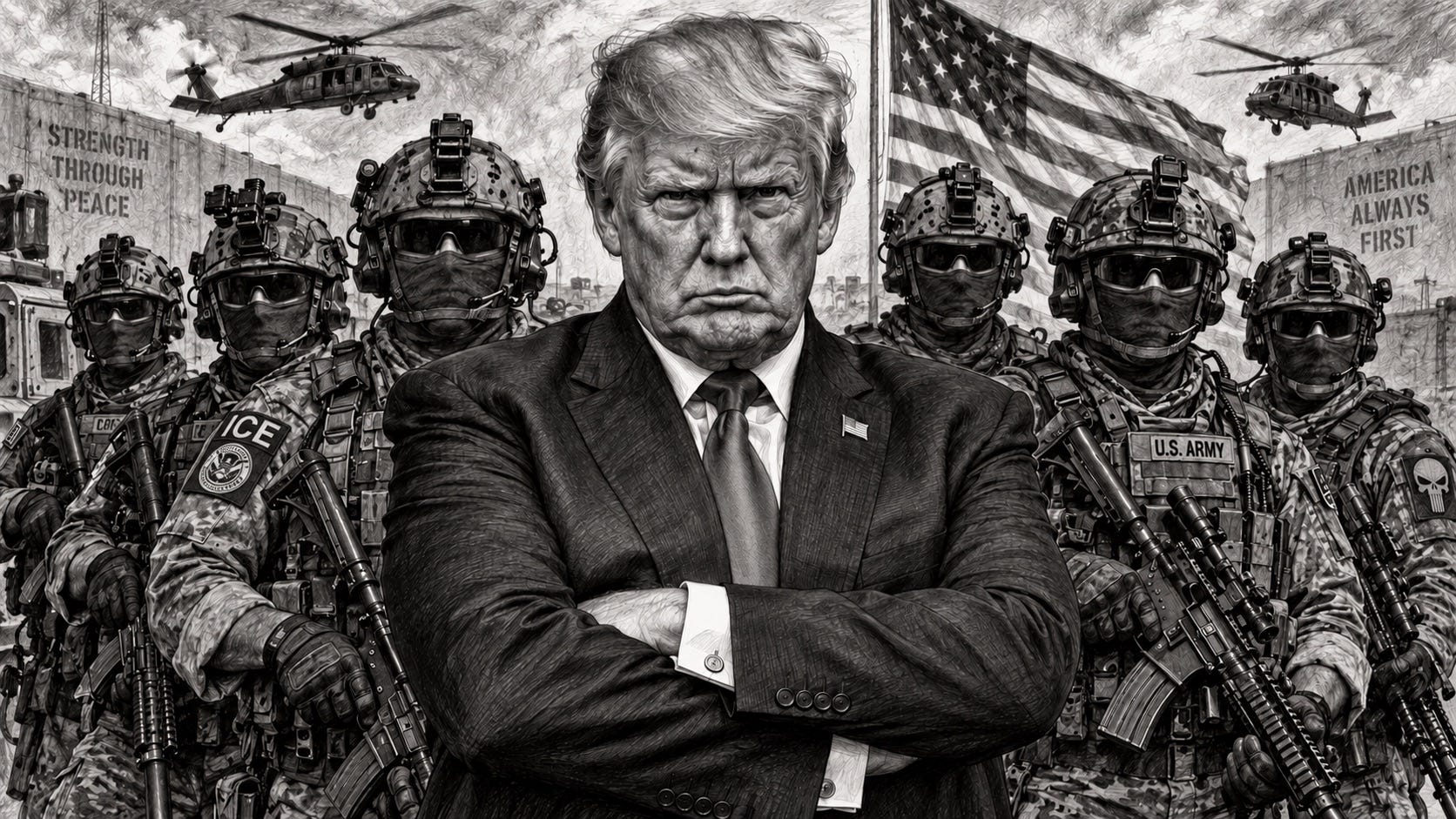
He’s Saying It Out Loud
It’s Tuesday morning, November 3, 2026. You drive to your polling place and find a notice taped to the door announcing that the President has declared a national emergency and federal authorities now control the vote. People close to Donald Trump are openly talking about that scenario right now.
In September, reporting revealed that Peter Ticktin, a longtime Trump friend and attorney, laid out a path where Trump declares martial law on or around Election Day. Ticktin put it bluntly: “Either martial law, or step aside.” Back in August, radio host Wayne Allyn Root pushed Trump to declare a “national security emergency” so he would be free to impose voter ID and proof of citizenship rules on every state, and Trump answered with a line that should worry every voter in this country: “stranger things have happened.” Steve Bannon went further. He called for a national emergency proclamation that would put immigration agents at polling places.
Trump has not announced any plan to declare martial law or an election emergency. His own White House and Cabinet advisers have spent months trying to pull him away from the fraud theories these allies keep feeding him. People in his inner circle still concede that a move to seize control of the elections remains possible.
I’ll tell you exactly where I stand. A declaration like this would be illegal and a travesty, and it would trample the constitutional rights of every American citizen, whatever their party. I’ve spent four decades in courtrooms, and I’m sharing this with my community because you deserve to know what the law says before anyone tries to tell you otherwise.
Here’s the headline you should carry with you. The law stands with the voter. The Constitution gives the President no power to postpone or seize a federal election.
Martial Law and National Emergencies, Explained
Martial law means the military steps in and replaces civilian government, including the police and the courts, over civilians in a defined area. No federal law defines it. No federal law gives a President the power to declare it either. Officials have declared martial law more than 60 times in American history, mostly at the state and local level, and the Constitution keeps applying the whole time, with courts holding on to their power to review every bit of it.1
A national emergency works differently. It’s a formal declaration under the National Emergencies Act of 1976, and the declaration by itself grants nothing. Think of it as a ring of keys. Each key fits one specific door Congress already built into some other law, and the President has to name the exact law he’s using. Those doors lead to areas like economic sanctions and calling up military reserves. None of them leads to the rooms where states run their elections.
The Supreme Court drove that point home on February 20, 2026. In Learning Resources v. Trump, the Court ruled 6 to 3 that the International Emergency Economic Powers Act gave the President no power to impose tariffs, even after he declared national emergencies to justify them, which tells you that slapping an emergency label on something never stretches a law past the words Congress wrote. What follows is everything you need to know and do to protect your vote and democracy.
