

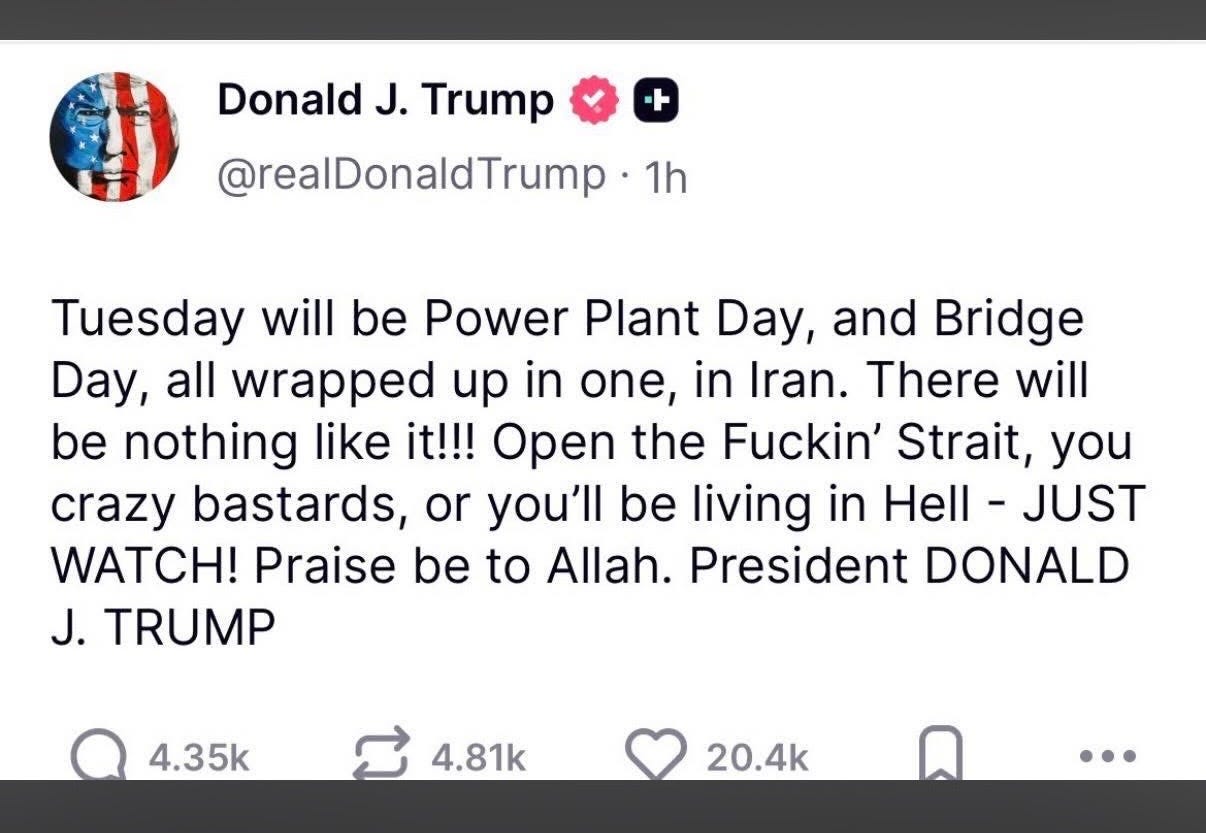
On Easter Sunday, the President of the United States posted an expletive filled ultimatum on Truth Social telling Iran to “open the F***in’ Strait, you crazy bastards, or you’ll be living in Hell.” He declared that Tuesday would be “Power Plant Day, and Bridge Day, all wrapped up in one, in Iran.”
Then, at a White House press conference on Monday, he doubled down. “Every bridge in Iran will be decimated by 12 o’clock tomorrow night, where every power plant in Iran will be out of business, burning, exploding and never to be used again.” A reporter asked if he was worried about committing war crimes. His answer was one word. “No.”
That answer tells you everything you need to know about where we are as a country right now. And if you care about the rule of law, about what America stands for in the world, about your kids and grandkids growing up in a nation that still means something, you need to understand exactly what is happening here and why it matters to you personally.
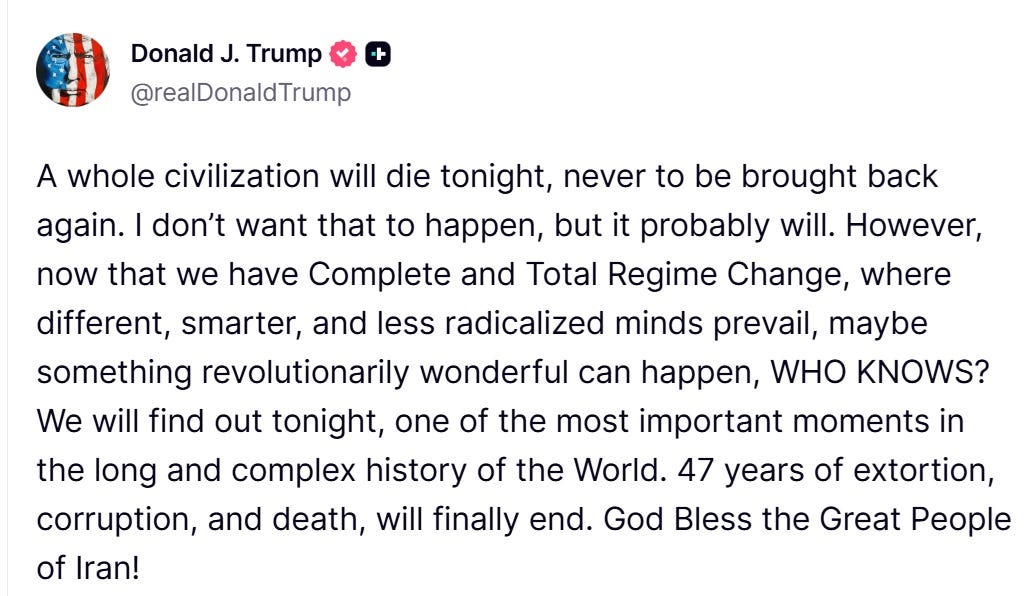
Update on April 7, 2026
This morning he posted this.
I am a trial lawyer. I have spent nearly four decades reading statutes, analyzing facts, and applying the law to the conduct of real people in real situations. So I did exactly that with Trump’s threats against Iran’s civilian infrastructure. I took the four foundational legal tests under international humanitarian law, the same body of law the United States helped write after World War II, and I ran Trump’s own words through each one.
The results are not ambiguous.
What the Law Actually Says
The rules governing armed conflict exist because the world watched what happened when nations waged total war against civilian populations in the 1940s. Entire cities turned to ash. Millions of noncombatants dead. After the smoke cleared, the international community sat down and created a legal framework to make sure it never happened again. The United States was at the center of that effort. We did not just sign onto these principles. We led the charge to create them.
These rules live in the Geneva Conventions and their Additional Protocols, and in something called customary international humanitarian law, which binds every nation on earth regardless of which treaties they have formally ratified. The U.S. Department of Defense incorporates these principles into its own Law of War Manual. Our military trains on them. Our officers swear to uphold them.
Four legal principles sit at the core of this framework, and every single one of them applies directly to what Trump is threatening to do.
Test One. The Principle of Distinction
This is the most fundamental rule in the entire law of armed conflict. It says that all parties to a conflict must distinguish between civilian objects and military objectives. You can only direct your operations against military objectives. Period.
A military objective is defined as an object that makes an effective contribution to military action and whose destruction offers a definite military advantage to the attacker. That is a two part test. Both elements must be met.
Power plants that supply electricity to 93 million Iranian civilians are not military objectives. Bridges that ordinary people use to get to work, to transport food, to reach hospitals are not military objectives. Iran operates hundreds of power plants scattered across the country, and most of them sit near major population centers. Destroying all of them, as Trump has promised to do, is not a targeted military operation. It is the wholesale destruction of a nation’s civilian infrastructure.
When a president announces in advance that he will destroy “every power plant” and “every bridge” in an entire country, he is not distinguishing between civilian and military objects. He is refusing to distinguish. And that refusal is the textbook definition of an unlawful attack.
Test Two. The Principle of Proportionality
Even when an object qualifies as a legitimate military target, the law imposes a second requirement. The expected civilian harm from any attack cannot be excessive in relation to the concrete and direct military advantage anticipated.
Think about that standard for a moment. Even if some Iranian power plants served a partial military function, which would make them what lawyers call dual use objects, the proportionality test still applies. And here is where Trump’s threat collapses entirely under its own weight.
Destroying the electrical grid for a nation of 93 million people means hospitals go dark. Ventilators stop. Water treatment plants shut down. Sewage systems fail. Food refrigeration ends. Emergency response systems cease to function. The cascading civilian death toll from destroying an entire nation’s electrical capacity would be staggering and sustained over weeks and months.
The military advantage of forcing open a shipping lane does not come close to justifying that level of human suffering. More than 100 international law experts from Harvard, Yale, Stanford, and dozens of other institutions signed an open letter last week making exactly this point. They warned that the conduct of U.S. forces and statements by senior officials raise serious concerns about violations of international humanitarian law, including potential war crimes. Amnesty International’s senior director for research stated it plainly. Attacking power plants essential for the basic needs of tens of millions of civilians would be disproportionate, unlawful, and could amount to a war crime.
Test Three. The Prohibition on Terror Against Civilians
The Geneva framework includes a specific prohibition on acts or threats of violence whose primary purpose is to spread terror among the civilian population. Read that language again carefully, because it covers exactly what is happening right now.
Trump’s stated purpose for these threats is not to gain a battlefield advantage over the Iranian military. He is trying to make the Iranian civilian population suffer so badly that their government capitulates on a shipping lane. He said the quiet part out loud. “They don’t want to cry, as the expression goes, ‘uncle.’ They will, and if they don’t, they’ll have no bridges. They’ll have no power plants. They’ll have no anything.”
That is coercion through civilian suffering. The law has a name for it. It is terror. And threatening it is just as illegal as carrying it out.
The secretary general of Amnesty International called Trump’s Easter post “revolting” and wrote that Iranian civilians will be the first to suffer from the destruction of power plants and bridges. No heat. No electricity. No water. No capacity to move or to flee.
When the President of the United States tells 93 million civilians they will be “living in Hell” unless their government does what he demands, he is not conducting diplomacy. He is threatening collective punishment. And collective punishment of a civilian population is one of the oldest prohibitions in the law of war.
Test Four. Collective Punishment
The fourth and final test is closely related to the third. International humanitarian law explicitly prohibits making an entire civilian population suffer for the actions of their government or military. You cannot punish a grandmother in Tehran for decisions made by military commanders. You cannot starve children of electricity because you want a shipping lane opened.
The concept is straightforward. Individuals are responsible for their own actions. Governments are responsible for their own decisions. Civilians who have no control over either one are protected from being used as pawns, as bargaining chips, as pressure points.
Trump’s entire strategy of threatening to destroy civilian infrastructure to coerce a government into compliance is collective punishment in its most undeniable form. Legal experts who study the laws of war have said so explicitly. The European Council president warned that targeting civilian infrastructure, namely energy facilities, is illegal and unacceptable. Former military JAG officers who spent their careers advising on targeting operations have stated that Trump’s words run counter to decades of legal training and risk placing our warfighters on a path of no return.
This Is Not Hypothetical. We Have Precedent.
In June 2024, the International Criminal Court issued arrest warrants for two senior Russian officials, former Defense Minister Sergei Shoigu and Chief of the General Staff Valery Gerasimov. The charges included directing attacks at civilian objects, causing excessive incidental harm to civilians, and the crime against humanity of inhumane acts. The underlying conduct was directing missile strikes against Ukrainian electrical power plants and substations.
That is the exact same conduct Trump is now threatening against Iran. The same type of targets. The same intended effect on the civilian population. The same disregard for the distinction between military and civilian objects.
The ICC found reasonable grounds to believe that those strikes were directed against civilian objects, and that for installations that may have qualified as military objectives, the expected incidental civilian harm was clearly excessive to the anticipated military advantage. Those are not my words. That is the ruling of an international tribunal applying the same legal standards I have outlined above.
What Happens If They Go Through With It
So what happens when a president, a defense secretary, and military commanders carry out strikes that the rest of the world calls war crimes? Who prosecutes them, how does the process work, and what does it mean for every single American?
Here is how international war crimes prosecution works in plain English.
The International Criminal Court in The Hague is the primary body that investigates and prosecutes war crimes, crimes against humanity, and genocide. It has 125 member states. Its prosecutor can open an investigation, gather evidence, and apply to a panel of judges for arrest warrants. Those warrants are then binding on every member state, meaning that if an indicted person sets foot in any of those 125 countries, that country is legally obligated to arrest them and transfer them to The Hague for trial.
The ICC has already done this with heads of state. It issued arrest warrants for Vladimir Putin. It issued arrest warrants for Israeli Prime Minister Benjamin Netanyahu. It issued warrants for Shoigu and Gerasimov over the exact same type of conduct Trump is now threatening. And on March 11, 2025, Philippine authorities arrested former President Rodrigo Duterte on an ICC warrant for crimes against humanity. He was surrendered to the court the following day and remains detained at The Hague right now as his case moves toward trial. That arrest stunned the world because it proved these warrants are more than symbolic paperwork. They have teeth. They follow you.
Now, the United States is not a member of the ICC. And Congress passed a law in 2002 called the American Servicemembers’ Protection Act, which most people know by its nickname, the Hague Invasion Act. That law authorizes the president to use “all means necessary and appropriate” to free any American or allied person detained by the ICC. It also prohibits U.S. cooperation with the court, bars extradition of Americans to The Hague, and prevents ICC investigators from operating on American soil.
Read that again. The United States passed a law authorizing military force against an international court that prosecutes war crimes. The Dutch government, our NATO ally, publicly protested the law. The international legal community condemned it. And it sits on the books right now, telling the world exactly how seriously this country takes international accountability for its own leaders.1
So the honest answer is this. If Trump orders the destruction of Iran’s civilian power grid and bridges, the ICC has jurisdiction because the crimes would occur on Iranian territory. The Rome Statute gives the court jurisdiction over crimes committed on the territory of states that have accepted its authority, and Iran accepted ICC jurisdiction when it cooperated with the court’s framework for investigating crimes on its soil. The prosecutor would gather evidence, much of it already available in Trump’s own public statements. The court would issue arrest warrants for Trump, for Defense Secretary Pete Hegseth, and potentially for senior military commanders who authorized or carried out the strikes. And then every one of those individuals would face a legal reality that follows them for the rest of their lives. ICC arrest warrants do not expire. They remain active whether you are in office or out of office. They attach to you personally, not to your title. Article 27 of the Rome Statute explicitly states that official capacity as a head of state shall in no case exempt a person from criminal responsibility.
That means Trump, Hegseth, and any other named individual would be unable to travel to any of the 125 ICC member states without risking arrest. That includes every country in the European Union. That includes Canada, the United Kingdom, Australia, Japan, South Korea, and Brazil. It includes virtually every major trading partner and diplomatic ally the United States has on earth.
Think about what that means in practice. A sitting or former American president who cannot visit London, Paris, Berlin, Tokyo, or Ottawa without the threat of being arrested and sent to The Hague for trial. A current or former defense secretary who cannot attend a NATO summit, a trade conference, or a diplomatic meeting in any allied country. Senior military officers who served their country and followed orders from their commander in chief, now facing personal criminal liability in jurisdictions around the world. We already saw Netanyahu forced to reroute flights to avoid ICC member states that might enforce his warrant. That would become the new normal for American leaders.
And it does not stop with the individuals named in the warrants. The global fallout for the United States as a nation would be severe and lasting.
Start with diplomacy. America’s ability to lead international coalitions, negotiate treaties, and broker peace agreements depends on moral authority and credibility. The moment the United States is formally accused of war crimes by the same court that indicted Putin, that credibility collapses. Every negotiation, every alliance conversation, every diplomatic initiative gets filtered through the reality that the world’s leading democracy stands accused of the same crimes as the authoritarian regimes it has spent decades condemning. Allied nations that depend on public support for their relationship with America would face enormous domestic pressure to distance themselves. European parliaments would demand reviews of defense cooperation agreements. Security partnerships that took decades to build would fracture under the weight of public outrage.
Move to trade and economics. The global economy runs on relationships, trust, and predictability. Countries that are members of the ICC face legal and political pressure to enforce its decisions. That creates friction in every trade negotiation, every bilateral deal, every international financial arrangement involving the United States. Companies with global operations would face reputational risk doing business with a government under ICC indictment. Foreign investment decisions, supply chain partnerships, and multinational corporate strategy would all be affected by the stigma of association with a country whose leaders face active war crimes warrants. The economic isolation that followed Russia’s invasion of Ukraine, the sanctions, the asset freezes, the trade restrictions, provides a real world template for what happens when a major power crosses lines that the rest of the world considers non negotiable.
Consider the military implications. The United States maintains roughly 750 military installations in more than 80 countries around the world. Status of forces agreements, basing rights, and military cooperation depend on the host country’s willingness to maintain the relationship. If American military leaders face ICC warrants, host nations would come under intense legal and political pressure to reassess those agreements. Even allies that choose to ignore the warrants would face domestic litigation and political consequences for doing so. The foundation of American military reach is international cooperation, and international cooperation depends on America being seen as a nation that follows the rules it helped create.
And consider the long game. War crimes charges do not go away when an administration ends. They persist across presidencies. They shape how the world deals with the United States for years and decades. Every future president would have to govern under the shadow of their predecessor’s indictment. Every future secretary of state would walk into meetings with foreign counterparts who remember that the United States bombed civilian power plants to coerce a government and then refused to answer for it. Every future generation of American service members would train under a body of law that their own commander in chief openly violated and mocked.
The damage would be generational. It would redefine America’s place in the world. And it would hand every authoritarian government on earth a permanent excuse to ignore the laws of war, because the United States did it first and dared the world to do something about it.
What This Means for You
You might be thinking that none of this matters because the United States does not recognize ICC jurisdiction over American citizens. And you are right that the U.S. is not a party to the Rome Statute. That is a political reality.
It is not a legal defense.
The principles of customary international humanitarian law bind every nation. The U.S. government acknowledges this. The Department of Defense teaches it. American military officers follow it. The fact that Trump dismisses the question with a single word “no” does not change the law. It only reveals how little he cares about it.
And here is what should concern you as an American citizen and voter. When a president publicly threatens to commit acts that the international community has defined as war crimes, he puts every service member who carries out those orders in legal jeopardy. He degrades the moral authority that the United States has spent decades building. He gives every authoritarian regime on earth permission to do the same thing to their own targets, knowing that America can no longer credibly object.
This is not a partisan issue. This is about the kind of country we are. Former officials from Trump’s own first administration have spoken out against targeting civilian infrastructure. Elliott Abrams, who served as Trump’s special representative for Iran, said publicly that he would rather see the U.S. go after regime targets than assets Iranians use to live their daily lives.
The Red Cross president stated this week that deliberate threats against essential civilian infrastructure and nuclear facilities must not become the new norm in warfare. Six weeks into this conflict and this is already happening. Deadlines get set and extended. Threats escalate. And the line between rhetoric and war crimes gets thinner every single day.
Where We Go From Here
I write these pieces because somebody has to say what is true, clearly and without apology, even when the truth is uncomfortable.
Donald Trump is threatening to commit war crimes. He is doing it publicly. He is doing it proudly. He is doing it on social media and from the White House press room. And when reporters ask him about it, he berates them for asking.
More than 100 of this country’s top legal minds have sounded the alarm. International organizations have condemned the threats. Former military lawyers who spent their careers inside targeting operations have warned that this path leads somewhere we cannot come back from.
Your voice matters right now. Call your representatives. Demand that Congress exercise its constitutional authority over matters of war and peace. Share this information with people who need to see it. Vote like your children’s future depends on it, because it does.
The law is clear. The facts are clear. The only question left is whether enough Americans care enough to demand accountability from the people making these decisions in our name, with our tax dollars, wearing our flag.
I care. And I know you do too.
Mitch Jackson, Esq.
The Geneva Conventions exist because the world decided some lines should never be crossed, and right now you need to know exactly where those lines are and who is crossing them. Subscribe to Uncensored Objection, free or premium, and get the truth delivered straight to your inbox.
When the Rome Statute was adopted in 1998 creating the ICC, the Clinton administration participated in drafting it and signed the treaty in 2000. The concern from the beginning, voiced loudly by military and foreign policy hawks in both parties, was that an international court with jurisdiction over war crimes could be used to prosecute American service members and senior officials for actions taken during military operations overseas. The fear was that U.S. troops deployed in combat zones like Afghanistan, Iraq, and the Balkans could face politically motivated prosecutions by foreign judges over whom the United States had no control.
After 9/11, that fear intensified. The Bush administration was planning military operations in Afghanistan and anticipating what would become the Iraq war. The Pentagon and the Joint Chiefs wanted an absolute guarantee that no American soldier, commander, or political leader could be hauled before an international tribunal for decisions made during those conflicts. Senator Jesse Helms and Representative Tom DeLay introduced the legislation, and it passed with strong bipartisan support in August 2002, just months before the Iraq invasion.
The Reagan administration had already laid the groundwork years earlier by refusing to submit Additional Protocol I to the Geneva Conventions to the Senate for ratification, arguing that it gave too much legal protection to guerrilla fighters and could be used against American forces. The Hague Invasion Act was the next logical step in that same posture: the United States wanted to wage war on its own terms, without answering to any international body for how it conducted those wars.
So in summary, the United States passed that law because it knew, even in 2002, that the kinds of military operations it was planning to conduct could be classified as war crimes under international law. And rather than accepting accountability, it chose to threaten the court itself.
Thank you Mitch for this comprehensive explanation of this war crime. What a tyrant we have as president ! We must make those calls and I'm ready for another protest!!