

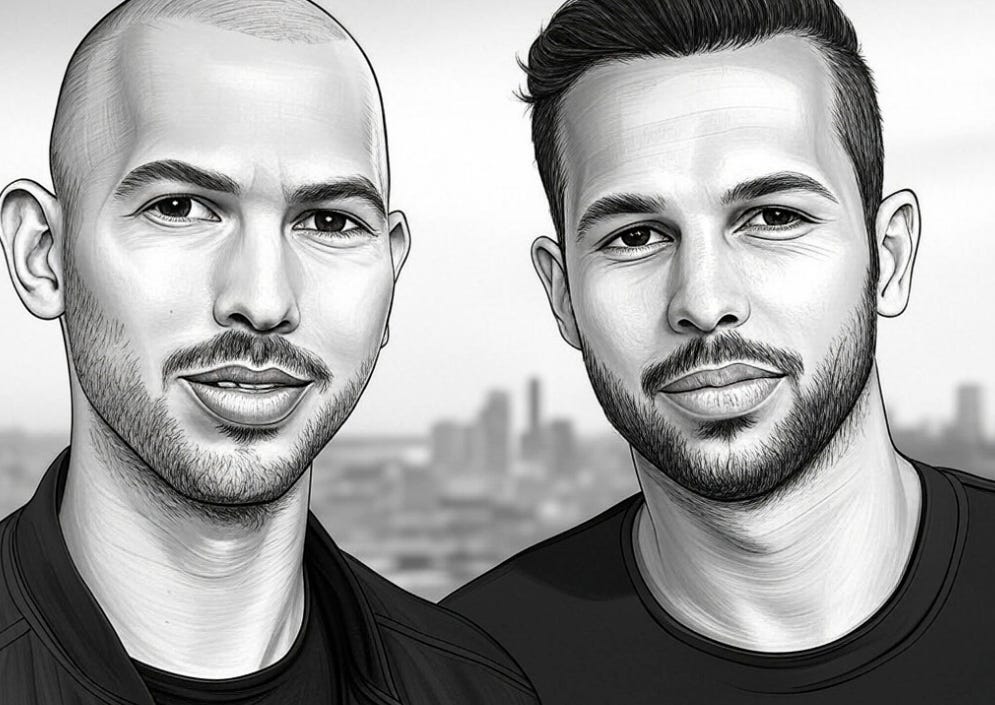
Mitch’s Quick Take
Ah yes, nothing says “law and order” quite like bending international legal norms to accommodate influencers accused of human trafficking. The Trump administration’s intervention to lift travel restrictions on Andrew and Tristan Tate isn’t about justice—it’s about securing the allegiance of a massive, disaffected, young male audience that idolizes Tate’s brand of toxic masculinity.
With procedural hiccups in Romania providing just enough legal cover, the U.S. stepped in, signaling that ideology (and online clout) matter more than criminal charges. This isn’t about fairness; it’s about ensuring Tate’s audience remains politically useful, with Trump’s camp happily trading victim justice for branding opportunities. For a deeper dive into how power, politics, and influence collide, read on.
DISCLAIMER: This is an investigative opinion piece and does not provide legal, financial, tax or investment advice. Always do your own due diligence and consult with an experienced professional in your state, region or country.
Introduction
The decision by U.S. authorities to lift travel restrictions on Andrew and Tristan Tate, despite their ongoing human trafficking charges in Romania, reflects a complex interplay of geopolitical influence, legal maneuvering, and ideological alignment. The Tate brothers, self-described misogynists and social media influencers with millions of followers, faced a travel ban in Romania since their 2022 arrest on charges including human trafficking, rape, and organized crime. Their sudden departure to the U.S. on February 27, 2025, following the ban’s revocation, has ignited debates over the role of political pressure, judicial independence, and the broader implications for international legal cooperation.
Geopolitical Pressure from the Trump Administration
A central factor in the lifting of the travel ban appears to be direct intervention by the Trump administration. Reports indicate that U.S. officials, including Special Envoy Richard Grenell, raised the Tate brothers’ case with Romanian authorities during the Munich Security Conference in early February 2025. While Romanian Foreign Minister Emil Hurezeanu denied explicit “pressure,” he acknowledged that Grenell had requested the brothers’ freedom of movement, framing it as a reiteration of the U.S. government’s stance. This aligns with the Tate brothers’ vocal support for Donald Trump, whose inner circle includes figures like Paul Ingrassia, a former Tate lawyer turned White House liaison, and Donald Trump Jr., who previously criticized their detention as “absolute insanity.”
The Financial Times reported that the Trump administration’s interest in the case stemmed from the brothers’ alignment with far-right ideologies and their influence among young men, a demographic critical to Trump’s political base. Andrew Tate’s reinstatement on X, formerly Twitter, by Elon Musk, a close Trump ally, further underscores the symbiotic relationship between the Tates’ online reach and conservative political networks. By advocating for their travel freedoms, the administration signaled support for a figure whose rhetoric resonates with segments of the American right, despite the serious nature of the charges against him.
Dual Citizenship and Jurisdictional Complexities
As dual U.S.-U.K. citizens, the Tate brothers’ case intersects with multiple legal jurisdictions. While Romania retains primary authority over the human trafficking charges, the U.S. government’s involvement introduces jurisdictional tensions. The brothers’ return to Florida, where they face a civil lawsuit from an alleged victim identified as Jane Doe, complicates matters further. Doe’s countersuit accuses them of defamation and witness intimidation, alleging they recruited her into a webcam sex trafficking ring. Their presence in the U.S. could facilitate discovery processes in this case, though it also raises questions about whether American authorities will pursue criminal charges independently.
In the U.K., where the Tate brothers face separate allegations of sexual aggression and tax evasion, authorities have sought their extradition via European arrest warrants. However, Romanian courts ruled that extradition would only occur after domestic proceedings conclude, creating a legal limbo that the travel ban’s lifting exacerbates. This multi-jurisdictional patchwork highlights challenges in prosecuting transnational crimes, particularly when defendants wield significant political and financial resources.
Ideological and Cultural Factors
Andrew Tate’s rise as a cultural figure cannot be divorced from the decision-making calculus. His Hustler’s University platform, which amassed nearly one million subscribers, and his prolific social media presence have radicalized young men globally, normalizing misogyny and anti-establishment rhetoric. The Trump administration’s alignment with Tate reflects a broader strategy to harness online subcultures for political gain, even at the cost of undermining legal accountability for alleged crimes.
Romanian prosecutors’ reluctance to enforce the travel ban may also stem from Tate’s portrayal of the case as a “political conspiracy” to silence him. By framing himself as a martyr against government overreach, Tate has galvanized supporters who view his legal troubles through a partisan lens. This narrative gained traction after Elon Musk endorsed Tate’s criticisms of the U.K. government, further blurring the lines between free speech advocacy and obstruction of justice.
Legal Setbacks in Romania’s Judicial Process
The Romanian legal system’s handling of the Tate case also created conditions favorable to the travel ban’s removal. In December 2024, the Bucharest Court of Appeal ruled that procedural irregularities, including improperly obtained evidence and witness testimony, rendered the initial indictment inadmissible, forcing prosecutors to revisit the case. This setback weakened the prosecution’s position and provided grounds for the Tate brothers’ legal team to argue for modified judicial controls, including the right to travel.
Romania’s Directorate for Investigating Organized Crime and Terrorism emphasized that the brothers remain under investigation and must return for court appearances, with failure to comply risking stricter measures. However, the decision to lift the ban despite ongoing charges suggests a calculated gamble by Romanian authorities to avoid diplomatic friction with the U.S. while maintaining nominal judicial oversight. Critics, including four women suing Andrew Tate in the U.K., have condemned the move as capitulation to political pressure, warning it could embolden efforts to intimidate witnesses.
Implications for International Justice
The Tate case underscores vulnerabilities in international legal frameworks when confronted with powerful political interests. The Trump administration’s lobbying sets a precedent for diplomatic interference in judicial processes, potentially encouraging other states to prioritize geopolitical alliances over human rights obligations. For Romania, a NATO member and EU state, balancing sovereignty with transatlantic relations remains fraught, particularly as U.S. influence reshapes global norms around accountability for sexual violence and trafficking.
Moreover, the Tate brothers’ ability to leverage their wealth and connections, exemplified by their fleet of luxury cars and high-profile legal team, highlights disparities in access to justice. Jane Doe’s lawsuit in Florida, which accuses them of using “lawfare” to intimidate victims, illustrates how legal systems can be weaponized against marginalized individuals. This dynamic risks chilling effects for other survivors seeking recourse, particularly in jurisdictions where political elites shield allies from scrutiny.
Worth a Watch (from Coffeezilla)
Conclusion
The lifting of travel restrictions on Andrew and Tristan Tate represents a confluence of political pragmatism, legal fragility, and cultural polarization. While the Trump administration’s advocacy played a decisive role, it operated within a context of procedural weaknesses in Romania’s case and the brothers’ strategic cultivation of ideological allies. But let’s be clear—this wasn’t about due process or judicial fairness. This was about capitalizing on Tate’s influence over millions of disillusioned young men, securing their loyalty to a political movement that thrives on grievance, defiance, and manufactured persecution. If you’re looking for a case study in how influence, money, and politics collide, this is it.
Mitch Jackson, Esq. | links
This post is free.
But free doesn’t build the future.
Independent journalism only works when people like you choose to lean in—not just with attention, but with support.
If this work matters to you, today’s a great day to take the leap.
$5 a month. $50 a year. For you or gift to a friend.
A small investment in something bigger than all of us.

Welcome to Florida Gaetz has new friends.
Gee just love my new neighbors said Donnie we have so much in common