

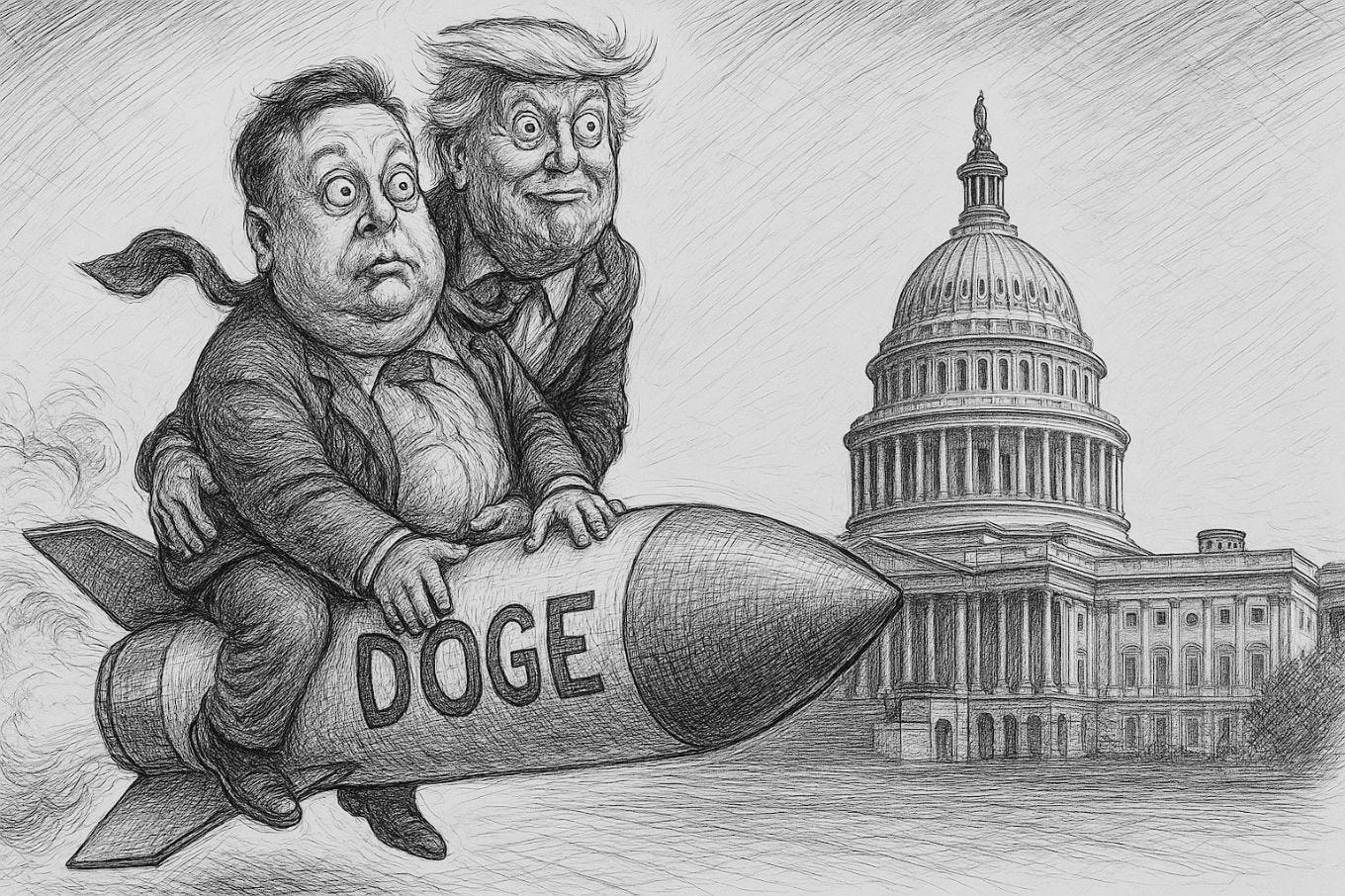
“When a billionaire saves $2.37 billion by tearing down the very watchdogs meant to keep him honest, that’s not efficiency, it’s a hostile takeover of government. This is what happens when you let the arsonists write the fire code.”
Executive Summary
$2.37 billion saved—that’s what Elon Musk’s companies walked away with while he ran Trump’s so-called Department of Government Efficiency, all without stepping back from his business empire. As Musk slashed oversight and gutted the agencies investigating Tesla, SpaceX, Neuralink, and more, the rules magically bent in his favor.
This isn’t efficiency. It’s corruption dressed up as reform, and it’s enabled by a president willing to hand the keys of government to the very billionaire it’s supposed to regulate. If you think this ends well for democracy, think again.
Key Points:
Conflict of Interest: Musk's dual role as a government official and CEO of companies benefiting from policy changes raises significant ethical concerns.
Financial Gain: His companies potentially avoided over $2.37 billion in legal liabilities due to reduced regulatory scrutiny.
Democratic Erosion: The consolidation of power and dismantling of oversight mechanisms under DOGE undermined democratic institutions and accountability.
For a deeper dive into how this unprecedented intertwining of private interests and public power unfolded, read the full article.
Elon Musk’s Business Empire and Its Stake in Government
Elon Musk isn’t just a tech entrepreneur, he’s a one-man conglomerate with his fingers in everything from electric cars to rockets to brain chips to whatever X is pretending to be this week. And here’s the kicker: every single one of his companies lives and dies by government rules, taxpayer dollars, or regulatory approval. So naturally, when Musk snagged a top government job under Trump, he didn’t divest, disclose, or step back, he just brought his empire with him. Because why just play the game when you can rewrite the rulebook to serve yourself?
Let’s take a quick tour of Musk Inc. and see just how many agencies now report to the guy they’re supposed to regulate.
- Tesla – Musk’s electric car and clean energy company is a household name. It sells hundreds of thousands of vehicles a year and has a market value in the hundreds of billions. Tesla has benefitted from government incentives like electric vehicle tax credits and environmental credits, and it once received a big federal loan that helped it survive its early years. But Tesla also faces safety and labor scrutiny.
Federal auto regulators have investigated its Autopilot self-driving feature after a series of crashes, and civil rights agencies have sued Tesla over alleged workplace discrimination. How regulators handle issues like car safety standards, recalls, or labor laws has huge financial implications for Tesla’s bottom line. Musk remains the largest shareholder and CEO of Tesla, so when the government takes (or doesn’t take) action on safety or discrimination, it directly affects his wealth.
- SpaceX – This private rocket company has revolutionized space launches and satellite internet. It launches rockets for NASA, puts military satellites in orbit for the Pentagon, and operates Starlink, a satellite network that even provides internet in war zones. SpaceX’s survival and growth have depended on billions in federal contracts – as of this year, it has over $10 billion in active deals with NASA and the U.S. Space Force.
With that reliance comes government oversight: the Federal Aviation Administration (FAA) licenses its rocket launches and has fined SpaceX for violating launch license terms, and environmental agencies watch its sprawling Starship test site in Texas. There was even a Justice Department lawsuit alleging SpaceX hiring discrimination against refugees. In short, SpaceX needs friendly regulators and continued federal funding. Any change in government policy on space contracts, satellite regulation, or environmental rules can make or break its ambitious projects.
- Neuralink – This is Musk’s brain-implant startup, aiming to help paralyzed patients communicate and eventually merge humans with AI. It sounds like science fiction, but it’s real, and it’s regulated. Neuralink must get approval from the Food and Drug Administration (FDA) for any testing on humans, and it’s been under the microscope for its treatment of animal test subjects. There have been disturbing reports of monkeys dying during Neuralink experiments, prompting a federal probe into potential animal welfare violations.
The Securities and Exchange Commission (SEC) has also looked into whether Neuralink exaggerated the safety of its device when raising money from investors. For a company like this, government oversight of medical trials and truthful marketing is crucial. If regulators go easy on Neuralink, Musk stands to gain by getting his product to market faster and avoiding penalties for any past missteps.
- The Boring Company – Often treated as Musk’s quirky side venture, this tunneling and infrastructure company digs transit tunnels. It hasn’t reached the scale of Tesla or SpaceX, but it’s working on projects like an underground loop in Las Vegas. Building infrastructure means dealing with a maze of permits and environmental reviews at both federal and state levels. Normally, a company blasting tunnels would answer to agencies that protect air quality, water, and worker safety.
In California, for example, such a project would undergo lengthy environmental impact studies. But Musk has always pushed to “move fast” – sometimes clashing with regulators who he sees as too slow. If those regulators are weakened or told to back off, the Boring Company can expand more easily and cheaply. Lower oversight might mean faster tunnel approvals, but it also raises the risk of safety oversights or environmental damage in communities where it digs.
- X (formerly Twitter) – Musk’s takeover of Twitter in 2022 turned it into “X,” a private company he controls. This social media platform is where millions of Americans get their news and where politicians campaign. It’s essentially part of our public square. While social media has fewer dedicated federal regulators than cars or rockets do, Twitter was under a consent decree with the Federal Trade Commission (FTC) to protect user privacy and data security. After Musk’s takeover, there were concerns that mass layoffs and new features at X might have violated those agreements.
The FTC had been investigating X for potential breaches that could lead to hefty fines. Also, the SEC accused Musk personally of failing to promptly disclose his massive Twitter stock purchase during the takeover, a delay that may have saved him money at the expense of other investors. In sum, X’s fate is tied to how regulators enforce rules on privacy, misinformation, and fair market practices, and Musk’s role in government raises the question of whether those rules will be enforced the same way for a company he owns.
- xAI – Musk’s newest venture is a startup focused on artificial intelligence. It’s still early days for xAI, but Musk clearly intends it to compete in the AI race against giants like Google. The federal government is just beginning to grapple with how to regulate advanced AI systems for safety and ethics. Normally, one might expect new rules or agencies to ensure AI doesn’t harm consumers or national security. But with Musk helping lead the government’s efficiency drive, any budding AI regulations could be stifled.
Interestingly, Musk has reportedly merged X (the social media platform) into the corporate umbrella of xAI, effectively combining a vast data source with an AI development lab. That means any government policy on tech, data, or AI could directly affect Musk’s intertwined tech platforms. If he can steer policy to favor “light-touch” oversight, xAI could develop its technology without the kinds of constraints or accountability others might face.
Each of these companies operates in a sector where Musk could face investigations, fines, or costly requirements. And each company’s success contributes to Musk’s personal fortune. That’s not a crime in itself, until you consider that Musk now has one hand on the levers of government that can pull back on those very investigations or costs. It’s as if the referee suddenly became a player in the game, with the power to call fouls on everyone, or swallow the whistle when it’s his own team.
That’s why ethics watchdogs and many lawmakers are alarmed. To understand the full picture, we need to look at what Musk’s new government role actually is, and which agencies and rules have been changed in ways that help him.
The New Power Office: What is DOGE?
When Donald Trump returned to the White House in January 2025, he created a new federal department with a cheeky acronym: the Department of Government Efficiency – DOGE for short. (Yes, even the acronym nods to a popular meme coin that Musk himself often jokes about.) Its mission on paper was to slash red tape, cut costs, and “streamline” government services. Trump put Elon Musk in charge of this effort, naming him as an official advisor and de facto head of DOGE.
In practice, DOGE operates like a wrecking ball aimed at the federal bureaucracy. Musk’s team has been scouring agencies for programs to eliminate, budgets to cut, and personnel to lay off, all in the name of saving taxpayer money and boosting efficiency. President Trump gave Musk an extremely broad mandate, find up to $1 trillion in savings, and significant influence over domestic policy to achieve it.
DOGE isn’t a traditional Cabinet department with years of history; it’s more like a special task force embedded in the government with Musk at the helm. Musk brought in some of his own allies and like-minded officials to staff key positions. By many accounts, he runs DOGE with a CEO’s mindset: setting aggressive cost-cutting targets and expecting agencies to meet them or face consequences.
Under Musk’s direction, DOGE quickly moved to freeze new regulations across federal agencies and began reviewing existing ones to recommend changes or repeal. It also set about consolidating or downsizing various offices. Thousands of federal workers were laid off or reassigned in the first few months of the Trump/Musk efficiency drive. In essence, DOGE acts as a central command to reshape the federal government’s priorities, and those priorities have often involved pulling back on oversight, especially in areas where Musk’s own companies were feeling the heat.
One of Musk’s first moves at DOGE was identifying which agencies have the biggest “cost burden” on industry, from financial regulators to environmental monitors, and putting them in the crosshairs. That dovetails with Trump’s political agenda, but it also has a convenient side effect for Musk: many of the agencies targeted just happen to be the ones that have investigated or regulated Musk’s businesses.
For example, DOGE has pushed for staff cuts and budget caps at agencies like the National Highway Traffic Safety Administration (NHTSA), which was scrutinizing Tesla’s Autopilot safety, and the Occupational Safety and Health Administration (OSHA), which had open investigations into workplace accidents at Tesla’s factories and SpaceX’s facilities.
Similarly, DOGE supported the firing or replacement of certain officials in independent agencies, people appointed in the previous administration who were viewed as too aggressive on regulation. In the name of “efficiency,” numerous inspector generals and senior regulators were shown the door. While Trump publicly framed this as clearing out the “deep state,” documents later revealed that many of those ousted were involved in actions affecting Musk’s companies.
By structure, DOGE blurs lines of oversight. It’s housed in the White House and its leader (Musk) is a close advisor to the President, which means it’s not subject to the same checks that an independent regulator or Cabinet secretary might be. It can lean on agencies behind closed doors.
Critics say DOGE essentially centralizes power in a way that sidesteps the normal process. Instead of agencies independently enforcing laws passed by Congress, now Musk and Trump loyalists at DOGE can override or stall those actions if they deem them “inefficient.” Under this structure, if a federal safety regulator wants to issue a fine or a new rule that a powerful company doesn’t like, DOGE can step in and say, Is this really necessary? – and quite possibly quash it. It’s government by cost-benefit analysis, but who’s calculating the costs and benefits? Musk’s fingerprints are all over those scales.
Regulators on a Leash: Agencies Affected by Musk’s Dual Role
To understand the conflict of interest at the heart of this arrangement, consider all the federal (and even state) agencies that have some authority over Elon Musk’s companies. Normally, these agencies are meant to serve as watchdogs, protecting consumers, workers, the environment, financial markets, or national security, without fear or favor. With Musk in power at DOGE, however, many watchdogs have effectively lost their bite or been put on a tighter leash. Here are some key agencies and what’s happened to them:
- National Highway Traffic Safety Administration (NHTSA) – This agency in the Department of Transportation oversees auto safety and can mandate recalls. NHTSA has been investigating Tesla’s Autopilot system for defects that could cause crashes. In late January, after Musk took office at DOGE, the head of NHTSA was replaced with an acting chief more aligned with the new administration’s views. DOGE also ordered a review of all pending auto regulations, which slowed down NHTSA’s work on issuing any new safety rules. Insiders say an imminent decision on Tesla’s Autopilot was delayed “for further study.”
That delay isn’t just bureaucratic foot-dragging, it directly benefits Tesla by buying the company time and potentially saving it from an embarrassing and expensive recall. For drivers and pedestrians, it raises the risk that a known safety problem goes unaddressed for longer. California’s state regulators have tried to step up (the California DMV has been looking at whether Tesla misleads consumers with the term “Full Self-Driving”), but they lack the clout of a full federal recall. Under DOGE’s influence, NHTSA’s foot is off the gas when it comes to reining in any safety issues specific to Tesla.
- Securities and Exchange Commission (SEC) – The SEC’s job is to protect investors and ensure companies (and executives) tell the truth about their businesses. Elon Musk has a history of tussles with the SEC, from his infamous “funding secured” tweet in 2018 to more recent issues. Before Trump took office, the SEC had active investigations involving Musk’s ventures: one probe into Tesla for allegedly not disclosing fire risks with its solar panels, another into Musk’s delayed disclosure of buying Twitter stock, and even one looking at Neuralink’s claims to investors.
Under the new regime, the SEC’s leadership changed, the outspoken chair appointed by the previous president is gone, and the commission’s new majority seems less eager to confront industry giants. Reports surfaced that an SEC inquiry into Tesla’s solar panel issue was quietly shelved in March. And while the SEC did file a complaint about Musk’s Twitter stock disclosure delay, any aggressive follow-through might be unlikely now.
The agency’s budget was put on the chopping block by DOGE’s cost reviews, with Musk’s team arguing that the SEC should focus on “major frauds” and not “innovators.” That rhetoric sounds reasonable until you realize it effectively means giving Musk a pass on any borderline securities issues, as if being a famous innovator places one above the usual scrutiny. State financial regulators have little sway here, so if the SEC backs off, investors who might have been misled are left hanging.
- Department of Justice (DOJ) – The DOJ can bring criminal charges or major civil enforcement actions against companies for things like fraud, antitrust, or violations of federal law. Prior to Musk’s government tenure, DOJ lawyers had opened a criminal investigation into Tesla over Autopilot, examining whether Tesla misled customers or investors about the technology’s capabilities and safety. They had also, under the previous administration, filed a lawsuit against SpaceX accusing it of discriminatory hiring practices (claiming SpaceX was discouraging refugees and asylum seekers from employment, which is against immigration and labor law). Once Trump and Musk were in charge, there was swift change.
In February, the new Attorney General – a Trump loyalist – abruptly dropped the SpaceX hiring discrimination suit, a highly unusual move so early in a case. Career attorneys were reportedly stunned, because the suit had been filed only months before and seemed backed by substantial evidence. The Autopilot probe? It hasn’t been officially closed, but observers note that no progress or public updates have come since the new administration took over. It’s as if DOJ lost interest in the case.
If Musk’s DOGE agenda is “efficiency,” one way to be efficient is not to sue or prosecute the boss’s businesses. Of course, that undermines the principle of impartial justice. People familiar with DOJ say this favoritism not only lets Musk’s companies off the hook, but it can demoralize prosecutors who see a double standard – one for the powerful, and one for everyone else.
- Equal Employment Opportunity Commission (EEOC) – The EEOC fights workplace discrimination. Last year, the EEOC filed a major lawsuit against Tesla, accusing the company of tolerating racial harassment of Black workers at its Fremont, California factory. It’s a huge case – Tesla’s own home state had already filed a similar suit after many complaints of racist slurs and conditions in the factory. Under normal circumstances, the EEOC would pursue this aggressively to get justice for workers and force reforms. But Trump and Musk wasted no time in shaking up the EEOC. Within days of taking office, Trump fired the EEOC’s general counsel and removed two commission members who had been supportive of the Tesla case (legal experts argue these firings may themselves have been unlawful).
The new EEOC leadership installed by Trump has shown little appetite for taking the case forward with vigor. There’s talk of an early settlement that might be very favorable to Tesla, a slap on the wrist, essentially. And DOGE’s budget hawks are now questioning the EEOC’s overall “return on investment,” which is bureaucratic code for cutting back its enforcement budget. For Tesla employees who faced abuse, this looks like the cavalry turning around and abandoning them. It’s a stark example of how Musk’s position allows him to potentially evade accountability: a federal agency was holding his company to account for civil rights – and now that agency’s leadership has been remade in a way that could let Tesla off lightly.
- National Labor Relations Board (NLRB) – This agency polices unfair labor practices, like if a company fires workers for trying to unionize or retaliates against whistleblowers. Musk’s companies have had multiple run-ins with the NLRB. Tesla in particular has been found to have violated labor laws by cracking down on union organizers at its factories. And just before Trump’s inauguration, the NLRB issued a complaint against SpaceX for allegedly retaliating against employees who raised concerns about workplace safety and Musk’s tweets.
Normally, NLRB members serve fixed terms and can’t be fired at will by the President, except Trump did fire one, a prominent pro-labor member who had been involved in cases targeting Musk’s companies. That firing is tied up in legal challenges, but the message was sent. The new NLRB appointees are more business-friendly and might be inclined to reverse or soften past rulings against Tesla.
DOGE has also floated the idea of folding some of NLRB’s functions into the Labor Department to “reduce redundancy,” a move seen by many as an attempt to neuter the Board’s independence. For Tesla and SpaceX workers, this could mean their complaints about unfair treatment will languish or die. For Musk, it means one less thing to worry about, no pesky federal labor judges ordering him to rehire organizers or delete anti-union tweets.
- Federal Aviation Administration (FAA) – The FAA oversees aviation safety, which includes licensing rocket launches and making sure companies like SpaceX don’t endanger the public. Last year, the FAA imposed fines on SpaceX for launching rockets without proper clearance and for some safety violations. SpaceX’s aggressive launch schedule for its Starship mega-rocket also raised environmental concerns after a test flight caused debris to rain down on a protected wildlife area in Texas.
Under Musk’s and DOGE’s influence, the FAA has been pushed to “streamline” launch approvals. DOGE officials highlighted SpaceX’s work as critical to American innovation and essentially told FAA leadership that any red tape slowing down launches was against the national interest. Environmental assessments that might have delayed SpaceX’s plans are being hurried along or slimmed down. And the $633,000 fine the FAA levied on SpaceX last year? Insiders say SpaceX is now negotiating to pay a fraction of it, or maybe have it waived entirely, after some high-level phone calls.
Local environmental groups and even some FAA safety engineers are frustrated, feeling that Musk’s clout has turned the watchdog into a lapdog. If the FAA can’t enforce its rules evenly, there’s a fear that it sets a risky precedent – not just for space launches, but for any powerful company that might bully regulators into overlooking safety.
- Environmental Protection Agency (EPA) – Musk’s businesses, from Tesla’s battery plants to SpaceX’s rocket facilities, have environmental impacts. Tesla’s factories deal with chemicals and waste (Tesla has previously been fined for hazardous waste violations in California), and SpaceX’s testing can affect air and water quality. While the EPA might not loom as large in Musk’s mind as some other agencies, it has played a role, for example, under the last administration the EPA was involved in enforcement actions over Tesla’s paint shop emissions and SpaceX’s launch site fuel storage.
Under DOGE, environmental regulators are facing steep cuts. One of Musk’s key charges was that environmental reviews “slow down infrastructure and innovation.” Now projects like new Tesla facilities or SpaceX expansions are getting fast-tracked with far less rigorous review. The EPA’s regional office that covers Tesla’s main factory was specifically told to “find efficiencies,” which resulted in fewer surprise inspections at the plant. And notably, the EPA’s Inspector General, who had previously pushed to hold Tesla accountable for past violations, was among those fired in the early days of the new administration.
State agencies can still enforce their own environmental laws (California, for instance, can regulate emissions at Tesla’s factories), but federal pullback often means less overall pressure to comply. Neighbors and workers who count on clean air and water may not see immediate effects, but the long-term consequences of lax enforcement could hit their health and safety down the road.
- Federal Trade Commission (FTC) – The FTC’s purview includes consumer protection and competition. Twitter (now X) was under FTC oversight because of past privacy breaches, it had a binding agreement requiring the company to safeguard users’ personal data. If that agreement is violated, the FTC can issue fines potentially running into the hundreds of millions.
After Musk bought Twitter and dramatically changed its operations, the FTC was reportedly investigating whether those changes violated the agreement. Musk publicly mocked the FTC and said he’d put “free speech” above all else, which raised eyebrows since it sounded like he might not honor prior commitments to user privacy.
Fast forward to Musk joining the government: the FTC’s chair and aggressive consumer protection officials suddenly find their agency in DOGE’s crosshairs. DOGE labeled the FTC’s privacy enforcement as “costly to business” and sought to limit its funding. The White House also replaced one of the FTC commissioners with a more industry-friendly pick, shifting the balance of power.
The result? The FTC’s inquiry into X has gone quiet. There are rumors it has been dropped or indefinitely paused, though no official announcement. This means Musk’s company likely won’t face accountability for any privacy lapses, at least not during this administration. For ordinary users of X, it means fewer assurances that their data won’t be misused, a rich irony given Musk’s professed concern for user trust when he took over the platform.
These examples scratch the surface, but they show a pattern: agencies that have rules Musk’s companies didn’t like have been reined in, restructured, or pressured by Musk’s team in the name of “efficiency.” Even some state-level efforts have been undercut.
California, for example, can sue Tesla or try to impose its own net safety standards for self-driving cars, but federal officials at DOGE have been considering new rules that could pre-empt state laws, arguing that a patchwork of regulations is “inefficient for business.” If that happens, states could be blocked from stepping in where federal regulators won’t.
From consumer product safety to finance, it’s hard to find a corner of Musk’s business interests that isn’t touched by a government office, and now it’s hard to trust that those offices are acting purely in the public interest rather than currying favor with a powerful insider.
Conflicts of Interest: Musk as Gamekeeper and Poacher
When Elon Musk assumed his role in the Trump administration, ethics experts immediately sounded the alarm. Here was the world’s richest man, still deeply involved with his private businesses, now put in charge of pruning the very government that regulates those businesses.
It’s a textbook conflict of interest, the kind that in any normal situation would demand either a divestment of assets or a strict recusal from related duties. Yet Musk did neither. While he stepped back from day-to-day management of some ventures (he handed off certain roles at Tesla and said he’d devote more time to the government), he explicitly kept all his ownership stakes. He is still the majority or controlling shareholder of SpaceX, X, Neuralink, and the Boring Company, and a major shareholder and the CEO of Tesla. He stands to profit or lose based on government decisions. And now he’s in a position to shape those decisions.
Conflict-of-interest laws exist for exactly this scenario. Federal law (18 U.S.C. § 208) prohibits government officials from participating in any matter in which they have a personal financial interest. If an issue comes up that could affect Musk’s companies, legally he’s supposed to recuse himself, essentially remove himself from any discussion or influence over that decision.
The Trump administration claimed that Musk would do this. In a joint televised interview shortly after inauguration, Musk said, with a shrug, “I’ll recuse myself if it is a conflict,” and President Trump chimed in to assure, “He won’t be involved” in anything directly touching his businesses. But those were just words, and reality has played out much differently.
In practice, Musk has been deeply “involved” in broad policy moves that inevitably affect his companies. Perhaps he hasn’t sat in on a meeting explicitly about a Tesla investigation, but when DOGE slashes the budget of an entire agency that just so happens to be looking into Tesla, it’s splitting hairs to claim he’s not involved.
Whistleblowers from inside DOGE have described an environment where Musk’s favorites get special attention. One former staffer who resigned in protest reported that Musk would frequently raise examples of “wasteful bureaucracy” by citing cases and investigations targeting companies he knows well, and it was obvious to colleagues that he meant his own. Policy memos from DOGE often cast a skeptical eye on regulations in sectors like space launch, social media, or electric vehicles, all areas where Musk is a dominant player. It’s hard to believe that’s a coincidence.
Musk’s failure to fully distance himself from his businesses while making government policy isn’t just an appearance problem; it may well be illegal. Normally, someone in Musk’s position would have been required to sign an ethics agreement. They might have had to divest their stock holdings or put them in a blind trust, or at least recuse from any specific decisions involving those firms. There’s no indication Musk has done any of that.
Reports emerged that the White House Counsel quietly issued Musk a broad waiver, essentially saying it’s in the national interest for him to serve despite the conflicts. If so, that would be a highly unusual and controversial use of a waiver, typically, they’re meant for cases where an official has a minor stock holding or an unavoidable conflict on a narrow issue, not for someone whose entire portfolio overlaps with their public duties. The Office of Government Ethics, an independent agency that oversees executive branch ethics, was reportedly sidelined; its director, who might have raised objections, was replaced in Trump’s first week.
So Musk enjoys a unique status: he’s inside the government with immense power, yet he’s not held to the same standards others might be. The spirit of public service is that officials put the public’s interest above their own. But Musk wears two hats and it’s clear he doesn’t recognize the difference.
Consider this: in internal communications (which investigative journalists later leaked), Musk’s team discussed how a new climate policy would affect Tesla’s business before the policy was even announced. In another instance, Musk was present in a strategy meeting about federal labor rules, rules that would definitely impact Tesla’s and SpaceX’s workforce, and he did not recuse himself. An ethics lawyer would shudder at these scenarios. The phrase “self-dealing” comes to mind: using public position to benefit private interests.
Musk’s defenders say he isn’t doing this for money, that he genuinely wants to make government more efficient and that his business knowledge is an asset. They argue that Musk actually lost personal wealth when he took this job because Tesla’s stock initially fell on news he’d be distracted. They point out he takes no salary for his advisory role. But those defenses miss the point.
Musk doesn’t need a government paycheck; what’s priceless is the influence he can wield. Even if he believes he’s acting for the greater good, the overlap between his personal financial incentives and his policy actions is too blatant to ignore. For example, if Musk pushes to delay an expensive regulation on rocket fuel emissions, that might save SpaceX a fortune in upgrades, and also conveniently align with Musk’s ideology that “environmental rules slow progress.” It’s a conflict of interest even if Musk convinces himself that what’s good for his companies is also good for America.
The ethical concerns here aren’t just theoretical. The Senate, or at least members of it, have been raising red flags. Senator Elizabeth Warren, a fierce advocate for strong ethics rules, sent a pointed letter to President Trump accusing him and Musk of essentially running a “government of, by, and for Elon Musk.” She documented how, in just a few weeks, multiple officials who had been involved in actions against Musk’s companies were fired or sidelined.
In normal times, a high-profile official so entangled with private interests might face an internal ethics investigation or a congressional inquiry. But with Trump’s allies controlling key committees and Musk at the heart of Trump’s agenda, formal accountability has been slow. Still, the drumbeat of criticism grows louder, suggesting that Musk’s dual role is setting a dangerous precedent: that billionaires can literally write the rules to favor themselves if they get the right friends in power.
A $2.37 Billion Escape: How Musk’s Companies Dodged Liabilities
The most startling evidence of Musk’s conflict of interest came in a detailed Senate staff report released in February. In dry legislative language, it laid out something alarming: Elon Musk’s companies had avoided or stood to avoid over $2.37 billion in potential fines, penalties, and other legal liabilities – largely thanks to actions (or inactions) by the very government Musk now helps lead. To put that number in perspective, that’s what it would cost to pay about 30,000 average Americans for a full year of work. It’s money that, absent political interference, might have been paid as penalties into the U.S. Treasury, or spent to fix problems those penalties were meant to address.
Where did that $2.37 billion figure come from? The Senate investigators (specifically, a team led by Senator Richard Blumenthal on an investigative subcommittee) combed through publicly known investigations, lawsuits, and enforcement actions involving Musk’s businesses. They tallied up the dollar amounts at stake, the fines regulators could impose, the damages the government might seek, the cost of compliance with rules that were on the horizon.
The picture was staggering. It identified 65 instances across 11 different federal agencies where Musk’s companies were under scrutiny. And in 40 of those cases, they could assign an approximate price tag to what Musk’s company might owe or have to spend if the law was enforced to its full extent. Add those up, and you get $2.37 billion in “potential liabilities” that were hanging over Musk’s empire the day before he took the reins at DOGE.
Let’s break down a few of the biggest chunks of this windfall:
- Tesla’s Autopilot and Safety Issues – $1.19 Billion Potential Fine: By far the largest single piece was tied to the Department of Justice investigation into Tesla’s Autopilot. This wasn’t just a safety recall; it was a criminal probe into whether Tesla and Musk had misled the public and regulators about just how capable (and safe) the “Full Self-Driving” mode really was. If DOJ found evidence of fraud or false statements, they could levy massive fines or seek penalties proportional to the gains Tesla made from marketing its cars as “self-driving.”
Senate staff estimated this could exceed a billion dollars, given how many Teslas were sold with the pricey Autopilot add-on and the severity of alleged deception. Once Musk was in power, that investigation stalled out, and thus that billion-dollar cloud largely disappeared. No indictment, no fine (at least not anytime soon). For drivers, though, it means the question of whether Tesla overstated safety is left unresolved by authorities, and any fixes or refunds that might have resulted are off the table for now.
- Workplace Discrimination at Tesla – $462 Million in Damages and Fines: The next biggest item was Tesla’s trouble with racial discrimination claims. The EEOC’s lawsuit, combined with a similar suit by California state regulators, put Tesla on the hook for potentially huge payouts to Black workers who faced abuse. Lawsuits of this scale can easily result in hundreds of millions in damages, especially if punitive damages are applied to send a message to a company.
Senate staff pegged this liability at roughly $462 million. That includes not just potential court judgments but also fines or penalties that could be assessed under federal law. Yet, with DOGE helping remove key officials and likely pushing for a quick settlement, it’s possible Tesla will pay far less, or delay the process long enough to negotiate something cheaper. That’s great for Tesla’s finances and Musk’s stake in the company, but it denies justice (and monetary compensation) to workers who might have been counting on the legal system to protect their rights.
- Tesla Solar Panel Fires – $240 Million in Disclosure Penalties: A few years back, Tesla’s energy division (inherited from its SolarCity acquisition) had a problem: solar panels it installed on roofs, including at big retailers like Walmart, were catching fire. A whistleblower came forward saying Tesla failed to warn shareholders of this safety issue.
The SEC started investigating whether Tesla should have disclosed these problems as material risks. If Tesla indeed broke securities law by hiding it, the company could face significant fines or be forced to compensate investors who suffered losses when the news eventually came out. The Senate report estimated this potential cost at about $240 million. It’s somewhat speculative, but not unrealistic given the size of Tesla’s solar business and the hit to its reputation.
Under Musk’s influence, however, it looks like this issue won’t see the light of day in court. If regulators quietly drop it, Tesla won’t have to pay a dime, and consumers might never hear more about a safety issue that could affect their homes.
- SpaceX Hiring Discrimination – $46 Million in Penalties: Musk’s space company was sued by DOJ for allegedly refusing to hire refugees and asylees, which is illegal discrimination. The government’s case argued that SpaceX’s hiring practices were too restrictive, possibly under the guise of export control laws but beyond what those laws require. Had this case proceeded, SpaceX could have been on the hook for fines and for changing its hiring processes, maybe even paying restitution to people turned away. The potential liability was measured around $46 million.
That’s not pocket change, even for a rocket company. But Musk’s new government allies didn’t even let the case reach a courtroom, it was summarily dismissed. SpaceX effectively got a pardon, saving it the money and the hassle of changing its ways. Of course, that comes at the expense of immigrant job-seekers who might have had a fair shot at employment if the suit succeeded.
- Musk’s Twitter Stock Maneuver – $150 Million Saved: Here’s an interesting one, because it’s about Musk’s personal actions rather than a company misdeed. When Musk was quietly buying up Twitter shares in early 2022, he delayed publicly revealing his stake as required by SEC rules. By the time he disclosed, he had amassed a larger position at a lower average price, essentially profiting from the secrecy.
The SEC later estimated that Musk’s slow disclosure likely saved him about $150 million, money that sellers of Twitter stock might have gotten if they knew Musk was gobbling up shares (because the price would have risen sooner).
The SEC actually filed a complaint on this in late 2024. In a normal world, Musk could have faced a hefty fine or been forced to disgorge those ill-gotten gains. But now the odds of the SEC pursuing this to the end are slim. Under the Trump administration’s philosophy, such enforcement might be viewed as hostile to a prominent business leader. So Musk probably keeps that $150 million benefit, consequence-free. The losers? Ordinary investors who sold Twitter stock without full information, essentially, the market wasn’t fair, and regulators are shrugging.
- Neuralink’s Fundraising Claims – (Liability TBD, but potentially significant): Neuralink’s case is unusual, but the Senate report flagged it as a concern. Musk allegedly made rosy statements about the safety and readiness of Neuralink’s brain chip when courting investors, even as internal tests were resulting in the deaths of lab animals. If those statements cross into misrepresentation, the SEC could penalize Neuralink or Musk for securities fraud. The company raised about $240 million from outside investors, so a lot of money was on the line based on Musk’s claims.
The Senate didn’t put a precise dollar figure on this one beyond noting the amount raised, but in theory, fines or required refunds could reach into the tens of millions. Given DOGE’s broad mandate to curb regulatory “intrusion,” an SEC action here seems unlikely to advance. That potentially saves Musk from another public scandal and financial hit. But it also means the truth about Neuralink’s practices might stay buried, and any investors who were misled have less chance of recourse.
- FAA and OSHA Fines – (Hundreds of Thousands): Not every liability was in the hundreds of millions. The report also counted smaller fines – for example, the FAA’s open fine of $633,000 on SpaceX for launch violations, and various OSHA penalties (roughly $580,000 tied to Tesla for safety violations, plus additional ones for SpaceX and the Boring Company). These sums are drops in the bucket to Musk’s empire, but they matter symbolically and to the workers involved.
Under Musk’s watch, even these fines have been contested and delayed. DOGE’s philosophy is that punitive fines “create a hostile environment” for business, so agencies have been encouraged to negotiate down or forgive first offenses. In plain terms, Musk’s companies might end up paying a fraction of what they otherwise would, or nothing at all, for safety lapses that in other circumstances would draw strict penalties. While saving half a million here or there doesn’t move the needle much for a billionaire, it does send a message to employees and other businesses: some people are effectively above the rules.
All told, the Senate report paints a picture of an oligarch’s dream, almost two and a half billion dollars of potential accountability wiped away or put on indefinite hold. It’s like a powerful spotlight that was shining on Musk’s companies suddenly got switched off when he stepped into the halls of power. That money, which should have been used to penalize wrongdoing or fund remedies, is instead staying in Musk’s coffers or fueling his ventures. For everyday Americans, $2.37 billion is a lot of roads unbuilt, schools unfunded, or tax breaks we’ll never see, because those fines that might have gone into public use are now effectively forgiven.
Crucially, that report came from the Democratic minority in the Senate. Republican leaders (who hold the majority) dismissed it as a partisan hit job. The White House blasted the findings as “baseless” and accused Senator Blumenthal and his colleagues of suffering “Trump Derangement Syndrome” – an attempt to deflect rather than engage with the substance.
Musk himself, normally very vocal on social media, was curiously quiet about the specifics of the $2.37 billion. Instead, he tweeted that he’s “fighting inefficiency” and called the Senate staff who wrote the memo “career politicians trying to scare people.” But notice, he didn’t refute the numbers. That’s likely because those numbers came straight from his companies’ legal filings and public disclosures.
What does all this mean for you and me? It means Musk’s dual role isn’t just abstract ethics, it has real financial consequences. If a wealthy insider can erase billions in liabilities through political influence, that shifts burdens onto the rest of us.
Corporations not held accountable for safety issues may cut corners that put consumers at risk. Fines not paid mean less funding for government programs that ordinary people rely on (or else, our taxes quietly make up the difference). And if one mega-billionaire gets away with this, others will surely try. It breeds cynicism that the system is rigged – and worse, it may actually rig the system if left unchecked.
Public Outcry and Political Pushback
At first, the idea of Elon Musk in the White House had a certain glamor or novelty to it. Here was a purported visionary entrepreneur helping a president shake up Washington, some thought it might bring fresh ideas. But as the reality of Musk’s influence set in, a lot of Americans began to feel uneasy, even angry. Over the past months, we’ve seen a surge of public protest and political backlash against Musk’s dual role running DOGE and his businesses.
In early April, a massive series of rallies dubbed “Hands Off!” protests swept across the country. From New York City to small towns in Alaska, hundreds of thousands of people took to the streets in what organizers called a National Day of Action. Their message: hands off our public services, hands off our democracy.
The protesters were targeting Trump’s policies broadly, but Musk featured prominently as a symbol of those concerns. Signs and chants at these rallies called out Musk by name, unusual for a mere advisor, indicating just how much he’s seen as a driving force.
In Los Angeles, demonstrators outside City Hall yelled “Musk, must go!” and carried placards depicting him as an unelected czar. In Washington D.C., crowds marched from the Capitol to the headquarters of agencies like the EPA and the Department of Labor, decrying the “looting” of government oversight to benefit billionaires.
The sheer scale of the protests, touching all 50 states, showed that this issue resonates far beyond the Beltway. It’s not every day that a policy advisor becomes the target of nationwide demonstrations. One protester in Atlanta summed it up to a reporter: “They’re dismantling our country and handing it to the ultra-rich. We have to stop this now.”
What’s fueling such anger? For many, it’s the visceral sense that their government is being hijacked. Ordinary citizens might not follow the ins and outs of SEC investigations or NLRB appointments, but they understand when something isn’t fair.
Word has spread that Musk’s companies are getting special treatment. Stories of Tesla avoiding a recall or SpaceX dodging a lawsuit make their way into social media and local news, often framed as “billionaire gets off scot-free.” People see Musk riding roughshod over institutions meant to protect the public, and it feels like a betrayal of the promise of equal justice.
There’s also an emotional element: Musk had cultivated an image as a different kind of billionaire, one who cared about humanity’s future, who was supposedly above politics. Now he’s perceived as just another mogul using power for self-interest, and that disillusionment adds fuel to the fire.
Politically, even some conservatives are a bit wary of Musk’s outsized role. While Trump’s base enjoys the spectacle of government being shaken up, not all Republican lawmakers are comfortable with one man holding so many reins. A few quiet voices in the GOP have murmured about “cronyism” – albeit far more softly than Democrats’ shouts of “corruption.”
For the most part, Republican leaders have closed ranks, defending Musk as a patriot trying to make government work more like a business. They argue the real issue is liberal regulators who overreached in the past, and Musk is correcting that. But behind closed doors, it’s been reported that some GOP senators worry Musk could become a liability if scandals keep emerging. There’s a precedent they recall: early in Trump’s first term, several appointees had ethics lapses that embarrassed the administration. Musk’s situation is larger and more complex than any of those.
Democrats, on the other hand, have been vocally united in opposition. Senator Elizabeth Warren, as mentioned, has been one of the most outspoken. She has called Musk’s setup “a rotating door on steroids,” saying that instead of going from government to industry, Musk is essentially “wearing both hats at once.” She and others have demanded investigations, some have urged the Justice Department’s Public Integrity section to examine if Musk violated conflict of interest laws or if any quid pro quo existed (like Musk funding Trump’s campaign in exchange for this post, which, if explicit, could be a legal bribery concern).
Progressive lawmakers like Representative Alexandria Ocasio-Cortez have used Musk as a rallying point in speeches, warning that “billionaire control over government is how democracies fall.” Even moderates who aren’t normally firebrands have raised concerns; for instance, Senator Mark Warner, not known for harsh rhetoric, said that Musk’s actions “undermine trust in government more than any conspiracy theory could.”
Watchdog groups and ethics organizations are in overdrive. Citizens for Responsibility and Ethics in Washington (CREW) filed a formal ethics complaint outlining all of Musk’s entanglements and asking for an independent counsel to review them. Public Citizen released a comprehensive report chronicling the first few months of Trump-Musk governance, highlighting 89 instances where investigations into major corporations (Musk’s included) were halted or interfered with. They described Musk’s presence as having a “chilling effect” on enforcement – agencies are preemptively backing off because they assume that’s what the boss wants.
The Project on Government Oversight (POGO) similarly has been collecting whistleblower accounts. One such account came from a now-retired Inspector General who was fired in Trump’s purge; he provided documentation of conversations in which a Trump White House official explicitly cited Musk’s displeasure with certain investigations as a reason those IGs “had to go.” That kind of smoking gun has bolstered calls for congressional hearings.
Media coverage has been intense and often critical. Major newspapers ran editorials with titles like “Government of Elon, by Elon, for Elon?” The New York Times detailed how Musk’s businesses have materially benefited from the dismantling of oversight (the piece by investigative reporters Eric Lipton and Kirsten Grind laid out several of the examples we discussed, bringing them to a wide audience). The Washington Post did a deep dive on the foreign policy implications, noting, for example, Musk’s cozy relationship with officials in China due to Tesla’s factory there, and how Musk’s influence might soften U.S. stances in ways favorable to Beijing.
Cable news has had a field day as well. On one side, you have commentators on conservative networks praising Musk as a hero taking on the “swamp.” But even some Fox News personalities expressed qualms when, say, the story broke that Musk’s companies had saved over $2 billion in penalties, that doesn’t sit well with populist-leaning conservatives who hate seeing elites avoid consequences. Meanwhile, on channels like MSNBC and CNN, Musk has been painted as the epitome of oligarchic overreach. One MSNBC segment memorably described Musk as “Trump’s unelected co-president,” underscoring how much sway he appears to have.
The public reaction isn’t all organic either, political opponents are seizing the moment. Potential candidates for the next presidential race are already honing their talking points. One Republican primary hopeful took a veiled jab, saying the party “should stand for small business, not just billionaires in business.” On the Democratic side, likely candidates are openly using Musk as a punching bag in speeches about corruption and the need to reclaim government for the people. It’s becoming a populist rallying cry: that America shouldn’t be run by and for a single tech tycoon.
This pressure is not lost on the Trump administration. They’ve tried some damage control, even hinting that Musk might step back from DOGE sooner than later to “focus on his family and businesses” – essentially giving him a face-saving exit if needed. Indeed, at a recent Tesla earnings call, Musk himself mused that he might reduce his involvement in DOGE to concentrate on Tesla’s struggles (Tesla’s stock has been volatile, partly because of the brand damage from Musk’s political role). This suggests that public pressure is having an effect.
And it’s not just protests and politics, there’s genuine concern among regular folks who don’t typically follow DC drama. A recent poll indicated that a majority of Americans, across party lines, are uncomfortable with Musk’s level of influence in the government. Words like “undemocratic” and “corrupt” were frequently chosen to describe the situation. That’s striking in a country often divided on everything; there’s a shared gut feeling that this isn’t how things are supposed to work.
A retiree in Florida might worry that Musk’s cost-cutting will threaten their Social Security office’s staffing. A factory worker in Michigan might be angry that Musk undercuts union protections while sitting in the White House. A tech-savvy teenager in California might fret that their online privacy is compromised because Musk neutered the FTC. These concerns all stem from different parts of Musk’s reach, but they add up to a broad unease.
In response, the administration’s strategy has been to dismiss and distract. Trump tweets (on his new platform of choice) that “Crazy leftists are jealous of Elon – that’s all this is!” Musk, when he does engage, frames critics as anti-business or anti-progress. But calling regular Americans “jealous” when they’re worried about their jobs and rights is tone-deaf. The pushback continues to grow, not shrink.
The protests in April will not be the last, organizers hinted at more actions, possibly a march on Washington centered specifically on corporate conflicts of interest. Whistleblowers are reportedly lining up to testify if Congress opens hearings. Even international allies have quietly expressed concern; one EU official wryly noted that America is “experimenting with a plutocracy” and that it might affect global cooperation on issues like tech regulation or climate.
What we’re seeing is a real test of our democratic immune system. The public outrage, the media scrutiny, the political dissent, these are all antibodies trying to fight off what many perceive as an infection of corruption and self-dealing. The question is, will it be enough to check Musk’s power, or will the administration successfully ignore the noise and continue on their path? The answer might determine not just the fate of Musk’s role, but the broader principle of whether American government is truly of the people or can be bent by one very powerful person.
Is It Legal? The Question of Ethics and Law
Beyond public opinion and political battles lies the fundamental issue of legality. Elon Musk’s entanglement of public duties and private interests is unprecedented in scope, but we do have laws on the books meant to prevent exactly this kind of situation. So, is Musk actually breaking the law? Or has he exploited loopholes to stay just within the lines? This is where things get a bit technical, but it’s crucial, because if the law isn’t sufficient to address this, it means our system has a gaping hole that needs fixing.
The main conflict-of-interest law for U.S. officials is 18 U.S.C. § 208, as mentioned earlier. In simple terms, it makes it illegal for government employees (including high-ranking advisors) to participate “personally and substantially” in any particular matter that affects their own financial interests. Violations can even be criminal.
On the face of it, Musk’s activities would seem to run afoul of this. If, for example, DOGE meetings or decisions involve regulatory changes that impact Tesla or SpaceX, one could argue Musk is “participating” in matters affecting him financially. However, §208 usually applies to specific “particular matters” – like a contract award, a specific lawsuit, or a rule-making targeting a narrow issue. Musk’s defenders might claim that DOGE’s work is broad policy, not a “particular matter.” It’s a fuzzy distinction, perhaps by design. If Musk is setting general policy that, incidentally, benefits him, he might try to claim that’s not illegal because it’s not a targeted action just for his benefit. That’s a questionable claim, but the ambiguity could give cover.
There’s also the matter of ethics agreements and waivers. Typically, high-level appointees sign an agreement laying out how they’ll avoid conflicts. If Musk did, it hasn’t been made public, and demands to see it have so far been stonewalled. If he didn’t sign one, that’s already a red flag and a break from norm. The President can, through the Office of Government Ethics (OGE), issue waivers that allow an official to work on something even if there’s a conflict, but these are usually transparent and justified on grounds that the official’s expertise is indispensable and the conflict is manageable.
Did Trump give Musk a secret waiver? It’s possible. The administration might argue Musk’s knowledge of technology is so vital that he needs to be involved in tech policy despite owning tech companies. But even a waiver can’t cover everything, especially not knowingly letting someone profit off their office. Not to mention, waivers are supposed to be documented and reported – hiding one would itself be an ethical violation.
Another legal concern is whether Musk’s role might violate procurement laws or the principle of impartial government contracting. Remember, Musk’s companies do a lot of business with the government. If DOGE influences what gets cut or funded, Musk could steer contracts toward his own ventures or away from competitors.
For instance, if NASA’s budget is being trimmed by DOGE, and decisions are made about which programs to keep, Musk could favor those involving SpaceX and cut ones involving, say, Boeing or Blue Origin (competitors in rockets). There are regulations against officials giving preferential treatment to particular companies. It’s hard to prove unless someone catches a smoking gun memo, but the structure invites that abuse. Some in Congress have suggested that Musk should have been required to recuse from anything involving federal contracts because of this.
To our knowledge, he hasn’t recused at all. If an audit eventually finds that DOGE or the White House directed contracts to Musk’s firms (or shaped solicitations to their advantage), that could trigger serious legal challenges and even contract nullifications.
There’s also the Federal Acquisition Regulation (FAR) which governs conflict of interest in procurement. It has provisions about “organizational conflicts of interest” which might apply if someone like Musk is both a contractor and a policymaker. Think about it: SpaceX is a contractor.
Musk in government could access non-public information about NASA or defense needs that SpaceX could unfairly exploit. Normally, contractors that help shape requirements for a contract can’t then bid on it, because they had inside influence. Musk is practically writing the rulebook while owning companies that benefit from the rules. Legally, that could be contested by competitors in court if they lose out and suspect favoritism.
What about constitutional issues? Some have whimsically brought up the Emoluments Clause, which usually is about officials (like a President) receiving benefits from foreign states. Musk isn’t President, but he does do business overseas (Tesla in China, for example). If foreign governments give his businesses sweetheart deals now to curry favor with him as a U.S. official, it’s a grey area.
The Emoluments Clause is meant to prevent foreign influence through financial favors. It was a big issue with Trump’s own businesses previously. Now with Musk, imagine if, say, the Saudi government (which invested in Musk’s ventures before) decided to pump money into SpaceX’s satellite projects while Musk holds office. That starts to look like a foreign gift indirectly to a U.S. official. No one’s litigated something quite like that, but it’s on ethics experts’ minds.
The Office of Government Ethics, which normally would police this, is unfortunately toothless at the moment. As noted, Trump replaced the OGE director. The new head is seen as much more pliant. Reports say that OGE hasn’t pushed Musk to divest and hasn’t objected to the lack of recusal. That’s not how it’s supposed to work; OGE is supposed to be the ethics referee, not a cheerleader. The fact that its independence has been compromised means internal checks are failing.
So then, who can enforce the law? In theory, the Department of Justice could investigate a conflict of interest crime. But obviously that’s unlikely given the Attorney General is firmly in Trump’s camp (and Musk’s by extension). Congress has oversight powers, but with one chamber in friendly hands, only Democratic-led committees (like in the Senate if Democrats hold a majority, or House committees if they can get a few Republicans to join) are raising the alarm. They can hold hearings, issue reports (as they did), and refer matters to DOJ or the public, but they can’t indict anyone.
There’s also the possibility of a lawsuit. For instance, a watchdog group or even a member of Congress might have standing to sue if they can show Musk’s conflict has caused harm. That’s a long shot, courts often say these are generalized grievances. But perhaps a competitor company could sue if they lost an opportunity due to Musk’s influence (like a contractor who bid for a project and believes SpaceX got an unfair advantage). Or perhaps workers or consumers affected by a dropped regulation could sue the agency to force action, essentially bringing the issue before a judge.
Some legal scholars have floated creative arguments: maybe Musk’s role amounts to an unconstitutional delegation of authority, since he’s a private citizen (not Senate-confirmed) exercising power like a Cabinet official. That ties into a basic constitutional principle, the President can have advisors, but normally significant authority comes with Senate confirmation and adherence to statutes. DOGE was created by executive fiat, giving Musk broad powers without the usual checks. Is that legal? We don’t fully know, because it hasn’t been challenged yet. If it were, the courts would have to wrestle with whether Trump overstepped by giving Musk too much unchecked authority.
And then there’s the broad picture: Musk might be benefitting from things that are technically legal but ethically dubious. It might require new laws to prevent this from happening again. For example, Congress could tighten the definition of conflicts to include broad policy that disproportionately benefits an official’s own holdings. They could require that any person in Musk’s role divest significant business interests or be subject to Senate confirmation due to the scope of influence.
One immediate reform some propose is to explicitly ban individuals with large active business interests from serving in roles that oversee cost-cutting or regulation of the economy. It sounds obvious, but apparently it wasn’t spelled out clearly enough to stop this situation.
At the core, Musk’s conduct tests whether our ethics laws have enough teeth. If he faces no real consequences, the message to others is that those laws are effectively optional for the powerful. It would invite a future President to do the same with another billionaire friend: “Here, run this department that conveniently affects your investments. Don’t worry about the rules, we’ll waive them.” It’s a dangerous precedent. Conversely, if investigations ramp up and Musk is found to have overstepped, it could reinforce the rule of law, showing that not even the richest person can be above the law.
Right now, it’s unclear how it will play out legally. We might have to wait for a change in political winds, say, a new administration or a shift in Congress, for a full accounting. But every day that passes sets a kind of de facto precedent. The longer Musk operates like this without legal challenge, the more normalized it becomes. That’s why some legal experts are urging current officials in the system (like inspectors general or even judges who might see related cases) to be brave and assert the principle that public office cannot be used for private gain.
In summary, Musk may be skating by on technicalities and the lack of immediate enforcement, but his situation highlights that our safeguards against conflicts in high places need reinforcement. The scenario is so extreme that it has effectively blown through the thin walls that were in place.
The lasting impact might be a bipartisan push in the future to erect stronger barriers, because even those who like Musk’s politics might not want to see a less benign figure copy this template down the road. If we care about government integrity, the laws must catch up to ensure this kind of dual-role arrangement never becomes the norm.
Conclusion: Keeping Power in Check – Our Democracy at a Crossroads
Elon Musk’s dual role as industrial titan and government maestro has put America in uncharted territory. We have learned in the past year just how much one powerful individual can reshape public policy to mirror his private interests. This isn’t just about one man or one administration, it’s a stress test for our entire system of checks and balances. And right now, many fear that system is failing the test.
Why should everyday Americans care? Because the consequences of this grand experiment touch us all. When a Tesla defect isn’t addressed promptly, it’s our families on the road at risk. When worker protections at a Musk factory are watered down, it’s the value of hard work and dignity on the line for all American labor.
When billions in corporate penalties are forgiven, it’s our communities that lose out on funds that could have built schools or fixed bridges. When policy is made by and for the ultra-wealthy, it’s the average citizen whose voice gets drowned out. And ultimately, when people lose faith that the game isn’t rigged, our democracy itself is in peril.
We stand at a crossroads. Down one path is a future where this kind of oligarchic influence becomes the norm, where government posts become prizes for tycoons and public good routinely yields to private gain. Down the other path is a recommitment to the principle that no one is above the law and that our government must work for everyone, not just the rich and powerful. To choose the right path, several things need to happen, and each of us has a role to play:
First, demand transparency and accountability. Musk’s actions have often happened behind closed doors. Shining a light on them is the first step to fixing the problem. Support calls for investigations – whether by Congress, inspectors general, or independent commissions. If hearings are held, pay attention. When the news reports conflicts or cover-ups, share that information and discuss it. Public awareness is a powerful weapon against corruption. It forces officials to feel the heat and can protect whistleblowers who come forward with the truth.
Second, strengthen our ethics laws. Our representatives should not let this saga pass without reform. Push your lawmakers to tighten conflict-of-interest rules so this can’t happen again. For instance, requiring high-level advisors to divest significant holdings or face mandatory oversight would be a start. Also, consider advocating for laws that ensure independent watchdogs (like inspectors general and the Office of Government Ethics) cannot be summarily fired for doing their jobs. We need guardrails – legal ones – to keep wealth and public office from intertwining to the degree we’ve seen.
Third, insist on recusal or removal where appropriate. It may be unrealistic to expect Musk to walk away from all his companies, but at minimum he should step down from the government role or severely limit his involvement. Many have called for Musk to resign from DOGE. If he won’t and Trump won’t remove him, then Congress should use every tool to isolate and neutralize his conflict. That could mean writing into budget bills that no funds can be used to implement DOGE policies that benefit Musk’s companies, effectively hamstringing his ability to do harm. It’s a band-aid, but it could mitigate the damage until bigger changes arrive.
Fourth, protect the institutions. It’s clear now how important agencies like the SEC, NHTSA, and others are, we notice when they’re gone or gutted. Support efforts to rebuild and empower these institutions. That might mean voting for leaders who value competent governance. It might also mean speaking out when you see those agencies under unjust attack. We need regulators to be strong, independent referees, not pushed-around puppets. In the long run, a fair marketplace and safe communities depend on them.
Fifth, uphold the spirit of democracy in our daily expectations. That sounds lofty, but it boils down to this: we as citizens should reject the cynicism that “rich people always get their way, so why bother.” If we accept that, we cede our power entirely. Instead, reaffirm the basic American ideal that the law applies equally to all. Teach it to your kids, mention it to your friends. This ideal has been bruised, but not broken. Each time we engage, whether by contacting an official, joining a peaceful protest, or simply voicing our concerns, we breathe life into that ideal.
In the story of Elon Musk at DOGE, there’s temptation to focus on the spectacle of it all: the world’s richest man, meme-loving and divisive, wielding power unconventionally. But strip away the hype, and it’s a very old story, one of concentrated power versus the common good.
Our nation’s founders feared the influence of kings and aristocrats; they enshrined checks and balances to guard against that. Over centuries, we’ve had to expand those ideals to tackle robber barons, monopolists, and yes, overreaching politicians. Each time, the antidote has been citizens rallying to insist on fairness, transparency, and accountability.
Today is no different. The Musk saga is this generation’s wake-up call. It tells us that our systems are only as strong as the people willing to defend them. The outrage and concern sweeping the country are not just about one man, but about reaffirming who we are as a people. Are we a nation of laws or a nation of lodestars for the wealthy? The answer lies in what we do next.
In the end, democracy is about trust, trust that our leaders serve the public, trust that the rules aren’t rigged. Right now that trust has been shaken. But we can restore it. By speaking out, by enacting reforms, and by never losing sight of the principle that public office is a public trust, we can ensure that this moment becomes a turning point. Let it be the moment we remembered that democracy isn’t a spectator sport. It thrives when we all participate and hold power to account.
Elon Musk may be a singular figure, but he does not own our government – we do. It’s time to reclaim it, for the sake of our democracy and the fairness we owe to each other, our kids, and our grandchildren.
Mitch Jackson, Esq. | links
The Article Was Just the Beginning. Ask My AI What’s Next.
You’ve read the facts. Felt the fire. Now dig deeper. My AI knows every article I’ve written and is ready 24/7 to help you explore the story behind the story.

You’re already part of this movement—thank you.
Your support powers independent journalism and keeps this work going strong.
If you’d like to do even more, there are two powerful ways to take the next step:
-Become a Founding Member and get direct access to Mitch to discuss issues and share ideas.
-Gift a subscription—monthly, annual, or founding—to a friend or family member who cares about democracy, truth, and fearless commentary.
Together, we’re building something bigger than all of us. Let’s keep going.

Here's my Friday afternoon "Closing Argument" on this case-- https://mitchthelawyer.substack.com/p/my-friday-afternoon-closing-argument?r=2fe7t3
Awesome analysis—thank you!