

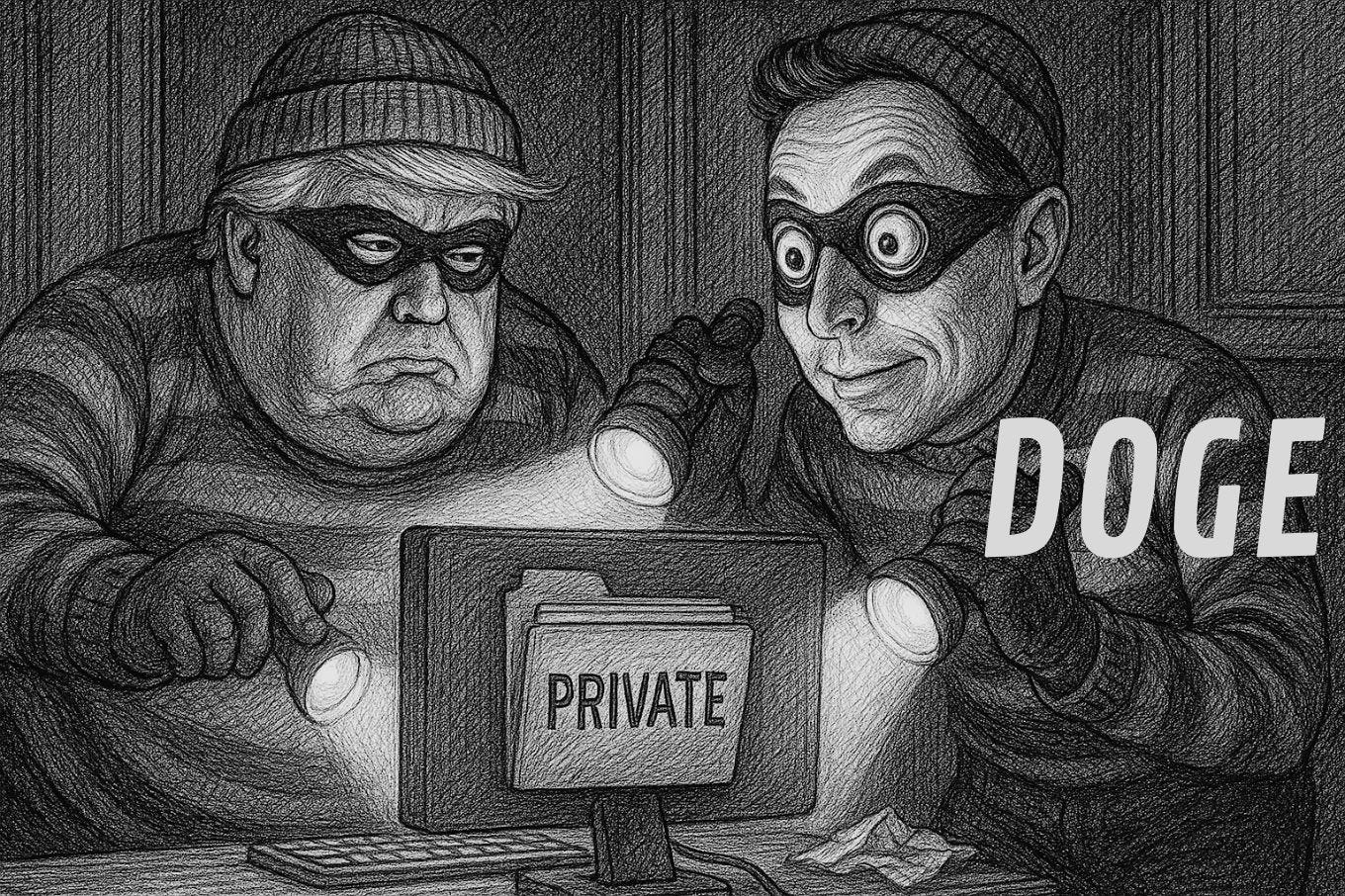
When I first heard about the new Department of Government Efficiency, casually nicknamed “DOGE,” I thought it was a gimmick, a flashy name with no real substance. But as an American lawyer committed to defending our Constitution, what I’ve uncovered is no joke.
In President Donald Trump’s 2025 White House, DOGE has morphed into something very real and very alarming: a domestic surveillance machine with access to a vast trove of personal information about everyday Americans. In my opinion, what’s happening with DOGE right now is an unprecedented threat to our privacy, our civil liberties, and the democratic values that bind us together. We need to talk about why this matters to you and what we can do about it.
The Government’s New All-Seeing Database
Here’s the situation in plain terms: DOGE is breaking down walls between government databases that were always kept separate for a reason. Traditionally, information about us held by different federal agencies lives in separate silos. Your tax records stay with the IRS. Your Social Security and Medicare details stay with the Social Security Administration and HHS. Your financial complaints might sit in a Consumer Protection Bureau database, and your health records with another agency.
These silos exist to protect our privacy – strict laws from the 1970s onward deliberately prevent easy sharing of your personal data between agencies. It’s a safeguard that says no single branch of government gets to see everything about you at once.
DOGE is upending that safeguard. Under an executive order issued by President Trump on his first day back in office, agency heads were instructed to give DOGE “full and prompt access to all unclassified records, software systems, and IT systems.” In effect, Trump told every federal department: hand over your data to Elon Musk’s DOGE team. And they have.
Musk’s hand-picked staff, many of them young tech engineers with little government experience, have reportedly gained entry into highly sensitive databases storing information most of us wouldn’t even share with close friends. I’m talking about things like your medical histories and prescriptions, notes from therapy sessions, detailed financial records, bankruptcy filings, income and tax data, social security status, the very intimate details of our lives that the government happens to have on file.
Imagine all these pieces of your personal life compiled in one giant master database. It may sound like dystopian fiction, but by many credible accounts it’s exactly what’s being built right now.
Why is this so dangerous? For one, the more centralized and wide-reaching a database is, the more power it gives those who control it. It’s power that can be abused or misused, whether through deliberate action or sheer carelessness. If one office can peer into almost any government record about you, it can potentially use that information against you in ways you’d never expect.
Maybe it’s a bureaucrat snooping on an ex-spouse’s tax returns, or a political appointee combing through an activist’s health records to find embarrassing info. Or a hacker, foreign or domestic, breaching this “one-stop shop” database and stealing data on millions of Americans in one go. All of these nightmare scenarios become more likely when all our eggs are in one basket.
We created walls between data silos decades ago precisely to prevent these kinds of abuses. After the Watergate scandal, for example, Congress tightened privacy laws because President Nixon had shown interest in weaponizing IRS tax data against his enemies. America decided back then: never again. But now, those protective walls are being knocked down at alarming speed.
What’s worse, we the public have no clear idea what DOGE is actually doing with this ocean of personal data. Even seasoned privacy experts and members of Congress are in the dark. A senior technologist who quit her government post when Trump took office said it plainly: “We don’t know what they’re doing, and that is terrifying.”
Normally, anyone handling sensitive citizen data in government goes through extensive background checks and oversight. But Musk’s DOGE crew was parachuted in fast, with little transparency about their vetting. Are these individuals qualified and cleared to handle, say, your health or financial records? We honestly don’t know. Agency insiders have quietly admitted it’s “not clear” what sort of checks or safeguards, if any, were put in place.
DOGE’s defenders claim these staff have proper clearances and “read-only” access in systems (meaning they can’t alter data). Even if that’s true, just being able to read all your information is enough power to abuse. The bottom line is that an unelected, barely accountable group has keys to the kingdom of our personal data. And that should raise an immediate red flag for every American.
How Your Data Could Be Weaponized
It’s bad enough that DOGE has access to so much private information. What’s truly chilling is how this data could be weaponized for political purposes, some evidence suggests it already is. Remember, DOGE was sold to us as a task force to “root out waste, fraud, and abuse” in government. But inside those federal agencies, many see a different mission unfolding: rooting out people whom President Trump and Elon Musk deem disloyal.
Multiple reports have emerged that DOGE is using advanced surveillance tools, including artificial intelligence, to monitor federal employees’ communications for any hint of criticism or dissent. Think about that. A government office supposedly focused on efficiency is scouring emails and chat messages to see who’s not fully aboard the Trump train.
At the Environmental Protection Agency, for example, managers quietly warned staff that Musk’s team was deploying AI software to flag any “anti-Trump or anti-Musk” language in their work chats. One source said employees were told, “Be careful what you say, what you type, and what you do – DOGE is watching.” This isn’t some wild conspiracy theory; it’s coming from people inside the agencies and has been documented in court filings and news investigations.
As a lawyer, I find this deeply alarming. Government employees do not surrender their First Amendment rights when they go to work. They have every right to discuss concerns or criticize policies internally without fear that Big Brother is listening in. But under DOGE’s regime, expressing an honest opinion about, say, a dubious environmental rollback could cost you your job.
Already, tens of thousands of civil servants have been fired or pushed out under Trump’s orders, often with DOGE’s fingerprints on the process. If data from personal files or communications is being used to identify and punish “troublemakers” (read: anyone not loyal to the president), that is a gross abuse of power. It turns the machinery of government into a political weapon aimed at our own public servants.
Now extend this concern beyond federal employees. If DOGE can trawl through internal records to target dissent within government, what’s to stop it from doing the same to ordinary citizens? With access to IRS data, for instance, could they single out a political opponent or a vocal critic in the public by quietly combing through that person’s tax returns? Could they dig up someone’s private struggles (a health condition, a bankruptcy, a disability claim) and use it to discredit or pressure them? In an America where DOGE goes unchecked, it’s not far-fetched to imagine such things.
In the 20th century, we had J. Edgar Hoover’s FBI compiling secret dossiers on activists and politicians to blackmail and control them. That was done in the shadows and rightly condemned when exposed. Today, DOGE seems poised to do something similar in broad daylight, supercharged by modern technology and sanctioned from the Oval Office.
This is not how a democracy is supposed to function. In a healthy democracy, the government doesn’t compile “dossiers” on citizens to intimidate or silence them. That’s the stuff of authoritarian regimes and police states. Yet here we are in 2025, watching a U.S. administration openly amass personal data and use surveillance tactics against its own workforce – and potentially against broader swaths of Americans – all under the banner of “efficiency.”
It’s both Orwellian and absurd: a program named after an internet meme has become a serious threat to fundamental American freedoms. I believe that if we allow this to continue, we risk normalizing a dangerous idea: that it’s okay for those in power to spy on and bully those who disagree with them. Nothing could be more un-American.
No Oversight and No Accountability
You might be wondering, can they even do this? Where are the checks and balances? Aren’t there laws to prevent exactly this kind of overreach? The answer is: they are trying, but so far DOGE has been able to slip through the gaps in our system. The lack of oversight is jaw-dropping.
For starters, the Trump administration has deliberately cloaked DOGE in unusual secrecy. They argue that because DOGE is part of the President’s own office (the Executive Office of the President), it doesn’t have to follow the normal transparency laws that apply to federal agencies. That means DOGE has been dodging Freedom of Information Act (FOIA) requests, the very mechanism by which journalists and citizens can usually pry loose government records.
In fact, Trump’s executive order cleverly repositioned a White House tech unit into the new “U.S. DOGE Service” precisely to keep it under White House control and potentially out of FOIA’s reach. A federal judge has already signaled that this setup likely doesn’t excuse DOGE from public records laws, and ordered the administration to start releasing documents.
But guess what? DOGE has stalled and stonewalled, providing essentially nothing of substance to date. They even asked for extensions in court, all while presumably continuing their activities behind closed doors. By the time the legal battles conclude (and they will likely drag on), DOGE’s work could be long done and the damage to privacy already inflicted.
Congress, too, has been largely kept in the dark. Members of both parties have started sounding the alarm, demanding basic answers: Who exactly is working for DOGE? Under what authority are they rifling through agency data? How are they vetting these people? Are they safeguarding sensitive information properly?
In one extraordinary instance, the Senate Intelligence Committee sent a formal letter to the White House posing 22 pointed questions like these. The response? Essentially a shrug. The administration has offered scant details, mostly bland reassurances.
No independent authority is truly monitoring DOGE’s actions right now. Inspectors General, the internal watchdogs at each agency, have been sidelined or even fired if they got in Trump’s way. Whistleblowers are undoubtedly afraid for their careers (with good reason, given the retaliations we’ve seen). And unlike in many other democracies, the U.S. has no single strong data privacy agency that can swoop in to enforce rules in real time.
Our privacy protections are a patchwork of outdated laws like the Privacy Act of 1974 and various sector-specific rules, good in theory, but slow to enforce and never designed for a scenario where a president might order mass merging of databases to target Americans.
To put it plainly, the guardrails that should protect us are failing. DOGE’s lawyers claim everything they’re doing is above-board, but dozens of lawsuits strongly disagree. More than a hundred federal employees and unions have sued to challenge DOGE’s authority to access personal information, citing the Privacy Act and constitutional rights. Advocacy groups have raced to court to block DOGE from digging into taxpayer data, pointing out that Congress made it illegal after Nixon for the President to access individual tax returns without strict process.
Yet here we are: reports indicate DOGE was given access to some IRS systems and only after public outcry was a promise made (behind closed doors) that they’d only get anonymized tax data. Even that promise hasn’t been verified. It shouldn’t take multiple lawsuits and Senate letters to ensure that Americans’ private information isn’t misused by their own government. But right now, lawsuits are one of the only tools we have, and they take time, – time during which DOGE keeps plugging away.
Meanwhile, DOGE operatives communicate on encrypted apps like Signal that erase messages, and they use shared Google Docs instead of official email to avoid leaving a paper trail. These tactics flagrantly flout federal record-keeping laws designed to ensure accountability.
If an agency head or White House staffer tried that under normal circumstances, Congress and the courts would be up in arms. But under Trump’s DOGE, it’s happening across the government. The irony is palpable: an office claiming to enforce efficiency and accountability is itself evading accountability at every turn. No meaningful oversight, no transparency, and no clear legal authority, this is a recipe for unchecked power, the exact opposite of how our federal government is supposed to work.
Dividing America and Eroding Democratic Norms
Beyond the legalities and data, I want to address the bigger picture of what DOGE represents. President Trump’s approach with DOGE reflects a broader disregard for the Constitution and for the unifying norms of our democracy.
As an attorney, I swore an oath to uphold the Constitution; I never thought I’d see a president behave as if that document were an inconvenience. Yet from day one of his return to office, Trump has treated the federal government as a personal tool, purging those he dislikes, bending rules to his will, and blasting anyone who questions him as part of some “corrupt deep state.”
This is more than just the usual partisan hardball. It’s an assault on the idea of an impartial, law-bound civil service and an assault on the concept that no president is above the law.
Consider the impact on national unity. Trump often frames his crusade as us (the patriots) vs. them (the bureaucrats, the critics, the “traitors”). By painting huge swaths of Americans, whether career public servants or political opponents, as enemies to be crushed, he divides this country in a profound way. DOGE has become an instrument of that division.
Instead of bringing Americans together to solve problems, the administration is using DOGE to sow mistrust and fear. Federal workers fear being spied on and unjustly fired. Ordinary citizens have growing distrust that agencies meant to serve them might instead share their secrets for political ends. Rather than strengthening trust in government, DOGE is undermining it.
We should be very clear: the Constitution was written to prevent exactly this kind of tyrannical behavior. It establishes checks and balances, protects free speech, and requires that power be used lawfully and fairly.
When a president claims the authority to do whatever he wants with our personal information, or to punish those who won’t pledge loyalty, he is betraying the spirit of constitutional governance. It harkens back to the darkest chapters of our history when leaders abused power, and it echoes regimes we’ve opposed around the world. As Americans, we’ve always prided ourselves on being a nation of laws, not a nation where might makes right.
I don’t say this lightly: if we allow these practices to continue, we risk losing some of the very things that make America, America. Privacy. Dissent. The rule of law. These aren’t abstract ideals; they directly affect whether we remain a free society or slide into authoritarianism. Right now, I feel both frustration and deep sadness.
Frustration that our president dismisses constitutional limits and demonizes good people who dedicated their careers to public service. Sadness that we even have to argue for basic principles like not spying on Americans without cause, or not using government data as a political cudgel. This is not a left or right issue, it’s an American issue. No citizen of any political stripe should want a government that can surveil and intimidate us at will. That’s why it’s crucial we stand together, across party lines, to push back against this dangerous trajectory.
Key Points to Remember
I know this is a lot to take in. To help you discuss this with friends and family, here are the key points about DOGE and why it matters to all Americans:
DOGE is merging personal information from across the government into one giant pool. Data that used to be kept separate, your taxes, benefits, health records, and more, is now accessible under a single Trump-controlled program. This centralization of sensitive data is essentially a massive domestic surveillance network in the making.
What started as a plan to cut government waste has turned into a tool for political power. There are credible reports that DOGE is spying on federal employees’ communications, hunting for anyone who isn’t 100% loyal to President Trump and Elon Musk’s agenda. That hints at a broader danger: personal data could be used to target or harass anyone deemed an “enemy.”
These actions are skirting longstanding privacy laws and constitutional principles. Rules that normally protect your information from being shared or misused are being ignored or bypassed by DOGE. This goes against the spirit of the Privacy Act and even the First Amendment (by chilling free speech). It’s exactly what our laws were designed to prevent after past abuses of power.
There is almost no oversight or transparency. DOGE operates largely in secret, claiming it doesn’t answer to the usual watchdogs. Congress and the public are getting few answers. With inspectors general sidelined and no dedicated privacy enforcement agency, Trump’s team is basically marking its own homework, and destroying the evidence as it goes. That lack of accountability is dangerous for any democracy.
This isn’t about saving tax dollars at all – it’s about control. Despite the official “efficiency” rhetoric, DOGE hasn’t proven it can save significant money. What it has done is consolidate power over information and personnel in the hands of a few. We should judge it by its actions, not its slogans, and the actions look like a power grab that threatens our rights.
Keep these talking points in mind. Share them in your community. A lot of people have never even heard of DOGE, and they need to know that this benign-sounding office is something to be very concerned about.
How We Can Stop This
So what can we do? It’s easy to feel powerless in the face of a program operating at the highest levels of government, but there are concrete steps that Congress and all of us as citizens can take right now to change course:
1. Congress must demand immediate oversight and transparency. Our representatives should hold public hearings and subpoena DOGE officials (including Elon Musk) to testify under oath about what data they’re accessing and why. They need to require regular reporting on DOGE’s activities.
Simply shining a bright light on this operation will pressure it to stay within the law. Lawmakers from both parties should unite on this – no member of Congress should tolerate an unaccountable spy network in the executive branch.
2. Strengthen and enforce our privacy laws. It’s clear that existing laws like the Privacy Act of 1974 need an update for the digital age. Congress should move quickly to pass legislation that explicitly forbids the kind of indiscriminate data merging DOGE is doing without court orders or individual consent.
They should also consider creating an independent Data Protection Agency or empowering an existing body to oversee how executive agencies handle Americans’ personal information. At the very least, give the Privacy and Civil Liberties Oversight Board real teeth to monitor DOGE and similar efforts. If laws have been broken (for example, improper access to IRS or health records), there must be consequences, up to and including cutting funding for DOGE or holding officials in contempt if they ignore subpoenas or court orders.
3. Protect whistleblowers and honest public servants. Congress should reinforce legal protections for any government employee who comes forward to report abuses related to DOGE. Inspectors General offices need to be empowered and shielded from retaliation.
We should celebrate, not punish, those who have the courage to speak out when our rights are at risk. And as citizens, we should support organizations and legal teams that are assisting these whistleblowers and fighting DOGE’s overreach in court.
4. Raise your voice and demand action. As citizens, our power lies in making noise and refusing to be complacent. Contact your Senators and House representatives, by phone, email, social media, or at town halls. and tell them you are deeply concerned about DOGE and the threat it poses to privacy and democracy.
Ask them directly what they plan to do about it. Politicians pay attention when enough voters care about an issue, and trust me, many of them are already worried about this behind closed doors. We have to make them feel the urgency publicly.
5. Support the groups fighting back, and stay informed. Civil liberties organizations, privacy advocates, journalists, and watchdog groups are working tirelessly to expose what’s happening and halt abuses. Support them if you can, even if it’s just by sharing their findings or donating a small amount.
Stay informed by following credible news on this topic (not just the government’s press releases). And keep the conversation going with your friends, family, and colleagues. The more Americans understand what DOGE is and why it’s dangerous, the harder it becomes for the administration to justify it or sweep it under the rug.
Each of these steps, big or small, contributes to building a defensive wall around our rights. We’ve seen in history that when the public and Congress work together to confront executive overreach, change does happen. It happened after Watergate, and it can happen now.
In closing, I want to emphasize that this isn’t about being pro- or anti-Trump, or conservative vs. liberal. It’s about preserving the core American idea that government should serve its people, not spy on them or intimidate them. I believe we can stop this slide toward a surveillance state, but only if we recognize what’s at stake and take action.
As a lawyer, a voter, and a parent, I refuse to accept that we must trade our privacy and principles for some illusion of “efficiency.” We can have a government that is both effective and respects our freedoms, those goals are not incompatible.
Right now, our democracy stands at a crossroads. Down one path is a future where leaders freely use technology and data to tighten their grip on power, unchecked by law or conscience.
Down the other path is a recommitment to the values of transparency, accountability, and personal liberty that have guided the United States for over two centuries. I’m confident that if enough of us raise our voices, we will choose the right path. Our message will be clear that purported government efficiency cannot come at the expense of liberty.
No one, not even the President, can trample on our rights without answering to the people. It’s time to take a stand and make sure that the America we leave our children is one where freedom and privacy still mean something. Let’s get to work.
Mitch Jackson, Esq. | links
Every article. Every fact. Every fiery opinion—my AI has it all.
Whether you’re wondering what it really means, how it connects to the bigger picture, or what you can do next, my AI is standing by 24/7. Ask a question. Challenge a point. Follow the thread. It’s like having a political deep-dive machine in your pocket.
Become part of the community!
This post is free—but building a future rooted in truth and democracy takes real investment. If my work speaks to you, subscribe and if you can, chip in $5/month or $50/year—because independent journalism that actually gives a damn (and delivers ideas you can use today) is worth backing.

As Louis Brandeis wrote, "Sunlight is said to be the best of disinfectants; electric light the most efficient policeman."
Great article.