

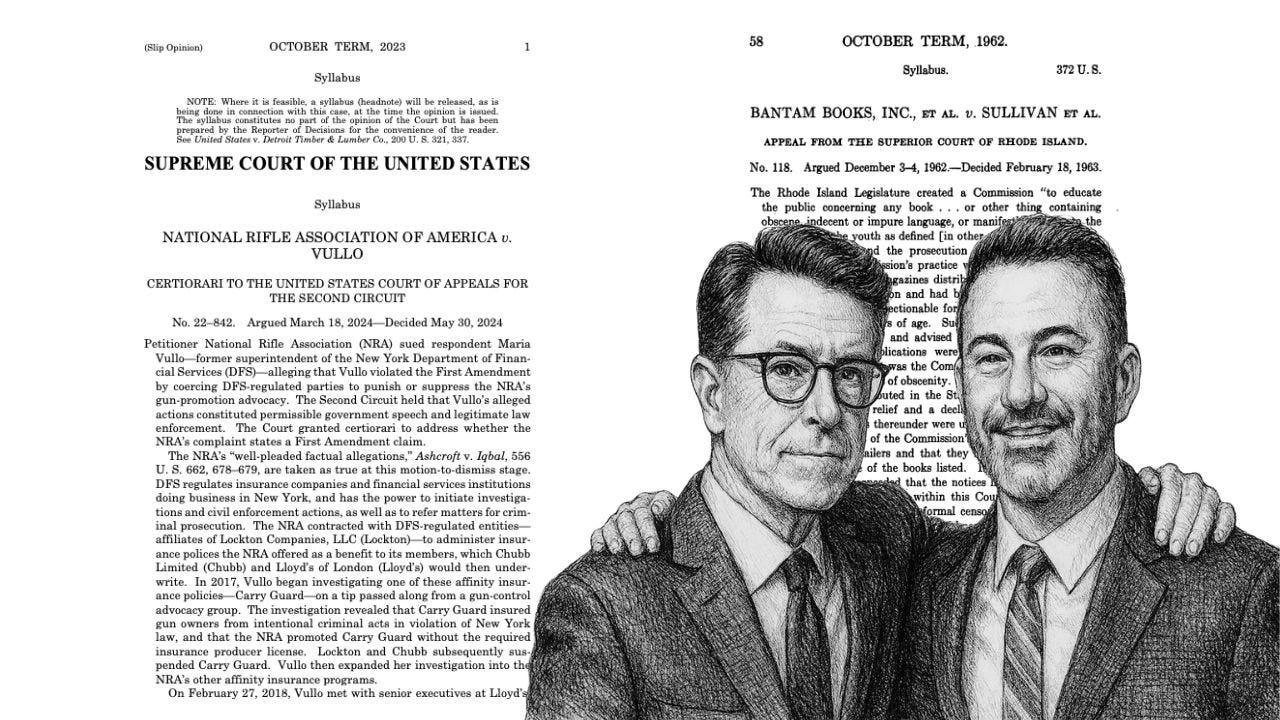
I get it. At first glance this sounds like a couple of late night comedians and some TV drama. Who cares, right? But this is so much bigger. The government cannot decide who gets to speak. It cannot bully companies with quiet threats to shut people down. That is dangerous. This is how freedom disappears while too many fail to appreciate what’s happening and others, in exchange for money and power, look the other way.
The Vullo and Bantam Cases
The Supreme Court has already spoken on the danger of government officials using private pressure to silence public voices. In National Rifle Association v. Vullo the Court ruled that a regulator violates the First Amendment when she uses her authority to push banks and insurers to cut ties with a group because she dislikes its message.
This is the same blueprint the Trump administration used when networks and advertisers originally pulled support for Stephen Colbert, and now for Jimmy Kimmel, after federal officials signaled that continued business with Kimmel would draw licensing and business deals trouble. The same principle also comes from Bantam Books, Inc. v. Sullivan, a 1963 decision that struck down government tactics designed to intimidate book distributors without passing a single law.
The Court in Vullo applied a four factor test drawn from Bantam Books to separate persuasion from coercion, and every factor points to a constitutional violation in the Colbert and Kimmel situations.
The Supreme Court’s Four Factor Test
The Court explained that government speech crosses the line into unlawful coercion when four conditions are present. Each element is a warning sign of indirect censorship.
Authority to Punish
The official must hold real regulatory or enforcement power. In Vullo the New York superintendent oversaw banks and insurance companies. In the Kimmel matter the Trump administration controls federal agencies that regulate broadcasters, advertisers, entertainment contracts and mergers.
Targeted Communications
The official communicates directly or indirectly with the private parties who can silence the speaker. Vullo sent letters and met with financial institutions. In this case, public podcasts, interviews, and other reports show that federal representatives, such as Brendan Carr, Chairman of the Federal Communications Commission, did this and more.
Implicit or Explicit Threats
The message contains hints of investigation, penalties, or regulatory and future business merger trouble if the private party fails to act. The Court in Bantam Books recognized that a “polite” request carries the force of a threat when backed by government power. Conversations about licensing reviews or federal contracts send the same signal to anyone supporting Colbert or Kimmel.
Predictable Response of Compliance
The private party responds by distancing itself from the speaker to avoid retaliation. In Vullo banks and insurers stopped working with the NRA. In both Colbert and Kimmel’s cases, partners withdrew support and cancelled his show.
Why This Should Matter to Every American
The First Amendment protects you from government officials who try to influence the information you can have access to and even silence speech by scaring the companies you rely on. A president does not need to sign an executive order to chill speech. A phone call or a meeting, or a social media post from the President of the United States, can create the same fear and intimidation.
When businesses believe they will face investigations or regulatory headaches for supporting a critic, they cut ties and the critic goes quiet. The harm to free expression is the same as a formal ban.
Because of the complete sh*t show we’re all experiencing today, I believe the democrats will regain majority control of Congress in 2026 and take back the Oval Office in 2028. When this happens, I wonder how MAGA Republican fans of what’s happening right now will feel if the new democratic president does this with their favorite hosts on Fox News?
The entire idea is repulsive. We need to stop this now and we need to double down on protecting everyone, and I mean everyone’s First Amendment Free Speech rights.
A Clear Pattern of Abuse
The Court in Vullo recognized that government actors can disguise threats as guidance. A regulator who warns of reputational risk while holding enforcement power crosses the constitutional line.
When federal officials pressure media executives or advertisers to punish a comedian for mocking the president, the conduct follows the same path. The law does not allow a public official to use influence to punish speech, no matter how strongly that official dislikes the message.
What You Should Do
Free speech belongs to everyone. Today it is a late night host. Tomorrow it could be a journalist, a business owner, or you.
The Constitution protects your right to hear voices that challenge those in power. Stay alert. Speak, organize, and vote to defend a country where government fear cannot silence the people.
Mitch Jackson, Esq. | links
Related Article: This Isn't About Jimmy Kimmel, It's About Who Owns and Controls the Information
Sign up for Uncensored Objection and stay ahead of the moves that threaten your voice. Get the straight story, talking points, and action steps you can use to protect free speech and democracy. Join today (free and premium) and stay informed before silence becomes the norm.
The Disney boycott is spiraling out of control. Last night, it hit a breaking point when Disney’s own performers refused to show up at their documentary premiere, shutting down the red carpet and canceling the performance. And then came the gut punch. On national television, John Oliver went after CEO Bob Iger, calling him out as a coward and daring him to stand up to Trump with three words that left no room for misinterpretation: “F*ck you. Make me.”
Thank you!!