

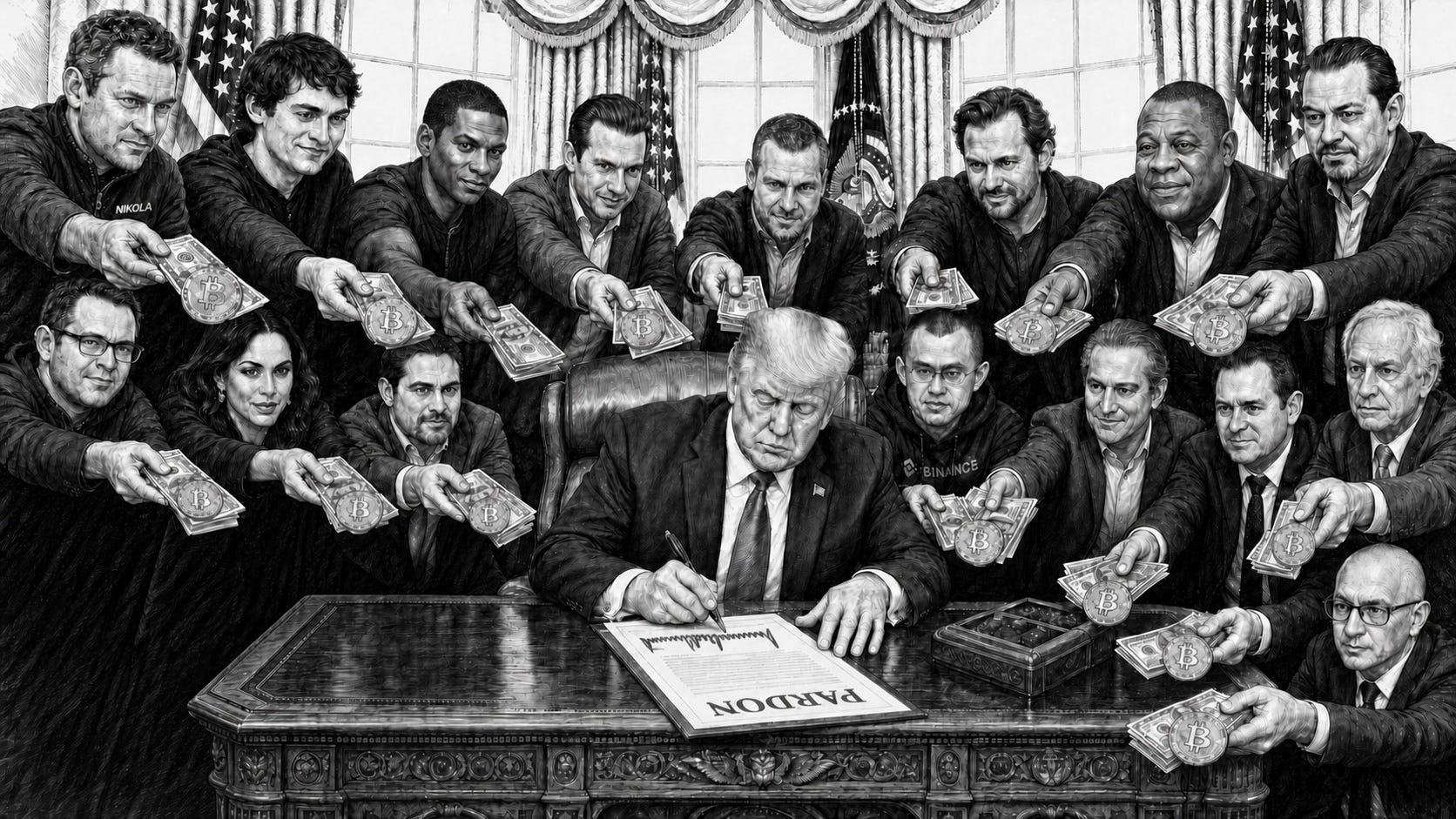
Five matters account for seventy-two percent of it. That is what sits in the appendix of the report House Judiciary Democrats released last Friday, August 21, 2026.
The headline says $1.7 billion in restitution, fines, and forfeitures erased by presidential clemency since January 2025. The appendix tells you where that money would have gone, and it does not all travel the same road.
I pulled the appendix and ran the arithmetic myself.
Restitution erased: $1,097,902,363
Forfeitures erased: $350,716,404
Fines erased: $204,812,218
Total: $1,653,430,985
The report’s math holds. Last June the same committee put the figure at $1.3 billion. Fourteen months later it stands at roughly $350 million higher.1
Here is the part almost every write-up of this report that I’ve seen has skipped. Those three columns sit next to each other in the table and look like one kind of money, and the moment anybody tries to collect on them they split into three separate systems that decide how much a victim ever sees. The column heading is the whole story.
Restitution names your loss in the judgment itself. You are entitled to it without applying for anything. Collection is slow and often fails, which I get to later, but nobody has to grant you permission first.
Forfeiture goes to the Justice Department’s Assets Forfeiture Fund under 28 U.S.C. § 524(c). From there it can still reach victims, through restoration, where prosecutors send the forfeited money to the Clerk of Court to be applied against a restitution order, or through remission, where a victim petitions under 28 C.F.R. Part 9. DOJ has moved serious money this way. It reported returning more than $400 million to victims of financial crime in fiscal 2008 alone. That route depends on a government lawyer deciding to act.
Criminal fines go to the federal Crime Victims Fund, which pays for domestic violence shelters, rape crisis centers, and victim assistance programs in every state. Those dollars reach victims of unrelated crimes, years later, through grants. The statute at 34 U.S.C. § 20101 carves out a short and specific list of fines that go elsewhere, covering the Endangered Species Act, the Lacey Act, railroad unemployment insurance, the Postal Service Fund, the Clean Water Act’s navigable waters revolving fund, and county public school funds. Nearly everything else lands in the Fund.
So no, this is not $1.7 billion snatched out of victims’ hands. It is money that would have reached victims through three systems of decreasing directness and increasing discretion. Some of it was also owed to government victims, Medicare and the IRS, which means it comes out of your pocket rather than an investor’s. It’s all important but the details matter.
I am telling you that up front because the number is going to get repeated all week, and so if you want to be the person in the room who can explain what’s really going on, here’s what you need to know.
Here are the five largest.
Trevor Milton, $695,200,000 in restitution
Milton founded the electric truck company Nikola. A jury convicted him in October 2022 of securities and wire fraud for lying to retail investors. His signature move was a promotional video showing a prototype truck appearing to drive under its own power. Prosecutors established that the truck had been towed to the top of a hill and rolled down.
He drew four years and remained free pending appeal. In March 2025 prosecutors filed their restitution calculation at $695.2 million. Two weeks later, according to the report, Trump called Milton personally to tell him about a full and unconditional pardon that wiped out the money.
Before that call, Milton and his wife had given more than $1.8 million to committees supporting Trump’s reelection campaign, including $920,000 to the Trump 47 Committee in October 2024 and $750,000 in September 2024 to a super PAC affiliated with Robert F. Kennedy, Jr. He also hired two lawyers with direct ties to the President. The report says Trump told Milton to call Bobby and thank him. The donation figure is contested. CBS News, citing the Wall Street Journal, reported at least $3 million to the campaign and to groups in the President’s orbit, a wider accounting than the committee used.
A White House official told CBS News that Milton’s donations “played absolutely no role” in the decision. They think you’re stupid.
This is 63 percent of the report’s entire restitution column and 42 percent of the $1.65 billion headline. One man, one filing, one phone call.
Ross Ulbricht, $183,961,921 in forfeiture
Ulbricht ran Silk Road, the online drug marketplace. A jury convicted him in February 2015 on seven counts covering narcotics distribution, continuing criminal enterprise, computer hacking, fraudulent identification documents, and money laundering. Judge Katherine Forrest sentenced him to life and ordered him to forfeit $183,961,921. He received a full and unconditional pardon by Trump on January 21, 2025, one day into the second term.
Read that word again. Forfeiture. In its report (you can read the full report via the link in the footnotes), the committee refers to this correctly, and it is the second largest single figure in the report.
Forfeited money can still reach victims through restoration or remission. In this case that was always unlikely. The FBI tied the figure to the value of drug and false-identification sales on the site, and the sentencing court treated the bitcoin moving through Silk Road’s payment system as forfeitable proceeds. It was never a tally of identified losses belonging to named victims in a restitution order.
Ulbricht is also different in kind. Trump promised the clemency publicly at the Libertarian National Convention in May 2024. He promised a commutation to time served and delivered a full pardon instead, which also erased the forfeiture. Ulbricht’s family and a large public campaign had lobbied for years. What the report does not show in his case, and does show in others, is a paid intermediary with access to the President’s inner circle. In my book this is represented a strategic political promise allowing Trump to keep his base happy.
BitMEX and four of its executives, $130,150,000 in fines
Arthur Hayes, Benjamin Delo, and Samuel Reed founded the Bitcoin Mercantile Exchange. Gregory Dwyer was one of its first employees and later ran business development.
All four pleaded guilty in 2022 to violating the Bank Secrecy Act. Hayes, Delo, and Reed each agreed to a $10 million criminal fine that prosecutors described as the money derived from the offense. Dwyer agreed to $150,000. All four received probation rather than prison. The company itself, operating as HDR Global Trading Limited, pleaded guilty in July 2024, and on January 15, 2025, Judge John Koeltl fined it $100 million and imposed two years of probation.
On March 27, 2025, all five received full and unconditional pardons. The report counts $130.15 million as erased.
Do not confuse that figure with a different $30 million. The Commodity Futures Trading Commission separately obtained consent orders in May 2022 requiring Hayes, Delo, and Reed each to pay a $10 million civil penalty. A presidential pardon reaches offenses against the United States. It does not reach civil penalties, so those stand.
This entry also carries a first. The report says Trump appears to be the first president to pardon entire corporations, and I have found nothing contradicting that. The company was a live defendant with an unpaid criminal fine, and the pardon power reached it.
Carlos Watson and Ozy Media, $96,359,511
Watson founded Ozy Media and built it into what looked like a digital media success. In 2021 the New York Times reported that Ozy’s chief operating officer had impersonated a YouTube executive on a call with Goldman Sachs while the bank weighed a $40 million investment. Goldman grew suspicious and never invested. The company collapsed within days of the story.
A jury convicted Watson and the company in 2024. He drew nearly ten years. The court ordered $36,769,154 in restitution to defrauded investors and $59,590,357 in forfeiture.
On March 28, 2025, according to the report only hours before Watson was due to report to prison, Trump commuted his sentence to time served and erased both figures. The report describes a clemency campaign that ran through a New York attorney, drew on Alan Dershowitz answering questions posed by the White House, and used Steve Bannon as a reference. Months later the administration closed the government’s remaining civil fraud case against Ozy Media.
This is the entry where the forfeiture column matters most. That $59.59 million could have been restored to the same defrauded investors named in the restitution order. Both numbers went away on the same day.
Lawrence Duran, $87,533,863 in restitution
Duran co-owned American Therapeutic Corporation, a chain of Florida mental health clinics that generated roughly $205 million in false Medicare claims and collected about $87 million. Prosecutors said staff forged patient charts for people with Alzheimer’s and severe dementia to bill for therapy that never happened. He pleaded guilty in April 2011 to all 38 felony counts against him and was sentenced that September to 50 years, which the Justice Department called the longest prison sentence ever imposed in a Medicare Fraud Strike Force case. The commutation warrant, dated May 28, 2025, ended his obligation to repay a single dollar.
One qualification the report does not make, at least as I understand the facts. Judge King ordered that restitution jointly and severally with Duran’s co-defendants, including his co-owner Marianella Valera and the corporate defendants. Clemency for one joint obligor does not release the others. On paper the debt survives against people who were not pardoned. In practice those co-obligors have little or nothing, so the collection picture is close to the same. The accounting point still belongs on the record. In any case, the victim here is Medicare, which means every taxpayer absorbed the loss.
The five largest owed to victims
Because the two lists are not the same, here is the restitution column ranked on its own.
Trevor Milton, $695,200,000, owed to defrauded Nikola investors
Lawrence Duran, $87,533,863, owed to Medicare
Jason Galanis, $84,817,513, owed to pension funds and the Oglala Sioux Nation
Adriana Camberos, $48,824,415 joint with her brother, owed to defrauded grocery suppliers
Devon Archer, $43,427,436, owed in the same bond fraud that hit the Oglala Sioux
Three that belong in the conversation
Jason Galanis, $84,817,513. Convicted for schemes including the theft from the Oglala Sioux Nation and the defrauding of New York pension funds covering transit workers and longshoremen. His clemency warrant directed that no further restitution be collected. Days later he asked a federal judge to return the $2 million he had already paid toward his victims, arguing the purpose of the payment no longer existed. Judge Kevin Castel denied the request. Two conflicts worth knowing: the report’s narrative calls this a pardon and says he owed more than $160 million, while ABC News and the California Governor’s office describe a commutation of a 189-month sentence, and the report’s own appendix says $84,817,513.
Adriana and Andres Camberos, $76,505,571. Convicted in October 2024 of defrauding grocery suppliers out of $58 million in gross profits over four years. They bought a Ferrari F12 Berlinetta, a Lamborghini Huracán, multiple homes, and cryptocurrency. Adriana had already received first-term clemency for a separate counterfeiting conviction. Both received unconditional pardons on January 15, 2026. The report says the pardons let them keep the cars.
Changpeng Zhao, $50,000,000. The Binance founder pleaded guilty to failing to maintain an anti-money-laundering program at an exchange that prosecutors said failed to report more than 100,000 suspicious transactions. He hired a longtime friend of Donald Trump, Jr. to lobby for clemency while Binance built infrastructure for the Trump family crypto venture and brokered a $2 billion Emirati investment. He was pardoned in October 2025. Asked about it, Trump said he had no idea who Zhao is.
I am flagging Zhao’s number rather than counting it. Reuters reported at the time of his release from custody in 2024 that he had paid the $50 million criminal fine, and his own sentencing memo referred to the fine he had paid. If that is right, the pardon erased nothing here. Money already paid over is gone from Trump’s pardon reach, and the Supreme Court said in 1890 that proceeds paid into the treasury come back only by act of Congress. The appendix carries a footnote making exactly that point about a different pardonee, Joseph Lewis, and no such note for Zhao. Somebody should ask the committee about it.
There is a further irony in the Binance file. The Office for Victims of Crime reports the Crime Victims Fund balance at over $3.6 billion as of May 2026. The association representing state VOCA administrators puts the working picture far tighter, saying roughly $1.9 billion of that sits in reserve from the Binance and British American Tobacco settlements and that only about $74 million carries into fiscal 2027 once this year’s obligations clear. Congress set the fiscal 2026 threshold at $1.95 billion, above which deposits are held for the following year. Treat the association’s breakdown as an advocate’s accounting. The direction is not in dispute. The fund that would have received these erased fines is running thin while settlement money sits parked.
What the pardon warrant actually does
Here is the mechanic almost nobody explains. A pardon can shorten a prison sentence and leave the financial penalties standing. That is how Trump’s first term generally worked. Sentences got cut and restitution stayed on the books.
Trump’s second-term warrants are drafted differently. They expressly direct that no further fines, penalties, forfeitures, or restitution be collected. That single clause is what turns a mercy grant into a wealth transfer.
The legal authority runs back to a 1995 Justice Department Office of Legal Counsel opinion holding that a full and unconditional presidential pardon remits court-ordered restitution the victim has not yet received. The opinion draws its line at money already in the victim’s hands, relying on Knote v. United States, 95 U.S. 149, 154 (1877). Once the victim holds the cash, the President cannot reach it.
In January 2026 the Supreme Court added weight. In Ellingburg v. United States, decided January 20, the Court held unanimously that restitution under the Mandatory Victims Restitution Act is “plainly criminal punishment.” Justice Kavanaugh wrote. Justice Thomas concurred, joined by Justice Gorsuch.
My take is that Ellingburg answered an Ex Post Facto question, not an Article II question. The Court said expressly that its holding does not mean a restitution statute can never be civil, and it rested on the MVRA’s specific text and structure. No court has squarely decided whether restitution sits inside the pardon power, and OLC had already answered that question its own way three decades earlier. What the case does is take away the best argument on the other side. Anyone preparing to tell a court that federal restitution is really a civil debt beyond the President’s reach now has a unanimous Supreme Court opinion aimed at that position. I’m expecting somebody to litigate this issue anyway inside eighteen months, probably for a victim group with a strong equitable story.
The one door that stays open
Now the part I want every defrauded investor reading this to understand. Article II gives the President power over “Offences against the United States.” In Ex parte Grossman the Supreme Court read that phrase as marking off offenses against the United States from other categories, and the Constitution Annotated states the settled understanding that state criminal offenses and federal or state civil claims fall outside the pardon power.
In 1894 the Court said the same thing in plainer words, observing that an executive may relieve a wrongdoer from the punishment the public exacts, and that neither executive nor legislature can pardon a private wrong or relieve the wrongdoer from civil liability to the person he has wronged. That 1894 line is dicta, and no modern case has tested it against a clemency warrant like these. It remains the clearest statement of the rule. What this means is that while the criminal case is closed, your civil claim is a separate animal.
If you lost money to someone on the appendix in this report, you may still hold a civil claim under whatever theory the facts support. Federal law at 18 U.S.C. § 3664(l) also provides that a criminal conviction estops the defendant from denying the essential allegations of the offense in a later civil suit brought by the victim. Whether a pardon disturbs that estoppel is unsettled and worth litigating. Modern and earlier cases lean toward the victim.
For example, in 1993 the Court described a pardon, in dicta, as an executive action that mitigates or sets aside punishment rather than an overturning of a conviction. In 1914 it allowed a pardoned offense to count as aggravation in a later proceeding. In 1915 it observed that a pardon carries an imputation of guilt and that accepting one is a confession of it.
Two warnings, and they are urgent.
Statutes of limitation run whether you act or not. For many of these victims the civil clock had already run before the pardon issued, so clemency didn’t just erase the restitution, it took away the last remedy that was actually alive. For other victims, there may be arguments to be made and time to file. Each case is different.
Assets move. The report says the Camberos siblings kept a Ferrari and a Lamborghini, and that Joseph Schwartz appears to be avoiding process servers on wrongful death judgments. Every month you wait gives someone time to move money to a spouse, a trust, or an offshore entity.
If you’re a victim and after reading this post, you want to pursue your rights, immediately contact an experienced lawyer in your jurisdiction. Nothing in this article is legal advice, and no article can tell you whether your particular claim survives.
The Closing Argument
The January 6 pardons drew every camera in Washington. They account for $3 million in this report, which is eighteen hundredths of one percent of the total.
Do not misread that number, and do not let anyone weaponize it. Court-ordered restitution for January 6 tracked direct physical damage to the Capitol, which the Architect of the Capitol put at about $2.73 million. The Government Accountability Office separately estimated the total federal cost of the attack at roughly $2.7 billion once you count Capitol Police, the District of Columbia, other agencies, security, and investigations. The restitution figure was always going to be small because restitution measures broken glass and damaged statues.
The point is about where the attention went. The cameras followed the $3 million. The billion moved somewhere else, quietly, in appendix rows with names most Americans have never heard. Nursing home residents. Pension holders. Retail investors who bought a truck stock. An Indian nation. Medicare. A shelter in a county you have never visited that runs on grant money from a fund now stretched thin.
Five matters moved $1.19 billion. Not one victim on the receiving end of those five had a lawyer in the room when the decision got made, and not one of them was asked.
I have practiced law for four decades and during that time, I’ve watched clients wait years for a judgment and wait years more to collect on it. Restitution exists because Congress decided a criminal conviction should not leave the victim holding the loss. A clause in a clemency warrant now undoes that in one sentence, without notice, without a hearing, and without any obligation to explain. That is the story. The dollar figure is the receipt.
What You Do Now
If you were a victim in any of these cases, call a civil attorney in your state this month and ask about your statute of limitation. The criminal remedy is gone. Your civil claim may not be.
Call your House representative and both U.S. senators. Use the phone. The Capitol switchboard is 202-224-3121. Give your name and your town. Ask them one thing: will you support a bill requiring public disclosure of every fee paid to every intermediary in a clemency application?
Understand why that is the ask. The Supreme Court has said Congress cannot limit the effect of a pardon or carve any class of offender out of it. Every proposal to restrict who gets clemency dies on that rock. A disclosure requirement regulates the lobbyist and the fee, leaves the President’s power untouched, and survives.
Read the appendix yourself. It is the table at the back of the report linked below. Look at the column headings before you look at the numbers, because the headings are the whole story. Find one name, look up what that person did, and tell one other person this week.
Mitch Jackson, Esq.
You just read the receipt that almost nobody else will bother to open, and that puts you ahead of everyone still shouting the headline. Grab the free subscription to Uncensored Objection so the next breakdown lands in your inbox, and go paid if you want me digging through the fine print at midnight for you.
See Pardons,Inc.: How Trump and His Clemency-for-Cash Racket LetWhite-Collar Criminals and International Drug Dealers Walk Free and Dodge Billions in Restitution Owed to Their Victims [House Committee on the Judiciary- Ranking Member Jamie Raskin]. The complete report was added to my Sidebar AI for paid community members to easily search and do a deep dive.
We do not live in a democracy here in the US, people.
This is what’s known as an oligarchy.
Pay to play.
To be screwed by an individual is bad enough, to be screwed by a PEDO PINO -God would strike me down.
Can these be reversed if the buffoon is impeached and convicted if one of the 100s of articles of impeachment is for receiving payments of sort to issue pardons, commutations, etc?