

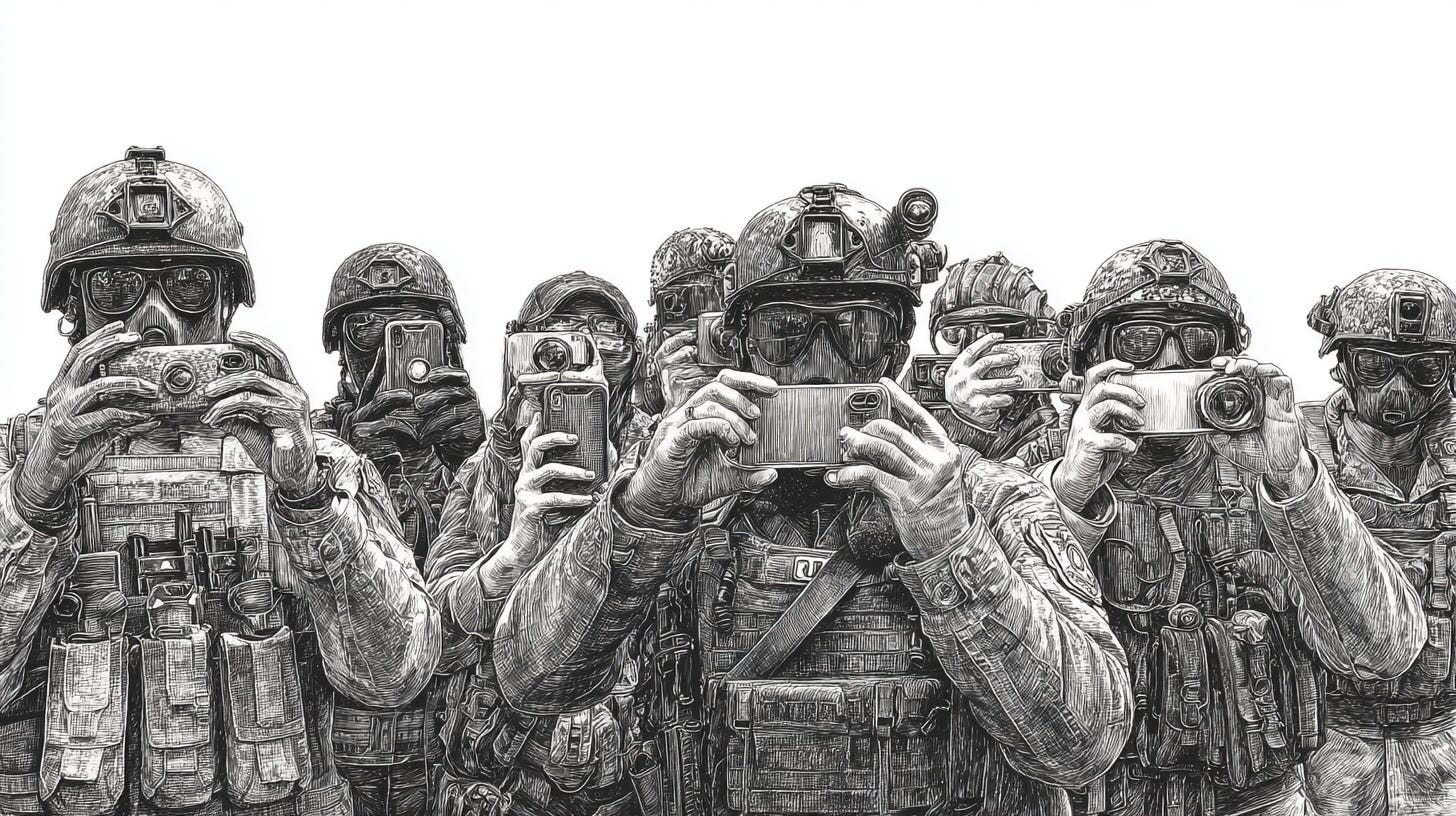
How much power should a federal agent hold over your identity, your movements, and your future without leaving a public record of how that power was used. That is the question sitting in front of us right now as immigration agents across the country rely on sophisticated mobile surveillance technology carried in their pockets while most do not wear body cameras that would document their actions.
I have spent more than three decades as a trial lawyer watching what happens when authority operates without witnesses and when evidence disappears before a judge or jury ever sees it. What ICE is doing today is not accidental, not improvised, and not benign. It is part of a deliberate technological architecture designed to identify, track, investigate, and remove people with minimal friction and minimal accountability, and once you understand how it works, you will never look at a cell phone in a federal agent’s hand the same way again.
Why This Is Not About Convenience or Efficiency
The use of personal and agency issued cell phones by ICE agents is not about saving time or adapting to modern tools. These phones serve as portals into a powerful enforcement ecosystem that replaces traditional investigation with instant access to massive federal databases. A body camera creates a continuous, neutral record of what happens in public encounters. A phone creates a selective record controlled entirely by the agent. That choice alone tells you everything you need to know about priorities.
When an agent chooses a phone over a body camera, the agent chooses discretion over documentation, control over transparency, and silence over evidence. That decision becomes more troubling once you understand that these phones are not passive devices. They are keys.
Mobile Fortify and the Field Identification Machine
At the center of ICE’s mobile enforcement strategy sits an application known as Mobile Fortify. This app allows agents to photograph a person’s face, scan fingerprints, capture identifying documents, and run real time identity checks directly from the field. Once data enters Mobile Fortify, it connects to federal biometric and biographic systems that store millions of records.
This means an agent standing on a sidewalk, in a parking lot, or at a workplace can confirm or deny a person’s identity in minutes without a warrant, without judicial oversight, and often without the individual understanding what data is being collected or how it will be used. The phone becomes a mobile booking station without the protections that normally accompany arrest or interrogation.
HART, IDENT, and the Biometric Backbone
For years, the Department of Homeland Security relied on a system called IDENT, a massive biometric database storing fingerprints and facial images. IDENT is now being replaced by HART, the Homeland Advanced Recognition Technology system. HART expands biometric collection beyond fingerprints to include facial recognition, iris scans, and other identifiers, and it integrates data across agencies.
When ICE agents collect photos or biometric data through mobile tools, that information flows into this system, where it can persist indefinitely and be accessed by multiple federal entities. This is not a simple identity check. It is a permanent digital imprint tied to a person’s name, movements, and encounters with the government.
Palantir, FALCON, and the Data Fusion Engine
Behind the scenes, ICE relies on data analytics platforms that bring disparate information together into a single investigative picture. One of the most significant tools is Palantir’s FALCON system. FALCON aggregates data from law enforcement records, immigration files, travel history, financial information, and communication metadata to map relationships and patterns.
When an agent uses a phone to enter a name, license plate, or image, that query can pull from FALCON’s networked intelligence. This allows agents to see associations, prior encounters, family connections, and location histories. It is not coincidence. It is design. Phones act as entry points into a system built to collapse distance between suspicion and enforcement.
TECS, ATS, and the Travel Surveillance Loop
ICE and CBP share access to systems such as TECS and the Automated Targeting System. These platforms monitor border crossings, travel itineraries, shipping data, and passenger records. A person who has ever flown internationally, crossed a border, or appeared in a travel database may have records accessible to agents in the field.
A simple roadside encounter can trigger a cascade of historical data, much of it collected long before any alleged wrongdoing. This information can influence detention decisions without the subject ever knowing why they were flagged.
ENFORCE, EARM, and the Removal Pipeline
Once an individual enters ICE’s enforcement machinery, systems such as ENFORCE and the Alien Removal Module manage custody status, court proceedings, and deportation logistics. Data collected in the field flows downstream into these systems, shaping outcomes that affect liberty, family separation, and exile.
When documentation relies on selective phone records rather than continuous body camera footage, the narrative becomes one sided. The government controls the story from first contact to final removal.
Neighborhood Surveillance Without a Warrant
Beyond mobile biometric tools, ICE has also acquired neighborhood scale surveillance technology that extends monitoring far beyond individual encounters. Two systems, Tangles and Webloc, were purchased through the contractor PenLink, which merged with the firm that developed them. Tangles aggregates large volumes of public and commercial data, including social media activity and phone related signals.
Webloc uses commercial location data to map how millions of devices move through a block, neighborhood, or city, showing where phones go and how long they remain there, often without a warrant. An agent can query a name or device identifier and retrieve location histories and connections that reveal personal patterns before any judicial oversight, turning what once required warrants and subpoenas into automated, continuous civilian surveillance.
Fourth Amendment and Due Process Risks
The Constitution does not evaporate in the presence of technology. The Fourth Amendment protects against unreasonable searches and seizures, especially invasive digital searches. Courts have recognized that biometric data and digital records carry heightened privacy interests.
When agents collect facial images, fingerprints, or identifying information through mobile apps without warrants or clear consent, serious constitutional questions arise. When those encounters lack body camera footage, courts lose the ability to assess coercion, consent, and credibility. Evidence integrity collapses when the only record belongs to the party exercising power.
Psychology of Surveillance Without Oversight
Every psychologist understands how behavior changes when observation disappears. Accountability shapes conduct. The absence of neutral recording increases risk of escalation, misjudgment, and dehumanization. Phones empower the user. Cameras empower the truth.
Agents operating under constant surveillance behave differently from agents who decide when the record starts and stops. That is human nature, not theory.
A Second Trump Term and the Expansion of Unchecked Power
This technological shift fits neatly into the culture of a second Trump presidency defined by hostility toward oversight, contempt for constitutional limits, and open distrust of institutions that impose accountability. Inspectors general get sidelined. Courts get attacked. Records get erased. Enforcement agencies receive a message that transparency is optional.
When phones replace body cameras, that message becomes operational reality.
This Is Not About Immigration Alone
This system does not stop at undocumented immigrants. It normalizes mobile surveillance, biometric tracking, and data fusion in everyday encounters. Once normalized, it spreads. Once accepted, it expands.
You deserve law enforcement that records its actions honestly. You deserve technology that serves justice rather than secrecy. You deserve rights that exist even when fear drives policy.
Pay attention. Talk about this. Demand transparency. Demand oversight. Demand laws with teeth.
When power hides its own actions, democracy weakens. Refusing to look away is the first act of defense.
Mitch Jackson, Esq.
Related: Why Are ICE Agents Hiding Their Faces?
Newest program is RAVEn - Repository for Analytics in a Virtualized Environment. It is a Palantir-developed data-mining platform designed to replace the older FALCON system, allowing for faster, more comprehensive processing of diverse data, including social media, biometric, and financial records. If you have crossed an international border, ICE knows all about you.
Your iPhone is quietly building a detailed map of everywhere you've been, every timestamp, every coordinate, every stop you made last week. Law enforcement and ICE know exactly where to find it.
If you want to know what your phone is hiding and how to stop it, check out my new article titled "Your iPhone Is Secretly Mapping Every Place You Go and Here Is How to Shut It Down in Five Minutes."
https://www.linkedin.com/pulse/your-iphone-secretly-mapping-every-place-you-go-here-how-jackson-5ru1c