

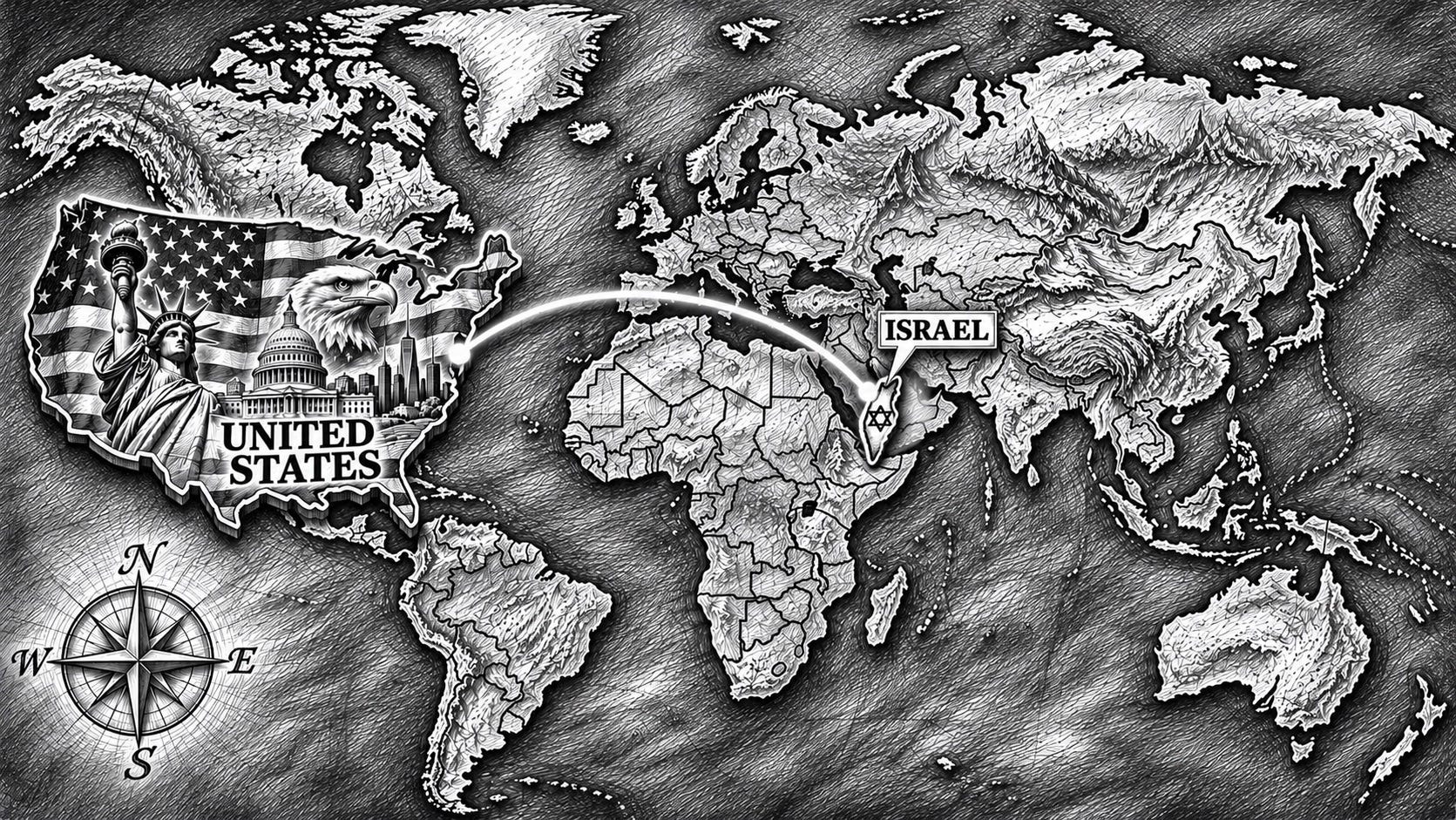
Lately AIPAC keeps popping up everywhere, from cable news to your family dinner table. So I asked my team to dig into what this group is and what it does. What we found grabbed my attention, and I think it will grab yours too.
Here is my promise to you before we start, so you know exactly what you are getting: I am handing you the documented facts and the strongest arguments from each side, laid out in plain English and updated through the middle of November 2026, so that the next time this topic comes up at work or over Thanksgiving dinner, you walk into that conversation with solid information and leave the shouting to somebody else. You decide.
What AIPAC is and how it works
AIPAC stands for the American Israel Public Affairs Committee. It ranks among the most financially significant pro-Israel lobbying and political advocacy organizations in the United States. AIPAC is an American organization, and its mission is to strengthen the relationship between the United States and Israel. It works to influence American foreign policy and the bills Congress passes. It also plays an active role in elections.
AIPAC has operated through three related organizations. AIPAC itself is the lobbying organization, and it pushes for U.S. policies that support Israel. AIPAC PAC is a political action committee, created in December 2021, that gave money to congressional campaigns, and most of that money came from donations that individual supporters earmarked for specific candidates. Think of an earmarked donation like a letter you drop off at the post office. You write the check and pick the candidate, and AIPAC PAC delivers it.
The United Democracy Project, better known as UDP, is a super PAC created in January 2022, which means the law allows it to spend unlimited amounts of money to support or oppose congressional candidates, as long as it spends that money on its own and never coordinates any of that spending with the campaigns or the candidates it wants to help. That rule matters.
The picture changed on October 21, 2026. AIPAC announced that it would stop endorsing candidates and stop giving money to them through its PAC, a change that ends the earmarking system described above. AIPAC says it will keep encouraging its members to give directly to candidates on their own. UDP keeps operating, and it keeps its power to raise unlimited amounts of money.
AIPAC has backed both Democrats and Republicans. It has also gone after candidates whose positions clash with its priorities. In 2024, AIPAC says, 326 of the candidates it endorsed won their general elections, 120 Democrats and 206 Republicans.
Follow the 2026 money
Now let’s talk dollars. Federal Election Commission filings show that AIPAC PAC raised $57.8 million in the 2026 election cycle through October 14, 2026. Over that same stretch, the United Democracy Project raised $112.8 million, and it still held about $56.6 million in cash on that date.
A separate analysis of federal records, updated on November 11, 2026, reports that AIPAC PAC has sent about $123.7 million to federal candidates since late 2021, a total that includes earmarked donations, and that UDP has spent about $120.5 million on independent expenditures since 2022.
Here is where people trip up. Those two big numbers measure different types of transactions, so you should never simply add them together and call the result unique funding. Adding them is like adding the miles on your odometer to the gallons in your gas tank. Both numbers are real, and the total means nothing. Funny thing about a big number is how fast it gets repeated without anyone checking what it counts.
Who writes the checks
The Israeli government does not fund AIPAC. By law, the money comes from American donors. Its political committees disclose their donors in federal campaign finance filings, which means anyone with an internet connection is able to look up who gave and how much.
The single biggest contributor to UDP this cycle is AIPAC itself, which gave the super PAC about $30 million, close to a third of everything UDP raised. AIPAC is a nonprofit, and nonprofits of its type are allowed to keep their own donors private, so part of the money behind UDP traces back to a list the public never sees.
Individual contributors to UDP have included prominent American investors and businesspeople, and four of the most familiar names among its largest 2026 donors are Paul Singer, Blair Frank, Marc Rowan, and Haim Saban, whose donations show up in the same public filings that you and I are free to read any day of the week. Saban has given across several cycles.
One more fact belongs here. During the 2026 primaries, UDP sent a large share of its spending through newly formed PACs with names that never mention Israel or AIPAC, and one news report found that more than 40 percent of its primary spending ran through those outside groups. The money still shows up in federal filings. Finding it takes an extra step.
The heat around AIPAC
Critics argue that AIPAC’s heavy campaign spending gives pro-Israel donors outsized influence over congressional elections and American foreign policy. Supporters argue that AIPAC represents Americans exercising their constitutional right to back candidates who share their foreign policy priorities.
Keep one legal line front and center. Supporting policies that favor Israel and receiving campaign money from the Israeli government are two separate things under the law. Foreign nationals are generally prohibited from contributing to American elections.
You are able to examine AIPAC’s influence through four kinds of public records: campaign contributions, independent expenditures, lobbying disclosures, and congressional voting records. Go to AIPAC’s official website too and read how the group describes itself in its own words.
One question reveals a lot. Start by finding out how many sitting members of Congress have received campaign money connected to AIPAC and how much each one received. Then line those numbers up with how each member voted on legislation involving Israel. Those records give you a concrete starting point for investigating political influence without assuming that a contribution determined a vote. A check and a vote sitting side by side make a lead worth following, and when I’m trying cases in court, a lead never became proof until the evidence carried it all the way home, no matter how good it looked on the first day of trial.
The supporters’ side
Here are the strongest arguments that AIPAC is good for American democracy, laid out the way its supporters make them, with a focus on constitutional rights and on fair, accountable elections.
Supporters start with the First Amendment. American democracy protects the right of citizens to organize, advocate, lobby, and give money to candidates who represent their interests. AIPAC gives Americans who want a strong relationship between the United States and Israel an organized political voice. Supporters warn that restricting that participation because the advocacy concerns another country puts at risk the same constitutional freedoms that labor unions and environmental groups rely on every day.
Supporters also say AIPAC strengthens participation and representation. The group organizes donors and mobilizes voters, and it helps supporters take part in the political process. Because it backs candidates from both major parties, it gives voters a way to put foreign policy near the top of their list in congressional elections. In the supporters’ view, this is exactly how representative democracy is supposed to work, with citizens organizing around shared interests and trying to elect representatives who will stand up for those interests in Washington.
Voters who care about Israel’s security and about America’s alliances and policy in the Middle East use AIPAC’s advocacy and election work to support or challenge congressional candidates, which supporters see as one more tool that regular people have for holding their elected officials accountable at the ballot box.
Supporters point to transparency too. AIPAC’s political committees have to comply with federal campaign finance disclosure rules, and those rules give the public information about donors and expenditures. Think of a neighborhood association that pools its money to back a school board candidate and then posts the list of every family that chipped in.
Where critics see danger
Critics make four arguments of their own about why AIPAC is bad for democracy.
Critics worry first about wealthy donors gaining outsized influence over American elections. UDP, AIPAC’s affiliated super PAC, spent about $61.4 million in total during the 2024 election cycle, and roughly $37.9 million of that went to ads and other independent expenditures aimed at specific races. Spending on that scale lets wealthy donors pay for huge advertising campaigns that ordinary voters and less funded candidates have no way to match. Picture a town hall where everyone gets a microphone and one group shows up with a stadium sound system.
Critics say that when financial resources outweigh grassroots support, the system drifts away from political equality, the democratic principle that every citizen’s voice deserves the same weight.
Critics also argue that AIPAC discourages independent judgment by elected officials. When an organization is able to spend millions supporting or opposing congressional candidates, lawmakers have reason to think about becoming a target in their next election, and critics say that pressure pushes them to line up with AIPAC’s policy priorities. Critics want lawmakers judging each bill on what their own constituents need. This worry is about political incentives. It stops short of proving that anyone bought or controlled a particular vote.
Critics also say AIPAC lifts the interests of one foreign policy alliance above competing American priorities. AIPAC’s stated mission centers on strengthening the relationship between the United States and Israel, and critics argue that concentrating so many political resources on that single goal makes it harder for Congress to evaluate military assistance and human rights questions on their own terms. They say the same pressure reaches into foreign policy as a whole. The democratic concern, as critics put it, is whether lawmakers stay accountable enough to American voters when they balance policy involving Israel against other national interests.
Foreign money and the law
One fact stays steady. AIPAC is an American organization, and it says the Israeli government neither directs nor funds it. Federal law prohibits foreign nationals and foreign governments from financing American elections, directly or indirectly, so the debate over whether AIPAC’s influence is excessive is a separate question from any allegation of illegal foreign financing, and keeping those two questions apart makes every conversation about AIPAC clearer and more honest.
Two principles in a tug of war
The whole disagreement comes down to two principles that pull against each other. Freedom of political participation holds one end. Under that principle, Americans have the right to organize and to spend money on political advocacy for the candidates who represent their views.
Equality of political influence holds the other end. Every American gets one vote. Americans do not all have the same financial resources to influence the political system.
AIPAC shows this tension clearly, especially because federal law permits super PACs to accept unlimited contributions for independent political expenditures. The question worth carrying into your next conversation reaches beyond the right of Americans to advocate for Israel, and it asks whether any privately financed organization should be able to exercise this much financial influence over congressional elections, no matter which foreign or domestic policy that organization promotes.1
Bigger spenders
People ask me all the time whether other groups pour more money into politics than AIPAC does. They do. Several American political organizations and donor networks spend substantially more to influence U.S. elections, and they include groups supporting Republicans, groups supporting Democrats, business interests, and particular industries.
Before you look at the numbers, lock in one distinction. Money handed straight to a candidate and money spent off on its own to help elect or defeat one, those are two different animals. A direct donation is like handing your friend cash for her lemonade stand. Independent spending is like a stranger buying billboards all over town telling people to visit her stand, paying for every one of them out of his own pocket, and never once picking up the phone to talk to her about it.
Look at independent spending on ads and outreach during the 2024 election cycle, which covers 2023 and 2024. Future Forward USA, a Democratic group, led the pack at more than $500 million. Make America Great Again Inc., the Republican super PAC aligned with Trump, spent $376.9 million, and WinSenate, a Democratic Senate group funded almost entirely by the Senate Majority PAC, spent $311.3 million. On the Republican side, the Congressional Leadership Fund spent about $216.7 million and the Senate Leadership Fund spent about $211 million. The Democratic House Majority PAC came in at $195.7 million. America PAC, a Republican group backed by Elon Musk, spent about $172 million, and Americans for Prosperity Action, the conservative group tied to the Koch network, spent $138.5 million. Fairshake and its two affiliated super PACs, which represent the cryptocurrency industry, spent about $133 million together, and AIPAC’s United Democracy Project spent roughly $37.9 million.2
All of these figures are rounded, and this list samples the biggest players without ranking every group in the country. UDP’s total spending for the cycle, counting operating costs and gifts to other PACs, came to about $61 million, which still leaves it well below every other group named here. For what it’s worth, this comparison shows that AIPAC sits well below the largest political spending operations in American elections. The picture shifts once you follow the money that lands with candidates.
Cash that lands with candidates
PAC contributions given directly to candidates during the 2024 cycle tell a different story. Public tallies put Never Back Down, the super PAC that backed Ron DeSantis, at the top with $5.25 million, a figure that deserves caution because super PACs are barred from giving money directly to candidates. The National Association of Realtors gave $4.19 million. AIPAC PAC’s own contributions came to $3.04 million, which put it ahead of Blue Cross/Blue Shield at $2.93 million and the National Beer Wholesalers Association at $2.79 million.
That $3.04 million figure leaves out the substantial donations that individual supporters route through AIPAC PAC to candidates. Remember the post office. A separate analysis of federal filings estimates that in 2024, approximately $53.7 million reached candidates through AIPAC PAC, largely in the form of earmarked donations that supporters wrote and AIPAC PAC delivered, which makes AIPAC considerably more significant in direct candidate fundraising than its own contribution figure suggests. AIPAC itself put the 2024 total at more than $53 million for 361 candidates.
The 2026 midterm fundraising race
Federal filings for the 2026 midterm cycle, reported through October 14, 2026 and rounded off, show that at least nine big outside groups raised more money than AIPAC’s affiliated super PAC, and a few of them raised four or five times as much as UDP did. The Senate Leadership Fund raised $545.6 million. MAGA Inc. raised $449.4 million. The Senate Majority PAC raised $354.4 million and the House Majority PAC raised $294.4 million. The Congressional Leadership Fund raised $260.8 million and America PAC raised $216.0 million. Restoration PAC raised $140.9 million, Fairshake raised $138.2 million, and Americans for Prosperity Action raised $115.3 million. AIPAC’s UDP raised $112.8 million. These numbers measure fundraising, and fundraising is a different measure from direct contributions to candidates.
Spending tells the same story. By early October 2026, six outside groups had each spent more than $60 million on the midterms, led by the Senate Leadership Fund at nearly $174 million, and UDP had spent about $53.5 million on independent expenditures through the end of September.
Why AIPAC draws a bright spotlight
AIPAC’s spending is unusually concentrated. It focuses on congressional elections and on one specific foreign policy issue. A sum that looks modest next to presidential campaign spending becomes hugely visible in a single House primary. Think of a garden hose; spread across a whole field, it barely darkens the dirt, and aimed at one flowerpot, it floods it. In 2024, AIPAC’s super PAC spent about $14.6 million in one New York congressional district, and that race became the most expensive House primary on record at the time. In 2026, UDP spent more than $30 million in a single Michigan Senate primary.
Then there’s the Iran war and what’s happening in Gaza. Critics across both parties argue that Netanyahu steered Trump into the war. For many Americans, Gaza deepens the connection, and 60 percent now view Israel unfavorably. Those issues deserve their own post. Here the point is the money, and with the Iran war and what’s happening in Gaza, every dollar UDP spends in a primary reads to voters as a vote on these additional unpopular issues too.
Here is the bottom line. AIPAC is not America’s largest political spending organization, and it does rank among the significant networks directing contributions to congressional candidates, especially when you count earmarked donations. Its October 2026 decision to stop direct contributions and earmarking changes how that money moves from here forward, and its super PAC remains fully in the game. Money talks in American politics, and the public record lets you hear every word it says.
The broader democratic question is whether concentrated political spending should face additional limits, no matter if the money comes from pro-Israel donors, cryptocurrency companies, labor unions, billionaires, or any other interest, and that question applies with equal force to every group named in this piece. I shared two posts in the footnotes about these issues include Citizens United.
Your move
You now know more about AIPAC than most of the people arguing about it online. Use it. You know how its organizations work, where its money comes from, how its spending stacks up against the biggest players in American politics, and what supporters and critics each believe about its effect on democracy.
The records, they sit there waiting for anyone willing to read them. Your opinion grows teeth the moment you back it with records. Freedom and equality are still pulling on that rope, and now you get to decide where you grab hold.
Pull up your own representative’s campaign finance and voting records this week, and then share what you find in the comments, because every person who reads the record firsthand makes the next conversation about AIPAC a little smarter for all of us who are listening.
Mitch Jackson, Esq.
Elon Musk gave about $474 million in the 2026 midterm cycle, based on what has been publicly disclosed so far. The New York Times built that total from federal, IRS and state filings, and it covers disclosed donations to federal and state political groups since January 1, 2025. Musk also gave money through groups that don’t disclose their donors, and the federal records only run through mid-October.
Re: Critics worry first about wealthy donors gaining outsized influence over American elections…if you truly care about undue influence…why doesn’t Congress investigate the 100’s of millions of dollars Elon Musk donated…I heard it was $300 million just for Texas to defeat Talarico…which thankfully failed miserably