

Introduction
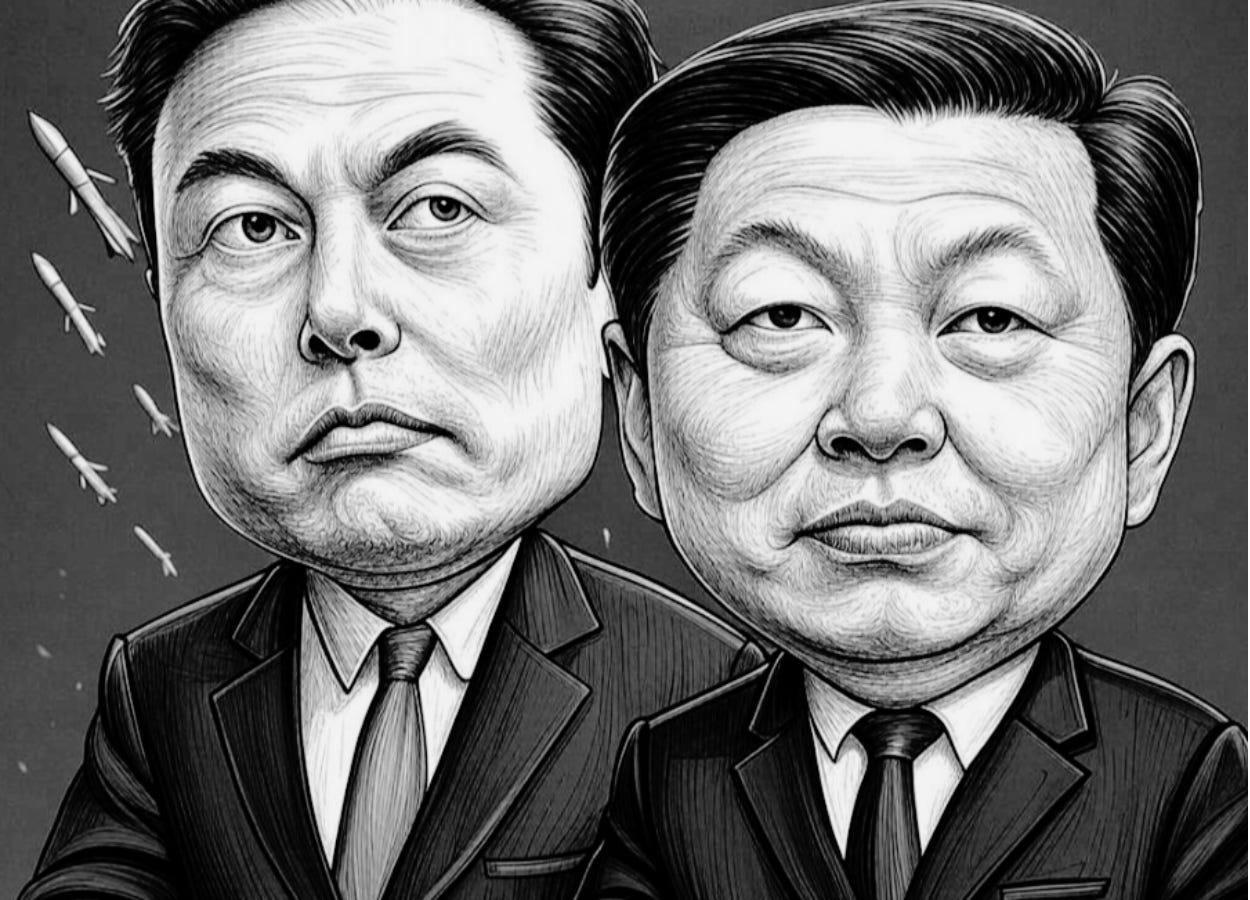
Elon Musk, the world’s richest person and CEO of multiple cutting-edge companies, has cultivated extensive business interests connected to China over the past 25 years. These interests range from electric vehicles to space technology.
Musk’s ventures – including Tesla, SpaceX (with its Starlink satellite network), X (Twitter), Neuralink, and the Boring Company – all intersect with China either directly through factories and suppliers or indirectly through strategic considerations.
As Musk’s influence in industry and technology has grown, so have concerns about how his China ties could conflict with United States national security. My report examines Musk’s business engagements in China and analyzes current and potential future national security conflicts stemming from those ties.
Dig deeper with AI. News moves fast—and the stakes are high. This special Perplexity AI page lets you explore all the facts, sources, and context of this specific article with zero fluff. No filters. Just clarity.
Elon Musk’s Direct and Indirect Business Interests in China
- Tesla’s Deep Presence in China: China is Tesla’s second-largest market and a critical manufacturing base for the company. Musk entered China’s auto market in 2014 and rapidly expanded. In 2019 Tesla opened Gigafactory Shanghai – its first factory outside the U.S. – which was built with generous support from the Chinese government. Tesla was allowed to own this factory outright (a first for a foreign automaker in China) thanks to Musk’s strong relationship with Beijing.
Chinese state banks provided large low-interest loans (over $1.4 billion) and local authorities offered tax breaks to help construct and operate the Shanghai plant. This factory now produces at least half of all Teslas globally and serves as a major export hub. In recent years, more than one-third of Tesla’s annual vehicle sales have been in China, giving Musk a huge financial stake in Chinese success.
Tesla also relies on Chinese suppliers for critical components: the company’s key battery supplier is China’s CATL, and many raw materials (like lithium and rare earth minerals for EV motors) are processed or sourced in China. Musk has frequently visited China to nurture these ties, meeting top officials to discuss expanding Tesla’s operations. He has even thanked China’s leaders for their support – in 2023 he personally thanked President Xi Jinping for China’s role in developing the EV industry and noted it was Tesla’s 10th year in the Chinese market.
To appease regulators, Tesla stores all data from Chinese Teslas on servers in China and opened a showroom in Xinjiang despite international criticism, reflecting Musk’s willingness to align with Beijing’s requirements to keep Tesla thriving.
- SpaceX and Starlink: Musk’s rocket company SpaceX and its Starlink satellite internet network have no direct business in China, mainly because of U.S. export laws and Chinese restrictions. In fact, Beijing views SpaceX’s technologies with wariness: China has banned Starlink in its territory and considers the satellite network a potential security threat.
Musk has revealed that the Chinese government explicitly sought assurances from him that Starlink service would not be offered in China. He has complied, keeping Starlink out of China to avoid angering Beijing. While SpaceX does not partner with any Chinese firms (U.S. law forbids sharing rocket technology with China), Musk’s dealings still intersect with Chinese interests indirectly.
For example, Chinese officials have been closely watching Starlink’s impact in other countries. Musk noted that Beijing disapproved of him providing Starlink terminals to Ukraine during the war, illustrating how his actions with SpaceX can affect Chinese strategic concerns. SpaceX itself buys little from China due to security rules, but it competes with China’s growing space industry.
Musk’s successful reusable rockets have spurred China to develop similar technologies, and Chinese media have credited him for accelerating their own space efforts. Overall, Musk keeps SpaceX’s core operations U.S.-focused, but his need to keep Tesla viable in China means he remains attentive to Chinese concerns about SpaceX projects like Starlink.
- X (Twitter) and Chinese Influence: Musk’s social media platform X (formerly Twitter) is officially banned in mainland China, yet China still looms large in its ecosystem. When Musk acquired Twitter in 2022, he brought on foreign investors – including at least one with Chinese ties (the crypto exchange Binance, originally founded in China).
More significantly, Musk’s content moderation policies have benefited Chinese state interests. Under his ownership, X stopped labeling Chinese state media accounts as such, making it easier for official propaganda outlets to spread messages abroad. Researchers have reported a surge in Chinese government propaganda and disinformation on X, exploiting Musk’s looser reins on bots and fake accounts.
During Chinese domestic protests in late 2022, bot networks flooded Twitter with unrelated spam to bury news of the demonstrations – a tactic that became more effective due to Musk’s staffing and policy changes. Musk’s own statements have also sometimes aligned with Beijing’s viewpoints on issues like Taiwan. While X is not a direct business venture in China (and generates no revenue there), Musk’s need to maintain goodwill for Tesla has made him notably cautious about antagonizing China on his platform. He has engaged with Chinese diplomats’ posts on X and generally avoids criticism of Chinese policies. This balance suggests that even a platform used mainly outside China is indirectly shaped by Musk’s Chinese business interests.
- Neuralink and Biotechnology: Musk’s brain-machine interface startup Neuralink currently has minimal direct connection to China, but China is a rising player in neurotechnology. Musk’s company is developing implantable chips to link human brains with computers, a cutting-edge biotech field that Chinese researchers and companies are also exploring aggressively. While Neuralink has so far focused on U.S. regulatory approval for human trials, Musk could see China as a future market or a place for clinical studies if U.S. rules become too strict. China’s regulatory environment for biotech trials can be more lenient, which might tempt ventures like Neuralink to collaborate or conduct research there in the future.
Moreover, Chinese universities are producing top talent in AI and neuroscience – expertise that Musk’s ventures may seek to hire. There is no known Chinese investment in Neuralink, and Musk has not announced any partnerships there, but the strategic interest is mutual: China’s military and tech sector are closely following brain-computer interface developments.
Musk’s prominence in this field means any major breakthroughs or data from Neuralink could attract attention from China, either through scientific exchange or industrial espionage. In sum, while Neuralink’s China ties are indirect today, the groundwork exists for deeper interaction as the neurotech and AI race heats up.
- The Boring Company and Other Ventures: Musk’s tunnel construction firm, The Boring Company, has no direct business in China at this time. Its focus has been on U.S. projects (like Las Vegas tunnels) and some discussions in Europe. China, however, has some of the world’s most advanced tunneling and infrastructure companies. Musk has praised China’s engineering prowess in the past, and it’s conceivable that The Boring Company could one day source machinery or technology from Chinese partners, or even bid to build infrastructure in Chinese cities. Thus far no such deals exist, so this remains a hypothetical interest.
As for other personal ventures, Musk’s past role in founding OpenAI had little connection to China (OpenAI is U.S.-based and its services are blocked in China). Musk’s new artificial intelligence initiative, xAI, is just getting started (as of 2023–2025) and has no known Chinese partnerships – but Musk has expressed that China should be involved in global AI cooperation.
He met with Chinese officials in 2023 to discuss AI regulation, indicating a possible openness to align on AI safety standards. Additionally, Chinese tech giants like Tencent once held a small stake in Musk’s Tesla (Tencent bought a 5% share in 2017), showing that Chinese capital has indirectly supported his ventures.
Musk’s personal wealth (much of it tied up in Tesla stock) is thus partly intertwined with Chinese investors and consumers. Over 25 years, Musk has transformed from having virtually no China links to being deeply enmeshed in China’s industrial landscape through Tesla and maintaining a careful, strategic relationship across his portfolio.
National Security Conflicts and Implications
Elon Musk’s extensive China-linked business interests raise numerous national security concerns for the United States. As Musk’s companies span critical sectors – aerospace, communications, automotive, energy, and emerging tech like AI and biotech – any leverage China gains over him could have far-reaching security implications. Below are key conflict areas and their implications:
- Aerospace and Defense: SpaceX is now a vital contractor for the U.S. government, launching military satellites and supplying the Pentagon with satellite communication (Starlink) services. Musk’s company holds sensitive information about U.S. defense and space operations.
There is concern that Musk’s reliance on China (through Tesla) could be exploited by Beijing to influence how he deploys these capabilities. For example, if a U.S.–China confrontation erupts (say over Taiwan), Musk might face Chinese pressure to limit Starlink coverage or rocket launches in certain regions, undermining U.S. military communications or logistics. Already, Beijing’s sway was evident when Musk reportedly denied Ukraine full use of Starlink near Crimea after Chinese (and Russian) signals of disapproval.
In a future conflict, the U.S. military’s dependence on Musk’s infrastructure – from Starlink’s battlefield internet to potentially SpaceX’s Starship for rapid global transport – could become a strategic vulnerability if Musk is unwilling to act against China’s interests. Even absent direct pressure, Musk’s access to U.S. defense planning (through contracts and advisory roles) while he simultaneously engages with Chinese officials presents a clear conflict.
U.S. officials fear that Musk could, even inadvertently, share insights with Beijing or be swayed to advocate policies friendlier to China to protect his business. Essentially, Musk’s dual role as a top U.S. defense contractor and a major investor in China forces an uncomfortable question: in a crisis, where will his loyalties lie? That uncertainty itself is a national security risk.
- Satellite Networks and Space Infrastructure: Musk’s Starlink constellation provides a new, global telecommunications layer – one that China cannot easily control. This has strategic implications. Starlink can enable U.S. and allied militaries to communicate outside of traditional networks, and it can give internet access to people under authoritarian regimes.
China perceives Starlink as a military threat and has reportedly developed plans to disable or destroy parts of the constellation if necessary. If Musk continues deepening ties with China, U.S. policymakers worry he might acquiesce to restrictions on Starlink’s use to avoid angering Beijing.
For instance, he might refuse to activate Starlink over Taiwan or East Asia during heightened tensions, hampering U.S. intelligence and coordination. Moreover, any Chinese components or software in Starlink satellites or user terminals (even minor electronics) could be vectors for espionage or sabotage.
Musk’s companies must guard against Chinese infiltration of their supply chain – a constant security concern. Conversely, Tesla vehicles in China continuously collect mapping and sensor data; Chinese law forces that data to stay in China. This prevents Musk from using it globally but also means Chinese authorities have potential access to it, which could include detailed maps of Tesla-rich cities like Los Angeles or New York if data policies ever falter.
The interplay of Musk’s satellite network with Chinese space ambitions (China is launching its own “Starlink-like” constellations) also sets up a competitive clash. Any cooperation Musk might consider – like coordinating frequencies or orbits with China – could conflict with U.S. military priorities in space. Overall, Musk’s influence in orbital infrastructure is unprecedented for a private citizen, and it directly intersects with U.S.–China strategic rivalry in space.
- Artificial Intelligence and Advanced Tech: Musk’s involvement in AI (through ventures like xAI and even Tesla’s self-driving tech) creates another potential conflict area. The U.S. and China are racing for AI supremacy, with national security implications ranging from autonomous weapons to intelligence analysis.
Musk has publicly urged U.S.–China collaboration on AI governance, which, while well-intentioned, might conflict with U.S. strategies to maintain an edge over China. If Musk’s AI companies rely on Chinese talent or resources, there’s a risk of intellectual property transfer to China. Conversely, if Musk gains access to U.S. government AI research or data (for example, rumors that xAI could train on government datasets), officials worry that his China ties could expose that work.
Musk’s Tesla Autopilot is effectively an AI for driving – and China has been cautious about letting Tesla deploy its Full Self-Driving in-country until Chinese firms catch up. Musk’s negotiations to get FSD approved in China (including possibly sharing data or source code with Chinese regulators) could inadvertently give Chinese developers insight into American AI algorithms. In the future, if Neuralink or Tesla develop AI that could have military uses (like autonomous drones or AI-driven robotics), any collaboration or data-sharing with China would raise red flags at the Pentagon.
A less discussed angle is Musk’s philosophy on open-sourcing technology: he has opened Tesla’s patents and might open-source some AI. While this can accelerate innovation, it also means Chinese entities can freely adopt Musk’s innovations, potentially leapfrogging U.S. defense R&D. Musk straddling the line between open global tech and protecting U.S. advantages is a tricky balance with security implications.
- Telecommunications and Social Media Influence: Through X (Twitter), Musk controls a key platform used by U.S. officials, military personnel, and the public to communicate. Changes in that platform under Musk have had national security effects. By removing labels on Chinese state media and reducing moderation, Musk amplified Beijing’s propaganda reach to American audiences.
Chinese information operations – from spreading disinformation to sow discord in U.S. politics – have found a more permissive environment on X. This directly conflicts with U.S. efforts to counter foreign influence campaigns. Additionally, there’s concern that Musk’s ownership could lead to censorship or surveillance issues.
If the Chinese government demanded the data of certain X users (for example, Hong Kong or Uyghur activists abroad) or pressured Musk to silence accounts that criticize China, would he resist? His financial dependence on China suggests he might be vulnerable to such demands. Even if Musk never shares user data, Chinese cyber-agents may attempt to hack X’s systems. Any security weakness could expose sensitive communications of U.S. government officials who use the platform.
Musk’s close China ties also raise the specter of him using X to shape public opinion in ways favorable to China – for instance, promoting narratives that the U.S. should “get along” with Beijing or downplay human rights concerns, because that aligns with his business interests. For an American voting audience, this is a subtle but serious concern: a major social media platform’s policies might be influenced by a foreign adversary’s leverage over its owner. In sum, Musk’s handling of X has opened new fronts in information warfare that U.S. national security planners are watching warily.
- Automotive, Energy and Critical Supply Chains: Musk’s core business, Tesla, sits at the nexus of energy security and advanced manufacturing – areas where the U.S. is racing to reduce dependence on China. Yet currently, Tesla’s supply chain relies heavily on Chinese inputs, from battery cells to mineral processing.
This reliance poses a strategic risk: in a U.S.–China standoff, China could restrict battery exports or materials, crippling Tesla’s production and by extension U.S. electric vehicle supply (since Tesla is the market leader). That would undermine U.S. economic security and efforts to build a domestic EV industry independent of China. Musk’s personal incentives might conflict with any U.S. policy that seeks to decouple these supply chains.
If the U.S. considers export controls or tariffs on Chinese EV components for security reasons, Musk has a financial motive to lobby against them to protect Tesla’s cost structure. We have already seen Musk oppose the idea of U.S.–China “decoupling,” calling the two economies “conjoined twins” and arguing against separating them.
From a national security perspective, such interdependence is risky in sectors like energy storage (batteries) and solar technology (where Tesla’s SolarCity business also sources parts from China). Furthermore, Tesla cars themselves raise security questions. They are essentially computers on wheels, recording data with cameras and sensors.
In 2021, the Chinese military banned Tesla vehicles from bases, fearing the onboard cameras could send sensitive imagery to the U.S. Musk had to reassure them by storing data locally. But imagine the reverse scenario: thousands of Chinese-made Teslas on American roads, potentially with software that could be compromised by a hostile actor. This concern isn’t far-fetched; it’s analogous to worries about Chinese-made phones or telecom gear.
While Tesla is an American company, the deep integration with Chinese manufacturing could introduce hidden vulnerabilities in its products. Musk’s China ties therefore complicate efforts to secure critical supply chains and infrastructure in the U.S.
- Biotechnology and Human Enhancement: As Neuralink and similar technologies advance, there’s a quiet national security aspect to consider. Brain-computer interfaces and AI-enabled prosthetics could have military applications (for rehabilitation, or even enhanced soldier performance). If Musk’s Neuralink makes breakthroughs, the U.S. would want to secure those innovations. However, Musk’s open approach and any future partnership with Chinese researchers could mean advanced biotech knowledge flows to China.
Conversely, China’s aggressive push in gene editing and neural tech – sometimes skirting ethical lines – could tempt Musk to collaborate or at least exchange ideas, given his fascination with rapid innovation. U.S. security experts worry about dual-use technologies; a brain chip that helps a paralyzed patient could also be used to augment cognitive abilities of a fighter pilot.
If Musk, intentionally or not, becomes a bridge for China to access cutting-edge biotech (or vice versa), it blurs the control of these sensitive innovations. While this risk is less talked about, it falls under the broader concern of technological edge: Musk’s enterprises drive innovation in many fields, and any compromise of his IP or favoring of Chinese partnerships could erode U.S. technological superiority in biotech and beyond.
- Geopolitical Influence and Leverage: Finally, there is the overarching issue of Musk’s personal influence on U.S. policy and public opinion, and how China might leverage it. Musk has become an adviser and confidant to U.S. leaders and now heads up DOGE. Beijing is well aware of this and views Musk as a valuable conduit.
U.S. lawmakers have warned that the Chinese Communist Party may try to use Musk to influence American decision-makers. This could happen subtly: through Musk advocating policies (like easing tech export restrictions or mediating U.S.–China “peace”) that align with his business interests in China.
Already, Musk has floated proposals on sensitive geopolitical issues (Ukraine and Taiwan) that dovetailed with Chinese positions – raising eyebrows among U.S. officials. His suggestion that Taiwan be made a special administrative region of China, and that Ukraine concede territory for peace, were both applauded by Chinese state media. While Musk framed them as pragmatic ideas to avoid war, many in the U.S. saw them as alarming echoes of authoritarian talking points coming from a prominent American figure.
This highlights a less tangible but critical risk: the potential conflict between Musk’s business calculus and U.S. national security goals. If Musk were to push for policies like withdrawing U.S. military support from allies in Asia or cutting defense spending – under the influence of protecting Tesla’s market – it could undermine American strategic posture. Moreover, Musk’s insider access to government data (if he indeed is leading tech initiatives for the government) could be a target for Chinese intelligence.
Every time Musk travels to China and meets officials, there is an opportunity for espionage – from attempts to bug his devices to simply gathering insight from his conversations. U.S. counterintelligence must account for the possibility that Musk, wittingly or unwittingly, might relay U.S. strategic thinking to China, or that China could blackmail him with threats to his businesses. This kind of leverage over a person who controls critical infrastructure and holds sway in policy circles is a novel challenge for U.S. national security.
In summary, Elon Musk’s vast and intertwined interests in China present a complex challenge. On one hand, his companies benefit from China’s market and resources; on the other, those ties create avenues for Chinese influence over technologies and services vital to U.S. security.
The conflicts range from the concrete (e.g. dependency on Chinese batteries for American electric cars, or Chinese censorship demands on Starlink) to the strategic (e.g. Musk’s advocacy aligning with Beijing’s aims). U.S. policymakers are increasingly mindful of these issues. Musk himself has to perform a high-wire act: assuring China that he is a “friend” to their development while convincing Americans that his priorities remain aligned with U.S. interests.
As his influence grows, so does the need to carefully monitor and manage the national security implications of having a single individual straddling the world’s two great powers. Both well-known concerns (like Tesla being leveraged against Starlink) and lesser-known risks (like AI or biotech transfer) make it clear that Musk’s China connections will remain under scrutiny.
My uncensored opinion is that American voters and leaders need to grapple with a hard truth—how to harness the upside of Elon Musk’s innovations without opening a strategic backdoor for Beijing.
This isn’t optional. Transparency isn’t happening fast enough.
And at the current pace? Real oversight still feels miles away.
Mitch Jackson, Esq. | links
The rules are shifting. The pace is relentless. Politics won’t hit pause—and neither can you.
What happened yesterday? It’s already old news. To keep up, you need more than a headline. You need clarity. Context. The kind of insight that cuts through the chaos and tells you what really matters.
No filler. No filters. Just the facts and analysis that move the conversation forward.
Want to stay smart in a world that’s moving fast? Start here.
