

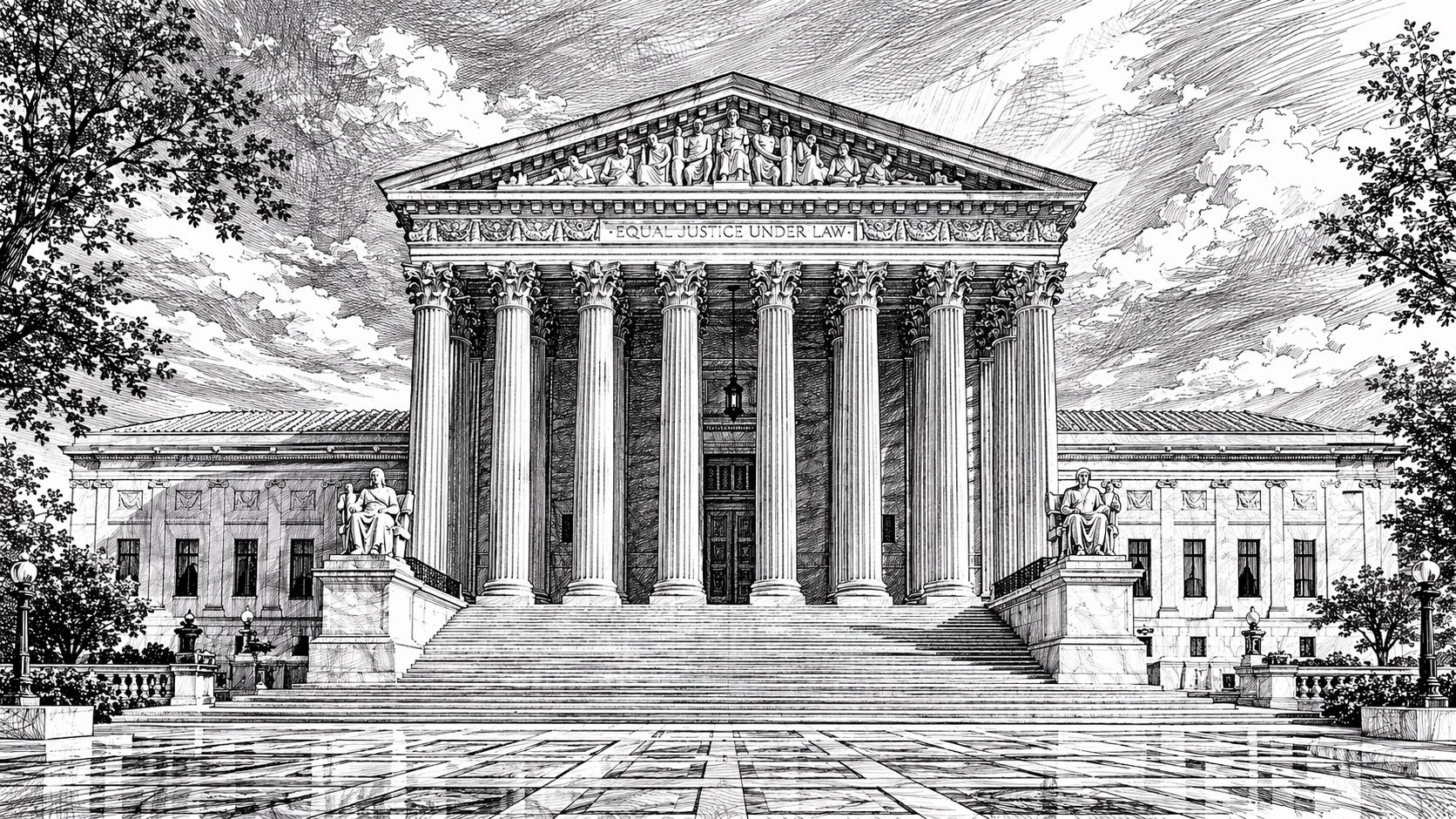
Forty years in courtrooms. Seventy jury trials. I know a cut corner when I see one.
The Supreme Court of the United States is running one. The New York Times has the documents to prove it.
This is not an abstract legal debate for law professors to chew on over bourbon. This lands on you. Your business. Your rights. Your vote. All of it sitting in the hands of nine people in black robes who stopped acting like careful judges and started acting like a rushed committee making snap calls behind closed doors.
You are about to learn what a shadow docket is. You are about to learn what it has cost this country. You are about to learn why the pattern of who keeps winning on this docket should have every American sitting up straight right now.
What the Shadow Docket Is
Let me explain in plain English. Forget the law school version.
The Supreme Court has two ways of deciding cases. The first is the one you see on television. Lawyers argue in front of the justices. The justices ask questions. Months later the court hands down a full written opinion with the reasoning laid out page by page. This process protects everyone. It forces the justices to show their work. It gives the losing side a roadmap for where the law now stands. It earns public trust in the outcome.
The second way is the shadow docket. No oral arguments. No briefing in the normal sense. Sometimes no meeting in person. Sometimes no real deliberation at all. The justices issue an order in a few sentences, often unsigned, usually with no explanation of why they ruled the way they did.
Originally the shadow docket stayed rare. Emergency stuff. A death row inmate needing a last minute stay. A state asking for an injunction before an election. Quick narrow moves.
Over the last decade the shadow docket stopped being rare. It became a way to decide some of the biggest questions in American law. Immigration policy. Environmental regulation. Voting rights. Presidential power.
The receipts show who benefits. The receipts also show how far from careful judging this court has drifted.
What the New York Times Found
The New York Times obtained internal Supreme Court documents pulling back the curtain on the birth of the modern shadow docket. Scholars mark the beginning at 2016. In 2016 the court killed President Obama’s signature environmental plan in a one page order with almost no reasoning.
For years the decision sat in a black box. Nobody outside the building knew how the justices got there. The public saw the outcome and nothing else. The leaked papers change everything.1
You learn Chief Justice Roberts, the man who sells himself in public as the patient institutionalist, pushed hard and fast to shut down the Obama plan. From the first memo he circulated, he already had the answer. He talked about the costs to the coal industry. He sounded irritated with the Obama administration. He drove the process forward in a matter of days over the court’s midwinter break.
You learn Justice Kagan pushed back. She told her colleagues the request had no precedent in the court’s history. She warned stopping the Obama plan at this stage would break new ground. She sent her warning around the conference table. The public learned nothing.
You learn through the papers that the process moved faster than any serious constitutional case should move. Days, not months. Memos over a holiday. Deliberation compressed to the point of absurdity.
You learn none of them seemed to grasp what they were building. They opened a door and walked through it. The door stayed open. Every administration since has learned to use it.
This is the origin story. A rushed decision, made in days, with no public reasoning, reshaping how the highest court in the country operates.
The Job Is to Get It Right, Not to Get It Done Fast
Here is something I have said to young lawyers for four decades. Care, details and accuracy matter more than speed in a courtroom. Every single time.
The Supreme Court exists for one reason. To get the hard questions right. Nine justices. Life tenure. A marble building designed to feel timeless. A confirmation process forcing months of vetting. Everything about the structure exists to pull the court away from the daily pressure to hurry.
Hurry is how you get bad law. Hurry is how a small procedural ruling becomes a precedent warping decades of policy. Hurry is how judges skip the briefing. Hurry is how judges skip the written opinion telling the country why the law now reads this way. Hurry is how a case gets decided by vibes rather than reasoning.
You run a business. You know the difference between a fast decision and a good one. You know what happens when you skip due diligence. You lose money. You lose trust. You lose credibility. You lose the customers who built the business with you.
The Supreme Court is doing the judicial version of this. The cost lands on you, your family, and every business depending on a stable legal environment to operate in.
A court issuing rulings in days with no written reasoning stopped doing law. Something else took over. Call it crisis management. Call it political triage. Real judging looks different.
Politics Have No Business on the Bench
Let me be straight with you about something bothering me as a lawyer.
Every justice on the court took an oath to apply the law without regard to personal preferences. The oath is the load bearing pillar of the whole system. Treating it as decorative sets the pillar on fire.
When a justice lets policy views drive the ruling, the system breaks. The law stops being the law. The law becomes the opinion of whoever happens to be on the bench this week.
The leaked memos raise a hard question. Whether Chief Justice Roberts read the Clean Power Plan case on the merits. Or started from a conclusion he liked and worked backward. His language in those memos, the irritation, the concern about industry costs, the push to move fast, the timeline compressed to days, reads more like a policy debate than a legal analysis.
You are allowed to ask the question. You are allowed to demand an answer.
Judicial impartiality is a professional standard with enforceable meaning. I have seen appellate courts reverse trial judges for less. When a Supreme Court justice treats a case like a policy argument, the damage runs deeper than any single ruling. It teaches the country the law is whatever the winning coalition says it is.
The Duck Test
Now for the part getting Congress off its chair.
Look at who has been winning on the shadow docket over the past several years. A pattern jumps out. The Trump administration, across both terms, pulled in a historic number of shadow docket wins. The court granted emergency applications. Froze lower court rulings. Blessed policy changes with one paragraph orders. Skipped oral argument.2
I have practiced long enough to recognize a pattern when I see one. You have run a business long enough to recognize one too. When one side keeps winning under one set of rules, and loses or sees delays under another, the rules are the story.
Show the data. Release the records. Let the public see it.
If the shadow docket produces one set of results for one president and a different set for another, the problem sits squarely within Congressional authority to examine. The Senate Judiciary Committee exists for this reason. The House Judiciary Committee exists for this reason. Oversight of the federal courts sits at the foundation of Article I power. Oversight is a basic function of the branch writing the laws the court is supposed to interpret.
If it walks like a duck and quacks like a duck, Congress owes the country an honest look at whether it is, in fact, a duck.
Perhaps there is an innocent explanation. Perhaps the timing of emergency applications favored one administration through pure coincidence. Perhaps the cases themselves drove the outcomes.
Perhaps something else.
You deserve to know. Public reasoning is the whole point of a judiciary operating in a democracy.
What You Do With This
Here is what I want you to walk away with.
The shadow docket is real. The shadow docket decides issues affecting your taxes, your business, your health care, your speech, your vote. It operates with almost no public explanation. It moved from a rarely used procedural tool to a main driver of American law in under a decade. The New York Times now has documents showing it came into existence in a rush, over a holiday, with less care than most of your business contracts get.
You have more influence on this than you think.
Call your senators. Ask them where they stand on shadow docket transparency. Ask them whether the Senate Judiciary Committee is looking at the pattern of rulings during the Trump terms. Ask them whether they support legislation requiring the Supreme Court to publish written reasoning for every shadow docket order changing the law. Ask them to explain what they plan to do with the information.
Remember, they work for you, not the other way around.
Share this piece. Share the reporting. Thank the reporters doing the work. Do not let this story die because of the daily noise and time passing.
Secret rulings in a democracy contradict the idea of a democracy. The court owes the country its reasoning. The country owes itself the oversight.
The shadow holds its grip only as long as you agree to look away.
Stop looking away.
Mitch Jackson, Esq.
“The Inside Story of Five Days That Remade the Supreme Court.” Secret memos obtained by The New York Times illuminate the origins of the court’s now-routine “shadow docket” rulings on presidential power [read here].
Between January 2001 and January 2017, spanning the full George W. Bush and Obama administrations combined, the federal government sought emergency relief from the Supreme Court only 8 times over those 16 years. The first Trump administration sought emergency relief 41 times. That is more than five times the combined total of the prior 16 years. In Trump’s second term, there were thirty requests for emergency relief filed between January 20, 2025, and November 6, 2025. Of the thirty requests filed by the second Trump Administration in that time period, twenty-four were granted. The Court has sided with the second Trump administration 80 percent of the time in these emergency rulings, often without revealing its reasoning. During Trump’s second term there has been an “astronomical” increase in emergency applications, and the Court’s shadow docket work has virtually eclipsed its merits docket work. See Brennan Center, Congressional Research Service, Harvard Law School, University of Chicago Law Review, and Wikipedia’s tracking of significant shadow docket decisions.
Fine essay, Mitch. 🫱🏻🫲🏽 Justice Ketanji Brown Jackson is pushing back.⚖️ https://www.politico.com/news/2026/04/15/ketanji-brown-jackson-supreme-court-emergency-docket-00873317