

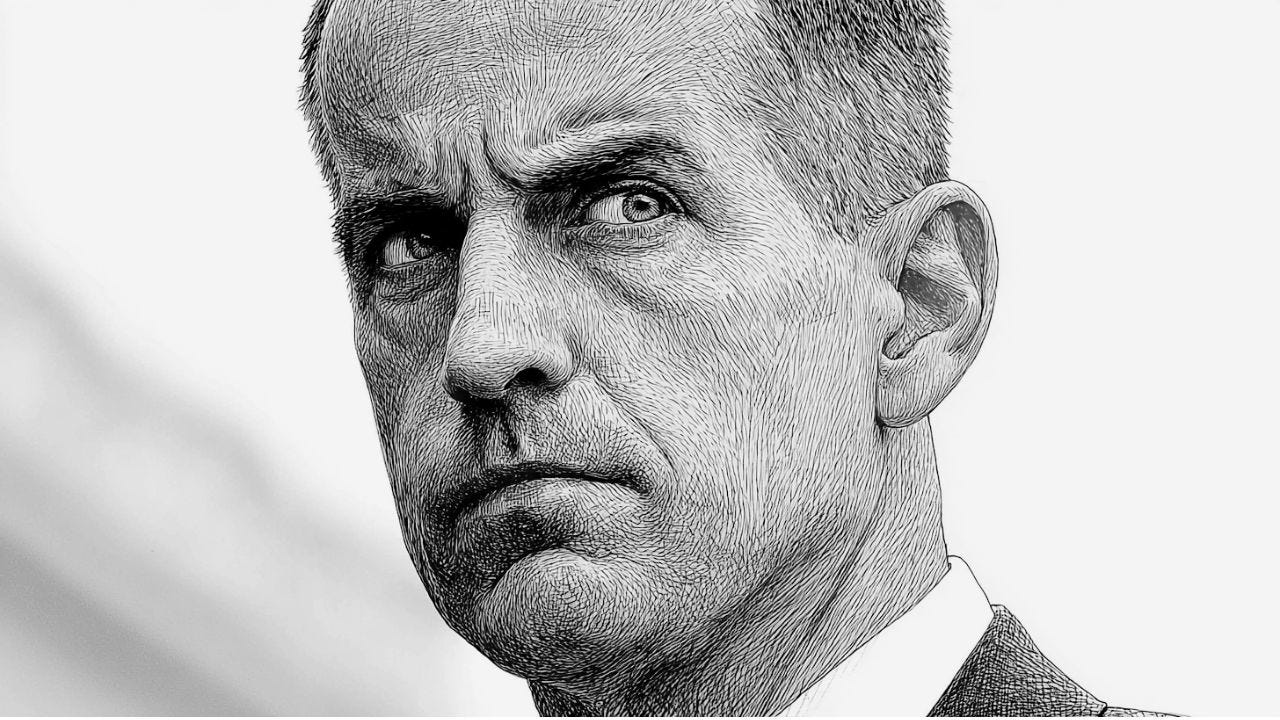
Four decades in courtrooms taught me how to spot a shakedown the second it walks through the door. NBC News reported one inside the Department of Homeland Security in March, and the wreckage is still piling up.
The man at the center of this story is Corey Lewandowski. First campaign manager for Trump’s 2016 run. Longtime Trump loyalist. He took an unpaid role at DHS in January 2025 as a special government employee. No Senate confirmation. No public financial disclosure. No accountability to voters.
Here’s what got me. Current DHS officials told NBC he operated as the de facto chief of staff to Secretary Kristi Noem. Staff inside the building referred to him as chief. He sat in on meetings and shaped decisions. Three DHS officials told NBC he held broad authority over which companies won contracts for detention, deportation, surveillance, and transportation. The machinery of the mass deportation agenda ran through his hands.
Noem had a policy requiring her approval on contracts over one hundred thousand dollars. She largely delegated those duties to Lewandowski, according to three DHS officials. Billions in federal dollars funneled through one unelected advisor.
The GEO Group Story
I have litigated and tried many cases to verdict. I know the difference between a clean paper trail and a dirty one. This one is dirty. It smells.
GEO Group runs the largest network of immigration detention facilities in the country. Federal contracts already brought the company more than one billion dollars a year. With deportations ramping up, GEO Group stood to win billions more.
GEO Group founder George Zoley met with Lewandowski during the presidential transition, before Lewandowski held any government role. Sources told NBC Lewandowski said he wanted personal payment in exchange for protecting and growing GEO Group’s DHS contracts.
Zoley refused.
The two met again in March 2025. This time Zoley offered to put Lewandowski on a consulting retainer with the company. Sources told NBC Lewandowski turned down the retainer and countered with a different demand. He wanted payments tied to each new contract GEO Group won. A success fee, in plain English.
Zoley refused a second time.
In the months after, the length of two GEO Group contracts shrank. Facilities capable of housing migrants sat idle, even as Congress poured money into DHS to accelerate deportations. Sources familiar with GEO Group’s thinking told NBC the company believes those reductions tied directly to its refusal to pay.
Lewandowski flatly denies the allegations through his spokesperson and says he never demanded payment from GEO Group. He also told NBC he received zero dollars from any DHS contract he signed off on. His denials belong in the public record.
One complication worth naming. GEO Group did win a new one hundred twenty one million dollar contract in December 2025 to help locate specific immigrants. The contracting story is not as simple as a pure freeze-out.
California Congressman Mike Levin agrees:
The Second Company
NBC’s reporting names a second firm. Salus Worldwide Solutions. A company run by a donor to Stephen Miller’s America First Policy Institute. In May 2025, Salus won a roughly one billion dollar DHS deportation-related contract.
NBC reported a Salus representative contacted a marketing firm about a twenty million dollar subcontract. On a September call, the Salus rep told the firm owner the deal was guaranteed with one requirement: hire a consultant tied to Lewandowski to handle the relationship. The marketing firm owner ended the call in alarm and walked away.
A lawyer for Salus denied the account entirely and said the company would never engage in such an arrangement.
The White House Knew
The complaints did not stay quiet. NBC reported GEO Group and several other contractors took their concerns to officials in Trump’s inner circle. Four senior White House officials, one former White House official, and one person familiar with the conversations confirmed the complaints to NBC.
One senior White House official told NBC they personally fielded a dozen complaints from at least four different companies. Another senior official raised the issue with Trump during an October 2025 meeting. The conversation ended early, cut short by other business.
A senior White House official acknowledged the situation to NBC in one sentence I want you to sit with. “We are aware of the allegations of pay to play.”
Aware. And for months, nothing happened.
Three sources familiar with West Wing thinking told NBC aides held back in part because they feared Trump would defend Lewandowski.
What the Law Says
Federal law speaks directly to this conduct. Under Title 18 Section 201 of the United States Code, it is a felony for a public official to corruptly demand anything of value in exchange for being influenced in an official act. The penalty reaches fifteen years in federal prison and disqualification from any future federal office.1
Jessica Tillipman, associate dean for government procurement law studies at George Washington University, told NBC the arrangement raises serious red flags under federal procurement integrity rules. She is one of the most respected voices in government contracting ethics in the country.
What Has Happened Since
Accountability has started moving.
Trump fired Noem on March 5, 2026, effective March 31. Senator Markwayne Mullin of Oklahoma replaced her as DHS Secretary. Noem moved to a new post as Special Envoy for The Shield of the Americas. Her handling of contracts and her role in the two hundred twenty million dollar DHS advertising campaign featuring her prominently drove the firing.
DHS has since confirmed to Reuters Lewandowski no longer holds a role at the department.
The DHS Office of the Inspector General launched a formal investigation into how contracts were handled under Noem and Lewandowski. Investigators ordered dozens of DHS officials to preserve records.
House Oversight Democrats, led by Ranking Member Robert Garcia, demanded records from GEO Group and Salus Worldwide Solutions. Senators Adam Schiff, Peter Welch, and Richard Blumenthal asked both companies to preserve their communications with Lewandowski. Trump himself has reportedly asked aides whether Lewandowski profited personally from the advertising campaign.
What You Do Right Now
You share this story. You make sure your neighbors know the name Corey Lewandowski. You call your senators and your House member and demand the inspector general investigation and congressional probes produce full public findings and meaningful consequences. You write down the names of every official who admitted awareness and did nothing, because those names belong in the public record forever.
Corruption dies in daylight. You are the daylight.
I will keep bringing you these stories, one by one, until this administration answers for what it has done.
Mitch Jackson, Esq.
Section 201 of Title 18 is entitled “Bribery of public officials and witnesses.” The statute comprises two distinct offenses, however, and in common parlance only the first of these is true “bribery.”
The first offense, codified in section 201(b), prohibits the giving or accepting of anything of value to or by a public official, if the thing is given “with intent to influence” an official act, or if it is received by the official “in return for being influenced.”
The second offense, codified in section 201(c), concerns what are commonly known as “gratuities,” although that word does not appear anywhere in the statute. Section 201(c) prohibits that same public official from accepting the same thing of value, if he does so “for or because of” any official act, and prohibits anyone from giving any such thing to him for such a reason.
The specific subsections of the statute are:
Bribery
a. § 201(b)(1): offering a bribe to a public official
b. § 201(b)(2): acceptance of a bribe by a public official
Gratuities
a. § 201(c)(1)(A): offering a gratuity to a public official
b. § 201(c)(1)(B): acceptance of a gratuity by a public official.
The two offenses differ in several respects. The most important of these differences concerns how close a connection there is between the giving (or receiving) of the thing of value, on the one hand, and the doing of the official act, on the other. If the connection is causally direct - if money was given essentially to purchase or ensure an official act, as a “quid pro quo” then the crime is bribery. If the connection is looser - if money was given after the fact, as “thanks” for an act but not in exchange for it, or if it was given with a nonspecific intent to “curry favor” with the public official to whom it was given -then it is a gratuity. The distinction is sometimes hard to see, but the statute makes it critical: a § 201(b) “bribe” conviction is punishable by up to 15 years in prison, while a § 201(c) “gratuity” conviction permits only a maximum 2-year sentence. In addition, with a “bribe” the payment may go to anyone or to anything and may include campaign contributions, while with a “gratuity” the payment must inure to the personal benefit of the public official and cannot include campaign contributions.