

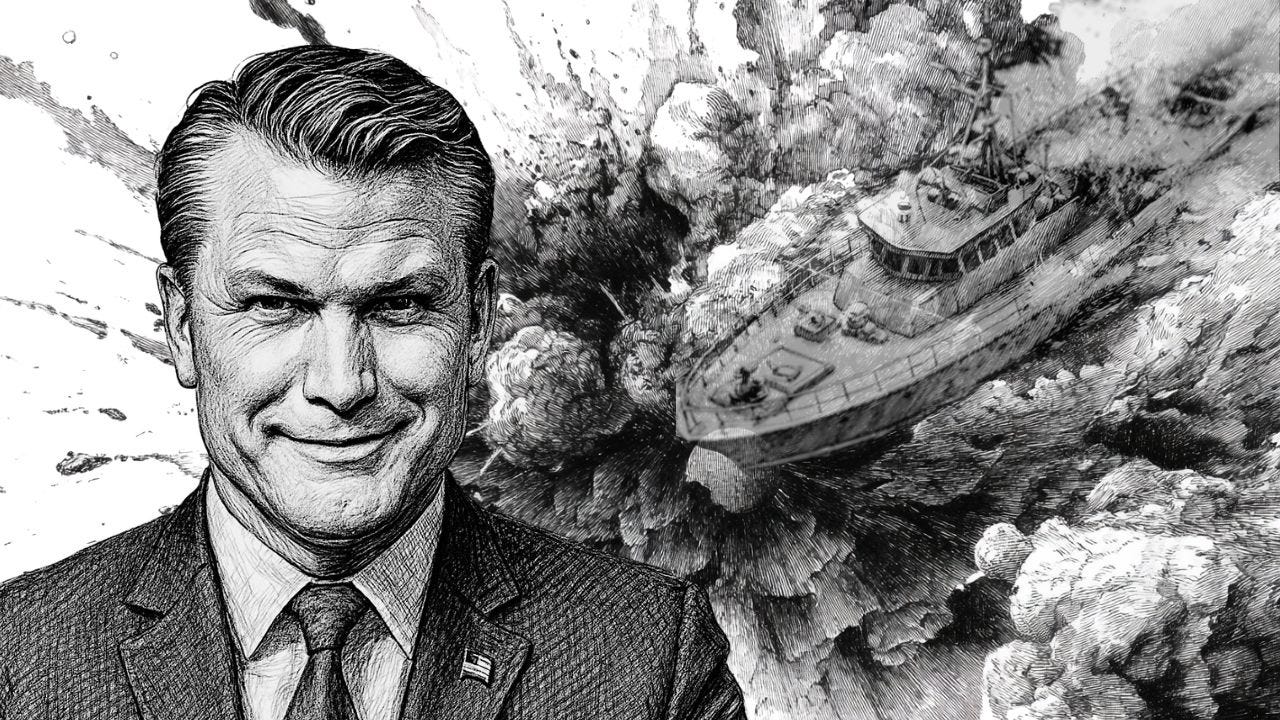
This is a hard truth. If the recent reports about Pete Hegseth and the boat-strike campaign under Donald J. Trump are accurate, America has crossed a terrifying line. What follows is a clear description of what is alleged to have happened, why these actions amount to war crimes under both U.S. and international law, and why you should demand accountability now. At the end I’ve included a chart of crimes and penalties.
INTRODUCTION
What if I told you the U.S. military may have executed defenseless people in the Caribbean, under orders that echo some of history’s darkest moments in war. Many Americans have no idea this might be true. You will soon learn what’s at stake for our laws, our morals, and our democracy. I bring decades of courtroom, mediation, estate-planning and public-policy experience. I’ve seen how the law protects people. I write because what is being reported, a “kill them all” directive, is not only illegal, it’s un-American.
WHAT HAPPENED
Since early September 2025 the U.S. military has carried out repeated strikes on small vessels in the Caribbean Sea and eastern Pacific Ocean. The government claims these boats belonged to drug traffickers or “narco-terrorists.” The campaign, now known as Operation Southern Spear, has reportedly struck at least 22 vessels, resulting in more than 80 deaths. Only two people from the targeted vessels have survived and been repatriated. The rest died, including in at least one follow-up strike aimed at survivors clinging to wreckage.
Public reporting based on inside accounts alleges that on September 2, after the first strike failed to kill all aboard, Hegseth issued a verbal order to “kill everybody.” That second strike reportedly eliminated survivors, people already hors de combat after the initial missile strike.
Update (Monday afternoon ET after this article dropped)
If you are hearing this for the first time it may seem unfathomable coming from a U.S. administration. That reaction matters.
WHY THIS MAYBE A WAR CRIME
International humanitarian law and U.S. law draw a clear, bright line between legitimate military action and atrocity.
Under the laws that govern armed conflict the wounded, shipwrecked, incapacitated or surrendered must be spared and given protection. Ordering that no survivors be taken crosses that legal line. The rule one must never issue a “no quarter” order exists precisely to forbid this kind of atrocity.
If the reported facts are true the “kill them all” order amounts to willful killing of persons hors de combat. That is a war crime under both international treaties and U.S. statutory law including the War Crimes Act of 1996. U.S. service members who carried out the order become criminally liable under domestic murder statutes and the Uniform Code of Military Justice if they obeyed what was plainly an illegal command. Military personnel are trained to refuse manifestly unlawful orders.
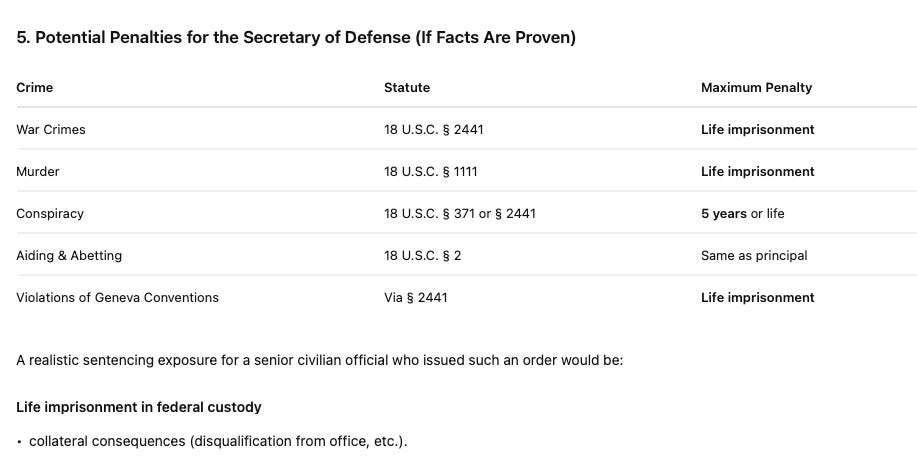
The official who issued the order, in this case, Pete Hegseth, the Secretary of Defense, also becomes criminally liable. Under U.S. law he can be treated as a principal in the crime. That means life imprisonment is a realistic statutory sanction if guilt is proven.
WHAT’S CLEARLY UNKNOWN
Supporters of the strikes assert the targeted boats were trafficking narcotics. Yet the government has not publicly provided convincing evidence that those vessels carried drugs or posed an imminent threat. Observers note that the majority of fentanyl and illicit drugs entering U.S. markets come via Mexico, not via Caribbean sea-routes. Videos released of strikes show destroyed boats but no seized drugs.
Even if drugs were aboard, drug smuggling is not a death-penalty offense under U.S. law. The use of lethal force without due process against people at sea far from non-military conflict casts grave doubt on the legality and moral justification for this policy.
WHY THIS MATTERS FOR AMERICA
When we discard the rule of law we break the very foundations of our democracy and our moral claim to defend human rights and dignity.
If the U.S. government executes people without trial, without rescue, without mercy, then we become what we once condemned. That act stains our flag, our institutions, our honor. It sends a message: the executive can treat foreigners, even suspects, as disposable. That kind of power without accountability erodes global trust in U.S. leadership and domestic trust in the rule of law.
Accountability must start now. Congress needs to investigate publicly and thoroughly. The Department of Justice and military prosecutors need to examine evidence and bring charges if warranted.
You should care about this because you, as an American voter and citizen, deserve a government bound by law and by humanity.
WHAT YOU CAN DO
Demand transparency. Urge your representatives in Congress to support oversight hearings and full disclosure of legal memos and internal communications that justified these strikes. Raise your voice. Talk about this with friends, neighbors, colleagues. Tell them we must not sacrifice justice for expediency.
If we remain silent then we lose the right to claim moral leadership in the world. Then we give permission for more of the same under the next crisis.
I speak to you not just as a trial lawyer with decades of experience, not just as someone who writes to educate people about the truth behind breaking political news, law, and justice. I speak to you as a citizen who fears what happens when we surrender our values.
This moment is a fork in the road. We can demand accountability. We can insist our leaders answer for what they do in our name. We can reclaim our country’s honor.
If you agree act. Tell your representatives to open serious investigations. Share this. Let others know what is happening. Let this outrage become action.
Mitch Jackson, Esq.
Our Internal Law Firm Research Memo
There’s a ton of detail in this analysis, and cramming all of it into the main article would bury the message you need to hear. Instead of overwhelming you, I’m pulling back the curtain and sharing exactly what we uncovered during our research so you can see the full picture for yourself.
Below is a fully expanded, fact-checked legal analysis. It incorporates U.S. criminal law, the Uniform Code of Military Justice (UCMJ), international humanitarian law, the Geneva Conventions, and customary law of armed conflict. It also outlines potential charges, statutes, penalties, and prosecutorial pathways if the facts reported are accurate.
Expanded Legal Analysis: Potential Crimes, Statutes, and Penalties
A report alleging that a U.S. Secretary of Defense issued a “kill them all” order directing forces to execute surviving, incapacitated individuals after an initial missile strike raises extremely serious legal issues. Under U.S. law, the Uniform Code of Military Justice, and international humanitarian law, such an order, if proven, amounts to a direct violation of multiple criminal statutes and is specifically prohibited by codified war crimes rules.
Below is a breakdown of the exact crimes this conduct could trigger, the relevant statutory and treaty provisions, and the potential legal exposure for both the official who issued the order and personnel who carried it out.
1. Possible Violations of International Humanitarian Law (Laws of Armed Conflict)
A.
Prohibition on “No Quarter” Orders
A “kill them all” directive is functionally a no quarter order, which is expressly prohibited under:
Geneva Convention I, Article 12
Protects the wounded and shipwrecked; prohibits violence against persons who are hors de combat (out of the fight).
Geneva Convention II, Article 12
Specifically protects shipwrecked members of armed forces and others at sea.
Additional Protocol I, Article 40 – “Quarter”
States: “It is prohibited to order that there shall be no survivors.”
Customary International Humanitarian Law, Rule 47
No quarter orders are universally prohibited.
B.
Protection of Shipwrecked Survivors
Geneva Convention II, Articles 12–18
Require rescuing and caring for shipwrecked or incapacitated individuals, even if they are enemy combatants or suspected criminals.
C.
War Crime Classification
Under the Rome Statute of the International Criminal Court:
Article 8(2)(a)(i) and (ii) – Willful killing and inhumane treatment of protected persons.
Article 8(2)(b)(xii) – Declaring that no quarter will be given.
Article 8(2)(b)(xvi) – Killing combatants who have surrendered or are hors de combat.
These are internationally recognized war crimes.
2. Possible Violations of U.S. Federal Criminal Law
The following domestic statutes would apply regardless of the victims’ nationality, because U.S. law criminalizes war crimes committed by U.S. nationals anywhere in the world.
A.
War Crimes Act of 1996 (18 U.S.C. § 2441)
This is the most direct statute.
Relevant provisions:
§ 2441(a): Makes it a federal crime for a U.S. national or service member to commit a war crime.
§ 2441(c)(1): Defines war crimes to include “grave breaches” of the Geneva Conventions—such as willful killing and unlawful targeting of shipwrecked persons.
§ 2441(c)(3): Includes intentionally targeting persons known to be hors de combat.
Penalty:
If the victim dies: Life imprisonment.
If death does not occur: Up to life imprisonment, depending on severity.
This would likely be the primary charge for a senior official who issued the order and any personnel who carried it out.
B.
Conspiracy to Commit War Crimes (18 U.S.C. § 371 or § 2441)
If multiple individuals planned, agreed to, or executed a prohibited attack, conspiracy charges could be added.
Penalty: Up to 5 years (for § 371), or the penalty of the underlying war crime (for § 2441 conspiracy).
C.
Murder or Manslaughter (18 U.S.C. §§ 1111–1112)
Unlawfully killing individuals in international waters can trigger general homicide statutes.
§ 1111 (murder): Penalty ranges from life imprisonment to death (death penalty unlikely for policy reasons).
§ 1112 (manslaughter): Up to 15 years.
D.
Extraterritorial Jurisdiction
These crimes are prosecutable even though they occurred in international waters under:
18 U.S.C. § 7(1) – Special maritime and territorial jurisdiction
18 U.S.C. § 3238 – Crimes committed outside the United States
3. Possible Violations of the Uniform Code of Military Justice (UCMJ)
Although a Secretary of Defense is a civilian political appointee, UCMJ applies to service members who carried out the order. It also applies to some civilians accompanying armed forces in certain circumstances, but prosecution of a cabinet official under UCMJ is legally uncertain and historically unprecedented.
Still, these provisions would apply to personnel who obeyed the order:
A.
Article 118 – Murder
Unlawful killing of noncombatants or persons who have surrendered.
Penalty: Up to life imprisonment.
B.
Article 119 – Manslaughter
Penalty: Up to 10 years.
C.
Article 92 – Failure to Obey a Lawful Order / Obeying an Unlawful Order
Military personnel are trained and required to refuse manifestly unlawful orders.
Penalty: Dishonorable discharge and up to 2 years, plus additional charges.
D.
Article 134 – General Article (Crimes and Offenses Not Capital)
Allows prosecution of war crimes and other federal offenses not explicitly covered elsewhere.
4. Responsibility of the Secretary of Defense
A civilian Secretary of Defense can be criminally liable. The law recognizes:
A.
Command Responsibility Doctrine
If a commander gives an unlawful order and forces under his or her authority commit crimes, the commander is liable.
Codified in:
International law (Geneva Conventions; customary law)
U.S. War Crimes Act (18 U.S.C. § 2441)
B.
Direct Liability
If he personally issued a “kill them all” order, he is a principal in the crime (18 U.S.C. § 2).
This carries the same penalty as the perpetrator.
C.
Possible Forums for Prosecution
U.S. Federal Court – Most likely.
International Criminal Court – Possible, though the U.S. is not a party; referral by UNSC is theoretically possible.
Foreign Universal Jurisdiction – Some nations may prosecute war crimes committed by foreign officials.
Congressional investigation – Leads to criminal referral.
Military investigation (DoD IG) – Would not itself prosecute but would provide evidence.
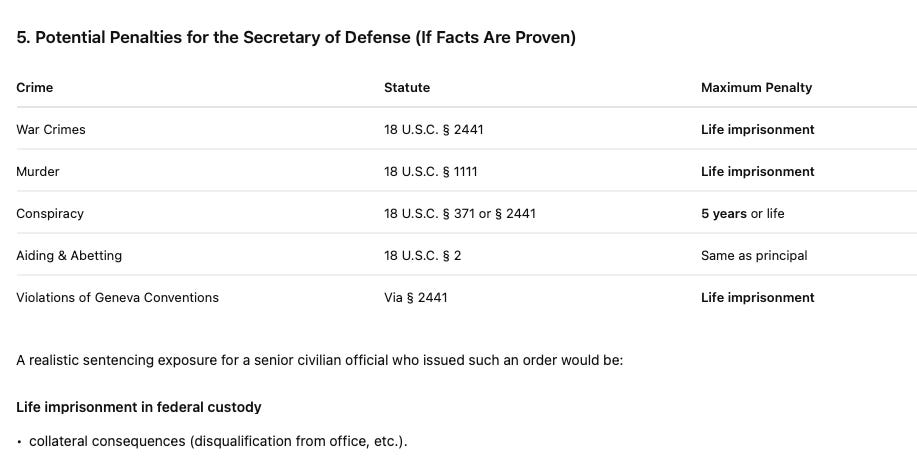
5. Potential Penalties for the Secretary of Defense (If Facts Are Proven)
6. Conclusion
If the reported facts are accurate, specifically that a U.S. Secretary of Defense ordered forces to kill shipwrecked survivors or prevent surrender, this conduct satisfies the core definition of a war crime under both U.S. statutory law and the Geneva Conventions. The War Crimes Act (18 U.S.C. § 2441) would be the central mechanism for prosecution and carries a maximum penalty of life imprisonment.
Military personnel who carried out the order would also face liability under the UCMJ and federal murder statutes unless they refused the unlawful command, which they are legally obligated to do.