

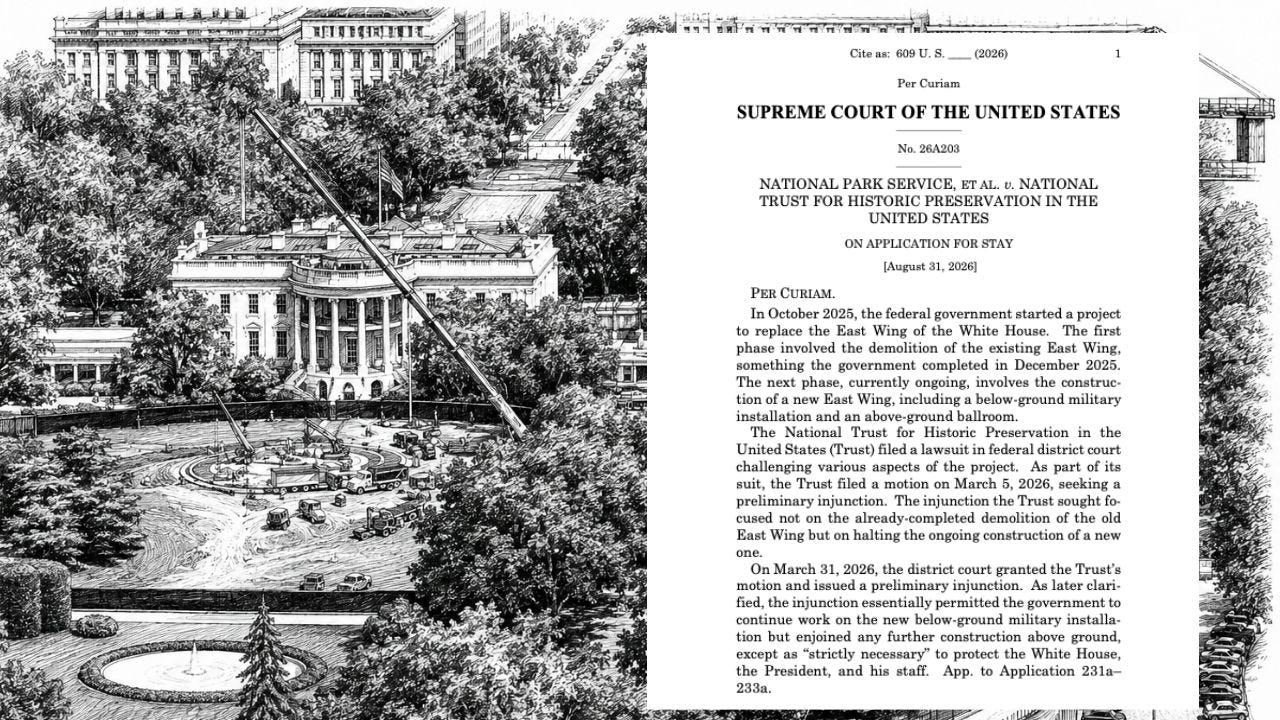
Five justices handed Trump a practical win this week on his White House ballroom, and they did it without ever deciding whether the project is legal. The vote was five to four. The Court said only that the government is likely to win the argument that the National Trust for Historic Preservation has no legal right to sue. Construction keeps rolling.
What the Court Did Monday
The order lets work continue on a 90,000 square foot luxury ballroom, the replacement for the East Wing that Trump tore down at the end of 2025, carrying a $400 million price tag the White House says private donors are covering, an assertion that has been widely disputed, with taxpayer dollars paying for the bunker and the security work underneath. The dispute turned on standing. Lower courts had found that the administration went past its authority by building without approval from Congress, and Monday’s unsigned order froze those rulings in place as the government prepares its formal appeal. The majority wrote in plain terms that it was not passing on the legality of the East Wing project.
The National Trust for Historic Preservation
The trust brought the case through Alison Hoagland, an architectural historian who lives in Washington and sits on the organization’s board of trustees. It’s a nonprofit chartered by Congress in 1949 that works to protect and preserve historic buildings, landmarks, and places across the country. Ms. Hoagland walks near the White House regularly, and she swore in a declaration that a ballroom of this form and scale would cause her professional, personal, aesthetic, and historical injuries, because a structure that overshadows the White House in height and mass strips the building of its primacy.
The majority said no. Offense at what your government does falls short of the concrete, particular injury the Constitution demands, the Court wrote, adding that nearly any government project offends somebody’s sensibilities. Standing is the ticket you need to get through the courthouse door. Hoagland, the majority decided, was not holding one.1
Roberts Broke With the Five
Roberts read the injury differently and I believe correctly. He leaned on the Court’s own environmental cases to do it. A preservationist suffers real harm when a historic building she frequently enjoys is transformed, he wrote, in the same concrete way an environmentalist suffers real harm from the extinction of a particular animal or the ruin of a particular river. He said Hoagland is no ordinary plaintiff and the White House is no ordinary building.
Then he answered the question the majority left alone, which is who controls changes to federal property in Washington. His answer was Congress. He wrote that the construction is likely unlawful because Congress has passed nothing resembling express authority for it. He warned that recasting a real aesthetic injury as mere offense will come back to haunt environmental cases, and he told his colleagues in writing that Monday was no victory for the separation of powers. He closed with Winston Churchill, who said that we shape our buildings and afterward our buildings shape us, and he reached for Theodore Roosevelt as well, insisting that the people deciding what to tear down and what to build up at the People’s House have to follow the rules. All three of the Court’s liberal justices signed his six page dissent.
How This Reached the Justices
The trust sued in December, a week after the demolition of the East Wing, which happened without the approval of Congress, was finished. On March 31, Senior U.S. District Judge Richard J. Leon ruled that Congress has to authorize the ballroom before it rises, and he carved out an exception for work needed to protect the president. In April he tightened that ruling after the administration tried to fold the entire project into the security exception, letting the underground bunker and the safety work proceed and refusing to let the ballroom itself go up. National security is no blank check for otherwise unlawful activity, he wrote. The administration appealed. On Aug. 7 a D.C. Circuit panel upheld him two to one, with Judges Patricia Millett and Bradley Garcia writing that whether a massive ballroom gets built is for Congress to decide, over a dissent from Judge Neomi Rao, who said the panel had elevated the displeasure of a single passerby above the president’s own security judgment. The panel gave the government fourteen days to reach the Supreme Court.
Security Became the Argument
Trump’s lawyers arrived with a practical case. Government filings put the project at 65 percent complete as of Aug. 24, with a 250 person crew working 20 hours a day, seven days a week, and the solicitor general warned that stopping now would imperil the president and leave a large hole beside the executive residence. The scope had grown, and Trump began calling the site the Ballroom Military Complex, a name covering the replacement of the Presidential Emergency Operations Center, the World War II era bunker below. The majority never said those security claims carried the day. The Court gave no detail. It found that the remaining stay factors favored the government and left the reasoning there.
Roberts had already acted alone on Aug. 21, issuing an administrative stay with no reasoning and no vote count attached, a placeholder to hold things in place as his colleagues studied the request.
Where This Leaves You
The president and CEO of the National Trust for Historic Preservation, called the outcome deeply disappointing and pointed out that the majority never weighed in on whether the ballroom is legal. He said the decision settles nothing on the merits, and his organization keeps pressing the argument that every president serves as a temporary steward of the People’s House who lacks unilateral authority to demolish and redesign it without Congress.
I want my community to know that this case is alive in the lower courts. The stay holds as the government asks the Supreme Court to take the case in full, and the practical math has shifted, because concrete that hardens today becomes tomorrow’s argument that the building has gone too far to stop. Congress has its own route into court, and with Republicans holding both chambers through the November midterms, a challenge from this Congress is a political nonstarter. The construction crews will finish before the lawyers finish and so for all practical purposes, the building will probably be completed despite never getting approval from Congress.
When all is said and done, keep the holding straight when someone tells you the Supreme Court blessed this ballroom, because it did no such thing: two lower courts found that the president acted without the authority only Congress hands out, and four justices including the Chief called the work likely unlawful. Despite this, the construction rolls on because five justices decided this particular challenger likely reached the courthouse door without the right kind of injury, which leaves the People’s House in the hands of whoever pours concrete fastest.
Congress had its chance the moment the first brick came off the East Wing. It said nothing, the same way it says nothing every time Trump breaks the law, and here we are.
Mitch Jackson, Esq.
Subscribe to Uncensored Objection and I will keep reading the orders the majority hoped you would skip, so you know the difference between a court blessing a project and a court closing a door. Free gets you select pieces, paid keeps the reporting independent, and both of them put another set of eyes on what the concrete crews finish while the lawyers argue.
Some members of SCOTUS remain firmly in their Trump Trance. I am disgusted that a ballroom of Ego is even considered by SCOTUS. #WarCriminalTrump
I hope the next elected president tears down the building! I'd gladly pitch in and contribute $$ for that. The only thing Trump should have his name on is a prison where he gets locked up.