

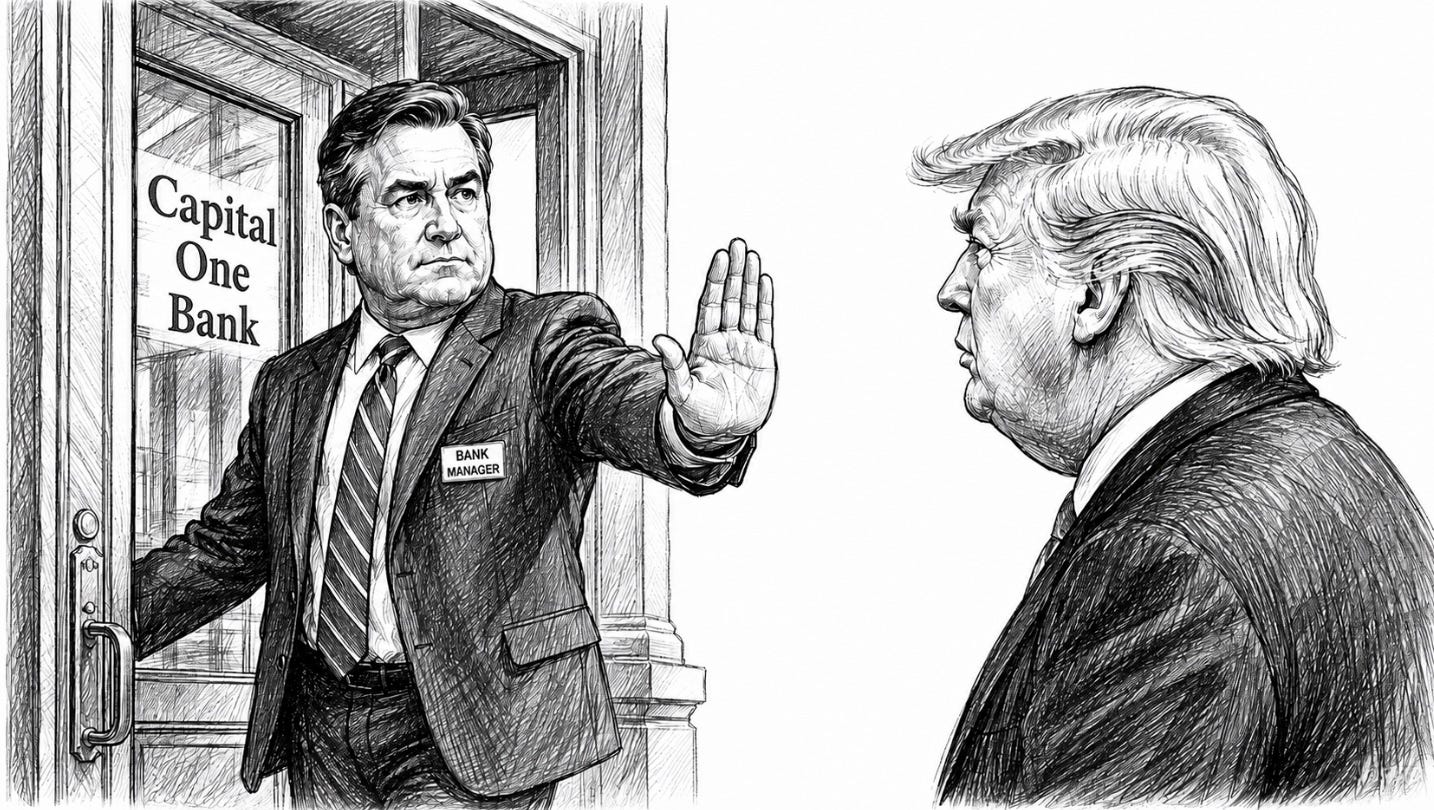
In a July 31, 2026 motion to dismiss filed in federal court in Miami, Capital One told a judge it closed more than 300 Trump-affiliated accounts in 2021 “for anti-money laundering (’AML’) reasons,” after “months of analysis and a careful review” by its AML team. Reuters called it the first time a bank has formally tied money-laundering concerns to President Donald Trump’s family business.
The disclosure surfaced only because the Trump Organization sued. Capital One says federal bank-secrecy law would otherwise have barred it from revealing those findings, and that the reason went public only because the plaintiffs chose to litigate. No leak. No whistleblower. The Trump family and businesses pulled the truth out themselves with this lawsuit, and now they own it.
Key Findings
Late on Friday, July 31, 2026, Capital One filed a 23-page motion to dismiss the Second Amended Complaint in The Donald J. Trump Revocable Trust v. Capital One, N.A., No. 1:25-cv-21596 (RKA), in the U.S. District Court for the Southern District of Florida, before Judge Roy K. Altman. The pivotal passage:
”the plaintiffs’ own allegations make clear that Capital One closed Plaintiffs’ accounts for anti-money laundering (’AML’) reasons,” and “the closures were the result of months of analysis and a careful review by Capital One’s AML team in accordance with bank policies and regulatory guidance.”
The review ran through Capital One’s financial-crimes team, which the bank describes as staffed by employees with “decades of law enforcement experience.” The plaintiffs, it argues, “cannot meaningfully criticize the robust process” that team followed, because “the transaction patterns identified by Capital One are among the types of activity flagged by federal banking guidance.”
Capital One says it had no duty to explain the closures, and that federal law would have forbidden it anyway. Under the Bank Secrecy Act’s anti-”tipping-off” rule (31 U.S.C. § 5318(g)(2)) and the SAR-confidentiality regulations, a bank generally cannot reveal that it flagged a customer as suspicious. That is why closure letters give no reason. Capital One says it never publicized the termination, gave the plaintiffs months and multiple extensions to find new banking, and disclosed the AML rationale only because they were sued.
