

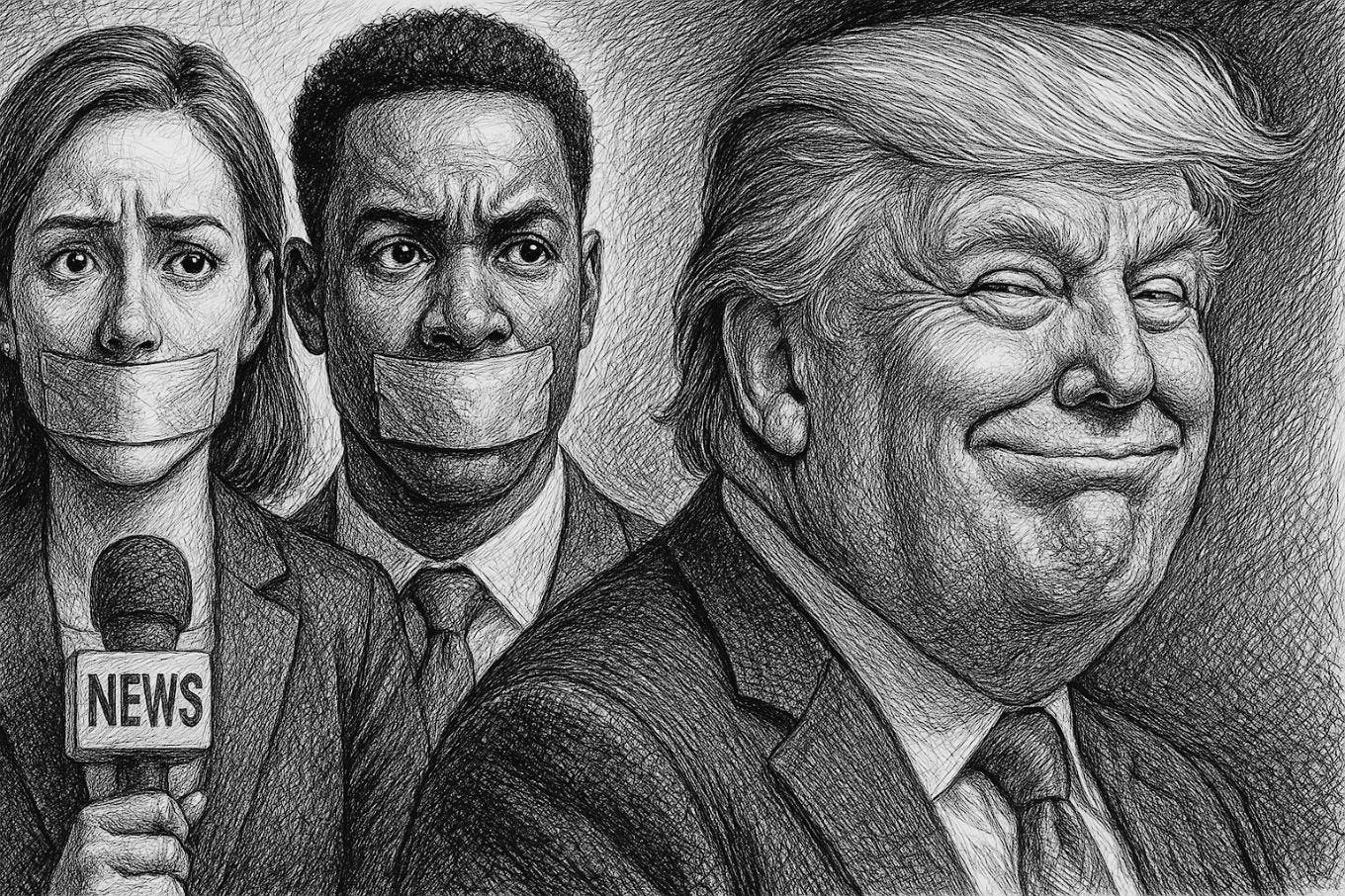
On May 1, 2025, Donald Trump did what cowards do when they fear the truth: he signed an executive order to shut it up.
He called it “Ending Taxpayer Subsidization of Biased Media.” Cute name for what is, in reality, a political hit job.
With a single stroke, he ordered every federal agency, and the supposedly independent Corporation for Public Broadcasting, to cut off funding to PBS (Public Broadcasting Service) and NPR (National Public Radio).
Why? Because they won’t play his game. Because they won’t lie for him.
And now, CPB has until June 30 to rewrite its grant rules to fit Trump’s narrative—or else.
Why This Happened
The underlying reason Trump is trying to control or dictate the news narrative is power, specifically, the power to shape perception, control public opinion, and eliminate accountability.
Here’s a deeper breakdown:
1. Authoritarian Playbook 101: Discredit Independent Media
Trump has long labeled mainstream media outlets as “fake news” or “the enemy of the people”—classic authoritarian rhetoric designed to erode public trust in independent journalism. This is all about delegitimizing truth itself unless it serves his interests.
2. Control the Narrative = Control the People
Trump understands that if you control what people hear, you control how they think. He favors outlets like Fox News, OANN, and Truth Social because they echo his messaging without scrutiny. Public broadcasters like PBS and NPR, which are legally bound to objectivity, are a threat to that control.
3. Silencing Critics Before the 2026 and 2028 Elections
By targeting media that report facts critically, especially around January 6, his criminal indictments, or policy failures, he aims to remove watchdogs just as he ramps up his campaign. It’s a preemptive strike to soften the battlefield before voters head to the polls.
4. Revenge and Resentment
Trump operates from grievance. Media outlets that exposed his lies, incompetence, or corruption have long been targets of his wrath. Defunding them is not just strategic—it’s personal.
5. Distract, Divide, and Conquer
When the press is under attack, attention is diverted from other serious issues: ethics violations, judicial overreach, corporate favoritism. It also rallies his base around a shared enemy—“elitist media”—while fragmenting the information ecosystem.
In sum: Trump wants to dominate the narrative because the truth is dangerous, to him. A free press challenges unchecked power. And for a man whose political survival depends on illusion, distraction, and division, that’s unacceptable.
These Are Objective and Reputable News Sources
PBS and NPR are generally considered objective and reputable sources of news by media analysts, journalism scholars, and fact-checking organizations.
1. Reputation and Ratings
Media Bias/Fact Check rates PBS and NPR as “least biased” and “highly factual.”
Ad Fontes Media, which uses a multi-partisan panel, places both in the “reliable and unbiased” quadrant of its Media Bias Chart.
Reuters Institute surveys consistently show high trust in PBS and NPR, especially compared to other U.S. outlets.
2. Funding and Governance
They receive some federal funding via the Corporation for Public Broadcasting, but most of their budgets come from viewer donations, sponsorships, and member stations.
Their governance structure is designed to maintain editorial independence.
3. Criticism
Right-wing commentators and politicians, including Trump, often accuse PBS and NPR of liberal bias, particularly when covering topics like climate change, race, or government accountability.
However, those claims are not substantiated by consistent evidence of factual inaccuracy or partisan reporting.
4. Professional Standards
Both organizations adhere to journalistic ethics, maintain public ombudsmen, and issue corrections transparently.
Bottom line: PBS and NPR are widely respected for their journalism and are not “biased media” by credible, independent standards. Accusations of bias tend to be politically motivated rather than based on objective media analysis.
Is This Legal?
Trump’s executive move to defund PBS and NPR is not only legally dubious under the Constitution’s Congressional power of the purse and the Impoundment Control Act, but also violates the independence of the Corporation for Public Broadcasting and likely infringes on the First Amendment by retaliating against press organizations for unfavorable coverage.
Legal Concerns
Congressional Control of Federal Funding: The U.S. Constitution grants Congress the power of the purse, meaning that only Congress can appropriate federal funds. The Impoundment Control Act of 1974 prohibits the president from unilaterally withholding or rescinding funds that Congress has already allocated. Therefore, an executive order directing the cessation of funding to PBS and NPR may conflict with this statute.
Independence of the Corporation for Public Broadcasting (CPB): The CPB is a private, nonprofit corporation established by Congress through the Public Broadcasting Act of 1967. This act explicitly states that CPB operates independently and is not subject to direction, supervision, or control by any federal agency or officer. Consequently, the president's authority to direct CPB's funding decisions is legally questionable.
First Amendment Implications: Critics argue that targeting PBS and NPR for alleged bias and attempting to cut their funding could be viewed as government retaliation against media organizations for their editorial content. Such actions may raise First Amendment concerns, as they could be seen as infringing upon freedom of the press.
Responses and Legal Actions
PBS and NPR have publicly condemned the executive order, labeling it as "blatantly unlawful." They have indicated intentions to challenge the order through legal avenues to protect their funding and editorial independence.
The CPB has also rejected the executive order, emphasizing its status as an independent entity not subject to presidential directives. It has initiated legal action against the Trump administration, particularly in response to attempts to remove CPB board members, which the CPB argues exceeds presidential authority.
Conclusion: Why This Isn’t Just About PBS or NPR
This was never about budget. It was never about bias.
It’s about control.
Trump’s executive order isn’t some policy tweak, it’s a smoke signal from the authoritarian playbook. Discredit the press. Control the story. Silence the critics. Punish the ones who told the truth.
He’s not trying to lead a country. He’s trying to manage a brand. One that collapses the minute facts are allowed to speak freely.
PBS and NPR are just the first targets. He’s softening the ground before the next election—scrubbing away the watchdogs who might bark too loudly.
And all the while, he distracts, divides, and points fingers at anyone who won’t play along.
Because when you run on resentment and fear, truth becomes the biggest threat of all.
This isn’t media reform. It’s a warning shot. And we’d be fools not to hear it.
Mitch Jackson, Esq. | links
The Conversation Doesn’t End Here. It Gets Smarter.
My AI remembers every article, every fact, and every hot take. So if you’re still thinking about what you just read, talk to it. It’s your 24/7 wingman for breaking news, bold opinions, and deeper truth.

This post is free.
But free doesn’t build the future.
Independent journalism only works when people like you choose to lean in—not just with attention, but with support.
If my work and message resonates with you,— today’s a great day to take the leap.
It’s also a unique gift to a family member or friend who is interested in this kind of commentary on breaking political news and democracy.
At just $5 a month. $50 a year. It’s a small investment in something bigger than all of us.

Excellent. Miller is playing Trump. Next step, courts! Thank you!
We're going to do a "Perkins Coie" on Trump and his admin! https://www.perkinscoiefacts.com/