

Updates at end of article.1
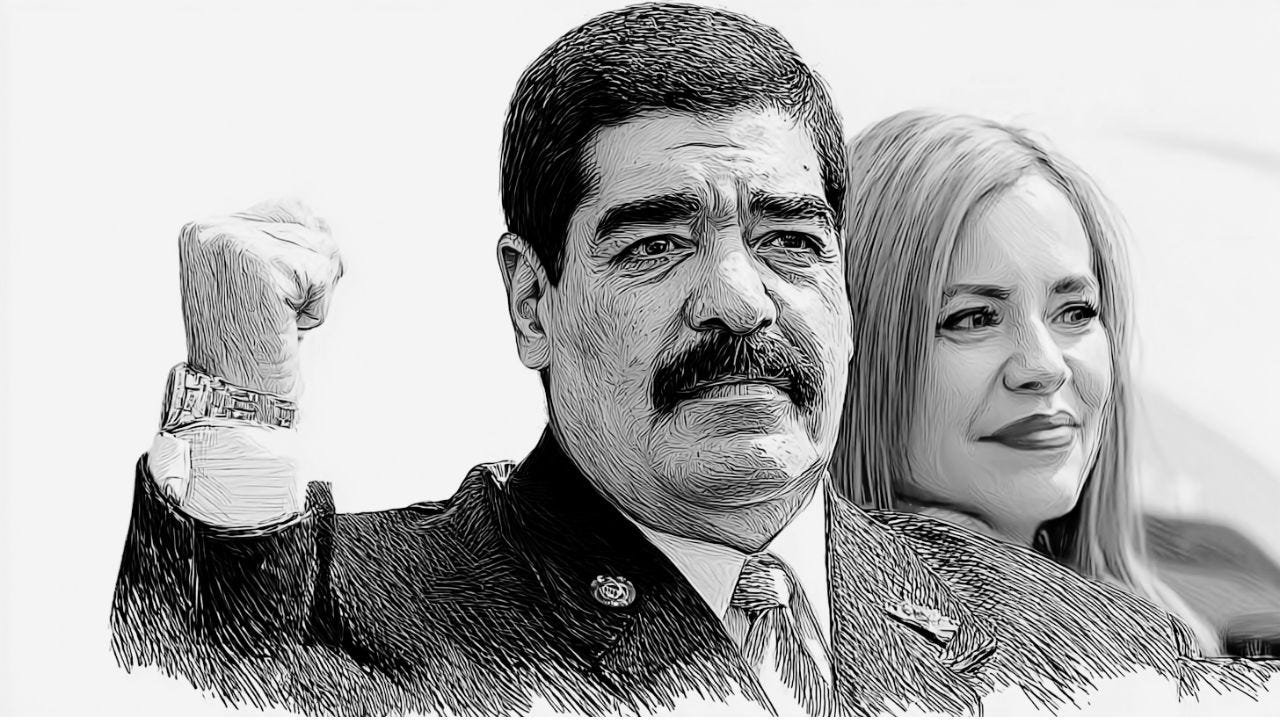
U.S. officials and administration statements report that American forces have taken Venezuelan President Nicolás Maduro, his wife, Cilia Flores, and others, into custody during a U.S. military operation inside Venezuela. According to those statements, these individuals are being transported to the United States to face federal criminal charges in New York.
The reported operation follows months of escalating U.S. military deployments, maritime interdictions, intelligence activity, and economic pressure aimed at Maduro’s removal. If confirmed, it would represent one of the most consequential U.S. actions in Latin America in decades.
What the U.S. Administration Says Happened
Trump said U.S. special operations forces carried out a coordinated strike inside Venezuela, secured Maduro and Flores, and transferred them to a U.S. naval vessel operating in the Caribbean. He said senior officials monitored the operation in real time and reported no confirmed American fatalities, though some injuries occurred.
U.S. officials say intelligence services tracked Maduro’s movements in the days leading up to the raid, with aerial surveillance playing a central role. Trump said he rejected last-minute outreach from Maduro seeking negotiations and ordered the operation to proceed.
Before the reported capture, the Pentagon had deployed thousands of U.S. troops, naval vessels, and air assets to the region. Officials described the buildup as part of a broader campaign that included maritime strikes and covert actions targeting drug trafficking networks.
Criminal Charges and Legal Claims
Attorney General Pam Bondi announced that Maduro and Flores face federal indictments in the Southern District of New York. Read it here.

It’s noted that there’s nothing in the indictment about American owned oil being stolen by Venezuela. I discuss this in more detail in the updates below.
According to indictment and public statements by the Attorney General, Nicolás Maduro is charged with narco-terrorism conspiracy, cocaine importation conspiracy, and weapons offenses involving machine guns and destructive devices, with Cilia Flores included in a related superseding indictment. These charges carry severe statutory penalties under federal law. Narco-terrorism and large-scale drug trafficking conspiracies are punishable by up to life imprisonment, with significant mandatory minimums. Weapons charges involving machine guns or destructive devices in connection with drug trafficking can also carry sentences of 30 years to life. Any actual sentence would be determined by a federal judge after conviction, based on the statutes, sentencing guidelines, and the evidence presented.
The indictments expand on earlier U.S. cases accusing Maduro of enabling or overseeing drug trafficking by senior Venezuelan officials. Some analysts have questioned whether those networks function as a centralized cartel or whether Maduro personally directs trafficking activity.
Administration officials argue that standing indictments provide legal grounds for Maduro’s arrest regardless of his position as head of state. Critics dispute that interpretation and have raised constitutional, statutory, and international law concerns.
Political Reaction Inside the United States
VP Vance publicly defended the operation, arguing that criminal indictments negate any immunity claims. President Trump dismissed objections from congressional Democrats who questioned the operation’s legality and the absence of explicit congressional authorization.
It’s important to know that if U.S. forces were introduced into hostilities or a situation where hostilities were likely, the Constitution assigns Congress the power to declare war, and the War Powers Resolution requires the president to consult with and report to Congress. I don’t know if this happened or not.
For now, it appears the administration appears to be relying on executive authority and existing criminal indictments rather than advance congressional authorization. Critics argue that a military action inside a sovereign nation to seize a foreign head of state, if it occurred, would go beyond routine law enforcement and implicate Article I of the Constitution and the War Powers Resolution, raising serious questions about congressional oversight, limits on executive power, and the precedent such unilateral action could set.
House Intelligence Committee leaders called for immediate briefings, stating that no evidence had been presented of an imminent threat justifying military action. Some lawmakers warned the move could destabilize the region and weaken international norms.
Response Inside Venezuela
Venezuelan state media reported explosions at military installations in Caracas and nearby areas following the operation. The government declared a state of emergency and accused the United States of violating Venezuelan sovereignty.
Senior officials appeared on state television calling for public mobilization and military unity. Authorities demanded proof that Maduro is alive and accused Washington of attempting to seize control of Venezuela’s resources.
Several high-ranking figures within the Maduro government, including senior military and political leaders, have not been reported detained. Their continued presence raises immediate questions about who now holds authority inside the country.
Conditions on the Ground
Reports from Caracas describe heavy military activity, damaged facilities, and a strong security presence near key installations. Armed pro-government civilian groups were seen guarding infrastructure and commercial areas.
Residents rushed to supermarkets and border crossings amid fears of instability. Venezuela has already experienced one of the largest migration crises in the world, and early signs suggest renewed displacement concerns.
International Reaction
China, Russia, and the United Nations criticized the reported U.S. action, warning it could violate international law and set a dangerous precedent. Russia expressed support for Venezuela’s government, while China condemned the use of force.
Some regional leaders welcomed the development, framing it as accountability for alleged criminal conduct. Others cautioned that the action could invite retaliation or justify similar interventions elsewhere.
Opposition and the Question of Power
The United States and several allies previously rejected the legitimacy of Venezuela’s most recent election. Opposition figures remain divided and largely outside the country. No transition plan has been announced.
U.S. officials signaled that additional actions against regime insiders could follow, depending on their response. Whether authority consolidates under Venezuela’s vice president, fractures among competing power centers, or shifts toward an interim arrangement remains unclear.
Broader Context
The reported operation follows an aggressive U.S. campaign combining military force, sanctions, and oil interdictions. While framed as a counter-narcotics effort, multiple analysts note that Venezuela is not a primary source of drugs entering the United States.
What Happens Next
If confirmed, Maduro’s presence in U.S. custody would trigger complex legal proceedings and significant geopolitical consequences. Immediate questions include verification, succession, regional stability, and whether this action escalates or concludes the current phase of U.S.–Venezuela confrontation.
The situation remains fluid. Independent confirmation and further details are still emerging.
Mitch Jackson, Esq.
Thanks for reading Uncensored Objection. Comment, share, and if you can upgrade to premium to keep this work strong, independent, and focused on protecting truth and facts.
UPDATES
Update (01-05-26):
We connect the dots between the Donroe Doctrine and a hostile takeover of Venezuela in our new article, “Maduro Was Not Arrested for Drugs. He Was Removed for Oil and the Money Trail Leads Straight to Trump and Corporate Beneficiaries.”
Update (4:08 PM ET): This Cost American Taxpayers $1.3 to $1.9 Billion (so far) And Another $2-$20+ Billion Over The Next 6 Months.
Based on publicly reported force levels, standard Pentagon cost benchmarks, and conservative operating assumptions, U.S. taxpayers are already on the hook for an estimated $1.3 to $1.9 billion for this operation, and that figure continues to climb. By late October, reporting placed the cost of the initial military buildup at more than $600 million, before the operation even reached its current phase.
Since then, maintaining a carrier strike group and supporting naval, air, intelligence, and special operations assets in the region has likely cost between $15 and $18 million per day, depending on tempo and assets deployed. Over roughly two additional months, that alone adds $600 to $1.1 billion, with tens of millions more attributable to surge costs tied to the raid itself, including flight hours, munitions, and special operations deployments.
Over the Next 6 Months: Based on what was said this morning about staying to “run” Venezuela, the next 6 months plausibly span from roughly $2–$4 billion (if this remains mostly offshore pressure and influence) to $12–$20+ billion (if it becomes real governance and security control on the ground). The spending will track one variable above all: how many U.S. personnel are committed on Venezuelan territory, for how long, and with what mission scope.
Even using the most cautious assumptions, the math points to a price tag well north of a billion dollars for current expenses, spent without congressional authorization and now paired with talk of occupation and governance.
This is not a hypothetical cost. It is real money, already spent, paid by American taxpayers, at a moment when the administration is openly shifting from arrest to control, and from justice to occupation.
Update (1:47 PM ET): Are Vladimir Putin and Benjamin Netanyahu Next?
Vladimir Putin is subject to an International Criminal Court arrest warrant for war crimes, including the unlawful deportation and transfer of Ukrainian children during Russia’s invasion of Ukraine, a war that has killed tens of thousands of civilians and displaced millions. Israel’s Prime Minister Benjamin Netanyahu is also subject to an ICC arrest warrant alleging war crimes and related offenses tied to the Gaza conflict, where international bodies have documented mass civilian suffering, widespread destruction, and a severe humanitarian crisis.
Yet no serious government argues that these warrants justify invading Russia or Israel, toppling their governments, and dragging their leaders to court by force. That contrast is the point. An indictment or warrant is not a legal blank check for regime change, and “justice” does not become more legitimate when it is invoked selectively, only when it aligns with power, leverage, or resources.
Update (1:16 PM ET): What’s Really Happening
Nicolás Maduro is a bad guy. But the Trump administration’s claim that this was simply about “bringing Maduro to justice” collapses under its own weight. If the sole objective were prosecution, that goal was achieved the moment Maduro and others were taken into custody and placed on a plane to the United States. Arrest, extradition, indictment, trial. Full stop. That is what law enforcement looks like. What followed instead tells a different story. The president is now saying the United States will stay, will “run” the country, will decide who governs next, and will take back control of Venezuela’s oil. Those are not the words or actions of a government executing a criminal arrest. They are the language of regime change and occupation.
Calling this justice while simultaneously asserting control over another country’s political future and natural resources is not credible. Venezuela’s oil is not “our oil” under U.S. law, Venezuelan law, or international law, and saying it repeatedly does not make it true. Declaring that the United States will determine Venezuela’s next president goes far beyond enforcing indictments. That is not the neutral application of justice. It is the exercise of power. When prosecution turns into governance, and arrests turn into claims of ownership and control, the justification shifts from accountability to domination. At that point, the original explanation no longer holds.
Americans have seen this movie before. Lofty language about justice and security is used to sell something far larger, far more consequential, and far more permanent. What is being described now is not a narrow operation to bring alleged criminals before a court. It is regime change with the explicit aim of controlling oil and political outcomes. Dressing that up as law enforcement misleads the public about what is actually happening in their name. And that is not a small distinction. It is the difference between justice and conquest, and Americans deserve the truth about which one is unfolding.
Update (12:40 PM ET): My Take is This is All About Oil and Distracting From His Failed Policies Here at Home
What is happening isn’t new, it’s predictable. When a president starts losing control at home and the numbers stop cooperating, he looks overseas, calls aggression “strength,” and tries to pass off regime change as leadership. He doesn’t care about our Constitution or democracy here at home and so to believe he cares about these things when it comes to Venezuela is misguided. Americans didn’t sign up to run another country while their own government can’t deliver stability, affordability, prosperity, or accountability at home.
Update (12:30 PM ET): Venezuela Oil Isn’t “Our Oil.”
Trump keeps saying this is “our oil.”
The fact is, it isn’t “our oil” in any legal or factual sense. Venezuela’s oil belongs to Venezuela under international law, its own constitution, and long-standing principles of state sovereignty. The United States does not own Venezuelan oil because of geography, markets, prior business dealings, or sanctions. Even when U.S. companies operated there in the past, the oil remained the property of the Venezuelan state. Calling it “our oil” has no basis in U.S. law, international law, or historical practice.
When Trump says “our oil,” he is using a political and transactional framing, not a legal one. He appears to mean oil that the United States believes it should control, access, or profit from, either because of sanctions, past commercial ties, or leverage gained through force. But that is power language, not ownership. Turning influence into ownership would require conquest, occupation, or a compliant government transferring control, all of which raise serious constitutional, legal, and international law problems. Saying “our oil” may sound simple, but legally speaking, it is a claim without standing.
Update (12:20 PM ET): This Was Always About the Oil
Let’s call this what it looks like. Venezuela sits on the largest proven oil reserves on the planet, estimated at roughly three hundred billion barrels, more than Saudi Arabia. And from the moment Trump began talking this morning, his message was about staying, rebuilding, and “running” Venezuela, he has returned again and again to oil. He has framed it as something that was “stolen,” something America is owed, something that can be taken back and turned into profit. When a president repeatedly links military action, governance, and reconstruction to oil production and revenue, that is not incidental language. That is motive. Oil is the strategic asset at the center of Venezuela’s global importance, and Trump is openly signaling that control of that asset is the prize.
Trump talked about rebuilding the oil industry. He talked about America “making a lot of money.” He talks about taking back what he says was stolen. That framing strips away any pretense that this is primarily about democracy, humanitarian relief, or regional stability. This is about leverage, resources, and profit. Control the oil, and you control the economy, the currency, and the future of the state.
History is filled with examples where regime change was justified in lofty terms but driven by energy interests underneath. When the president says the quiet part out loud, that Venezuela’s oil belongs to us and can be monetized, it becomes harder to deny what is really driving this moment. This is not subtle. This is oil, power, and money, said plainly and repeatedly, by the person making the decision.
Update (12:12 PM ET): What Does Running Venezuela Mean?
At this point, there is no clear or detailed plan explaining what it would actually mean for the United States to “run” Venezuela, and Trump’s public language goes far beyond anything the U.S. has formally described or realistically prepared to sustain. While Trump has said the U.S. will stay involved until a “safe transition of power,” he has not outlined a governance model, legal framework, or administrative structure. That vagueness matters, because Venezuela’s own constitution calls for power to pass to Vice President Delcy Rodríguez if the president is removed, a reality that directly conflicts with the idea of the United States assuming control. International reaction has also centered on sovereignty, with governments and institutions warning that imposed external control would violate international law and destabilize the region.
What prior reporting suggests is something far narrower than the words “run the country” imply. U.S. planning has historically focused on supporting a post Maduro transition through economic aid, humanitarian relief, sanctions relief, security assistance, and diplomatic recognition of an opposition led government, not on Washington administering ministries or governing territory. In practice, “run” is far more likely to mean heavy U.S. influence over recognition, sanctions, security coordination, and oil sector decisions, combined with international involvement through regional and financial institutions. Analysts consistently note that any durable outcome would require buy in from Venezuelan political and military actors and neighboring states, and that a unilateral, prolonged U.S. effort to govern Venezuela would be legally fraught, politically explosive, and difficult to sustain.
Update (11:57 AM ET): Trump Just Said America Will “Run” Venezuela. That’s a Constitutional Redline.
If Trump is saying the United States will stay in Venezuela and run the country, that immediately pushes past the outer limits of presidential power under U.S. law. There is no clear authority that allows a president, acting alone, to occupy and govern a foreign nation on an open ended basis. The Constitution gives Congress the power to declare war, raise and fund armies, and govern territory. The president is commander in chief, but that role allows him to direct military forces, not to unilaterally establish a military government or assume control of another country. A long term occupation or governing role is historically treated as an act of war or its equivalent, and that authority sits with Congress.
The War Powers Resolution reinforces this. When U.S. forces are introduced into hostilities or situations where hostilities are likely, the president must notify Congress within forty eight hours and may only continue for sixty days, with a short withdrawal window, unless Congress authorizes the action. An occupation or effort to run a country would almost certainly exceed those limits without explicit congressional approval. History makes this even clearer.
When the United States occupied or governed other countries, such as Germany and Japan after World War II or Iraq after 2003, it did so only after Congress authorized war or the use of military force and funded and defined the mission. There is no modern precedent for a president lawfully running another country without Congress.
International law points the same way. Occupying and administering a country triggers the law of military occupation and generally requires a lawful basis under the U.N. Charter, such as self defense or Security Council authorization. Unilateral occupation without that foundation is widely viewed as illegal under international law.
So the bottom line is this. The president does not have clear legal authority to take over and run another country on his own. Yes, doing so would require congressional authorization. And no, this cannot be brushed aside as law enforcement or a limited action. Running a country is occupation and regime control, and that shifts the legal and constitutional spotlight directly onto Congress.
It's noted that just last month, Senator Lindsey Graham said that while he supports aggressive action against Nicolás Maduro, any sustained U.S. military operation or effort to remove a foreign head of state would require congressional authorization under Article I of the Constitution and the War Powers Resolution, and should not be carried out by the executive branch alone.
Stunning developments violating laws and conducted in secrecy with no notice to Congress. Trump’s remarks make it clear that other countries are at risk of the same if they don’t align with his agenda. He promises to help the people there, but the devastation to the American people makes him untrustworthy. The propaganda and aggressiveness is mindblowing. Country by country will be his focus to assert himself as dictator, not just at home. The Generals are all in. I believe it was Miller’s voice saying that Trump will do everything he has promised to do and he can’t understand why we don’t get it. Iran will probably be next. They call this America First. Big Tech was in the middle of all this with their “precise” accomplishments. It is entirely unsettling as it forces us to get a broader perspective—more dangerous than before.