

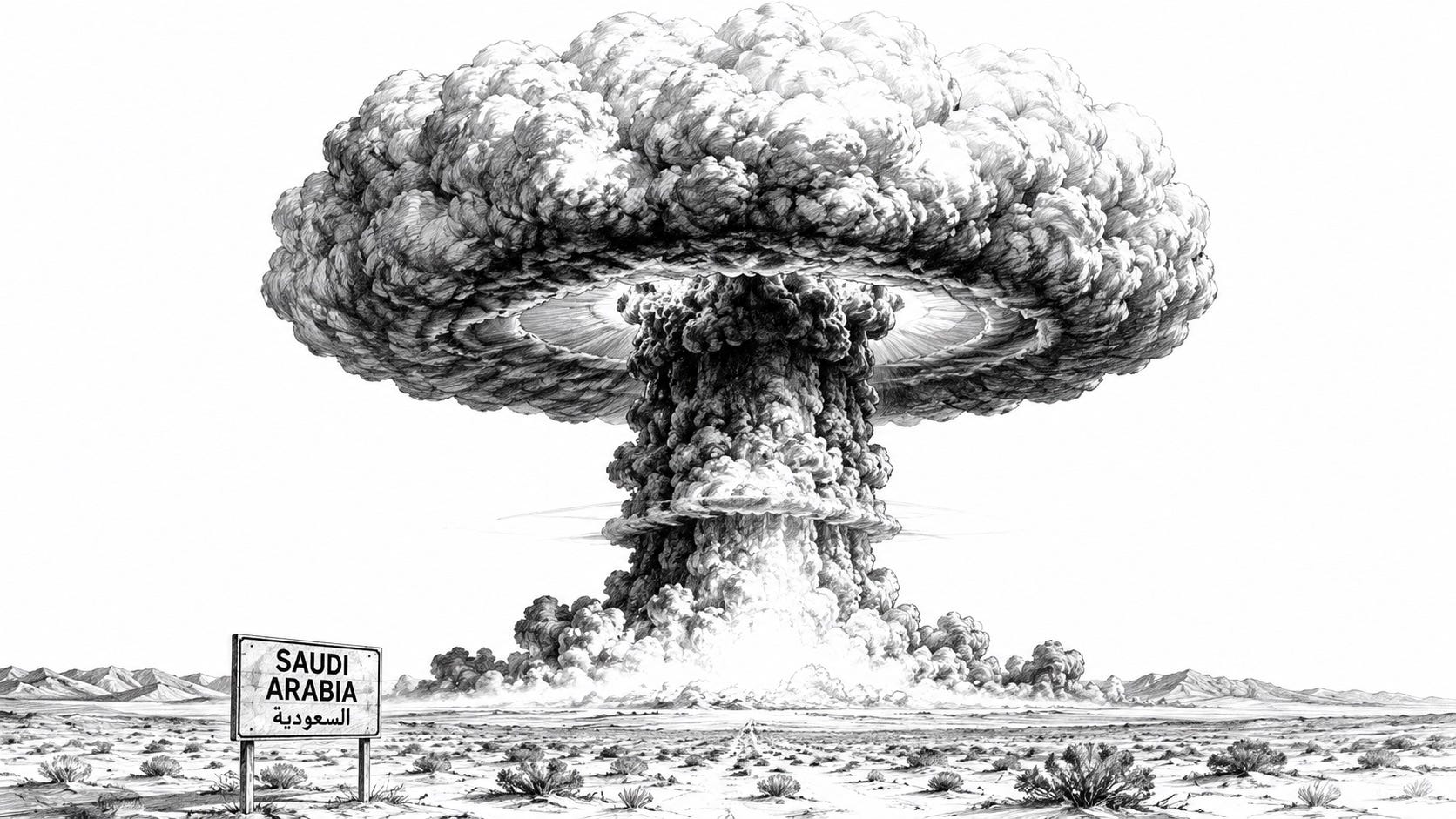
The nonproliferation guardrail that every comparable American nuclear deal has carried got dropped. Once you follow the money, the conflict of interest stops being subtle.
It’s being reported this evening that the President of the United States just signed off on letting Saudi Arabia move toward enriched uranium. His son-in-law’s firm is sitting on two billion dollars of Saudi government money as this goes gets posted. Read that again slowly, because the White House is counting on you to skim past it.
The Wall Street Journal broke the story first, and the Associated Press confirmed it through two people familiar with the decision. Trump has approved a civil nuclear cooperation agreement with the kingdom. The deal runs thirty years. It pulls in U.S. firms to build the program. And it could allow for a uranium enrichment facility on Saudi soil after a joint study between the two governments. The administration plans to send the pact to Congress within days.
The safeguard they quietly deleted
This agreement moves through a legal vehicle called a 123 Agreement, named for Section 123 of the Atomic Energy Act of 1954. Energy Secretary Chris Wright and Saudi energy minister Abdulaziz bin Salman are the named signatories. The two already signed a preliminary joint declaration in Riyadh back in November 2025, so this final step has been in motion for months. That part is routine. Dozens of countries hold 123 Agreements with Washington.
What is not routine is what got left out.
Reuters reports that this deal drops the “Gold Standard.” That is the commitment blocking a partner nation from enriching uranium and reprocessing spent fuel, the two technical roads that lead toward a bomb. When the United Arab Emirates signed its 123 Agreement in 2009, it accepted the Gold Standard. The United States has treated that pledge as the price of admission for decades.1
Saudi Arabia gets to skip it.
Enrichment alone does not build a warhead. A nation still has to master other steps. That caveat is real, and I want you to hold onto it so nobody accuses this newsletter of hype. One source cautioned that the agreement provides a legal pathway on the nuclear fuel cycle without obligating Washington to transfer any enrichment technology. Fair enough. But enrichment is the hard part, and it is the exact capability the West has spent years trying to deny Iran. Now that door opens for Iran’s chief regional rival with the guardrail removed.
Crown Prince Mohammed bin Salman told CBS in 2018 that if Iran built a bomb, his kingdom would move to match it as fast as possible. He has never retracted that. If the name sounds familiar, that’s because this is the same guy responsible for killing Washington Post journalist, Jamal Khashoggi.2
Saudi Arabia already signed a mutual defense pact with nuclear-armed Pakistan, and Pakistan’s defense minister has since said his country’s nuclear program would be made available to the kingdom if the moment came. That is the neighborhood this deal drops centrifuges into.
Now follow the money
You cannot read this decision honestly without looking at who profits from the relationship, so let’s put the documented facts on the table. Not rumors. Filings, letters, and reporting.
Jared Kushner runs a private equity firm called Affinity Partners. Saudi Arabia’s Public Investment Fund, the sovereign fund that MBS himself chairs, committed two billion dollars to it. Forbes reports that the arrangement carries a 1.25 percent management fee, which pencils out to at least $125 million flowing to Kushner’s firm over five years, money that helped push his personal net worth past a billion dollars. Affinity later joined a PIF-led consortium, alongside Silver Lake, in a $55 billion deal to take Electronic Arts private, the largest leveraged buyout on record.3
A House committee investigated whether Kushner leveraged his first-term White House role to land that Saudi money. House Democrats went further and pushed for a special counsel to examine whether he was operating as an unregistered foreign agent.
The Trump Organization has its own direct lines to the Saudi government. It partnered with Dar Global, the international arm of a Saudi developer, on a Trump Tower in Jeddah and a resort project in Oman. The Saudi Public Investment Fund bankrolls LIV Golf, and LIV then paid Trump-owned clubs in Florida and New Jersey to host tournaments. Add the family-aligned crypto venture, World Liberty Financial, which critics say is structured to skim a cut off Gulf-linked money as it moves. I chatted with investigative journalist, Molly White, a few weeks ago about the crypto connection and grift.4
This is not a president with a distant, arms-length interest in Saudi goodwill. This is a family with billions in active, government-sourced money on the line.
Where I draw the line, and where the record does
I am a trial lawyer before I am a columnist, so I will tell you exactly what the evidence supports and exactly what it does not.
The evidence does not show a signed quid pro quo. Nobody has produced a document proving the nuclear deal was traded for a Saudi check. The deal also carries a genuine strategic logic that predates this administration. Both Trump and Biden chased a version of it, because Washington would rather have American companies inside the Saudi program than hand the job to Russia or China. That case is real, and pretending otherwise would insult your intelligence.
Here is what the evidence does show, cleanly and beyond dispute. The Trump family collects enormous sums from the Saudi government. The President then approved an unusually permissive nuclear arrangement for that same government. And the standard nonproliferation guardrail got stripped out along the way.
Even the libertarian Cato Institute, no partisan operation, called the entanglement between Trump enterprises and the Gulf a glaring conflict of interest. A conflict of interest is a structural fact. It exists whether or not a crime does. And it is the exact reason a deal this consequential deserves harder scrutiny, not the benefit of the doubt.
What happens next, and what it really takes to stop it
Here is where most coverage will mislead you, so read this part carefully.
Once the pact reaches Congress, it sits in a review window of roughly ninety days of continuous session. Then it goes into force on its own. Blocking it is not a matter of a floor vote going the right way. Congress has to pass a joint resolution of disapproval, and because the President will veto that resolution, stopping the deal requires a two-thirds supermajority in both the House and the Senate to override him. A narrow majority cannot do it. Even a change in House control after the November elections, which some analysts expect, would not clear that bar on its own.
So the realistic fight is not a clean kill in Congress. The realistic fight is public and it is about leverage.
Watch whether the administration rushes the submission to burn down the review clock before opposition organizes. Call your representative and demand one specific thing, that the Gold Standard enrichment ban be restored as a written condition, the same standard the UAE accepted without complaint in 2009. And refuse to let anyone frame legitimate questions about the President’s family finances as partisan noise. Following the money is not a smear. It is the job.
The White House wants you to treat enriched uranium in Saudi hands as a boring policy footnote while the family cashes Gulf checks. Do not give them that.
Stay loud. Stay uncensored.
Mitch Jackson, Esq.
The “Gold Standard” is a binding commitment written into a U.S. civil nuclear cooperation agreement in which the partner country permanently gives up the right to enrich uranium or reprocess spent nuclear fuel on its own soil, the two fuel-cycle steps that can produce weapons-grade material, and instead agrees to source its reactor fuel from the international market under monitoring. The United Arab Emirates set the benchmark in its 2009 123 Agreement by accepting exactly that no-enrichment, no-reprocessing pledge, which nonproliferation experts have held up ever since as the model condition for letting a country build nuclear power without opening a pathway to a bomb.
A declassified U.S. intelligence assessment released in 2021 concluded that Crown Prince Mohammed bin Salman approved the operation that killed Washington Post journalist Jamal Khashoggi at the Saudi consulate in Istanbul in October 2018, based on the finding that a team of operatives close to him would not have carried out such an act without his authorization.
Just when you think he can't get anymore corrupt, he surprises you. When are we going to wake up from this nightmare?
Thanks for explaining the Gold Standard aspects in this deal. It seems obvious why the Saudis want to have an ability to do an end run by the nuclear inspectors for full bomb making capabilities. Just the same as Iranians were alleged to be doing for the last 47 years but the Saudis will get a free pass. How does this even begin to be secretly negotiated without Congress being, at the very least, having some knowledge? Oh... Kushner and Witkoff. Follow the money. Sword dancing. Bonespurs and Bonesaw. Arms for oil. Basing rights. Favored nation status. Imperial Executive Branch.
Got it.
The USA public buys gasoline and still takes the Saudis to lunch, I see. Same as it ever was.