


Two grown men, acting like toddlers in a crib, yanking a toy back and forth while the roof’s caving in on the rest of us. This isn’t leadership, it’s ego-driven chaos, and America’s the one getting hurt.
A Personal Vendetta Shouldn’t Endanger Our Future
In the near future we may all wake up to find America’s rockets grounded, our astronauts stranded on the space station, and our most innovative industries thrown into chaos, all because of a personal feud. This scenario sounds like something out of a political thriller, but it’s perilously real.
President Donald Trump has threatened to cancel every U.S. government contract and dollar of support tied to Elon Musk’s companies. Let me be clear, I’m no fan of Musk or Trump. But take a few steps back from the noise and egos, and what you’ll see is bigger than a billionaire baby brawl. This kind of personal grudge match, playing out on the national stage, is ugly and dangerous. It puts our country’s progress, security, economy, and the rule of law at risk. When personal vendettas start driving government decisions, everyday Americans lose.
Here’s a handful of screenshots from Thursday afternoon, and yeah, they say a lot without me having to say much at all.
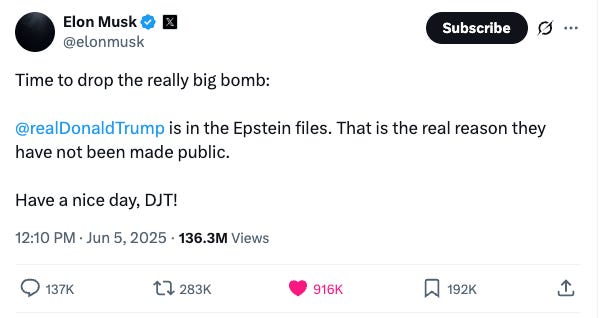
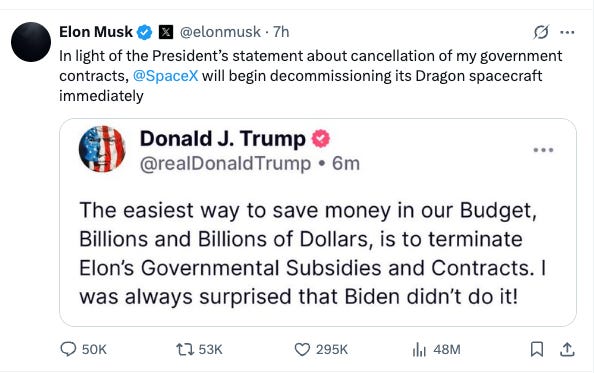
This is crazy.
We’re not talking about minor deals; we’re talking about partnerships that touch all our lives. Elon Musk’s businesses are woven into America’s economy and future: key defense contracts, launching our satellites, driving the electric car revolution, connecting rural communities to the internet, even boring tunnels to ease traffic. Pulling the plug on these partnerships out of spite would have far-reaching consequences for each company and for all of us. Let’s break down what’s at stake in plain language, so every American voter understands why this politically motivated retaliation is misguided, unnecessary and dangerous.
SpaceX and Starlink: National Security in the Crossfire
SpaceX, Musk’s rocket company, isn’t just launching flashy rockets for show, it’s become a cornerstone of U.S. national security and space exploration. With NASA and the Pentagon as major customers, SpaceX carries our astronauts to the International Space Station and deploys the satellites that keep our troops and allies connected. Its satellite internet network, Starlink, has been a lifeline for soldiers in war zones and for rural Americans who lack broadband.
What happens if the government yanks support for SpaceX and Starlink? In the short term, chaos. NASA would suddenly lose its primary way to get astronauts into orbit. We could find ourselves back to hitching rides from Russia to reach the Space Station, an embarrassing and risky step backward.
Critical military satellites, used for everything from GPS navigation to detecting missile launches, could face severe delays. The U.S. Air Force and Space Force have leaned on SpaceX’s affordable, reliable launches to replace aging satellites; without SpaceX, those launches either don’t happen on schedule or cost the taxpayers billions more with other providers.
Our troops and allies might lose rapid access to Starlink’s battlefield internet, which has literally been a lifesaver by keeping lines of communication open in conflicts like Ukraine. Even here at home, projects to modernize things like air traffic control networks using SpaceX’s technology could stall, leaving us stuck with outdated, unreliable systems.
Long term, the damage could be even greater. America’s edge in space technology would erode. SpaceX is the first company to land and reuse orbital rockets, making space access cheaper than ever. If SpaceX’s contracts are canceled, its groundbreaking Starship program (intended to return Americans to the Moon and eventually Mars) could be slowed or scrapped. That means the jobs of thousands of engineers, technicians, and factory workers across the country would be at risk. It means ceding ground to China and other nations racing to dominate space. Our military would have to fall back on slower, more expensive launch options, potentially leaving America vulnerable if adversaries launch new satellites or weapons faster than we can.
Let’s be clear: cutting off SpaceX and Starlink is not like tweaking a budget line item. It’s pulling the rug out from under America’s space program and security strategy. Astronauts, soldiers, and citizens would all feel the impact. This kind of self-inflicted wound would delight our competitors and enemies. As an American, that scares me more than I can express.
Tesla: Jobs, Energy, and the Economy at Stake
Musk’s ventures aren’t just in the heavens, they’re also in our driveways and on our streets. Tesla, his electric car company, spearheaded a revolution in clean vehicles. In doing so, it employs over 100,000 Americans and has built massive factories from California to Texas that are revitalizing manufacturing. Tesla has benefited from public policies meant to encourage innovation, things like consumer tax credits for electric cars and partnerships on battery technology. Those incentives weren’t handouts to Musk; they were investments in a cleaner, tech-driven future for all of us. And Tesla delivered: it made electric cars desirable, helped cut air pollution, and spurred an entire industry to follow suit.
Now picture all of that being jeopardized overnight. If the federal government slams the door on Tesla to “punish” Musk, the immediate shock would hit our economy hard. We saw a glimpse of that when mere threats of retaliation caused Tesla’s stock to plummet, vaporizing billions in value in a single day.
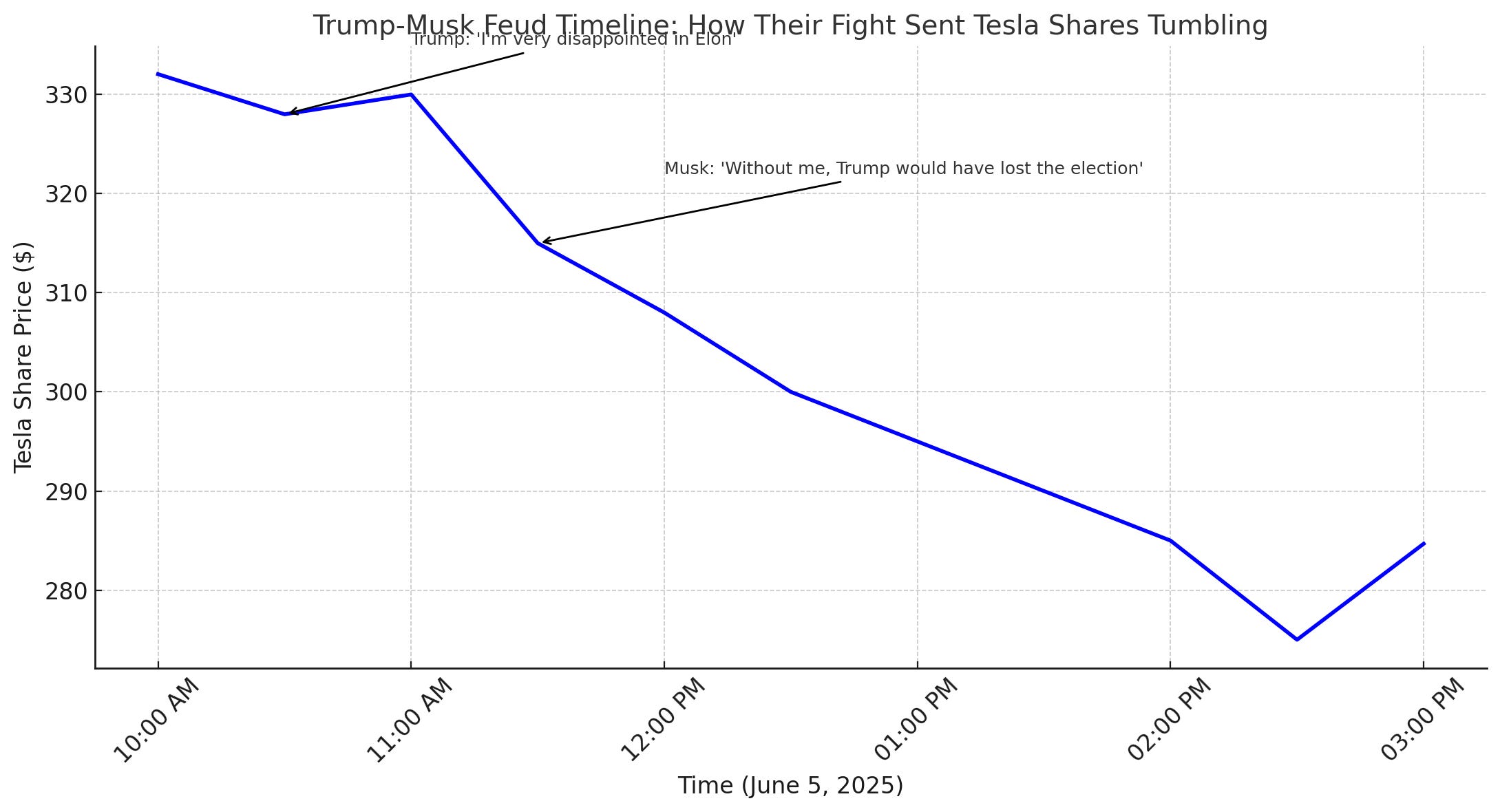
Think about what that means: many Americans’ retirement funds and college savings are invested in index funds or stocks that include companies like Tesla. A political vendetta causing a stock crash hurts ordinary people’s nest eggs, not just a billionaire’s bottom line.
Without government support or contracts, Tesla could face an uphill battle selling its cars. One way the government supports EVs is by offering a tax credit to buyers, effectively knocking $7,500 off the price. If those credits are killed out of spite, everyday Americans trying to buy an affordable electric car will feel the pain. Many families might decide an EV is out of reach without the credit, cutting into Tesla’s sales and slowing the shift away from gasoline. That means more pollution in our communities and more gas money sent overseas, all because of a feud.
Canceling ties might also scare off other support that Tesla and its suppliers rely on. Tesla has been planning new battery factories and charging networks, creating construction jobs and tech jobs, many in states that strongly supported President Trump. How ironic and tragic would it be if those very communities lose out on jobs because the White House decided to freeze out Musk’s businesses? And it’s not just Tesla; other automakers investing in EVs would get a clear message that the rules can change on a whim. Why invest in American innovation if one political spat can yank the rug out? The uncertainty could chill investment across the entire auto industry, just as the world market for electric vehicles heats up.
We need to understand the broader economic implications here. Tesla isn’t an island; it’s part of a larger ecosystem of suppliers, contractors, and workers. Small machine shops in the Midwest make parts for Tesla; trucking companies deliver its cars; software engineers in cities big and small write code for its vehicles. If Tesla pulls back, those jobs are at risk too. And let’s remember consumers: competition from Tesla has been pushing down the price of electric cars and pushing other brands to improve. Remove Tesla’s momentum, and we could all end up paying more for the innovations that were just around the corner.
In short, sabotaging Tesla doesn’t just hurt one CEO. It hurts American workers, American technological leadership, and every American who breathes cleaner air thanks to electric cars or who hopes to one day drive one. It’s shooting ourselves in both feet economically.
Innovation on Ice: Tunnels, Technology, and Tomorrow
Elon Musk’s influence extends beyond rockets and cars. He’s involved in ventures like The Boring Company, which digs high-speed tunnels to fight traffic, and Neuralink, which works on medical implants that could one day help paralyzed people move or blind people see. These projects may sound futuristic, even whimsical, but they represent the kind of bold innovation that has always made America a leader. And guess what? They, too, have had intersections with government support.
The Boring Company, for instance, has contracts with city governments (Las Vegas, for one) to build novel underground transit loops. If the federal government declares open season on anything Musk touches, how long before local officials get cold feet about partnering up? Think about your own city: would you want a new traffic-busting technology shelved because it became politically radioactive? We all complain about gridlock and crumbling infrastructure; turning infrastructure innovation into a political casualty is the last thing this country needs. It sends a message that solutions won’t be judged on merit, but on who your friends are.
Neuralink’s work, meanwhile, is still experimental, but the potential is life-changing. Federal agencies like the FDA don’t fund Neuralink, but they do regulate it. If Musk is in the doghouse, is there a risk that regulators will, consciously or not, slow-walk approvals for clinical trials of these brain devices? Even a hint of political bias in scientific oversight would be devastating. The people who stand to lose are patients, maybe a wounded veteran hoping for a neural implant to regain mobility, or a stroke survivor dreaming of a day they could speak again. We should be encouraging these moonshot efforts, not chilling them.
And let’s not forget Musk’s ownership of the social media platform X (formerly Twitter). While the government doesn’t “fund” X, a significant part of public discourse and even emergency communications happen on such platforms. A president bent on revenge could pressure government agencies to stop communicating on a Musk-owned platform, or launch antitrust and regulatory attacks purely out of spite. That might score points against Musk, but it would also erode trust in impartial law enforcement and disrupt how information flows to the public. It sets a precedent that critical communication tools can become political battlegrounds, hardly healthy for our democracy.
The pattern here is dangerous: any cutting-edge idea linked to Musk could be left to wither on the vine, not based on its merit or benefit to the public, but because of personal animus. That’s not how America became a beacon of innovation. We got here by embracing the new and working with visionaries, even those who challenge the status quo. If we let personal grudges dictate which innovations move forward and which get iced out, we’ll all pay the price in lost technologies, lost cures, and lost opportunities.
Absolutely—here’s a detailed addition you can drop directly into your article:
xAI: When AI Becomes a Political Casualty, We All Lose
Let’s talk about xAI, Musk’s artificial intelligence venture that, like it or not, is quickly becoming a major player in the AI race. I don’t trust Musk to steward our digital future any more than I trust Trump to respect our Constitution. But when you zoom out from the personalities and look at what’s unfolding, it becomes crystal clear: if Trump follows through on cutting off government collaboration with xAI out of revenge, it won’t be Musk who pays the highest price. It’ll be us.
xAI, now merged with the social media platform X, is building AI models trained on real-time public discourse. That includes everything from trending news and cultural reactions to political content and scientific commentary. The company’s flagship AI assistant, Grok, is already being integrated into major platforms and tools, and it’s not a stretch to imagine xAI’s models powering defense analytics, public infrastructure planning, health forecasting, or emergency response systems in the near future. If the government abruptly bans contracts, blocks regulatory cooperation, or pressures agencies and state partners to steer clear of anything xAI touches, we lose access to cutting-edge tech that could save lives, improve services, and increase transparency.
The danger here isn’t just about tech falling behind. It’s about allowing the U.S. government to treat AI not as a public good, but as a loyalty test. What happens when political grudges start shaping who’s allowed to compete in the AI space? We risk handing over the next frontier of digital intelligence to countries that don’t share our values. We stall research that could help detect diseases faster, make transportation safer, or protect our national cyber-infrastructure. And we send a chilling message to every AI startup in America: stay in line politically, or we’ll cut you off.
AI is too important to be politicized. And yet, here we are, watching a sitting president threaten to kneecap one of the most ambitious AI ventures in the country, not because it failed the public, but because its owner hurt his feelings. That’s not leadership. That’s tyranny in tech’s clothing.
An Attack on American Principles and Partnerships
As a lawyer, I’m trained to see both the practical effects and the principles at stake. And make no mistake, the principles here are as profound as the practical fallout. The United States government entering into contracts with private companies is not some casual favor, it’s often a carefully crafted partnership to achieve things that matter to the American people. When those contracts are awarded, people on all sides make commitments. The government commits taxpayer dollars to a goal (whether it’s landing on Mars or getting more electric cars on the road), and companies commit to delivering results. This system only works if both sides operate in good faith, focused on the public interest.
What we’re witnessing with this Trump-Musk feud is a potential betrayal of that good faith. Tearing up contracts or yanking support not because the company failed to perform or broke the rules, but purely as punishment for criticizing a politician, is deeply un-American. It resembles the tactics of authoritarian regimes where leaders persecute businesses that don’t toe the line. Our country was built on the idea that no one is above the law, not even the president. If the government can nullify its promises on a whim, who will ever trust it again? Why would any business partner with the government if they fear the next election could bring an vendetta that wipes them out?
Think about the chilling effect this will have on every public-private partnership. Today it’s Musk; tomorrow it could be any company that falls out of favor. Will defense firms hesitate to innovate advanced tech if they fear a future president might retaliate against them for, say, supporting the “wrong” candidate? Will clean energy startups hold off on investing in U.S. projects because those subsidies could vanish with a single angry tweet from the Oval Office? The long-term cost is a culture of fear and stagnation, where taking risks to help America is seen as, well, too risky.
And let’s talk about us, the taxpayers. We’ve already invested in many of these ventures. Our tax dollars helped SpaceX develop rockets that keep our satellites flying. We supported Tesla’s early days because we wanted cleaner air and a competitive auto industry. If those investments are suddenly cancelled, we don’t even get the returns we hoped for. It’s like paying to build a house and then torching it before you ever move in, just because you’re mad at the builder. We, the people, deserve better stewardship of the progress we paid for.
Finally, the legal ramifications: While a president has broad authority, he cannot just snap his fingers and break contracts without consequences. There are laws to prevent exactly this kind of capricious action, because the law recognizes that the government’s word is a public trust. Canceling contracts en masse would trigger a flurry of lawsuits. It could cost taxpayers even more in legal fees and penalties. And if done with clear intent to retaliate, it might even be deemed an abuse of power. As a lawyer, I can’t help but see it as setting up a constitutional crisis pitting personal power against the rule of law.
Stand Up: Country Before Grudges
This isn’t about picking sides, it’s about protecting what actually matters. I can’t stand half the garbage Musk or Trump post on X, and honestly, most of it makes me want to throw my phone across the room. Their words divide, their actions inflame, and not one ounce of it helps bring this country together. Enough already.
But, you don’t have to like Elon Musk, Trump, or drive a Tesla to see that letting a personal grudge sabotage American innovation and security is flat-out wrong. We, the everyday people, have a voice in this. And it’s time to use it.
First, let’s demand that cooler heads prevail. Leaders in Congress, including those in the President’s own party, need to hear from us right now. Tell your representatives and senators that you expect them to stand up for what’s in the national interest. Cutting off our nose to spite our face is not in the national interest. Remind them that you care about American jobs, American technology, and American leadership, and you’re watching to see who protects those things and who bows to one man’s anger.
Second, we must insist on preserving the principle that government contracts are not political weapons. If there are real issues with a contract or a subsidy, they should be debated transparently and fairly in Congress or through the proper legal channels, not decided in a midnight social media post. Urge your elected officials to put safeguards in place. For example, Congress can exercise oversight or even pass legislation to prevent whimsical cancellation of critical programs. Our system has checks and balances for a reason: to stop impulsive decisions from causing irreparable damage.
Third, speak up beyond the halls of power. Talk to your friends and neighbors about what this feud really means. It’s easy for political news to become a blur of personalities, but this is about your future and your community. Are there SpaceX suppliers or Tesla service centers providing jobs in your state? Let others know that those livelihoods could be collateral damage. Are you proud that America is a leader in space or clean energy? Explain that those achievements are on the line. We need a groundswell of public awareness to cut through the drama and focus on what matters.
Lastly, remember that as voters, we hold the ultimate power. If this kind of retaliatory governance continues, we must use our votes to reject it. It doesn’t matter if you’re a Republican, Democrat, or independent, we should all be able to agree that the government shouldn’t sabotage the nation’s progress out of spite. Hold candidates accountable. Ask them if they will commit to supporting innovation and honoring the nation’s commitments, regardless of personal feuds.
In our great country’s story, this moment is a test. Will we allow petty grievances to derail the forward march of progress? I have faith that we will not. America has faced down internal divisions and external threats, and we have always found our way by remembering our core values: fairness, vision, and unity in pursuit of the common good.
Now is the time to live up to those values. Let’s not sacrifice our future to a feud. Let’s send a loud, clear message that America’s future is bigger than any one president or billionaire, and we, the people, will fight to protect it.
Here’s my call to action: Reach out to your representatives. Write letters, make calls, post on social media. Support organizations and leaders who stand against this dangerous retaliation. Together, we must ensure that our nation’s progress, in space, in clean energy, in technology, continues unimpeded by personal politics. Our future is too important to burn on the altar of ego. We must keep America moving forward.
Mitch Jackson, Esq. | links
Thank you for reading, sharing and caring.
This post is free, but building a future rooted in truth and democracy takes real investment. If my work speaks to you, consider supporting—because independent journalism that actually gives a damn is worth backing.