

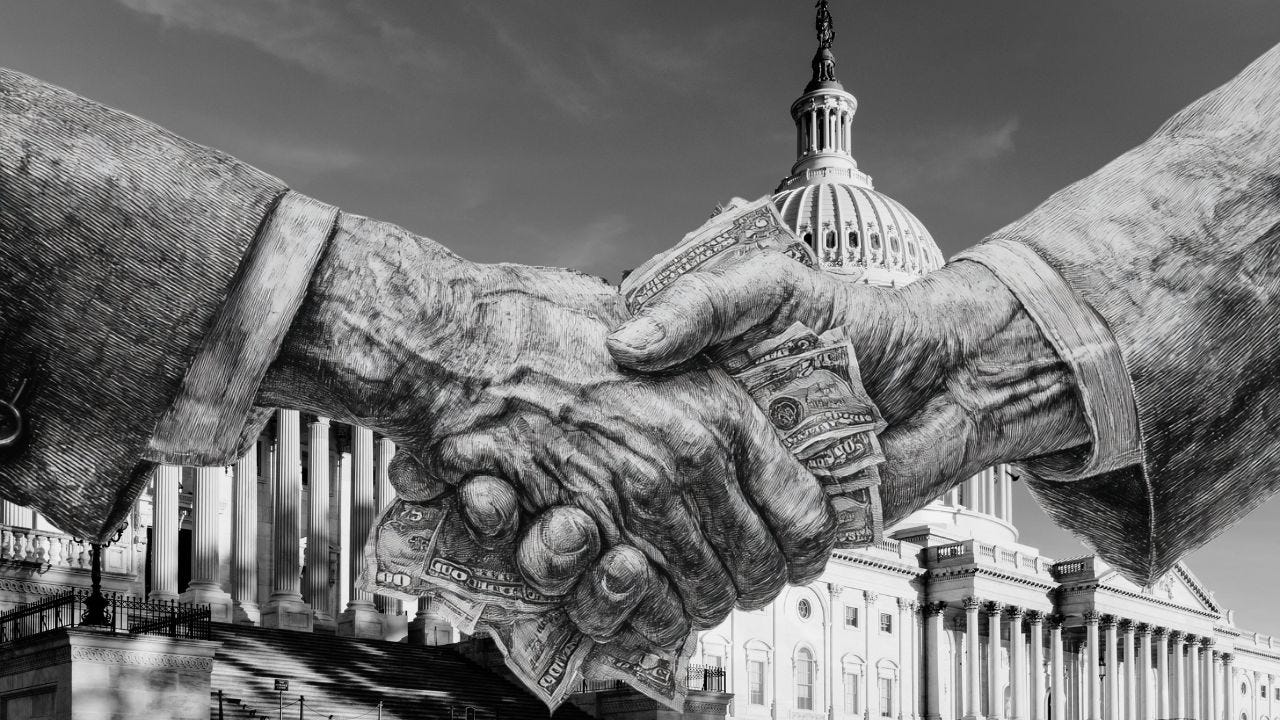
Why do so many ideas with broad public support die in Congress? Why do elected officials seem to listen more to donors and lobbyists than to their own voters? One big reason is the outsized influence of political lobbying.
Lobbying is the practice of paid influencers persuading government officials to take specific actions. In a healthy democracy, your voice would guide your representatives. Today, wealthy special interests hire armies of lobbyists to make sure their voices drown out yours. They swarm state capitals and Washington, spending staggering sums to shape laws and regulations in their favor. Last year alone, interest groups spent over $4 billion lobbying the federal government. There are now more than 13,000 registered lobbyists in Washington. That works out to about two dozen lobbyists for every member of Congress.
How did we get here? The idea of lobbying was not always sinister. The Founding Fathers protected the right of citizens to petition their government, allowing people to bring concerns directly to their leaders. In the early days of the republic, an ordinary American could knock on a lawmaker’s door and be heard.
Over time, that simple right was twisted into a professional influence industry. By the 19th century, money had thoroughly infiltrated politics. Lobbyists openly plied lawmakers with favors and gifts. One famous gunmaker even handed out revolvers to members of Congress to win support for a bill. Buying access became part of doing business in government.
As lobbying grew more brazen, there were attempts to rein it in. In the 20th century, Congress passed laws to force lobbyists to register and disclose their activities. Every time new rules appeared, lobbyists found ways around them. Some avoided the official “lobbyist” label entirely, using titles like consultant or adviser to operate in the shadows. Former public officials slid through the revolving door into lucrative lobbying gigs, cashing in on their government connections. Weak enforcement and clever loopholes meant that much of this influence peddling continued undisturbed.
Today, there are still few effective checks on lobbying. Disclosure rules exist on paper. Money finds a way to speak louder than any rule. Politicians rely on lobbyists for campaign funds, for talking points and research, even for writing legislation. This creates glaring conflicts of interest.
An elected official who takes large donations from an industry is unlikely to vote against that industry’s wishes. In some cases, lawmakers champion policies that benefit their own investments or the businesses of their friends and family. The lines between public duty and private gain blur, and trust in government plummets.
We have seen blatant corruption happen under the banner of lobbying. In the early 2000s, a lobbyist named Jack Abramoff bribed members of Congress with lavish trips and gifts in exchange for favorable votes. He eventually went to prison, and the scandal exposed a web of backroom deals and payoffs.
At the state level, there have been lawmakers caught taking envelopes of cash from industry players for legislative favors. Those are the stories that make headlines and lead to indictments. They drive home a simple point: when lobbying crosses the line into bribery, the public pays the price.
All of this deeply affects how people view their government. When you see wealthy lobbyists walking in and out of the halls of power, it sends a clear message about who gets a seat at the table.
Many Americans now believe politicians are essentially bought and paid for. Surveys confirm this: an overwhelming majority of the public, across party lines, says lobbyists and big donors have too much say, and that regular people have too little. It is a recipe for cynicism. Why bother engaging in politics if you suspect the real decisions are made behind closed doors?
Some folks throw up their hands and tune out. Others get swept up in anger and division, which lobbyists and their PR machines eagerly feed with misleading claims to keep voters distracted. The more frustrated and misled we become, the easier it is for special interests to keep doing what they do.
Consider the recent boom of the cryptocurrency industry. It is a new field. Its leaders quickly learned the old Washington playbook. Crypto companies and investors have poured millions of dollars into lobbying Congress and federal agencies to shape rules in their favor.
And it worked. In 2025, lawmakers pushed through a set of bills favorable to the crypto industry with minimal oversight. President Trump eagerly signed one of those bills into law and touted it as a win for innovation. He did not mention that his own family was launching a cryptocurrency venture that stood to benefit.
The crypto lobby got what it wanted: lax regulation and political goodwill, even as one of the industry’s biggest figures was exposed for massive fraud. This example shows how easily big money bends policy when politicians prioritize donor interests over the public interest. Molly White researches and writes about this weekly over on her outstanding Citation Needed newsletter.
Now think about the gun lobby, which has been a force in American politics for generations. Organizations like the NRA have spent decades pressuring politicians to block even modest gun safety measures. They donate generously to campaigns and threaten to punish any lawmaker who doesn’t toe their line. They flood the public with fearmongering claims that any new gun law will strip away fundamental rights.
This strategy has worked. Again and again, bills that most Americans support (such as universal background checks or limits on military-style rifles) never even make it to a vote. At the same time, communities continue to suffer routine gun violence. The gun lobby’s grip on our lawmakers has been so strong that it often outweighs the will of the people, even when lives are on the line. If you have time, take a look at the ACLU’s view of gun rights here.
Our current political leadership has failed to restrain these forces. In many ways it has encouraged them. Trump rode back into power in 2025 promising to fight for the people against the “swamp” of insiders. That promise rang hollow. Washington’s culture of influence peddling is more rampant than ever. Many of Trump’s own allies and former officials are now well-paid lobbyists cashing in on their connections.
His administration routinely aligns itself with the interests of its biggest donors and cheerleaders. The White House loudly wages culture wars in public. Behind the scenes, it quietly gives industry lobbyists much of what they want. The result is a government that keeps people divided and distracted as lobbyists thrive. We were told things would change. The only things that changed were the slogans on television. The same money, the same backroom deals, the same conflicts of interest still rule the day, now more than ever.
I am deeply worried about where all this leads. I worry for my fellow Americans who feel misled and powerless, and for our kids and grandkids who will inherit this system if we don’t fix it. A government that answers to lobbyists, not to the people, cannot solve the real problems that affect your daily life. It erodes faith in our institutions and tears at our national unity.
Neighbors turn against each other in these manufactured culture wars. The big money players simply laugh all the way to the bank. This is not the future we want for America. We cannot accept a democracy that exists in name only.
It does not have to stay this way. The beauty of our system is that real power still rests with the people. Change will happen if enough of us demand it. Throughout our history, when citizens have united and spoken up against corruption, they have won reforms that made our country better. We can do it again.
It starts with each of us being informed and engaged. Talk to your friends and neighbors about what is going on beyond the political theater. Do not fall for the spin meant to divide us. Support leaders who reject the influence of big money and put people first. Insist on transparency and hold your representatives accountable.
Remember that your voice matters. When you and millions of others speak up, you remind those in power that they work for you. This nation’s government was designed to be of the people, by the people, for the people. It is up to us to make it true.
Let’s reclaim that promise, and ensure that our America, the America we pass down to our children, is a place where the people, not the lobbyists, are in charge.
Mitch Jackson, Esq. | links
Lobbying Rules, Laws and Regulations
Lobbying Disclosure Act of 1995 (LDA):
Requires quarterly (previously semi-annual) registration and disclosure of lobbying activities, clients, lobbying issues, and expenditure amounts.
Applies to any lobbyist or organization that meets minimum thresholds for income or expenses related to lobbying.
Imposes penalties for violations (up to $200,000 and possible imprisonment).
Honest Leadership and Open Government Act of 2007 (HLOGA):
Amends and strengthens the LDA by increasing transparency, expanding reporting, and tightening rules on gifts and travel.
Imposes longer “cooling off” periods before federal officials can begin lobbying, bans certain gifts/travel, increases penalties, and imposes campaign finance disclosure for lobbyists.
Foreign Agents Registration Act (FARA):
Regulates lobbying for foreign governments or political parties with separate and stricter registration/disclosure—distinct but related to LDA.
Ethics Rules:
The House and Senate ethics codes prohibit gifts, certain types of travel, and set conflict-of-interest requirements for interactions with lobbyists.
