

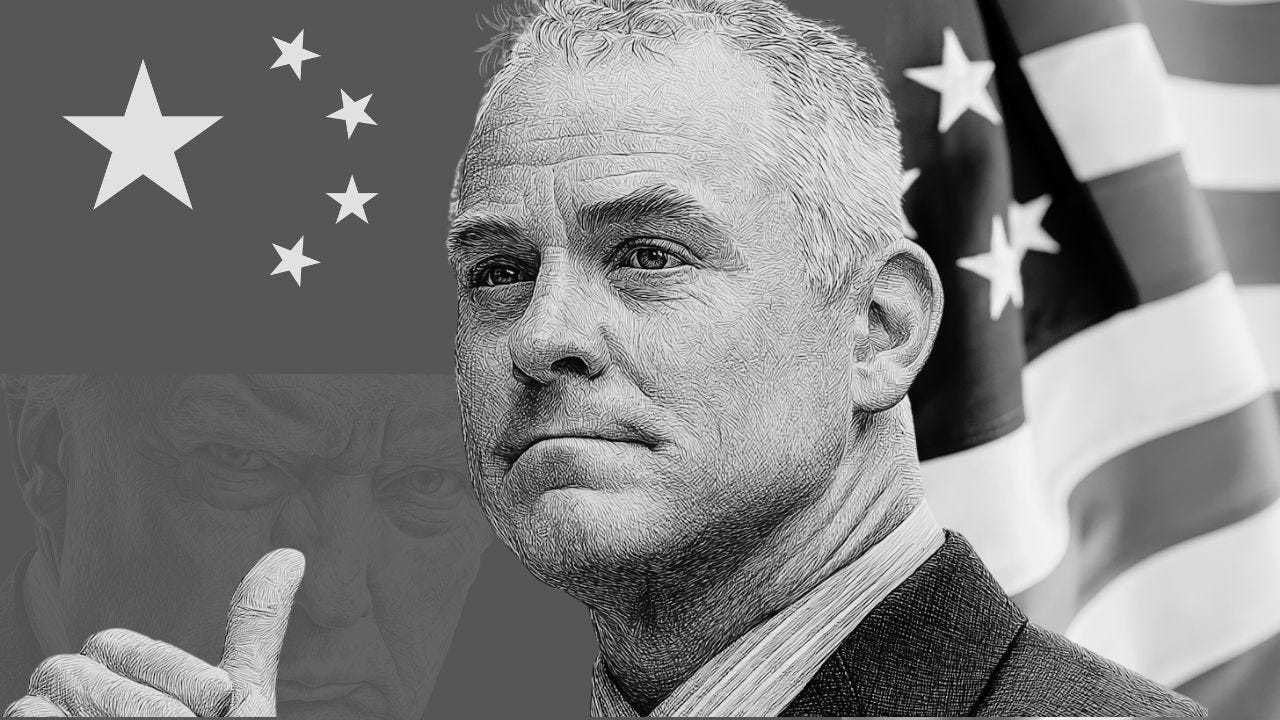
You need to understand what happened with the pardon of Michael McMahon. He was a longtime officer in the New York Police Department who went on to work as a private investigator.
McMahon was convicted by a federal jury in Brooklyn in 2023 of acting as an illegal foreign agent of China, and stalking a Chinese-national former Chinese city official living in New Jersey. He was one of three men convicted in the first U.S. trial connected to China’s “Operation Fox Hunt,” a covert effort to track and pressure dissidents abroad. His two co-defendants, both Chinese nationals, are still serving their prison terms. Three additional defendants admitted guilt, and five others remain fugitives believed to be in China.
The case tied into China’s so-called “Operation Fox Hunt,” a campaign of transnational repression seeking to pressure expatriates into returning to China. McMahon, according to prosecutors, aided in surveillance and intimidation of the target and his family.
Let me walk you through the details and why this pardon concerns me so much.
McMahon’s offenses were not simple misdemeanors. The conviction rested on finding that he acted illegally as an agent of a foreign government without registering, and engaged in interstate stalking and intimidation of someone whose safe-harbor in the U.S. should have been protected. That kind of conduct strikes at fundamental national-security concerns and at the rule of law.
When the president grants a full pardon in a case like this, he sends the message that even serious convictions tied to foreign governments and schemes of coercion can be wiped clean by political or personal influence. The pardon was reportedly defended on grounds that McMahon believed he was doing a straight private-investigation job for a construction firm, that he thought he wasn’t working for China’s government and that he had a commendable law-enforcement record. The White House cited his prior career and of course, what they described as overreach by prosecutors.
Those factors alone make the pardon controversial. But beyond controversy, the broader consequence is that the executive branch appears willing to erase accountability for individuals who prosecuted showed beyond reasonable doubt had acted to assist a foreign government in ways that bypassed U.S. legal mechanisms. The integrity of enforcement against foreign influence depends on consistent accountability. The message when such pardons are granted is that allegiance to the Constitution and public trust can be overridden by political favor.
You as a reader should feel alarmed. When we allow the most powerful person in government to use the pardon power in this fashion without transparent criteria or clear public interest justification, we erode a pillar of our democracy. The pardon is not just a legal act. It is a symbol of what behaviors are accepted, tolerated, or rewarded. In this case the symbol speaks of impunity.
Why this matters for everyday Americans and families
You might think that this is one of those elite-level things disconnected from your life. It is not. When foreign governments operate covertly on our soil and the U.S. legal system holds someone accountable, that protects all of us. Our security, our liberty, the principle that no one stands above the law.
When a pardon wipes away that accountability, it weakens the shield that protects you, your children, your grandchildren. We are talking about protecting the future of our democracy, the future of our economy, and our standing in the world.
Consider the ripple effects. If enforcement of laws against foreign influence becomes optional, if pardons become predictable rewards for political or personal loyalty, then the system begins to tilt. One day it may not be a former NYPD sergeant. One day the target may be you, your community, your voice. The structure of justice is under pressure and you have a stake in defending it.
The pattern of pardons that deepens the problem
This McMahon pardon is not an isolated incident. It fits a pattern of pardons by Trump that undermine public trust and the rule of law. Among the relevant cases are:
Former Tennessee House Speaker Glen Casada and his aide Cade Cothren. Both were convicted in 2025 of public corruption charges involving a taxpayer-funded mailer scheme, wire fraud and money laundering. Casada was sentenced to three years in prison, Cothren to about 2½ years. They were pardoned in November 2025 by Trump.
Crypto mogul Changpeng Zhao was pardoned. It signals that the highest office is willing to wipe away felony convictions tied to global money-laundering failures at a massive exchange. You should find it troubling that this clemency comes amid large-scale fundraising for a $300 million presidential ballroom and reported business links between the defendant’s company and the First Family’s crypto venture.
Ross William Ulbricht, founder of the Silk Road dark-web marketplace, convicted in 2015 for massive narcotics distribution, money-laundering and more, sentenced to life plus decades. Pardoned by Trump in January 2025.
Approximately 1,500 individuals convicted for participation in the January 6, 2021 attack on the U.S. Capitol received full pardons or clemency in January 2025 under Trump’s terms.
See Trump’s Pardon List
You can see the entire list at the government website. Look at the “Offenses” section for each person. It’s going to turn your stomach.
Each of these cases carries a message that deeply affects you, your environment and your country. When someone convicted of public corruption walks free by executive fiat, when a person convicted of aiding massive criminal enterprise is pardoned, when an entire class of political-violence defendants is granted clemency en masse—then the value of accountability erodes.
Why you must care and act
You work hard, you play by the rules, you expect that everyone else plays by the rules. You expect the system to protect your rights and enforce responsibilities. When the pardon power is used in ways that favors insiders, the powerful, those with political access, then the rule of law becomes a privilege not a guarantee. That threatens your kids, your grandkids, your democracy.
You spoke up last Tuesday in the elections and told the world you are tired of the self-dealing and corruption. You must speak up again, right now and also in the 2026 midterms.
You have to hold your elected officials to account. You must ask why these pardons were granted, what standard applied, how justice was measured, and who decided it served the public interest. Even better, you must demand that these pardons stop.
Enough is enough. The future of our unified national project depends on you refusing to accept double standards.
Conclusion
President Trump’s pardon of Michael McMahon, like many other of his pardons, crosses a dangerous line. It weakens the barrier that separates political convenience from justice. Alongside the pardons of Casada, Cothren, Ulbricht and the January 6 defendants, it reveals a pattern where public trust is being compromised. You have to refuse acceptance of this. You have to demand accountability, transparency and fairness for everyone.
Your voice matters. Use it. Share this. Talk to your neighbors. Our children and democracy depend on it.
Mitch Jackson, Esq.

Arch-conservatives used to call for a new constitutional convention. I now agree. Not to throw the baby out with the bath-water but to fix ambiguous language abused profligately. Some thoughts on changes:
> candidates for President must be deemed mentally fit and healthy by the a panel of Congress;
> clarify that the second amendment applies to arming state militias (i.e., the National Guard);
> clarify the second amendment to clarify and limit the right of self-defense;
> constrict pardoning to one person per pardon;
> allowing the president one pardon per year with any other pardons in the same year permissible with a two-thirds vote of each house of Congress;
> expand the scope of the emoluments clause to include members of the president's family;
> incorporate the War Powers Resolution into the congressional power over the declaration of war;
> include an explicit prohibition against impounding funds; as well as,
> integrate the language or intent of the Equal Rights Amendment.