

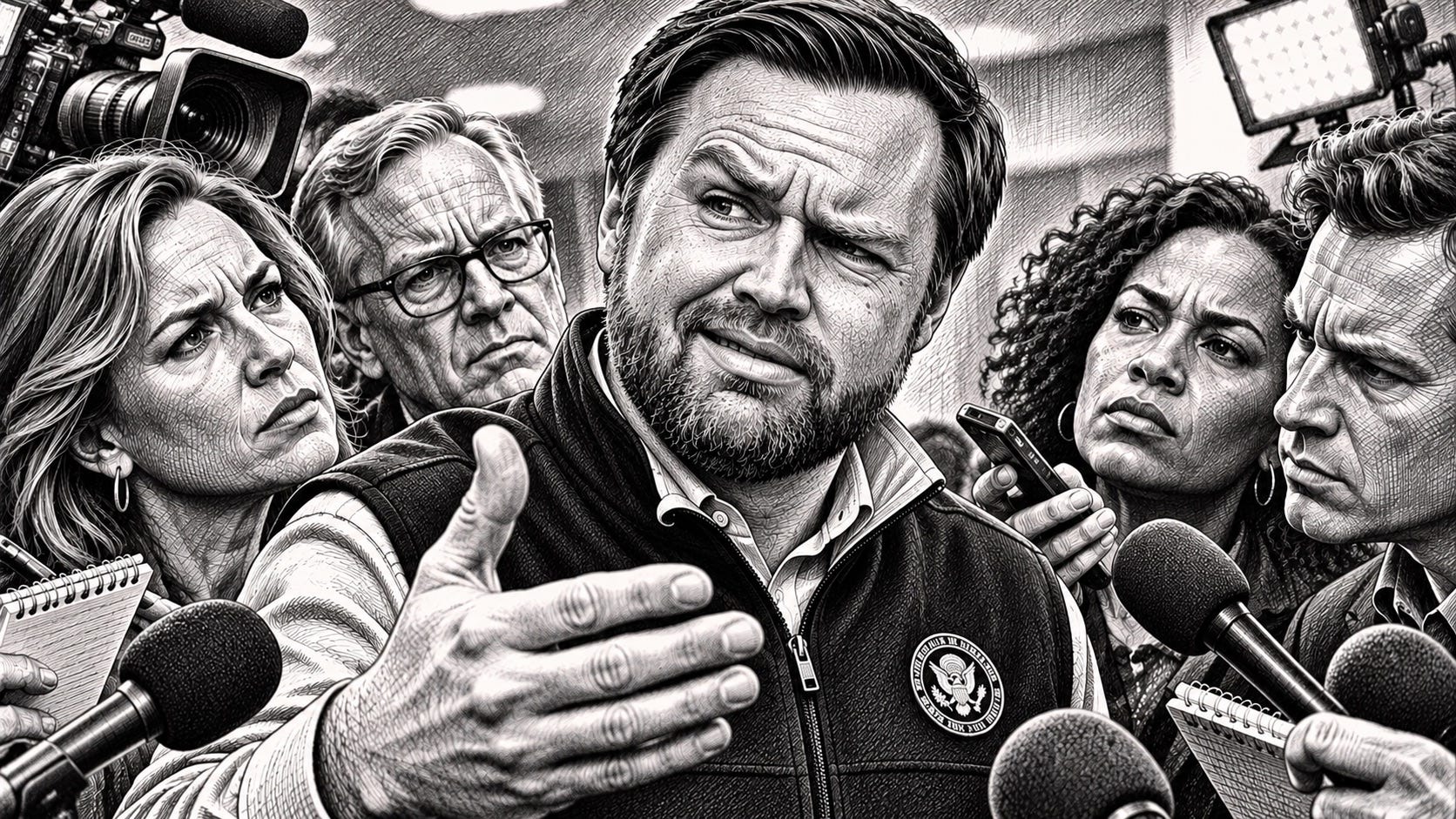
A reporter asked Vice President JD Vance a straight question. What role did he play in putting Jensen Huang back in the CEO’s chair at Nvidia, and what assurances did he get that the move poses no national security risk?
Your national security deserves a straight answer, and you’re about to watch the Vice President fail to give one. Watch the video now. Then meet me below, where I take his answer apart line by line, exactly the way I would if I had this knucklehead on the witness stand, under oath, with nowhere to hide. Spoiler alert: the passive voice won’t save him there.
I’ve spent 40 years in courtrooms watching witnesses dodge questions, and I know every move. Vance runs the playbook in this clip. He tells you nobody investigated Huang and asks you to accept that as proof Huang did nothing wrong. An investigation nobody opened clears no one.
This is gaslighting 101, and gaslighting only works on people who stop listening.
Claim #1: “We were told that he was under no investigation.”
Listen to the grammar. “We were told.” That’s the passive voice, the favorite hiding spot of every witness who doesn’t want to name names or facts. I’ve cross-examined enough of them to know the rule. A witness who hides the source is protecting the source.
So let me fill in the part Vance conveniently skipped. The people who would open that investigation work for him. The White House and the Justice Department control the switch, which means “no investigation” describes a decision his own team made. Then he held that decision up as proof. It’s the fire marshal who skips the inspection, signs the certificate anyway and expects a thank-you note for keeping the building safe. An unopened file is a choice, and someone made it.
Here’s what we need to know.
Did Trump directly or indirectly communicate to Todd Blanche to hold off investigating Jensen Huang and Nvidia?
Where other gears were set into motion that resulted in the alleged “no investigation” status?
Was any of the “we were told” part communicated in writing from the DOJ to the Trump administration? If so, who was involved in the communications?
And don’t let anyone tell you this administration can’t find the “open file” button. It found it just fine for Megaspeed. The Justice Department announced a criminal investigation of the Singapore company tied to Alice Huang, the woman U.S. intelligence officials believe is a Chinese spy. The company gets a criminal investigation. The CEO who admitted an affair with her gets nothing, and that’s by Vance’s own account. That isn’t an oversight. Someone chose where to look.
Now for the part Vance skipped entirely. This spring, Secretary of State Marco Rubio oversaw the drafting of a highly classified memo warning top officials that Huang had a close relationship with a suspected Chinese spy, according to The New York Times. The memo drew on surveillance of Alice Huang and a chip-smuggling investigation into Megaspeed, and it circulated before Trump’s May 13 to 15 trip to China. The Washington Post reports that Rubio sent Trump a memo built on a CIA report about her. Rubio then warned Trump in person aboard Air Force One, right before the Anchorage stop where Huang joined a delegation he had never been invited to join.
So the warning arrived in writing, and then it arrived again face to face. Two deliveries, signature confirmed. Trump’s response was that intelligence officials may have shown him the memo, but he couldn’t recall it. In his words, it “didn’t make much of an impact on me.” A classified warning about a suspected Chinese spy sitting next to the most important chip CEO in America, and it barely made a dent. Commerce Secretary Howard Lutnick, the official in charge of chip export controls, got the same classified memo, according to Axios. Same envelope, same shrug. A warning you ignore still counts as a warning.
Then look at what each man had riding on Nvidia. The Washington Post estimates Trump’s accounts held between $13 million and $62 million in Nvidia stock at the end of August, and CNBC found that one Trump sale came five days after Rubio reportedly briefed him. Cantor Fitzgerald, the firm Lutnick’s sons now run, held about $1.2 billion in Nvidia when the Senate confirmed him, then cut its reported share count nearly in half between September 2025 and March 2026. The White House says independent advisers manage Trump’s portfolio, and Cantor says client swaps drove its numbers. When the referee holds stock in the team, every no-call deserves a replay.1
You paid for this too. Nvidia closed at $188.70 on Friday, November 6. Huang admitted the affair that Sunday. On Monday the stock fell as much as 8.8% and closed down 4.3%, erasing about $192 billion in market value in a single session. On November 16 it closed at $156.14, roughly 17% below that Friday close. If you own an S&P 500 index fund or a 401(k), you absorbed a piece of that loss.
The verdict on claim #1: Vance took a written warning his own administration shelved and repackaged it as a clean bill of health. He did so to mislead you. Hold on to that, because it shapes every line that follows.
Claim #2: “We don’t try people based on anonymously sourced stories in the New York Times.”
Vance dressed a scarecrow in a New York Times byline, knocked it flat for the cameras and waited for applause. Nobody in that room asked for a trial. The reporter asked him one question: what assurances he received that putting Huang back in charge poses no national security risk. Vance answered a question from some other press conference.
So let’s talk about the standard he’s hoping you’ll forget. Criminal courts demand proof beyond a reasonable doubt because a person’s liberty is on the line. Huang’s liberty was never on the table. A board choosing who runs one of the most valuable companies on earth answers to its shareholders, and it can act on anything that shakes their confidence. No jury, no unanimous verdict, no twelve people in a box. You earn the keys to the vault with trust, and trust carries its own burden of proof.
His anonymous-source line doesn’t hold up much better. Hold it up against the record and it falls apart.
Start with Rubio. The warning came from inside Vance’s own government. Marco Rubio serves as both Secretary of State and national security adviser, and he oversaw a classified memo built on surveillance of Alice Huang and a chip-smuggling investigation into her company, Megaspeed. The Washington Post reports the memo Rubio sent Trump rested on a CIA report. That’s Vance’s own intelligence community talking, with his own cabinet colleague holding the pen.
Then look at Huang’s own words. On November 8, Huang told Nvidia’s employees, “I was unfaithful to my wife.” When he later stepped down, he wrote that he “did not live up to the standards expected of everyone at NVIDIA.” Nvidia’s board chair said Huang resigned after disclosing personal behavior inconsistent with the company’s code of conduct. In a courtroom, the rules of evidence let a party’s own statements come in against him, no anonymous source required. The most damaging witness against Jensen Huang is Jensen Huang.2
Now I’ll give Vance the one point he can claim. The New York Times reported that Huang also had a relationship with a senior executive who reported directly to him. That report rests on five unnamed people who worked at Nvidia, and Huang and Nvidia have declined to confirm it. Nvidia’s code of conduct tells employees to avoid conflicts, and it lists personal relationships as one. Set that report aside entirely and the admitted affair still carries the weight. Vance waved at anonymous sources to distract you from a confession in Huang’s own words.
Then consider who the admitted affair was with. U.S. intelligence officials believe Alice Huang works for China. Megaspeed, the company tied to her, reportedly bought billions of dollars’ worth of Nvidia chips and now faces a Justice Department criminal investigation. Megaspeed says it conducts lawful business. The man who runs the company making America’s most strategic chips carried on an affair with a suspected foreign agent connected to one of his big buyers. A board has every right to weigh that.
Finally, the board’s reversal. On November 17, Nvidia’s chair said the board did not intend to reinstate Huang. Six days later the board voted unanimously to bring him back, crediting conversations with Huang himself. Huang has not yet answered questions behind closed doors before House committees, scheduled for December 1 and 2.
The verdict on claim #2: Vance asked you to wait for evidence. There’s nothing to wait for. The evidence already includes Huang’s own confession and a written warning from Vance’s own administration. Read the record yourself, and hold every official who vouched for Huang to it.
Claim #3: “Obviously, they create a very important product.”
Vance used the word “important” twice in one answer. He called Huang “a very important executive” and called Nvidia’s chips “a very important product.” Write that down, because importance was the only defense he offered.
In 40 years of trying cases, a defendant’s importance never once made it into the jury instructions. The reporter asked about national security risk, and Vance answered with a résumé.
When the Vice President of the United States defends a CEO by pointing to how valuable his company is, every board in America gets the memo, and this is one memo people actually read. Grow big enough and Washington will vouch for you. That’s too-big-to-fail logic wrapped in a flag and handed out like a hall pass. And it gets the rule exactly backwards. The more a company matters to national security, the shorter the leash should be.
The verdict on claim #3: Vance had one question to answer about national security, and he answered it by reading Nvidia’s résumé out loud. Importance is the only defense he offered, and it’s the one defense no court in this country recognizes. Call it what it is, a permission slip for the powerful signed by the second-highest official in the land.
Claim #4: “The product they create is a very important part of us staying ahead of the SI arms race with China.”
Take Vance at his word. If Nvidia’s chips decide who wins the AI race, then protecting those chips sits at the top of the national security list. The judgment of the man who controls them sits right next to it.
Here’s who got close to that man. According to The New York Times, U.S. intelligence concluded that China’s Ministry of State Security recruited Alice Huang, a Megaspeed executive, to gather information on Jensen Huang. U.S. officials reportedly don’t believe Huang knew about her intelligence work. Give him that. A CEO who can’t spot a foreign intelligence operation sitting across the dinner table still has a judgment problem, and judgment is the job.
Follow the chips. Megaspeed became Nvidia’s largest buyer in Southeast Asia and has bought more than $4 billion of its chips since 2024. The Justice Department now leads a criminal investigation into Megaspeed over possible export-control violations. Commerce opened its own probe back in 2024, after officials spotted suspicious activity while watching for chip diversion. No charges have been filed. Nvidia says it investigated the Megaspeed allegations and found nothing.
Then look at this administration’s own record on the arms race. In May, Reuters reported that Commerce had cleared about 10 Chinese companies to buy Nvidia’s H200 chips. The officials now telling you these chips are too precious to risk signed off on selling them to Chinese buyers six months ago. It’s worth noting that that on Monday, November 23, 2026, was when the Trump administration added Singapore-based Megaspeed to the U.S. Department of Commerce’s Entity List (federal trade blacklist), just hours after Jensen Huang was reinstated as Nvidia’s CEO.
The verdict on claim #4: Vance’s own argument convicts his decision. The higher he raises the stakes of the chip race, the harder it gets to justify reinstating the man China’s spy service reportedly chose as its target. You don’t win an arms race by handing the keys back to the man the other side already targeted. When an official tells you the stakes are this high, hold him to a standard that matches them.
Claim #5: “We really do care about ensuring those chips do not fall into the wrong hands.”
Vance says he cares about keeping those chips out of the wrong hands. Somebody should tell him the chips already left. A federal grand jury has already indicted people accused of carrying them across the line, and the paperwork is public.
In March, the Justice Department charged a Super Micro co-founder and two associates with smuggling at least $2.5 billion worth of servers packed with Nvidia’s most advanced chips into China. Prosecutors lay out a route with all the subtlety of a heist movie. The servers shipped to Southeast Asia, got swapped into unmarked boxes and rolled on to China. Surveillance cameras allegedly caught the men assembling dummy servers to fool inspectors. Dummy servers. Somebody built decoys so the real hardware could slip out the back door. In one three-week window in the spring of 2025 alone, about $510 million in servers carrying Nvidia’s B200 and H200 chips allegedly went to China. That’s half a billion dollars of America’s best AI hardware in less time than it takes most people to get a dentist appointment.
Every one of these defendants stays presumed innocent until a jury decides otherwise. I’ll defend that principle all day long. The government’s own charging papers still map the route in detail, and those papers were filed by Vance’s own Justice Department.
Super Micro is the headliner, and the supporting cast keeps growing. Federal prosecutors also charged a group that used a fake real estate business in Tampa as a front to move hundreds of chips through Malaysia to China. A real estate office selling America’s AI edge out the side door. In September, the research group C4ADS traced 50 diverted shipments of restricted Nvidia GPUs through Southeast Asia and India into Hong Kong and mainland China. Its own authors say those numbers likely understate the problem. Read that again. The people counting the leaks think they’re undercounting.
The verdict on claim #5: Vance stood at a podium and promised to lock a barn his own Justice Department says has been empty since 2025. The charging papers describe billions of dollars in Nvidia hardware rolling out the door in unmarked boxes, and the Vice President’s big response is that he really, truly cares. That’s adorable. Caring after the chips land in China is a sympathy card mailed to the crime scene. Spare us the feelings, Mr. Vice President. The country needed a lock, and you brought a greeting card.
Claim #6: “We see this as an opportunity for Nvidia to focus on complying with American export controls.”
Calling it an opportunity is how Washington spells second chance. So look at what Nvidia did with the first one.
Go back to 2025. Nvidia was busy chasing licenses to sell chips into China, and Huang looked reporters in the eye and said there was “no evidence of any AI chip diversion.” Bold words. Senators Jim Banks, a Republican, and Elizabeth Warren, a Democrat, later suggested in a letter that Huang may have misled lawmakers. When Jim Banks and Elizabeth Warren sign the same letter, you’ve accomplished something Washington considers a miracle. And the Super Micro indictment describes diversion running through that very same period. So while the CEO was assuring everyone the chips stayed put, prosecutors say the chips were busy packing their bags.
Then there’s Megaspeed. Federal investigators asked Nvidia for its Megaspeed sales records in May 2025, and Nvidia put Megaspeed on its “no sell” list in June 2025, a month later. C4ADS puts Megaspeed’s Nvidia hardware imports at about $4.6 billion between 2022 and 2025.
Now picture this. The federal government is investigating Megaspeed, an Nvidia customer, for possibly diverting chips. In August 2025, Nvidia’s general counsel, Tim Teter, emails the Commerce agents running that investigation directly. His explanation was that a senior Commerce official had given him permission to reach out. How thoughtful. According to The New York Times, some of those agents saw the email as a procedural breach that could taint their investigation. The Times reports the case then moved to the Justice Department to keep it from being compromised, and Commerce’s work stopped.
Everyone has a tidy answer, of course. Commerce says it acted strictly by the book. Nvidia says it shares information with officials and works to stop smugglers. Good for them. Mark your calendar anyway, because on December 1 and 2, Teter will sit beside Huang when House committees question them behind closed doors. The lawyer who emailed the investigators and the CEO who said there was no diversion, side by side, answering to Congress. I’d pay good money for a transcript. Hey Anne P. Mitchell, Esq.. I know this is a big ask, maybe even an impossible one, but can you pull some strings, get these transcripts and post them on your amazing Substack for all of us to see?
The government’s side of the ledger looks no better. Other agencies proposed putting Megaspeed on Commerce’s trade blacklist, and Commerce had not acted. Commerce only recently announced rules to close a loophole that may have let Chinese companies remotely access advanced Nvidia chips through overseas data centers and guess what, Megaspeed is now back on the “do not sell to” list. Here’s something Nvidia and the government apparently is just learning- export controls only work when the people guarding the door want it closed.
So on this topic, here’s what we know, despite the Vice President misleading us to believe otherewise. The record does establish that restricted Nvidia chips reached China, that the CEO publicly denied diversion while it was allegedly happening, and that Nvidia’s top lawyer reached into an active investigation of one of its biggest customers.
The verdict on claim #6: Vance calls this an “opportunity” for Nvidia to start complying with export controls, as if compliance were a bonus feature Nvidia just unlocked. The company had its chance. Its CEO told reporters there was no diversion while prosecutors say servers were rolling out in unmarked boxes, and its top lawyer emailed the agents investigating one of its biggest customers. Nobody in this story needed another opportunity. They needed consequences, and Vance handed out a second chance with a bow on it.
Claim #7: “We think Jensen Huang is going to take that very seriously.”
Listen to the verb. “We think.” After a full minute of assurances, Vance closes on a hunch. When a witness says “I think” on the one question that matters, he has just told the jury he doesn’t know. Vance offered belief, and belief is what you reach for when the evidence runs out.
So let’s test that hunch against Huang’s actual track record, since Vance didn’t bother. In 2025, while Nvidia was chasing licenses to sell into China, Huang told reporters there was “no evidence of any AI chip diversion.” Federal prosecutors now allege that billions of dollars in Nvidia-powered servers were being diverted to China during that exact stretch. Some evidence. Then this month, Huang admitted he “did not live up to the standards expected of everyone at NVIDIA.” Those are the standards he set for more than 40,000 employees. Apparently the rulebook came with an exemption for the guy who wrote it. And that’s the man Vance thinks will take export controls “very seriously.”
I’ll give Vance the best fact he has. On November 17, Nvidia’s board formed a committee to oversee national security policy and export-control compliance, and the company said it is not shipping its Hopper data center chips, including the H200, to China. The board did that while Huang was out of the building, and Vance gave the credit to the man who wasn’t there.
Now read the board’s November 23 announcement closely, because it holds the most important sentence in this entire story. The board said it “received input from senior levels of the United States government,” and that based on that input it is confident Huang’s reinstatement poses no national security risk. Follow the bouncing ball.
Senior officials vouched for Huang to the board. Then the Vice President walked up to a podium and vouched for Huang to you. Everybody vouching, and not one person in that chain has told you who actually checked, or what they found. That’s a referral network passing itself off as due diligence. An assurance that bounces between Washington and a boardroom is an echo, and an echo proves nothing. I wrote more about the referenced input in my post, “Late-Night Thoughts on Nvidia: the Promises Nobody Will Show Us and Threats That May Have Been Made.”
The administration didn’t even speak with one voice. Rubio’s memo warned about Huang months ago. Treasury Secretary Scott Bessent called for a wholesale cleaning at Nvidia, and the next day Trump came out in support of Huang’s return. The reporter described Vance as heavily involved in bringing Huang back, and Vance chose Trump’s side out loud, on camera. He put his own name on this promise. Your name on a promise outlasts the man you made it for.
The verdict on claim #7: Vance closed out his national security answer with “we think.” Not evidence, not findings, just a feeling. And that feeling rests on assurances his own government handed the board, which the board then handed right back. Fifty-six seconds of confident delivery, and the closing argument is a vibe. Meanwhile, the man he’s vouching for denied any diversion while prosecutors say servers were sliding out in unmarked boxes, then admitted he broke the standards he set for everyone else. Mr. Vice President, a hunch is what you bring to a fantasy football draft. When American AI chips and American security are on the line, the country deserves proof. You brought a horoscope.
The Bottom Line
Let’s get one thing straight. The Vice President works for you. The President works for you. Every official you elected works for you, and none of them gets to forget it just because the cameras are rolling. Each of them swore an oath to support and defend the Constitution, and that Constitution exists to protect you and your family. That oath carries no exception for well-connected CEOs. You have every right to demand decisions built on evidence and made in the country’s best interest, and you should demand it loudly.
In the Huang matter, the record held a written intelligence warning and the CEO’s own admission. This administration looked at that record and answered with a hunch. Gaslighting from people who raised their right hand and took that oath is the last thing any of us should tolerate. I believe voters agree, and I believe it’s a big reason they delivered a blue wave on November 3.
An oath is a promise to the people, and the people get to collect. Collection day starts this January, when the new Congress is sworn in. Its first order of business should be a full investigation into every official who helped put Huang back in charge and every official who received the Rubio memo. Subpoenas, sworn testimony, the whole file. It’s the right thing to do, and it’s the only path left to protect our national interest and the safety of your family. Hold them to it.
Mitch Jackson, Esq.
PS: Don’t even get me started on the conflicts of interest, the stock positions and the market self-dealing questions hanging over this whole mess. That’s a separate post, and it might need its own exhibit binder. As for Howard Lutnick, start warming up the bus, because he’s the one getting thrown under it. I called it in this piece, and I’m standing by it. In Washington, somebody always takes the fall, and it’s never the guy at the very top of the org chart.3
How This Works
I keep most of my daily coverage free, because people need to know what is happening. Paid subscriptions are what make that possible. If this work matters to you, becoming a paid subscriber is how you keep it coming. Paid members also get the full archives and full access and participation to community comments and live video chats, and their support keeps most of the daily coverage free for everyone else. Founding members get direct access to me.
Since Donald Trump returned to the White House, his investment accounts have bought and sold Nvidia stock at least 103 times, with transactions worth a combined $27 million to $97.5 million. The biggest single buy came on Aug. 18, 2025, a purchase of $5 million to $25 million. By the end of last year, Nvidia had become one of Trump’s three largest individual stock holdings, worth between $12.5 million and $58 million, up from between $615,000 and $1.3 million a year earlier. His accounts bought $500,001 to $1 million of Nvidia on January 6 of this year, one week before the Commerce Department formally loosened the rules on selling Nvidia’s H200 and similar chips to China, a change Trump announced on December 8, 2025. The filings show 15 transactions involving Nvidia during the quarter, including a purchase of $1 million to $5 million on February 10. His accounts also sold as much as $1 million on May 18, five days after Secretary of State Marco Rubio reportedly briefed Trump on Jensen Huang’s relationship with a suspected Chinese spy, a briefing Trump denies. In August his accounts bought as much as $1.6 million and sold as much as $1 million of Nvidia stock, and by the end of that month his Nvidia stake stood somewhere between $13 million and $62 million.
The fact that he says SI instead of AI says it all, Artificial intelligence sounds better than Stupid intelligence. But hey donnie will tell his minions to say and do anything. These american people a are the only people calling lake Ontario - lake america, gulf of Mexico - gulf of america. It's as if they are all super stupid!
Thank you so very much, Mitch. Since recently finding you here on substack, you’ve consistently brought the receipts with key points of analogy and segways. Each case bears a dynamic opening, punctuated by an evolving premise, and closed with an iron clad bow.