

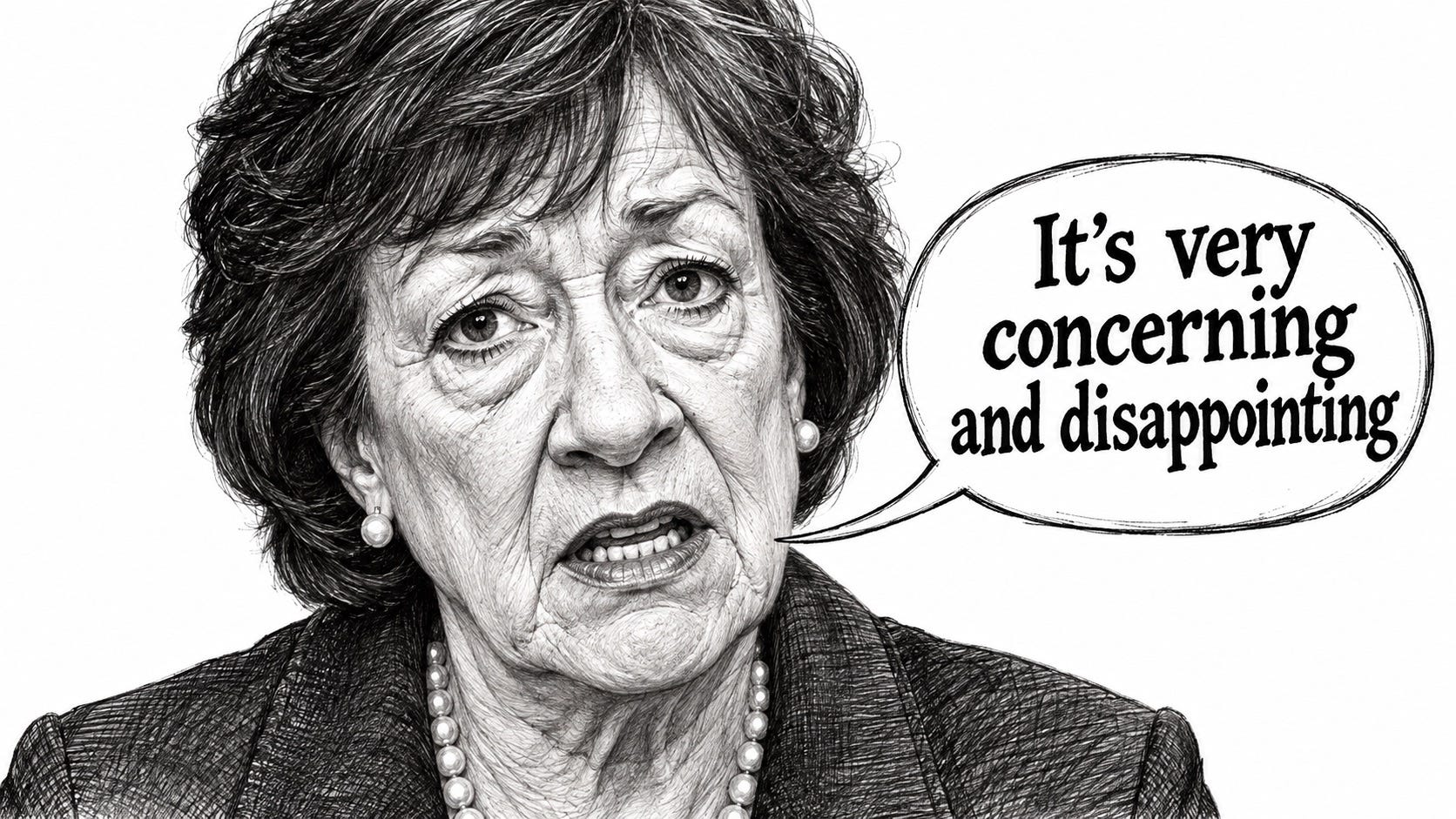
September 2024. A convicted defense contractor sits down across from FBI agents and slides a road map 50 pages long onto the table.
It names names. The document lays out his dealings with more than a dozen members of Congress and their staff. One name rises above the rest. According to ProPublica, his most important patron on Capitol Hill was Susan Collins of Maine.1
Today Collins chairs the Senate Appropriations Committee. That panel decides how the federal government spends its money, which puts her at the top of the call list for every company that lives off defense dollars. Keep that job title in mind.
Thirteen months later, one of the agents who took his confession got fired. The wider bribery investigation those agents wanted died on the table. Today the FBI says it found nothing that implicates Collins or her campaign. Sounds a lot like the Epstein files investigation, right?
First you get the record. Then we call two witnesses to the stand, Collins and the FBI, and you decide who holds up under cross.
What happened
Martin Kao ran Navatek, a defense contractor in Hawaii. On government funding, the company’s revenue climbed from about $10 million a year to nearly $40 million. He was indicted and the FBI arrested him in 2020. In 2022 he pleaded guilty to campaign finance crimes and pandemic loan fraud, and he is serving 87 months in federal prison.
As he waited for sentencing he cooperated, and what he told the agents in those sessions should make every taxpayer in America sit up straight: Navatek bought its way into the defense budget, and the work it delivered had no real value. ProPublica found the research never turned into products the military wanted to buy. The outlet reviewed the FBI’s evidence and published its findings on September 22.
Think of it like a builder who gets paid year after year for a bridge that never carries a single car.
Collins takes the stand
Here is the timeline, pulled from the emails and records ProPublica reviewed.
In 2018, Kao and his wife gave to Collins shortly before she put $8 million for a Navatek project into the defense budget. Emails show her staff made it clear to the Navy where that money should go. One naval official wrote that he had spoken with Collins’ office about the $8 million and that the interested company was Navatek. Those awards are supposed to be competitive. Picture a school science fair where the judge gets a phone call from the principal’s office naming the winner before a single student walks in the door with a poster board, and you have a pretty good idea of what happened to that “competitive” $8 million.
In 2019, Kao sent about $33,000 to her campaign through relatives, using company money, according to his indictment. When he hit the legal limit, he told her campaign to reassign his extra money to his father. An FBI agent flagged that move as an election law violation. Collins’ finance director called it perfect.
That August, Collins visited Navatek’s headquarters in Maine. Kao told agents that in a private meeting before the event, Collins said to him, “You’ve seen me deliver.” Less than a month later, the Senate’s draft defense budget carried $21.5 million for Navatek projects.
When the donations land first and the budget money lands second, the calendar becomes the most honest witness in the room.
Then came the meeting at a Corner Bakery. Kao says Scott Reed, chair of the super PAC backing Collins, asked Navatek executives for $500,000. Kao told Reed in writing that he would give through an LLC built to hide the donor, and Reed praised the plan. The $150,000 that followed came out of Navatek’s corporate account, and federal law bars federal contractors from giving at all. Kao’s email described the LLC as a personal vehicle, and nothing public shows Reed knew the money was corporate. A week after the check cleared, a super PAC aide asked for Kao’s number because Collins wanted to thank him. In February 2020, Kao told colleagues her office would support $32 million. The Senate set aside at least $10 million that year.
What the law says about campaign cash
Under 18 U.S.C. § 201, a member of Congress commits bribery by corruptly seeking or accepting anything of value in exchange for an official act, and campaign money counts. McCormick, a 1991 Hobbs Act case that courts generally apply to bribery built on contributions, requires prosecutors to prove an explicit quid pro quo, a clear this for that. McDonnell narrowed what counts as an “official act.” The Court kept one category squarely in bounds: using your office to pressure another official. A Senate office steering the Navy toward one company gives a prosecutor a strong argument that it falls inside that category.
A good defense lawyer would raise the Speech or Debate Clause, which bars prosecutors from using the budget line items themselves as evidence against a member of Congress, and that argument would take the budget entries off the table at trial. The Clause works like a locked room around the lawmaking itself, and a phone call to the Pentagon happens out in the hallway. In United States v. Brewster, the Supreme Court held that taking a bribe is never part of the legislative process, and it listed help securing government contracts among the activities outside the Clause’s protection.
On the fundraising side, 52 U.S.C. § 30122 makes it illegal to knowingly accept a contribution made in one person’s name with someone else’s money. That rule works like paying for a birthday gift and signing a stranger’s name on the card. Reed was told in writing the money would flow through an entity designed to conceal its source. Reed says he never discussed Kao or Navatek with Collins or her staff, and he was never charged. Corrupt deals rarely get spoken out loud, so the inbox does the talking.
Her side
None of this has been proven, and Collins was never charged. Her office calls the allegations “categorically false” and says the campaign cooperated fully and returned the illegal money. It says the FBI and the Biden Justice Department examined the matter and resolved it in 2021, and it lays the whole story at the feet of a convicted felon who, in its telling, spent his cooperation angling for a lighter sentence. Kao has real credibility problems, and his own judge gave him no credit for cooperating. Weigh all of it. Then weigh the emails, because many of them came from Collins’ own campaign finance director and her super PAC chair, with more written by a Navy official.
Now call the FBI
By late 2024, agents Michelle Ball and Kevin Gounaud of CR-15, the FBI’s public corruption squad, believed the evidence justified a broader bribery investigation of members of Congress. They weighed using undercover operatives. Then the ground shifted under them.
In January 2025, Trump returned to the White House.
February 2025 brought two blows. Leadership of the Public Integrity Section resigned after being ordered to drop the Eric Adams case, and Kash Patel was sworn in as FBI director on February 21.
Later in 2025, Trump appointees told the remaining corruption prosecutors to halt new cases. Senior FBI officials closed the inquiry into allegations involving a Collins adviser, saying they doubted Kao’s account.
In October 2025, the bureau fired Ball in a letter one page long that accused her of weaponization, a charge ProPublica ties to her work on the special counsel investigation of Trump’s 2020 election efforts, and she is now suing.
Early 2026, Gounaud was pushed out. Before she was fired, Ball won approval for a separate probe centered on South Carolina, including a steak dinner Kao shared with Lindsey Graham. Graham has not been accused of wrongdoing. ProPublica reports the investigation sparked by Kao’s revelations is now dead.
No public record shows Trump or Patel ordering anyone to protect Collins, and Collins herself voted against Patel’s confirmation. The public record shows a Justice Department that ordered corruption prosecutors to stand down and a bureau that fired one of the agents who built the case. Senior officials closed an inquiry touching a senator whose seat helps decide control of the Senate. Officials familiar with the investigation told the Times that agents found little to corroborate Kao’s claims against Collins and her advisers. Those same officials said more evidence stood a chance of surfacing had the case developed further. ProPublica says it independently corroborated much of Kao’s account.
An investigation you shut down early will always come back empty.
The FBI now calls any suggestion of wrongdoing false and says it removes agents only for misconduct or weaponization. It did not respond to ProPublica’s questions about the 2024 investigation. Any good trial lawyer will tell you that firing the agents who follow the money is the surest way to make sure the money never gets caught.
Your move
Start with the watchdog. Demand that the Justice Department Inspector General review who closed this inquiry and why. Ask your members of Congress to request the closing memo. Tell Collins to release her office’s communications with the Navy about Navatek.
Maine votes on November 3, so pick one person you know in that state, a cousin or an old college roommate, and send this to them today, because every voter there deserves the full record before casting a ballot that helps decide who controls the Senate.
Mitch Jackson, Esq.
“The FBI Anti-Corruption Squad Was Circling Susan Collins — Until Trump Got in the Way” by William Turton, Avi Asher-Schapiro, Molly Redden and Kirsten Berg
We should know all the names of politicians who benefitted from this bribery. ALL of them. How many of them are shielded by not being investigated as bribe takers?
Bonespurs Trump touts being a "peacemaker" while puzzling over whether he should annihilate Iran.
Show Trump & Co the down & out escalator in November with a Blue Tsunami!
Trump & Co hold up epic fraud & corruption *as a badge of honor* that his supporters are supposed to thrill to…the highest form of winning.
https://www.youtube.com/watch?v=4MnpJ1G5CrE
https://www.youtube.com/watch?v=wXtaImUpN7M Raskin on Trump pro fraud
Resist the MAGA corruption. #VoteBlue!